Showing posts with label Brazil. Show all posts

Tuesday, November 3, 2026

On Lara-Resende's Proposal to Reduce Interest rates in Brazil

André Lara-Resende's recent proposal (in Portuguese but you can use AI translation) to reduce Brazilian interest rates has generated considerable debate. He is certainly right that Brazil's high interest rates are the main cause of the rise of debt-to-GDP ratios. Brazil is on the wrong side of the Domar condition with GDP growth below interest rates (g < r), so debt should grow faster than output. He is also correct that the conventional argument according to which excessive government spending is responsible for the fiscal deficit is fundamentally misguided. Most of the nominal deficit results from interest payments, not primary expenditures. These are facts. On that we can all agree (hopefully).

The problem is that Lara-Resende, through a rather convoluted theoretical argument based on John Cochrane's Fiscal Theory of the Price Level (FTPL) and neo-Fisherian ideas, ends up accepting the conventional premise that Brazil faces an unsustainable debt-to-GDP ratio that must be reduced (my previous discussion of his theoretical views here and here). He proposes a peculiar way to lower the Selic (base rate) to approximately 7.5% within a year, to establish a rule limiting future interest rates, and use international reserves to contain the depreciation that might result.

A recent note by Franklin Serrano and Luiz Eduaro Melin, (see here; in Portuguese too), provides an devastating critique. Their central point is that Lara-Resende treats the exchange rate effects of lowering interest rates as a one time adjustment that can be managed with reserves. But with an open capital account, a sufficiently large reduction in the interest differential can generate persistent capital outflows. Depreciation creates expectations of further depreciation, encouraging additional outflows. The Central Bank would then be forced to sell increasing amounts of dollars to defend the currency, potentially exhausting its reserves (similar issue of my discussion with Huerta here).

Worse, Lara-Resende's proposal would prevent the Central Bank from using interest rates to counter these pressures, except under exceptional circumstances authorized by a new fiscal and monetary council. As Serrano and Melin note, this would tie the hands of the central bank, and might create the conditions for a crisis, where none exists.

This is particularly problematic because Brazil does not currently face an external constraint. I've made this point repeatedly on this blog, including during the crisis of 2015 (at least no one can say I'm inconsistent). Brazil has more than $360 billion in international reserves, and its relatively high interest rates have helped prevent destabilizing capital flight, preserve the reserves and control inflationary pressures, by avoiding runway depreciation (in contrast to neighboring Argentina, at least until recently; Argentina has depended on IMF and US Treasury loans, not reserves, BTW). This does not mean interest rates must remain at their current extraordinarily high levels. It means that the external consequences of lowering them cannot simply be ignored.

The difference with the Argentinean situation is crucial to understand the problems with Lara-Resende's proposal. I've often argued that Brazil does not grow faster because policymakers do not want to pursue the necessary expansionary policies, whereas Argentina can't grow without confronting its external constraint. Argentina lacks sufficient reserves and has recurrent difficulties obtaining foreign currency, and has done so by increasing indebtedness in foreign currency. Brazil has neither problem at present. Lara-Resende's proposal could create an external constraint where none currently exists. That would be quite an achievement!

Serrano  and Melin also question the theoretical foundations of the supposed limit to domestic public debt and the wisdom of transferring important fiscal and monetary decisions to a council with unclear democratic accountability. In this they follow functional finance principles that are well established. Brazil cannot be forced into default on public debt denominated in its own currency because of an inability to obtain reais. There are real constraints on economic policy, including productive capacity, inflation and the balance of payments. But there is no meaningful fiscal solvency constraint requiring the government to reduce the debt-to-GDP ratio. As Serrano and Melin emphasize, even the neoclassical literature does not establish the debt ceiling presumed by the confidence argument underlying Lara-Resende's proposal.

The obvious alternative is to expand public investment, increase real wages and social transfers, and promote faster economic growth. Public investment would sustain demand and expand productive capacity. Faster growth would also increase tax revenues and might even reduce the debt-to-GDP ratio. But that would be a consequence of successful economic policy, not its objective.

There is a historical warning here. Dilma Rousseff's New Economic Matrix attempted to stimulate growth through lower interest rates, currency depreciation and incentives to private investment, rather than a vigorous expansion of public investment. That did not work (see here). After her narrow reelection in 2014, she made matters worse by appointing Joaquim Levy to reassure financial markets and adopting austerity. The result was a deep recession and a political crisis. Lula's fourth term should avoid both mistakes. Financial markets and much of the financial press are already demanding another round of fiscal adjustment. Lara-Resende correctly rejects that prescription, but his alternative risks introducing exchange rate instability in pursuit of an unnecessary fiscal objective.

Monday, November 2, 2026

Interview for Chilean Radio on Brazilian Elections

Here a discussion in Spanish (you can use closed captions in English), about the elections in Brazil, and some of the problems of the economy that Lula will have to face in his last mandate.

Monday, October 26, 2026

It's the economy, Lula! Lessons from a hard-fought victory

Lula won (whew!). Luiz Inácio Lula da Silva defeated Flávio Bolsonaro, son of the former far-right president, by 51.79% to 48.21% of the valid votes. It was the third closest presidential election since the return of democracy in 1989, surpassed only by the narrow victories of Lula himself in 2022 and Dilma Rousseff in 2014. It was also a historic reversal. For the first time since 1989, the candidate who finished second in the first round won the runoff. The victory is a relief for Brazilian democracy. But the fact that he came from behind, and that polls showed a dead heat until the very end, should be concerning.

The remarkable mobilization between the two rounds certainly mattered. The enormous street demonstrations, led in many cases by students and social movements, helped change the political atmosphere. So did the extraordinary social media campaign organized by André Janones, whose Exército do Lula on WhatsApp attracted more than ten million followers. The left demonstrated that it could challenge the far right in the digital arena, and the decline in abstention between rounds suggests that mobilization was critical to the result. These were central elements of Lula's comeback. But they do not explain why the election was so close in the first place. As I argued before the runoff, the fundamental problem was the economy.

Presidential elections are, to a considerable extent, referendums on the incumbent's economic performance. This is the central insight of Ray Fair's well-known econometric model of American presidential elections (more recent forecasts here, but for the house elections). Economic growth, inflation and periods of particularly strong expansion help explain the incumbent party's share of the vote. When the economy is doing particularly well, reelection is highly likely (think Clinton in 1996). When the economy collapses, or inflation is high, incumbents are usually defeated (Hoover in 1932, and Carter in 1980 would be the classic examples). The interesting cases are those in between, when economic performance is neither disastrous nor truly great, and the election can go either way (like Kamala in 2024). Fair's model is estimated for the United States, but the underlying political logic is relevant elsewhere.

That, I would argue, is precisely what happened in Brazil. Lula's third administration improved economic conditions. Employment recovered, the minimum wage increased, social programs were restored, and income tax relief benefited lower income households. Yet the recovery was not vigorous and, even worse, the economy was decelerating in the last year. GDP grew by 2.3% in 2025, and growth over the four quarters ending in the second quarter of 2026 slowed to 1.9%. Brazil was not in a recession, but neither was it experiencing the sustained prosperity associated with Lula's earlier administrations.

The central problem was the renewed commitment to fiscal orthodoxy. Fernando Haddad's fiscal framework, although less restrictive than the previous spending ceiling, continued to constrain the expansion of social expenditure and public investment. The government's determination to reassure financial markets limited its ability to accelerate growth and improve the material conditions of its electoral base. The fights within the PT's coalition about fiscal policy, that I discussed at the beginning of his third term, mattered.

The contrast with Lula's first two terms is instructive. Rising real minimum wages, expanding social transfers and public investment helped sustain growth, employment and the PT's popular support. Conversely, even Jair Bolsonaro understood the importance of putting money in people's pockets. His 50% increase in Auxílio Brasil (the changed name of Bolsa Família during his government) payments in 2022 almost secured his reelection despite the disastrous record of his administration.

The point is not that campaigns, political organization or the defense of democracy are unimportant. Lula's comeback demonstrates exactly the opposite. The mobilization on the streets and online was crucial in an election that could have gone either way. But political mobilization is not a substitute for economic transformation. Better communication can help defend a government's achievements, but it cannot compensate indefinitely for their limitations.

Lula's victory has prevented the return of a political movement that openly challenged democratic institutions after its previous defeat. That is enormously important. Yet another close election, after the equally narrow result in 2022, suggests that appeals to democracy alone cannot guarantee the durability of a progressive coalition.

I hope Lula and the PT (in particular, since Lula, a once in a generation political figure, will not be around any more in 2030) have learned the lesson. The next administration should vigorously expand social expenditures and public investment, pursue sustained increases in the real minimum wage, and substantially raise social transfers.* These are not simply electoral instruments. They are the foundations of a more prosperous and equitable economy, and ultimately of a stronger democracy. Fiscal policy should serve those objectives rather than subordinate them to the demands of financial markets.

Lula has won his last election. The task now is to make sure that the next one need not be so close. It's the economy, Lula!

* I'm happy to have a conversation with those that think that there is no "fiscal space" to do that.

Tuesday, September 29, 2026

Trump and Rubio fight to sway Brazil’s election and control the hemisphere

By Mark Weisbrot

One of the most important elections in recent Latin American history will take place Sunday in Brazil. Incumbent president Luiz Inácio Lula da Silva has recently been emphasizing the issue of national sovereignty. One reason: The challenger, Flávio Bolsonaro, has the strong backing of the Trump administration — and the U.S. has been intervening heavily on his behalf.

In the last few months of Brazil’s election campaign, Trump has met with Bolsonaro at the White House, imposed new tariffs on Brazilian goods and tried to send State Department officials to Brazil. (Both Brazilian and American officials said the presence of Trump administration operatives would cast doubt on the integrity of the voting there.)

A letter last week to Secretary of State Marco Rubio from 31 members of Congress documented additional hostile actions and concluded that “the United States is acting as an agent of interference and destabilization.”
Advertisement

The election is forecast to be very close, and the sovereignty issue could be persuasive for swing voters.

Trump’s intervention undermines a basic and generally cherished right to self-determination, as well as the right to democracy itself. It is even clearly illegal under the Charter of the Organization of American States, to which the United States is a signatory.

Read rest here. 

Monday, September 21, 2026

People eat GDP. They don’t eat democracy. On the Brazilian elections

Maria da Conceição Tavares famously said that "nobody eats GDP, they eat food." I agreed with Conceição about many things, but on this I have my doubts. Conceição was really criticizing the notion that growth has to come first and then distribution would be possible, a proposition associated, in Brazil, with the dictatorship. Obviously, distribution matters. Conceição's broader point was that growth accompanied by wage compression and greater inequality does not necessarily improve the conditions of ordinary people. In the 2014 interview (in Portuguese) in which she made the famous remark, she emphasized that, despite weak growth during the Dilma government, employment and income distribution had not deteriorated, which for her was what mattered. Fair enough.

But the slogan sometimes is taken too far, as a generalized critique of GDP (my old defense of GDP). GDP is not an abstraction disconnected from people's material lives. It is the production of goods and services, including food, housing, health care and all the other things people consume. More importantly, there is a clear direct connection between GDP growth and employment creation (normally expressed in Okun's Law). So, material well-being is tied to GDP growth. In addition, people tend to vote on the basis of their economic circumstances. Most people do not go to the voting booth to preserve democracy. This has some relevance for the current political debate in Brazil, and for Lula's prospects of reelection in a few weeks.

When Lula was elected in 2022, I argued that the central difficulty facing the new government was economic. Brazil had endured what was essentially a lost decade after the crisis that began in 2015. The spending ceiling and the broader commitment to fiscal conservatism threatened to limit the government's capacity to generate a much stronger recovery, expand social expenditures and raise real wages at the bottom. I wrote at the time that fiscal conservatism would have to be fought not only against the opposition but also within Lula's very broad governing coalition. I developed the same argument at greater length shortly thereafter in Catalyst. My point there was explicitly political. An economic recovery and vigorous growth were a precondition for the preservation of democracy. Returning to economic orthodoxy, I argued, risked persistent stagnation and could create the conditions for the return of the extreme right.  The broad coalition with ex-social democrats (PSDB in Brazil; the party of Lula's rivals, including his current vice-president Geraldo Alckmin) was of secondary importance in my view. The political coalition could not preserve democracy in the face of an economy that did not put growth and distribution at the center.

Worse the political coalition strengthened, inside the progressive coalition, the hand of the fiscal conservatives that would push against a more vigorous expansion of government investment and larger increases in wages and social transfers. All in the name of appeasing the markets and obtaining credibility, with the objective of achieving a (primary) fiscal surplus, which was finally attained this year (and was highly publicized and commemorated in government circles).

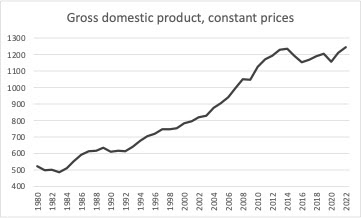
Note that Brazil did recover, and did pass its previous 2014 GDP peak in 2022 (see below). However, the economy can be in considerably better shape than it was under Bolsonaro and still not be doing well enough. An unemployment rate near historical lows is certainly good, as is 3% growth when compared to stagnation. But after a lost decade, the relevant comparison is not simply with the immediately preceding government. The relevant question is how rapidly living standards are improving and whether policy could have produced a stronger recovery.

Here the Carta de João Pessoa (in Portuguese) published by the Centro Celso Furtado is very useful. It begins from the proposition that Brazil's long-run problem is insufficient growth and explicitly says that socioeconomic development is unthinkable without economic dynamism reflected in GDP growth. More strongly, it calls faster growth a necessary condition for productive development, better distribution and welfare.

It also makes an important fiscal point I've been making for years in this blog. Faster growth itself raises revenue and creates room for public spending, whereas fiscal adjustment can generate a vicious circle that restricts growth and worsens the fiscal balances.

Lula's third term promoted a recovery and most macroeconomic indicators are reasonably good. The new fiscal regime implemented by Fernando Haddad and his team permitted a partial recovery in spending, especially through social benefits, the minimum wage and social expenditure, and that this contributed to moderately faster growth and better social indicators. But the Carta also emphasizes that the new framework retained spending limits and primary balance targets, added mechanisms for expenditure blocking, and left many spending categories far below earlier per capita peaks. Its diagnosis of the debt issue is especially pertinent. It suggests that for 2023–25 period estimates of average GDP growth of 3%, against a 6.3% real interest rate on gross public debt, imply that the interest-growth differential rather than the primary balance is the central source of upward debt dynamics.

The Carta argues that the present fiscal and monetary arrangements continue to restrict growth, particularly public investment. Its simulations suggest that a different combination of lower real interest rates, greater public investment and progressive taxation could produce growth closer to 4% while eventually reducing, rather than increasing, the debt-to-GDP ratio.

These arguments seem particularly relevant now that Lula is facing a tough reelection and possibly even a loss against Bolsonaro's son, Flávio. There is a growing tendency among parts of the Brazilian left to explain the government's political difficulties by appealing to everything except the possibility that economic policy has simply not delivered enough. One version emphasizes the continuing institutional struggle over democracy, and the Supreme Court scandal.* Another argues that the economy has actually performed well, but that Brazilians somehow fail to perceive their improved circumstances.

On this, there is a striking parallel between the debate over Bidenomics in the United States and the more recent discussions in Brazil. In the context of the American "vibecession," I made precisely the same point that, while the economy was growing, it wasn’t growing enough. I was skeptical of the triumphalist interpretation of Bidenomics from the beginning. The turn back toward fiscal policy and industrial policy was important, and Biden's policies were substantially more favorable to labor than those of his Democratic predecessors. But I argued in 2023 that on both fiscal and industrial policy "rhetoric is stronger than action."

In the Brazilian case a recent piece (in Portuguese) by Laura Carvalho and Guilherme Klein provides a thoughtful version of this argument. Not the naïve version that everything is great, and people didn't notice. They know that the economy is now not doing as well as it did during Lula's first two administrations, and that it could be doing better. But they emphasize the contrast between relatively favorable aggregate indicators and considerably more pessimistic popular assessments of the economy, and discuss several reasons for that gap, including the legacy of inflation, indebtedness, comparison with the much stronger social mobility of the earlier Lula period, changing aspirations and the frustrations of younger workers. Those are all relevant considerations. But there is another interpretation that inverts the emphasis. Perhaps it's not fundamentally a misperception (even if there is some of that). Perhaps the improvement has not been large enough to compensate for what was lost over the previous decade. The alternative is to take dissatisfaction seriously as information about material conditions. The question then becomes not why people fail to appreciate 3% growth, but whether 3% growth after a lost decade was enough. And the economic evidence can't be reduced to an argument of perceptions if we accept the Carta's diagnosis.

In the Brazilian case, the concern with fiscal responsibility – in the narrow sense of obtaining primary surpluses to appease financial markets – has been strong. The handling of Bolsa Família is particularly instructive. The government has just announced a 15% increase in the minimum payment, from R$600 to R$691, explicitly to compensate for accumulated inflation since 2023. It is the first inflation adjustment of the base benefit of the Lula administration. The R$600 floor itself, however, dates from the Bolsonaro government, when the R$400 Auxílio Brasil payment (the name Bolsonaro gave to Bolsa Família) received an additional R$200 (yeah, that's right, a 50% increase!). The evolution of the basic benefit is revealing of how cautious fiscal policy has remained during Lula's third term.

This brings us back to democracy. Perhaps people do perceive their material circumstances reasonably well. Obviously, people care about democracy. They care about corruption, and the supreme court crisis will have some effects. Elections should not be reduced mechanically to GDP growth (or low inflation; however the Fair model does very well). But democratic institutions cannot substitute for material well-being. Governments cannot assume that defending democracy will compensate indefinitely for disappointing growth in income and living standards. That is the danger in turning economic dissatisfaction into a communications or perception problem.

If people say that their material circumstances have not improved enough, perhaps the first question should not be why they fail to understand how successful economic policy has been. Perhaps economic policy has not been successful enough. James Carville's old line remains useful. It's the economy, stupid! Or, to turn Conceição's line around. People eat GDP. What they don't eat is democracy.**

* I won’t go deeply into the Supreme Court scandal. The simple story is that a banker (Vorcaro) bribed politicians (mostly from the right-wing coalition that controls Congress) and judges (including several of the Supreme Court), in order to get public funds (mostly from pension funds), with false promises of humongous gains, that never materialized. While Flávio Bolsonaro is directly implicated (there are audios of him asking for millions of dollars, and evidence that he and his family received the money), there is no evidence of Lula and those close to him having benefited from that. (quite the opposite; the scandal is being investigated because of Lula's government). However, Justice Alexandre de Moraes (who was not appointed by Lula), who is seen as a key enemy of Bolsonaro given his role in his imprisonment resulting from the attempted coup, is also implicated, since his wife also received bribes from Vorcaro. So, Lula is paying the price for the notion that the enemy of my enemy is my friend.

** Another person that I truly admired, like Conceição, Raúl Alfonsín, famously said that "with democracy... we eat." He paid a high price, because democracy did NOT deliver.

Saturday, May 2, 2026

The New Center-Periphery Relations


A new paper (in Portuguese) by Carlos Medeiros and Esther Majerowicz analyzes the economic relationship between China and Brazil using the center–periphery framework developed by Raúl Prebisch. It argues that, in the 21st century, this relationship reflects a dual process: China’s rise as a new global economic “center” and Brazil’s passive adaptation as a peripheral economy, reinforcing asymmetric development patterns.

A key claim is that China has become central not just because of its size, but because it is now a major source of industrial production and technological innovation, influencing global demand, trade patterns, and commodity prices. Its growth has reshaped the world economy, especially by increasing demand for raw materials and lowering prices of manufactured goods. For Brazil, this has led to a reprimarization of exports. The country increasingly exports commodities (soy, iron ore, oil) to China while importing manufactured goods. This pattern strengthens traditional center–periphery dynamics, despite being framed politically as South–South cooperation. This suggests similar problems as identified by myself and Esteban Pérez in a paper discussing the development strategies in Latin America. The main difference is that in the last decade and a half, the central position of China is more clear, even if the typical notion that American hegemony is over has been exaggerated in American liberal circles.

The authors identify two possible development paths. The dominant one is a business as usual strategy, aligned with Chinese demand and Brazilian agribusiness and mining interests, which deepens dependency. The alternative is a developmental strategy based on diversification, industrial upgrading, and technological cooperation, but this path seems currently unlikely. They also emphasize that Chinese investment in Brazil is concentrated in extractive industries and infrastructure, reinforcing the existing specialization pattern, although there are some emerging opportunities in sectors like renewable energy and digital technologies.

Finally, the paper argues that shifting toward a more balanced relationship would require active state planning, political will, and supportive social coalitions in Brazil. Without these, the current asymmetrical structure is likely to persist or deepen.

Friday, February 6, 2026

The bridge to austerity and stagnation

I have always emphasized in the blog the importance of  the Principle of Effective Demand and the pitfalls of Say’s Law, as central to understand Keynesian economics. Keynesianism is about that and NOT about the rigidity of wages, or the interest rate, or even fundamental uncertainty (something to which Keynes had to appeal to defend his ideas from 1937 on, as a result of retaining the marginalist notion of the marginal efficiency of capital). Very often that is an abstract discussion, hard to follow for students. I'm in the middle of teaching this again this semester (first time I taught Intermediate Macro was in 1993 at the Universidade Federal Fluminense, UFF).

A recent paper by Guilherme Haluska, Franklin Serrano, and Ricardo Summa (2026) provides a good empirical look at these theories in action. The authors analyze the period from 2015 to 2022 in Brazil, a phase marked by a radical shift toward fiscal austerity, labor reforms, and a rigid constitutional cap on government spending. This policy shift, famously dubbed "The Bridge to the Future," was predicated on the neoclassical belief that cutting public spending would boost confidence and reduce interest rates, thereby triggering an explosion of private investment and export-led growth.

The results, as the authors demonstrate, were exactly the opposite: the bridge led straight to stagnation. By utilizing a demand-led growth framework, they show that the sharp contraction in public investment and social spending actually dragged down aggregate demand. Far from being crowded in, private business investment fell as a share of GDP because firms, facing a shrinking domestic market and stagnant consumption, had no incentive to expand capacity. In other words, the accelerator works. As often emphasized in this blog.

The paper serves as a powerful contemporary reminder that, as Keynes argued and as we have noted in many prior posts (too many to link), when the state retreats from its role in managing demand, the market often fails to find a natural path back to prosperity, leaving the economy trapped in a low-growth equilibrium.

PS: A version of that, linked in the blog before, here. For a few similar posts suggesting Brazil has no fiscal problems, see this from 2024, or this one, this one from 2019, and this one from the beginning of the Brazilian stagnation period in 2015 (check how correct, in your view, my predictions were).

Monday, November 24, 2025

Make Argentina Crash Again


My article for The American Prospect on the Argentina situation was just published online. Argentina is far from being out of the woods. The expectation that the country will stabilize prices, float its currency, and build up reserves, and restart economic growth is a chimera. Despite market support for Milei’s program, the crisis remains unresolved. In my article, I explain why the challenges persist, an why this will end like the previous three neoliberal experiments, with a crash. While an immediate crash may not be on the horizon, it is somewhat inevitable. It's a matter of when, not if. And it may very well be with the next president, if the U.S. continues to financially prop Milei's government.

Note that contrary to the IMF, or Barry Eichengreen, who actually provided the IMF justification for floating rates more generally (as he explains there), I don't think to abandon the dirty float (band in this case) would be a good idea.* On that I think Milei's administration is correct. I even think that some degree, even more I think, of a reintroduction of exchange rate controls (the government reintroduced some controls on individuals, I must add) is necessary. Something that supposedly the IMF also favors. Capital controls as a macro-prudential measure in times of crises.

I also want to make clear that this is mostly about the current macroeconomic circumstances. The point is not to return to a world of Bretton Woods, with fixed exchange rates, and capital controls. It is clear that Brazil, for example, did much better than Argentina, with a dirty float and no capital controls. But, as noted by Fabian Amico, in a talk at Universidad Nacional de Moreno, recently, Brazil accumulated reserves in a different macroeconomic scenario.

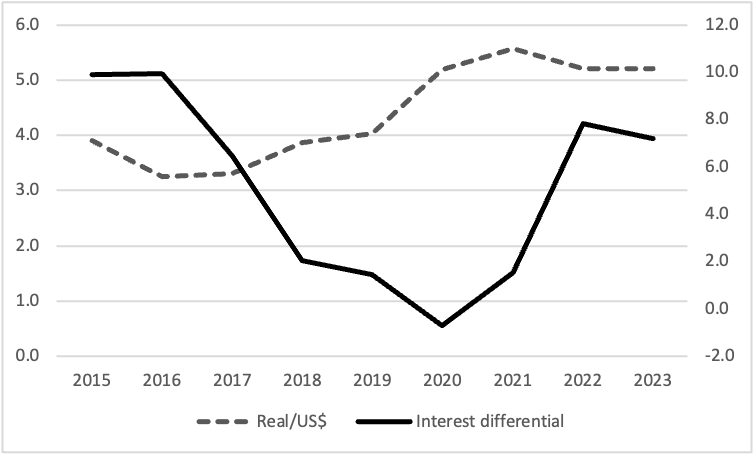
Brazil accumulated foreign reserves (see graph), maintaining a positive interest rate differential (the domestic interest rate minus the foreign reference rate, the U.S. one, the expected depreciation, and a measure of country risk). We discussed that with Amico and Serrano a few years back (in Spanish). Note that as capital inflows allowed Brazil's central bank to accumulate dollars, the real appreciated in nominal terms. In Argentina where both left and right of center governments have 'appreciation fear' (and their fear is about the real rate, let alone the nominal one), that would be politically difficult.

Exchange rate depreciation at this point would lead to accelerated inflation, and to contractionary pressures. Of course, there might be a situation (they had more than a few over the years) in which, with low country risk, and high interest rates at home, leading to a higher differential that allows for the profitability of holding peso denominated assets to be higher than holding dollars, we might finally get on the road to stability. That would be orderly macroeconomic policy, and not draconian fiscal adjustment. At any rate, that doesn't seem to be the case right now.

Over the long-term, it is very clear that all the previous experiments with this kind of policy (fiscal austerity, financial deregulation, and trade liberalization) ended up in a crash. There is also little reason to believe that this time it will be different. 

* It goes without saying that I would also be against dollarization, something that Milei promised in his campaign in 2023, and that has been recently floated by Laurence Kotlikoff in the Financial Times. This suggests that the old bipolar consensus has not been completely abandoned in more mainstream circles.

Monday, November 17, 2025

Policy-Constrained Growth: Government spending and economic recovery in Brazil during Lula's third term

By Ricardo Summa, Guilherme Haluska and Franklin Serrano

Despite headwinds from higher interest rates in the US and at home, the Brazilian economy is nevertheless emerging from a period of prolonged stagnation. After growing an average of 0.2 percent a year between 2015 and 2022, national growth averaged 3.3 percent annually during 2023–2024, the first two years of President Lula’s third term. Though quite modest in comparison to the massive social needs of a developing country, this is still better than expected.1 Part of Brazil’s recent positive performance has been due to growing exports, to be sure. But the bulk of Brazil’s current economic growth stems from a cause the government itself has been reluctant to recognize: expansionary fiscal policy, which has generated sufficient demand to counteract these forces of contraction.

Read rest here. 

Monday, March 17, 2025

The behavior of the nominal exchange rate between the Brazilian Real and the dollar in 2024

By Nathalie Marins, Ricardo Summa & Daniel Consul (Guest bloggers)

Currency devaluations can disrupt developing economies by raising import costs and food prices, which in turn reduces real wages. This impact is particularly detrimental to lower-income households, which typically allocate a substantial portion of their income to essential goods. Consequently, when the local currency weakens, governments encounter increased political pressure due to rising prices that erode purchasing power. Throughout 2024, the Brazilian real faced a continuous process of depreciation that intensified in December, prompting headlines accusing recent fiscal policy decisions of triggering a full-blown currency crisis. However, a closer look at the data suggests that external financial factors, monetary and exchange rate policy choices, and a short-term “flight to quality” played a far more significant role in driving this depreciation. In the following pages, we will examine the behavior of Brazil's currency in 2024 and explore the factors behind this trend.

Read rest here.

Friday, February 28, 2025

Serrano, Summa and Marins on Inflation, and Monetary Policy

This is the full round table on Inflation and Monetary Policy organized by the Bucknell Institute for Public Policy (BIPP), with Franklin Serrano, Ricardo Summa and Nathalie Marins.

Sunday, December 1, 2024

Very brief note on the Brazilian real and the fiscal package


The Brazilian real depreciated last week (full meltdown might be a bit of a hyperbole), and in many quarters there has been a suggestion that it is now undervalued, and that would somehow be connected to the dangers associated with the fiscal position, and the willingness of the Lula government to push the spending cuts, and the tax changes, with cuts for those at the bottom of the income distribution and hikes at the other end (more on the fiscal story in a bit).

The obvious reason for this is that the Brazilian basic interest rate was coming down from its post-pandemic high, and probably, and in spite of all the pressure from progressives and heterodox economists, it was a bit too low. As it can be seen, as the SELIC rate came down, the exchange rate started, eventually, to depreciate. This will have some impact on inflation, but it is nothing that should be of any significant concern. A higher SELIC, and a few interventions by the Brazilian Central Bank (BCB) should be more than enough to stabilize the exchange rate.

The fiscal situation does not require any adjustment, and certainly not one for next year, and not at the expense of reducing government outlays on education and health. Brazil managed to grow more than predicted by markets since Lula's election, because the fiscal rules were taken with pragmatism and the adjustment has been delayed. If the government goes through with the spending cuts, expect growth to decelerate, and the fiscal accounts to worsen.

This is exactly what Dilma tried in her first government, then backtracked, and then adopted in the aftermath of her victory in 2015, leading to the worsening of the fiscal results, and the impeachment (not that this is on the table; but the political future certainly is if Lula cannot deliver growth and better income distribution). Btw, the changes in the taxes are a good thing.

Sunday, August 4, 2024

30 years of the Real Plan: Unoriginal Lessons from Latin American Stabilizations

Original thoughts
 

The 30 year anniversary of the stabilization plan that controlled high inflation in Brazil, the so-called Real Plan, just passed earlier in July. I wanted to write something about it, but it got buried with other things. Here just some very short reflections.

 
There was a huge coverage in the media and several new books and papers written about it, including by several of the actual participants of the stabilization plan. If I have to leave one impression beyond the problems of all the mythology making, and the self-congratulatory mood of the whole thing, is that most of the analysts, including the economists that designed the plan, unlearned what they knew back then. People start defending some ideas because they are convenient, and next thing they end up believing their own half-baked justifications. The book shown above by three central figures in the conception and management of the Real -- Gustavo Franco, who wrote a dissertation under Jeff Sachs, with Lance Taylor in the committee that is worth reading, Pedro Malan, who was a very reasonable macroeconomist concerned with balance of payments problems in the 1970s, with a thesis supervised by Albert Fishlow, and Edmar Bacha, perhaps mostly known for his Belindia paper with Lance Taylor -- is a disappointment, but not a surprise. It suggests stabilization was possible because of the fiscal adjustment, and (this is somewhat interesting given the current debates in Argentina, where everybody wants a Plan) because the Plan wasn't really a plan, in the sense that it had no surprise measures. They mean, there was no price freeze.

The book is composed of short newspaper pieces, some previously unpublished but similar in size and style, over the last 30 years. The more recent are more illuminating for obvious reasons. The diagnostic is essentially that stabilization followed a serous fiscal commitment, an independent central bank concerned with inflation, and a flexible exchange rate to solve the external problem. There is almost nothing about the URV (Unidade Real de Valor), based on the Larida proposal, which was the center piece of the plans way of dealing with the realignment of relative prices during the transition to the new currency (one of the main problems with price freezes). Prices kept changing in cruzeiros, the actual currency, but remained fixed in URVs, that had a daily exchange rate with the cruzeiro. Then the cruzeiro was eliminated and the URV became the real, with a stable exchange rate with the dollar, one might add. Perhaps the lack of discussion can be blamed on the fact that neither Pérsio Arida nor André Lara-Resende participate in the book.

However, in a recent piece on Piauí, Lara-Resende, the more controversial and less conventional, at least these days, of the Real Plan forefathers, although he does say that the URV is the Columbus' egg that allowed to eliminate the problem of inertia, but then goes on to say that:
"Inflation is the result of a long process of fiscal disorder, that mirrors social demands and political conflicts, that cannot be resolved by the established institutional channels" (my translation).

In other words, inflation is caused by too much social spending and fiscal imbalances. The conflict is not, apparently one about income distribution, in the face of an external problem (foreign debt back in the 1980s). There is no mention of the exchange rate, the external obligations or the amount of reserves held by the central bank necessary to service the foreign debt.

Of course what allowed for the stabilization was the change in capital flows in the 1990s, in part the result of the lower rates in the United States after the financial crash of 1987, and more so after the 1991 recession, together with the Brady renegotiation of the external debt, that Brazil signed in 1992. By 1994 the reserves were reasonably large as can be seen below.

Reserves were very low in the 1980s, and that was the main reason for the failure of the heterodox plans, not just in Brazil, but in many other countries like Argentina. In May 1993, when Fernando Henrique Cardoso became Finance Minister, reserves were at about US$ 23 billion, and by the time the real became the currency, and the exchange rate between the real and the dollar was stabilized, reserves had more or less doubled (one can see the erosion of them after the 1999 crisis, and all of that is dwarfed by the accumulation of reserves that started in the second Lula government). There is a brief comment on the round-table at the Catholic University in which someone said that Gustavo Franco was instrumental in trying to keep the exchange rate stable, but it is almost an after thought.

This is lack of understanding of what allowed for stabilization in the 1990s, and not in the 1980s (in the case of Israel the US provided a large transfer of reserves to their central bank; stabilization by invitation, one might call it), is generalized. Many papers trying to find some specific element of the stabilization plans miss the fact that everybody stabilized in the 1990s, once dollars started flowing to the periphery.

At any rate, many other problems with these papers, books, round-tables, on Lula, and his views, on what would allow for higher growth now, on why price stability has been maintained, and so on. But the ideas are mostly conventional, unoriginal, and for the most part incorrect. They provide less knowledge now than what they knew back then.

Wednesday, June 26, 2024

Brief note on public debt and interest rates in Brazil

Robin Brooks, previously the chief economist at from the Institute of International Finance (IFF), and now at Brookings, suggests Brazil needs austerity, and, here is the punch line, that would promote growth (laugh track here).

The notion that it is the fiscal balances that determine the interest rate on public debt, and that fiscal deficits and high debt must imply high interest rates has no correlation with reality. Imagine the rate of interest that Japan would have if that was correct. In the case of Brazil the higher interest rates are entirely associated to Central Bank decisions.

In fact, if one looks at the correlation between interest rate and the size of public debt as a share of GDP, the correlation is weak, statistically insignificant, and negative. That is, higher debt is associated with lower interest rates by the central bank.

Let alone that the idea of expansionary fiscal contraction has been completely debunked with the austerity policies that followed the European crisis more than a decade ago. Ask Tories in the UK how well that worked!

Wednesday, June 19, 2024

Lula's fiscal problems

Almost everything that’s wrong with conventional views on fiscal policy is on display in this column (well written and clear) by one of the key journalists from Folha de São Paulo, Vinicius Torres Freire. He suggests that the current fiscal adjustment is not credible. For him, this is a confidence crisis, caused by Lula’s insistence on attacking the central bank policy and his lukewarm support for the adjustment. Why the adjustment is necessary, he never asks. It’s evident, for any educated or serious person, one must conclude. Debt is too high, spending cannot go on forever. These are truisms, and if repeated long enough they do seem right.

The problem of course is that the Brazilian fiscal problems (note that it is unclear why deficits that are not particularly large by historical or comparative standards and debt that grew as a proportion of GDP, but is in domestic currency and can be rolled over without any trouble routinely, are a problem) started when the economy stopped growing in 2015. And that’s when PT tried to promote an adjustment to appease the radical right. It was only then that public debt started growing as a share of GDP (see graph). We know how well that strategy worked out for Dilma.

In my Catalyst piece from last summer, I suggested that the problems Lula would face would be within his own coalition. The fiscal conservatives inside his coalition, and, in particular, those on the left and within PT, which include his own Finance Minister, Fernando Haddad. Haddad truly and earnestly believes, as much as Torres Freire, that the path to growth is through fiscal consolidation, lower deficits and debt, obtained in his view mostly by increasing revenue (his critics and the 'markets', read the traders on Faria Lima, would prefer cuts on social spending), and obtaining investment grade, which would lead to an investment boom.

Note that many political scientists, for example Marcos Nobre here, suggest that somehow the problem is that Lula needs to negotiate with the so-called Centrão, the clientelist groups in congress that control voting and have a grip on governability. In that view, he is between the rock of lack of governability, and the hard place of macroeconomic instability. In other words, he either continues with the clientelist policies that allowed all governments to deal with congress since the return of democracy, but pays the price of not being able to deliver the fiscal results necessary,  or he confronts them and does the adjustment, and keeps stability (and growth), but might have his agenda blocked. In this view,  price stability and growth go hand in hand, since fiscal restraint also allows for lower interest rates, which would be instrumental for growth. If Lula negotiates with the Centrão he would also spend on unnecessary things rather than the crucial things that are needed for growth, including in the green transition, in this view. The notion is that whatever he does, the likelihood is that the extreme right (the right without fear) might return (even without Bolsonaro).

Of course, that's a false dilemma. Brazil has no fiscal problem. The best way to consolidate, reducing debt, if that is deemed essential, would be promoting growth, and investing (public investment), including on a green transition, and that would allow the ratio of debt to GDP to fall, even if debt per se went up. The main problem for Lula is that many in his own party, and his key ministers are promoting an adjustment that might force him to miss the mandatory minimum expenditures on education and health, that would preclude providing the increases in wages of public sector workers, and the minimum wage, that would help promote a recovery. So Lula's fiscal problems are not what you might think, an economic constraint on his ability to spend. Brazil has no fiscal problems, which are always political problems, and has not have any serious external issues either, a recurrent theme gong back for more than two decades and discussed here, more recently (and here and here, the last one with links to 7 additional posts, to give a few examples over the years). Lula's problem is fiscal conservatism.


Sunday, September 3, 2023

Lulismo’s Past and Present

Lula da Silva’s return to the presidency in Brazil has opened up the possibility of deepening democracy and expanding the scope of egalitarian advance for the Brazilian working class. In what ways might his administration pursue expansionary fiscal and redistributive policies that would improve the conditions of his political base?

In the latest print issue of Catalyst, Matías Vernengo explores the historical and contemporary contours of Brazil’s political economy and outlines how the Lula administration can trade a restrictive economic policy for a broadly redistributive one.

Read more here.

Sunday, February 19, 2023

On central bank independence, and Brazilian monetary policy

The issue is back in the news. This time in Brazil (it was briefly an issue here when Trump did not reappoint Yellen, and then complained about Powell's interest rate where too high). At any rate, I always thought that there were good reasons for skepticism about central bank independence (CBI). As noted by Massimo Pivetti in this old piece on the Maastricht Accord and the, at that time, plan for the euro, the main reason to be doubtful is related to the interaction of monetary policy and fiscal policy. And as Quantitative Easing in the post-Global Financial Crisis has shown, central banks have become again fiscal agents of the state (never stopped being that, in all fairness).

The other important reason alluded by Pivetti for doubting CBI is the effects of the interest rate on the exchange rate and balance of payments. This is a quote from Pivetti:

And one could add, through the exchange rate, the effects on inflation also matter. This can be illustrated by the discussion of the Brazilian case. Lula has been very critical of the policies of the Brazilian Central Bank (BCB), and of the higher interest rates, since the campaign last year, and some sort of a truce has been in the works, with him being less direct (or at least that has been reported).

At any rate, the notion is that the higher interest rate is inimical to growth, even though Brazil did grow with relatively high interest rates in his first two mandates. The important thing to note is that Brazil had back then a relatively high and positive interest rate differential, that is a domestic nominal interest rates higher than the sum of external interest rate (the US rate) plus the risk premium (e.g. J.P. Morgan's Emerging Market Bond Index, EMBI), plus the expected nominal devaluation. In fact, as the interest rate differential (here just the difference of the BCB's Selic rate, the Fed Funds plus the EMBI) was coming down, the exchange rate depreciated.

Note that inflation accelerated and has been above the BCB's target only in more recent times, and the exchange rate is only one component of that. The higher prices of energy commodities, and the snags on the supply chain matter in the Brazilian case too. But the higher interest rate, and the higher and positive differential, did allow eventually for the stabilization of the exchange rate.

There is ample space to discuss how high the rate should be, but I'm doubtful that it can be close to zero or very low as suggested recently by André Lara Resende (that since my last post on his views, see here, has move away from Cochrane's fiscal theory of the price level, and closer to MMT; I just read his new book and that seems to be the case; on Cochrane's views on inflation see this video, also with John Taylor and Kevin Warsh).

Below the BCB's Selic rate and the Fed Funds for a longer period, starting after the stabilization of the Real Plan in the 1990s.

 
As one can see (Selic on the left, and Fed Funds on the right), the hike in the Brazilian rate has accompanied the hikes in the US, which are totally unnecessary, in my view, since inflation is cost push and not demand pull, but that's another story. But the fact remains that the ability of central banks in the periphery to conduct monetary policy independently from what happens in the center is still curtailed. Note that the reduction of Brazilian rates, from higher levels (since a positive differential must be maintained to avoid capital flight and depreciation), was possible because the Fed Funds for the most part has been very low.
 
That's probably the more important discussion about the CBI. Not just independence from financial interests, as John Kenneth Galbraith used to suggest, but also the degree of independence in a world with a hegemonic currency.

PS: In the Brazilian case, the really important question for the Lula government will be his ability to increase spending beyond the fiscal ceiling. That, and the ability to eliminate hunger, and reduce poverty rates, would determine the political success of his administration.

Saturday, November 12, 2022

Lula's election and what lies ahead

It's been a while since I wrote about the Brazilian crisis (a summary of the previous catastrophic election here). In part that election and the continued crisis explains why I have written less, not just about Brazil. This has been a long economic depression that started in 2015 (see graph), with a coup in 2016 and since 2018 the added problem of a right-wing authoritarian regime that won an election that was only possible with the political proscription of Lula. But at least the political problems have started to be solved with this election.

 
Source: IMF. Peak in 2014 (2022 estimated)

The Lula election last Sunday is a redemption story, no doubt. Not only because there was no prove of his corruption, even if corruption existed,* and even though the international press, including the reputable media continues to refer to him as an ex-convict. Corruption is a problem, but the one that matters is associated to the needs of governance in Congress, and the current Bolsonaro government has dealt with payments to members of congress through the so-called secret budget. And that will not vanish, and that could cause problems in the future. But in all fairness, the size of that and the implications in terms of the functioning of the political system, let alone for economic growth or the well-being of the population are far from clear.

At any rate, that is a secondary issue. The problems that Lula and his coalition will face are on the economic front. And not because Brazil is facing a serious crisis, like neighboring Argentina. This is the worst economic crisis in Brazilian history, but is purely political, and has been aggravated by the decisions taken by the Brazilian authorities, starting in 2015 with Dilma, trying to stave off the coup, and then with Temer and Bolsonaro.

The main problem is the limit on government spending, the ceiling that would limit the ability of the government to promote not just a more solid recovery, but more importantly one that allows for increasing real wages for those at the bottom. Fiscal rules were put in place for this reason, for the possibility of a left of center government, and that is why financial markets were convulsed by Lula's talk this week, and the real devalued. Not that it matters much.

There will be some arrangement that will allow the expansion of spending to cover the social transfers, and some additional social spending that was left out of Bolsonaro's last budget. But fiscal conservatism will be something that will have to be combated throughout the next four years, and not just from the opposition. Many within the government's complex coalition will be for austerity. There will be plenty of time to talk about that, and I would normally be pessimistic.

However, two things make me a bit optimistic (which is not very characteristic). It is important to differentiate what Lula does from what he says, or even what he believes. This is true of many on the left in Latin America. Before the previous Pink Tide, two decades ago, I was more concerned with the pleas for fiscal responsibility of many on the left. As it turns out, many of the progressive governments did expand social spending, and promoted an acceleration of growth, including Lula, and a significant expansion of real wages. Someone will say, this is not 2003, and there is no commodity boom that will lead to growth, or at least the easing of the external constraint.

However that was not what explained the Brazilian growth in the first Lula government. The external constraint was eliminated to some extent by the boom in commodity prices, but the fundamental source of foreign reserves was financial, and resulted from the relatively high remuneration for assets in domestic currency. That was to some extent possible because interest rates in advanced economies have been low in the center, and they will likely remain low (even if they are increasing right now). So on that front it is possible to expect an acceleration of government spending, and higher transfers to the relatively poor, with higher real wages at the bottom. Besides, Bolsonaro is gone, and that should be reason enough to be optimistic about the future.

* There is no evidence of Lula's personal corruption. The infamous Triplex apartment, for example, is clearly not his, and he never benefited in any other proven way. Many Latin American politicians, including Eduardo Cunha, which was instrumental in Dilma Roussef's impeachment, does appear in the Panama Papers. Paulo Maluf had undeclared accounts in Switzerland, just to name another Brazilian politician for whom there is objective, material evidence of corruption. To suggest that Lula knew about corruption, is more or less like saying that FHC knew about the buying of votes in congress to allow for his reelection (or many other issues during his government). In other words, is to say the obvious.

Thursday, March 10, 2022

Beyond Vulgar Economics: Conceição Tavares and Heteredox Economics

My paper (in Spanish) for a book on social thinkers in Latin America edited by Marcelo Rougier and Juan Odisio, and that I presented in a few venues since 2020, is now revised and done. The book includes chapters on Raúl Prebisch, Aníbal Pinto, Víctor Urquidi, Celso Furtado, Juan Noyola Vázquez, Helio Jaguaribe, Aldo Ferrer, and Osvaldo Sunkel, besides mine on Maria da Conceição Tavares. A version available here.

Wednesday, July 28, 2021

The economics of New Developmentalism

New versus Classical Developmentalism

New paper by Tom Palley, titled “The Economics of New Developmentalism: A Critical Assessment” which has been published in Investigacion Economica. Palley argues that "the issues raised will be a key element in the 2022 Brazilian presidential election that will likely pit Ciro Gomes versus Lula in the first round. Gomes aligns with New Developmentalism. Lula inclines to Classical Developmentalism. Of course, economic analysis is just part of the development problematic. It must be reconciled and integrated with the political reality of Latin America’s unethical economic elite, its corrupted political class, and the omnipresent threat of US intervention against change that challenges the economic status quo."