Showing posts with label Cochrane. Show all posts

Sunday, February 19, 2023

On central bank independence, and Brazilian monetary policy

The issue is back in the news. This time in Brazil (it was briefly an issue here when Trump did not reappoint Yellen, and then complained about Powell's interest rate where too high). At any rate, I always thought that there were good reasons for skepticism about central bank independence (CBI). As noted by Massimo Pivetti in this old piece on the Maastricht Accord and the, at that time, plan for the euro, the main reason to be doubtful is related to the interaction of monetary policy and fiscal policy. And as Quantitative Easing in the post-Global Financial Crisis has shown, central banks have become again fiscal agents of the state (never stopped being that, in all fairness).

The other important reason alluded by Pivetti for doubting CBI is the effects of the interest rate on the exchange rate and balance of payments. This is a quote from Pivetti:

And one could add, through the exchange rate, the effects on inflation also matter. This can be illustrated by the discussion of the Brazilian case. Lula has been very critical of the policies of the Brazilian Central Bank (BCB), and of the higher interest rates, since the campaign last year, and some sort of a truce has been in the works, with him being less direct (or at least that has been reported).

At any rate, the notion is that the higher interest rate is inimical to growth, even though Brazil did grow with relatively high interest rates in his first two mandates. The important thing to note is that Brazil had back then a relatively high and positive interest rate differential, that is a domestic nominal interest rates higher than the sum of external interest rate (the US rate) plus the risk premium (e.g. J.P. Morgan's Emerging Market Bond Index, EMBI), plus the expected nominal devaluation. In fact, as the interest rate differential (here just the difference of the BCB's Selic rate, the Fed Funds plus the EMBI) was coming down, the exchange rate depreciated.
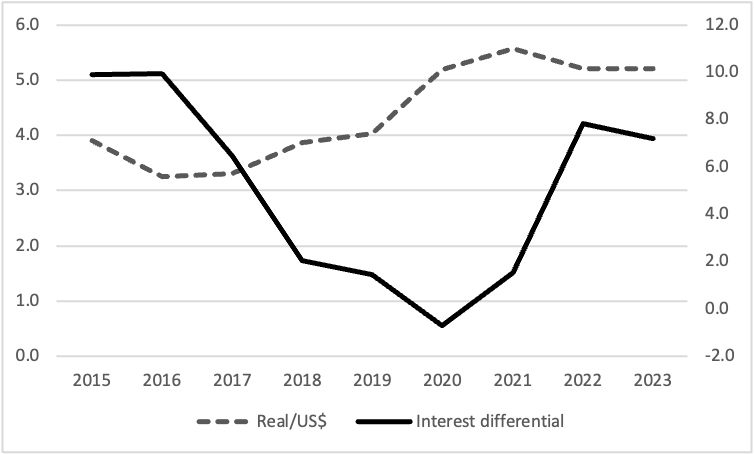
Note that inflation accelerated and has been above the BCB's target only in more recent times, and the exchange rate is only one component of that. The higher prices of energy commodities, and the snags on the supply chain matter in the Brazilian case too. But the higher interest rate, and the higher and positive differential, did allow eventually for the stabilization of the exchange rate.

There is ample space to discuss how high the rate should be, but I'm doubtful that it can be close to zero or very low as suggested recently by André Lara Resende (that since my last post on his views, see here, has move away from Cochrane's fiscal theory of the price level, and closer to MMT; I just read his new book and that seems to be the case; on Cochrane's views on inflation see this video, also with John Taylor and Kevin Warsh).

Below the BCB's Selic rate and the Fed Funds for a longer period, starting after the stabilization of the Real Plan in the 1990s.

 
As one can see (Selic on the left, and Fed Funds on the right), the hike in the Brazilian rate has accompanied the hikes in the US, which are totally unnecessary, in my view, since inflation is cost push and not demand pull, but that's another story. But the fact remains that the ability of central banks in the periphery to conduct monetary policy independently from what happens in the center is still curtailed. Note that the reduction of Brazilian rates, from higher levels (since a positive differential must be maintained to avoid capital flight and depreciation), was possible because the Fed Funds for the most part has been very low.
 
That's probably the more important discussion about the CBI. Not just independence from financial interests, as John Kenneth Galbraith used to suggest, but also the degree of independence in a world with a hegemonic currency.

PS: In the Brazilian case, the really important question for the Lula government will be his ability to increase spending beyond the fiscal ceiling. That, and the ability to eliminate hunger, and reduce poverty rates, would determine the political success of his administration.

Tuesday, May 3, 2016

John Cochrane on economic growth

There are three kinds of lies, "lies, damned lies, and statistics," supposedly said Benjamin Disraeli. This applies to John Cochrane piece in the Wall Street Journal today. Cochrane says that:
"Sclerotic growth is America’s overriding economic problem. From 1950 to 2000, the U.S. economy grew at an average rate of 3.5% annually. Since 2000, it has grown at half that rate—1.76%. Even in the years since the bottom of the great recession in 2009, which should have been a time of fast catch-up growth, the economy has only grown at 2%. Last week’s 0.5% GDP report is merely the latest Groundhog Day repetition of dashed hopes."
That is all true, and I myself complained about slow growth last week. However, this gives a false impression that the slowdown is a very recent thing, of the 2000s. In all fairness there has been a slowdown in growth going back to the 1970s or at least the 1980s. Growth since 1973 has been around 2.8%, and 2.6% since 1980, the years of the first oil shock and the productivity slowdown, and the beginning of the Reagan revolution respectively.

Yes, it is true that growth has further slowed down since the last recession (1.8% since 2000, and 1.2% since 2008), but growth has not only been slower over the last three decades (which, by the way go hand in hand with worsening income distribution), but also it has been more dependent on financial bubbles. And the last three recessions have been associated to the burst of a bubble. And given the structural conditions of the US economy, it seems that only with a bubble we will have healthier growth again.

The point is that an economy that depends on excessive accumulation of private debt, and debt-driven consumption bubbles is more volatile and prone to crisis. And that is associated both to financial deregulation and worsening income distribution. Certainly not to what Cochrane sees as the main American problem: "that the U.S. economy is simply overrun by an out-of-control and increasingly politicized regulatory state. If it takes years to get the permits to start projects and mountains of paper to hire people, if every step risks a new criminal investigation, people don’t invest, hire or innovate."

The notion that further deregulation would lead to a spurt of growth is preposterous. Yeah, because deregulating the financial sector has worked so well.  By the way, investment is a result of growth (accelerator) as well as innovation (Kaldor-Verdoorn). The problem is not enough spending on a sustainable basis, because party politics impedes public investment, and income inequality makes private spending more unstable. Austerity and inequality, not excessive regulation are behind low growth. But at least he is right that growth did not slowdown because of lack of innovativeness or a savings glut.

Wednesday, December 3, 2014

John Cochrane on Deflation

This is a bit old. Cochrane, the medieval dark lord of macroeconomics (Krugman suggests he has been an example of the Dark Age of Macroeconomics), has taken issue with the notion that deflation is a big problem. He suggests that: "Friedman long ago recognized slight deflation as the 'optimal' monetary policy, since people and businesses can hold lots of cash without worrying about it losing value." He explains that the reason for fears of deflation are associated to debt-deflation (the other two arguments are less relevant, namely: sticky wages and space for a higher inflation target).

He argues, however, that debt-deflation is not a problem. For him:
"Again, a sudden, unexpected 20% deflation is one thing, but a slow slide to 2% deflation is quite another. A 100% debt-to-GDP ratio is, after a year of unexpected 2% deflation, a 102% debt-to-GDP ratio. You’d have to go decades like this before deflation causes a debt crisis."
In his view, small amounts of deflation are not  enough to lead to a collapse of the economy. And he says the dreadful deflation spiral never happened, not even in Japan. So don't be afraid, deflation is actually kind of good.

He is talking about the general price level, and clearly we haven't have significant deflation in the Consumer Price Index (CPI) or other broad inflation index since the 1930s. Yet, as the graph below shows we did have significant asset price deflation in the US, with housing prices falling by 31% or so, not just 2%, right before the recession.
http://research.stlouisfed.org/fredgraph.jpg?hires=1&type=image/jpeg&chart_type=line&recession_bars=on&log_scales=&bgcolor=%23e1e9f0&graph_bgcolor=%23ffffff&fo=verdana&ts=12&tts=12&txtcolor=%23444444&show_legend=yes&show_axis_titles=yes&drp=0&cosd=2007-01-07&coed=2009-08-04&width=670&height=445&stacking=&range=Custom&mode=fred&id=SPCS20RSA&transformation=lin&nd=&ost=-99999&oet=99999&scale=left&line_color=%234572a7&line_style=solid&lw=2&mark_type=none&mw=1&mma=0&fml=a&fgst=lin&fq=Monthly&fam=avg&vintage_date=&revision_date=
In other words, there was significant collapse of prices that bankrupted several homeowners. The problem  was not just the negative effects of price adjustments on spending though. Cochrane supposes that all adjustments are on prices, since the economy has a tendency to move back to its natural output (unemployment) level. Crises (debt crises) are not just caused by the increase in the real value of debt (debt-deflation), they are more often than not the result of the collapse of the ability to pay, for countries when the value of their exports collapse (negative terms of trade shock), for individuals when they lose their jobs.

The problem is that with less prospects of growing demand (consumption, that was affected by stagnant wages and asset price deflation), and more so after the collapse of Lehman and the severe contraction in credit, firms fired about 9 million workers, reinforcing the negative quantitative effects of lower demand. The multiplier (which Cochrane thinks doesn't exist) works in both directions. So even small amounts of deflation, in an economy with quantity adjustments, might cause significant problems (and quantity adjustments are not the result of any wage rigidity, even if those exist, since no firm would hire an additional worker, not even at a lower nominal wage, if demand is not growing).

Think of Greece for example, where deflation (CPI deflation) is the result of contractionary policies that also led to the skyrocketing of unemployment, now at more than 25%.
The deflation is not particularly large, less than 2% actually. But the policies that cause the Great Depression levels of unemployment, and weaken the labor force, and lead to lower nominal wages, are the same that explain the deflation. In Greece deflation per se is not the problem. The lack of expansionary demand (fiscal) policy is. The problem is the obsession with low inflation, which leads to an overly contractionary policy stance. And that's what most authors that complain about deflation actually mean. For Cochrane Greece is fine, one would imagine, after all deflation is less than 2%. I suppose the natural rate of unemployment is probably 25% for him.