Showing posts with label Lara-Resende. Show all posts

Monday, August 3, 2026

Lara-Resende on Milei

 
Straight jackets of our own making

André Lara-Resende has published a long analysis of Javier Milei's Argentina, subtitled "microeconomic successes and macroeconomic mistakes." The essay is particularly significant because it confirms the considerable evolution of Lara-Resende's thinking on money and inflation. It also returns him to the subject with which he first became closely associated, namely: inertial inflation and the stabilization proposals that eventually to the Real Plan. His critique of Milei's macroeconomic policy is broadly correct. Yet his account remains limited by a conventional institutionalist interpretation of Argentine decline and, more importantly, by the failure to place the exchange rate and the external constraint at the center of the inflation and stabilization story.

The evolution is worth emphasizing. In earlier writings, Lara-Resende while rejecting the crude Quantity Theory of Money had accepted to a great extent John Cochrane's Fiscal Theory of the Price Level (FTPL). Inflation was not directly caused by the stock of money, but it remained fundamentally a fiscal phenomenon. For him expectations of future fiscal imbalances supposedly determined the current price level. As I noted several years ago (link above), endogenous money and occasional references to Knapp, Lerner and Modern Money Theory (MMT) were then being used to defend relatively conventional conclusions, essentially fiscal adjustment, pension reform, trade liberalization and a smaller, less patrimonialist state. The language was new, but fiscal dominance and austerity remained at the center of the argument.

Lara-Resende had already moved away from Cochrane and closer to MMT by the time of his more recent book. However, as late as his discussion of the thirtieth anniversary of the Real Plan, he still described inflation as the result of a prolonged process of fiscal disorder reflecting social demands that could not be accommodated through existing political institutions. This remained a fundamentally fiscal interpretation of inflation, even if clothed in a more sophisticated account of money and expectations.

In the new essay, the break is much more explicit. Lara-Resende now directly criticizes the FTPL. He correctly notes that the theory depends on expectations about fiscal results extending indefinitely into the future. Since these expectations are unobservable, any persistence of inflation can be rationalized after the fact by claiming that the public does not believe the fiscal adjustment will last. Milei has produced primary and even nominal fiscal surpluses, yet inflation has not immediately disappeared. The FTPL response is simply that people expect future governments to return to fiscal irresponsibility (a possible Kicillof government). As I joked (on Twitter after a comment from an Argentine econ prof.) if the plan works its Milei's success, if it fails it's the Peronist fault (heads I win, tails you lose, essentially). A theory that can explain every possible result in this way cannot be falsified, as Lara-Resende correctly notes. This is a welcome and substantial change from Lara-Resende's earlier position.

His positive argument returns to the inertial inflation approach developed at the Catholic University, in the 1980s. Inflation may initially be caused by a variety of factors, fiscal disequilibrium, excess demand, distributive conflict and supply shocks, but, once it has persisted for a sufficiently long period, indexation and backward-looking price formation give the process a life of its own. Wages, prices and contracts are repeatedly adjusted on the basis of past inflation. Even after the original shock has disappeared, yesterday’s inflation becomes the floor for today's. I have issues with this notion of multi-causal inflation, that still puts too much emphasis on demand pull factors (more on that below).

From this perspective, continued fiscal and monetary contraction is not only ineffective but unnecessarily destructive. Once the original inflationary pressures have been removed, austerity creates recession and unemployment without eliminating the mechanisms that reproduce inflation. This is Lara-Resende's central criticism of Milei's macroeconomics. The government has treated inflation as the consequence of deficits and monetary issuance, imposed a severe fiscal contraction, and obtained a deep recession and higher unemployment. Yet the inertial component of inflation persists. He basically thinks Argentina now is Brazil in the 1990s (not an Orloff effect, a reverse one, Argentina is Brazil yesterday, so to speak).

His proposal follows directly from this diagnosis. Not surprisingly he wants a Real Plan for Argentina, that should adopt a process of deindexation inspired by the Brazilian Unidade Real de Valor (URV), a virtual, indexed unit of account would allow prices to be expressed in a stable unit while the existing currency continued to depreciate. Once relative prices had been coordinated in the virtual unit, it could be transformed into the new national currency. The URV would therefore break the link between past and current inflation without requiring an even deeper recession.

Lara-Resende also rightly rejects dollarization. Money is a public institution and an essential part of national sovereignty. Dollarization would place Argentina under the monetary governance of the United States without giving Argentines any political representation in that governance. All of that is a major improvement over monetarism, the FTPL and Milei's fantasies about abolishing the central bank.

The problem is that Lara-Resende combines this somewhat heterodox macroeconomics with a rather conventional account of Argentina's long-term development. He starts from the familiar assertion that Argentina was once a rich and educated country, comparable to the advanced European economies, and that its subsequent decline constitutes a great historical mystery. The explanation is then sought in Mancur Olson, Douglass North, Daron Acemoglu and James Robinson. In other words, entrenched interest groups, corporatist coalitions, excessive regulation and the institutional inheritance of Peronism blocked creativity, investment and growth. This is the basis for Lara-Resende's distinction between Milei's successful microeconomics and mistaken macroeconomics. Federico Sturzenegger's deregulation campaign is presented as a potentially productive attack on the bureaucratic, corporatist and patrimonialist state inherited from Peronism. Milei's radicalism may have been useful, in this view, because it made possible a rupture with the Peronist legacy that has haunted Argentina since the middle of the twentieth century.

There are several problems with this story. Most importantly, Argentina was never really a developed country. It had a high income per capita during the Belle Époque, but high income derived from natural-resource rents is not the same thing as development. Saudi Arabia also has a high income per capita. Argentina was a kind of "beef-state" (instead of a petro-state) as I call it in this paper (in Portuguese), prosperous under the highly specific conditions created by its integration into the British-centered international economy, but dependent on manufactured imports, foreign finance and the export performance of a narrow primary sector. Its productive structure did not have the autonomy, technological capabilities or capacity to produce capital and intermediate goods characteristic of a developed economy. The collapse of British hegemony, the international division of labor and the Gold Standard therefore undermined the foundations of the agro-export model. It was not simply a rich, developed society mysteriously ruined by bad institutions.

The Peronist decline thesis is equally simplistic. Peronism cannot explain eight decades of decline because, among other obvious reasons, Peronism was frequently proscribed and excluded from government. More fundamentally, the evidence does not show that state-led industrialization produced Argentina's decisive economic collapse. Economic performance from the postwar period to the mid-1970s was far from disastrous. Per capita income maintained its position relative to the United States between roughly 1950 and 1975, and the 1964–74 period was particularly dynamic (not the Brazilian "Miracle", but pretty good). The major second phase of relative decline began after 1976 (more precisely 1975 with the Rodrigazo, but I'm splitting hairs here), when the military dictatorship abandoned industrialization and adopted the liberalizing policies of José Martínez de Hoz. The neoliberal period from 1976 to the collapse of Convertibility produced essentially no per capita growth over more than two decades.

The decision to abandon industrialization was not the inevitable consequence of its economic failure. It was inseparable from distributive conflict and the attempt to weaken organized labor and reverse the increase in the wage share associated with Peronism. The so-called Argentine Pendulum, discussed by Marcelo Diamand. Besides it happened in almost all countries, including Brazil that supposedly did not have Peronism, and had a much stronger industrial bourgeoisie (se my discussion here, in Spanish). Argentina's difficulty was that the expansion of domestic demand and real wages increased the demand for imported capital and intermediate goods. This repeatedly ran against the balance-of-payments constraint. The resulting stop-and-go cycles intensified distributive conflict, but they do not prove that higher wages, industrialization or state intervention were the source of long-term decline.

This is also why the New Institutionalist framework is inadequate. Institutions certainly matter, but not simply because they protect property rights, reduce regulation or prevent rent seeking. The relevant institutions are also those that sustain domestic demand, promote investment and technological capabilities, and relax the external constraint. A supply-side discussion of entrepreneurship and incentives misses the role of the state in creating markets, financing innovation, coordinating investment and securing access to foreign exchange. The supposedly successful East Asian economies did not develop by reducing the state to the protection of property rights. They relied on industrial policy, credit allocation, exchange controls and extensive public-private coordination. Milei is also getting the micro wrong, in other words.

This brings us to the principal limitation of Lara-Resende's inflation analysis. Inertia is important, but the stability of the nominal exchange rate is more central to Argentine inflation than his discussion suggests. He attributes the inflationary acceleration during the second half of 2023 largely to Milei's threat to abolish the peso and the central bank. That threat certainly encouraged the flight from the domestic currency. But the more direct mechanism was the depreciation of the peso, first the devaluation imposed under the IMF agreement while Sergio Massa was still minister, and then Milei's own maxi-devaluation after taking office. In a highly dollarized peripheral economy dependent on imported inputs, depreciation passes rapidly into domestic costs and prices. It also reduces real wages and sets off distributive attempts to recover lost income.

Money creation accommodates this process. It does not initiate it. Similarly, the fiscal adjustment did not produce disinflation. It produced the recession and the collapse in real wages. Milei reduced inflation by holding the exchange rate under control after the initial devaluation. That exchange-rate stabilization has depended on intervention, restrictions of various sorts and, crucially, access to external finance. Lara-Resende comes close to acknowledging this. He warns that Milei's combination of fiscal, monetary and exchange-rate policies is a familiar recipe for recession and a balance-of-payments crisis. He also notes that an unusual intervention by the United States prevented the program from collapsing when external payments came under pressure. But these observations remain somewhat detached from his explanation of disinflation. External financing appears as something necessary to prevent a later crisis, rather than as an essential condition for maintaining the exchange-rate anchor that made the reduction of inflation possible in the first place.

The same issue qualifies the proposed Argentine URV. The URV was undoubtedly an ingenious solution to the coordination and relative-price problems created by chronic inflation. But it does not explain by itself why the Real Plan succeeded in the 1990s when the heterodox stabilization plans of the 1980s failed. Brazil introduced the Real after the Brady restructuring, the return of capital flows to Latin America and a substantial accumulation of international reserves. The URV became a new currency that could be maintained at a relatively stable exchange rate against the dollar. The external conditions for stabilization had changed. In the 1980s, the foreign debt crisis, scarcity of dollars and continuous depreciations repeatedly undermined domestic price stabilization, and stabilization was possible after the Brady Plan allowed for the entry of new funds. An Argentine URV might help break indexation, to the extent that this is a problem (most indexation is to the dollar anyway in the Argentine case). It cannot create dollars, finance essential imports, service foreign-currency debt or defend the conversion rate of a new currency. Without an external strategy, reserve accumulation and controls capable of managing capital flows (in the short run) and imports, a new unit of account would eventually confront the same constraint as the peso.

Lara-Resende's intellectual evolution should therefore be welcomed. His rejection of the FTPL, his return to inertial inflation, his criticism of austerity as an instrument of stabilization and his rejection of dollarization all represent real advances. He is now much closer to a genuinely heterodox view of money and inflation than he was when he first became associated with MMT. But his interpretation remains incomplete.

Argentina's problem is not that an already developed economy was destroyed by Peronist regulation and fiscal irresponsibility. It is that a peripheral economy never completed its industrial transformation, repeatedly encountered the external constraint, and eventually abandoned its most successful development strategy in favor of liberalization, financialization and recurrent dependence on foreign borrowing. Inertia helps explain the persistence of inflation, although in the Argentine case, informal dollarization is more relevant. The exchange rate and the availability of dollars explain its major accelerations, the conditions under which stabilization becomes possible, and why Argentine stabilization programs so often end in another external crisis.

Sunday, August 4, 2024

30 years of the Real Plan: Unoriginal Lessons from Latin American Stabilizations

Original thoughts
 

The 30 year anniversary of the stabilization plan that controlled high inflation in Brazil, the so-called Real Plan, just passed earlier in July. I wanted to write something about it, but it got buried with other things. Here just some very short reflections.

 
There was a huge coverage in the media and several new books and papers written about it, including by several of the actual participants of the stabilization plan. If I have to leave one impression beyond the problems of all the mythology making, and the self-congratulatory mood of the whole thing, is that most of the analysts, including the economists that designed the plan, unlearned what they knew back then. People start defending some ideas because they are convenient, and next thing they end up believing their own half-baked justifications. The book shown above by three central figures in the conception and management of the Real -- Gustavo Franco, who wrote a dissertation under Jeff Sachs, with Lance Taylor in the committee that is worth reading, Pedro Malan, who was a very reasonable macroeconomist concerned with balance of payments problems in the 1970s, with a thesis supervised by Albert Fishlow, and Edmar Bacha, perhaps mostly known for his Belindia paper with Lance Taylor -- is a disappointment, but not a surprise. It suggests stabilization was possible because of the fiscal adjustment, and (this is somewhat interesting given the current debates in Argentina, where everybody wants a Plan) because the Plan wasn't really a plan, in the sense that it had no surprise measures. They mean, there was no price freeze.

The book is composed of short newspaper pieces, some previously unpublished but similar in size and style, over the last 30 years. The more recent are more illuminating for obvious reasons. The diagnostic is essentially that stabilization followed a serous fiscal commitment, an independent central bank concerned with inflation, and a flexible exchange rate to solve the external problem. There is almost nothing about the URV (Unidade Real de Valor), based on the Larida proposal, which was the center piece of the plans way of dealing with the realignment of relative prices during the transition to the new currency (one of the main problems with price freezes). Prices kept changing in cruzeiros, the actual currency, but remained fixed in URVs, that had a daily exchange rate with the cruzeiro. Then the cruzeiro was eliminated and the URV became the real, with a stable exchange rate with the dollar, one might add. Perhaps the lack of discussion can be blamed on the fact that neither Pérsio Arida nor André Lara-Resende participate in the book.

However, in a recent piece on Piauí, Lara-Resende, the more controversial and less conventional, at least these days, of the Real Plan forefathers, although he does say that the URV is the Columbus' egg that allowed to eliminate the problem of inertia, but then goes on to say that:
"Inflation is the result of a long process of fiscal disorder, that mirrors social demands and political conflicts, that cannot be resolved by the established institutional channels" (my translation).

In other words, inflation is caused by too much social spending and fiscal imbalances. The conflict is not, apparently one about income distribution, in the face of an external problem (foreign debt back in the 1980s). There is no mention of the exchange rate, the external obligations or the amount of reserves held by the central bank necessary to service the foreign debt.

Of course what allowed for the stabilization was the change in capital flows in the 1990s, in part the result of the lower rates in the United States after the financial crash of 1987, and more so after the 1991 recession, together with the Brady renegotiation of the external debt, that Brazil signed in 1992. By 1994 the reserves were reasonably large as can be seen below.

Reserves were very low in the 1980s, and that was the main reason for the failure of the heterodox plans, not just in Brazil, but in many other countries like Argentina. In May 1993, when Fernando Henrique Cardoso became Finance Minister, reserves were at about US$ 23 billion, and by the time the real became the currency, and the exchange rate between the real and the dollar was stabilized, reserves had more or less doubled (one can see the erosion of them after the 1999 crisis, and all of that is dwarfed by the accumulation of reserves that started in the second Lula government). There is a brief comment on the round-table at the Catholic University in which someone said that Gustavo Franco was instrumental in trying to keep the exchange rate stable, but it is almost an after thought.

This is lack of understanding of what allowed for stabilization in the 1990s, and not in the 1980s (in the case of Israel the US provided a large transfer of reserves to their central bank; stabilization by invitation, one might call it), is generalized. Many papers trying to find some specific element of the stabilization plans miss the fact that everybody stabilized in the 1990s, once dollars started flowing to the periphery.

At any rate, many other problems with these papers, books, round-tables, on Lula, and his views, on what would allow for higher growth now, on why price stability has been maintained, and so on. But the ideas are mostly conventional, unoriginal, and for the most part incorrect. They provide less knowledge now than what they knew back then.

Sunday, February 19, 2023

On central bank independence, and Brazilian monetary policy

The issue is back in the news. This time in Brazil (it was briefly an issue here when Trump did not reappoint Yellen, and then complained about Powell's interest rate where too high). At any rate, I always thought that there were good reasons for skepticism about central bank independence (CBI). As noted by Massimo Pivetti in this old piece on the Maastricht Accord and the, at that time, plan for the euro, the main reason to be doubtful is related to the interaction of monetary policy and fiscal policy. And as Quantitative Easing in the post-Global Financial Crisis has shown, central banks have become again fiscal agents of the state (never stopped being that, in all fairness).

The other important reason alluded by Pivetti for doubting CBI is the effects of the interest rate on the exchange rate and balance of payments. This is a quote from Pivetti:

And one could add, through the exchange rate, the effects on inflation also matter. This can be illustrated by the discussion of the Brazilian case. Lula has been very critical of the policies of the Brazilian Central Bank (BCB), and of the higher interest rates, since the campaign last year, and some sort of a truce has been in the works, with him being less direct (or at least that has been reported).

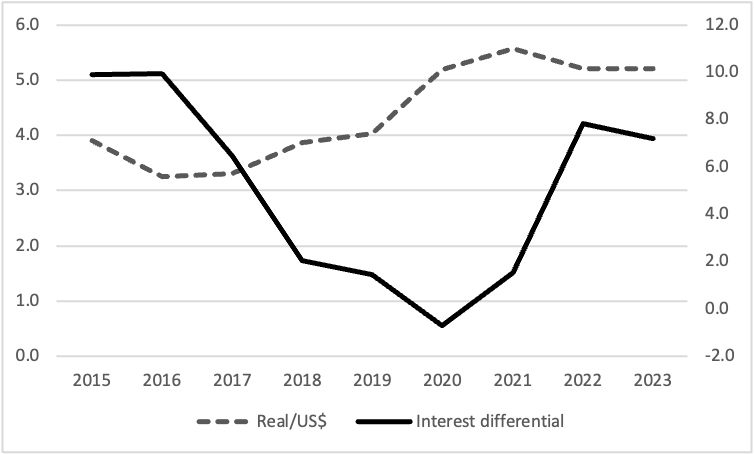
At any rate, the notion is that the higher interest rate is inimical to growth, even though Brazil did grow with relatively high interest rates in his first two mandates. The important thing to note is that Brazil had back then a relatively high and positive interest rate differential, that is a domestic nominal interest rates higher than the sum of external interest rate (the US rate) plus the risk premium (e.g. J.P. Morgan's Emerging Market Bond Index, EMBI), plus the expected nominal devaluation. In fact, as the interest rate differential (here just the difference of the BCB's Selic rate, the Fed Funds plus the EMBI) was coming down, the exchange rate depreciated.

Note that inflation accelerated and has been above the BCB's target only in more recent times, and the exchange rate is only one component of that. The higher prices of energy commodities, and the snags on the supply chain matter in the Brazilian case too. But the higher interest rate, and the higher and positive differential, did allow eventually for the stabilization of the exchange rate.

There is ample space to discuss how high the rate should be, but I'm doubtful that it can be close to zero or very low as suggested recently by André Lara Resende (that since my last post on his views, see here, has move away from Cochrane's fiscal theory of the price level, and closer to MMT; I just read his new book and that seems to be the case; on Cochrane's views on inflation see this video, also with John Taylor and Kevin Warsh).

Below the BCB's Selic rate and the Fed Funds for a longer period, starting after the stabilization of the Real Plan in the 1990s.

 
As one can see (Selic on the left, and Fed Funds on the right), the hike in the Brazilian rate has accompanied the hikes in the US, which are totally unnecessary, in my view, since inflation is cost push and not demand pull, but that's another story. But the fact remains that the ability of central banks in the periphery to conduct monetary policy independently from what happens in the center is still curtailed. Note that the reduction of Brazilian rates, from higher levels (since a positive differential must be maintained to avoid capital flight and depreciation), was possible because the Fed Funds for the most part has been very low.
 
That's probably the more important discussion about the CBI. Not just independence from financial interests, as John Kenneth Galbraith used to suggest, but also the degree of independence in a world with a hegemonic currency.

PS: In the Brazilian case, the really important question for the Lula government will be his ability to increase spending beyond the fiscal ceiling. That, and the ability to eliminate hunger, and reduce poverty rates, would determine the political success of his administration.

Tuesday, March 12, 2019

Lara-Resende and MMT in the Tropics

So André Lara-Resende, who I discussed here before, is again writing on the crisis of macroeconomics (in Portuguese and you might need to have a subscription), and now instead of embracing the Fiscal Theory of the Price Level (FTPL), has supposedly embraced Modern Money Theory (MMT). Many US MMTers cheered this as a demonstration of the reach of MMT in other countries. I would be less cheerful.

Lara-Resende, let me explain to non-Brazilian readers, was a student of Lance Taylor at MIT, and then a professor at the Catholic University in Rio, being a key author of inertial inflation, an heterodox view of inflation, that was central for the failed Cruzado Stabilization Plan back in 1986. He then participated in the successful stabilization of the economy with the Real Plan, when Fernando Henrique Cardoso was the finance minister in 1994, and during the latter's presidency a short lived president of the development bank (BNDES, in the Portuguese acronym) -- and not the central bank as many in the US have suggested (that was Persio Arida, his frequent co-author on inflationary inertia). Btw, he fell as the head of the bank because he was recorded in conversations with the president (Cardoso) on issues related to the privatization process of the telecommunications sector, in which they seemed to favor a particular group. The development bank during this period was essentially used to promote privatization as a part of the so-called Washington Consensus policies. Also, by the 1990s all the economists from the Catholic University had adhered to the Washington Consensus, and moved away from heterodoxy in the same way Cardoso distanced himself from Dependency theory, and still remain essentially aligned with neoliberal policies to these days. Lara-Resende included, as we will see.

Note that he does say that the four pillars of the new macro are that money and taxes are connected, that the government has no financial constraint, but only a real (capacity) constraint, that money is endogenous (the central bank sets the interest rate), and that the Domar rule holds and stability of debt-to-GDP ratios require the interest rate to be lower than the rate of growth. He also says inflation is all about expectations, and the Quantity Theory of Money (QTM) does not hold, something he had already said in his previous op-ed. Many (too many) interpreted this as being Chartalist Money, Functional Finance and Endogenous Money and as such as a version of MMT. Including some analysts in Brazil, with whom I fully agree on their critiques of Lara-Resende's policy conclusions, like the sharp critique by Guilherme Haluska here (also in Portuguese). Note, however, in my previous post on him, that he thought that the FTPL was an heterodox view of the macroeconomy, and he is explicit in his new op-ed that his ideas follow from his last book, in which he defends the FTPL.

In his book what he refers to "heterodox" is the experience with alternative monetary policies after the 2008 crisis, meaning Quantitative Easing, simply because it does not follow the QTM. In his words, from the 2017 book: “The result of the heterodox policies of the central banks in advanced economies, after the financial crisis of 2008, raised serious doubts about some fundamental points of the foundations of macroeconomic theory" or in the original if you don't trust me as a translator (I don't): "O resultado da experiência heterodoxa dos Bancos Centrais dos países avançados, depois da crise financeira de 2008, levantou sérias dúvidas sobre alguns pontos fundamentais da teoria macroeconômica." He does say that one of the pillars of the new macro paradigm is in his 2017 book, but my guess is the ideas are essentially the same. He used the language of MMT, and cited Knapp and Lerner to promote the same neoliberal policies of the 1990s, and the same ideas he defended a couple of years ago using FTPL.

So it is clear that the pillars are essentially of some weird New Classical story of the FTPL, in which fiscal dominance is central to the argument, and there is endogenous money, because of the neo-Wicksellian twist in modern macro. Yes, the QTM does not hold, but it is the expectations about future inflation that matter, and those are tied, in Lara-Resende's views, to fiscal policy (or at least were two years ago). The argument is the fiscal dominance one, that monetary policy has to deal with the unsustainable debt, so inflation is a fiscal phenomenon, and fiscal adjustment is needed. He was and is for austerity! He does use an MMT rhetoric and cites Abba Lerner for sure (more on that below), and that's a testament of the current relevance of MMT and its role in shaping the Bernie and Ocasio-Cortez's progressive views (something positive as I noted in my last post).

His argument is that Brazil is on the wrong side of the Domar stability condition, and, hence, the debt-to-GDP ratio is increasing (in domestic currency), and that something has to be done about it. Not sure why. Note that I always say that in domestic currency there is no default, and one of my complaints about MMT is that they do not pay attention to debt in foreign currency (at some point Warren Mosler was against capital controls and for flexible exchange rates, since the former were not necessary and the latter would solve external problems). But Brazil is not borrowing in foreign currency, and is sitting on top of a mountain of foreign reserves (something like US$ 380 billion, last time I checked, someone correct me if I'm wrong). Then he argues that inflation is all caused by excess demand in the developmentalist period, the period from the 50s to the 80s. However it is unclear why that is still a problem, or why there was excess demand, if it wasn't as a result of fiscal policy.

Fiscal reform, and, in particular, the pension reform are needed not to raise revenue (here is an MMT theme), in his view. He suggests that the reasons are that the pension system is unfair, and that in Lerner's fashion [sic] tax cuts are needed to promote the reduction of bureaucracy and allow for the expansion of more effective private investment.* These should be complemented with trade liberalization, a lower interest rate with a digital currency (bitcoin?) and fiscal adjustment, because the State is "bloated, inefficient and patrimonialist" (in the original: "Estado inchado, ineficiente e patrimonialista").

With friends like these, who needs enemies?

* It's true that Brazil has relatively high levels of taxes, in comparison to developing countries, but the problem is not that they are high, per se, but instead that they are regressive.

Thursday, March 16, 2017

Latin American Corner: Neo-Fisherism, New Keynesianism and monetary policy in Latin America (I)

By Naked Keynes (Guest Blogger)*


Since the 2000s, like other countries in the region, Brazil adopted inflation targeting. The results are not encouraging. Brazil has, without doubt, the highest interest rate levels of Latin American economies. Brazil also has probably the widest interest rate spread in the region. In the first months of 2017, the monetary policy rate stood at 12.25%. Available data for interest rates for the year 2016 show that the deposit rate is around 12.43%, while the lending rate nears, 50 %. In addition, between 2013 and 2016 the Central Bank steadily raised its monetary policy rate bringing it to the highest level in seven years.

The stylized fact that is even more disturbing is that at least since the beginning 2010, the monetary policy rate is positively related to the rate of inflation (Figure 1).
This stylized fact contradicts the very basis on which Brazil´s inflation target regime is founded and has sparked an important debate in monetary policy involving well known Brazilian economists including, among others, Lara Resende  Eduardo Loyo, and Luiz Carlos Bresser-Pereira. At the conceptual level the debate centers around New Keynesianism and Neo-Fihserianism. 

The inflation targeting framework is founded upon New Keynesian principles (rational expectations plus market rigidities) rests on three simple equations (in its reduced and essential form), aggregate demand and supply equations (IS and Phillips curve) and a Taylor rule. These are shown below.

(1) Yg=f(rn-rt, et), where Yg is the output gap and rn and rt are the natural and current interest rates.

(2) πt=f(Et(πt+i),Yg, vt), πt=inflation rate; Et=mathematical expectation formed in t.

(3) it=f(Et(πt+i), θπ πg, θY Yg, ut), where it=policy rate of interest, θπ,θY=policy parameters associated with the inflation and output gaps, and et, vt, ut are random errors, independently distributed with mean zero and constant variance.

The aggregate demand equation (1) specifies a negative relation between the real interest rate (or to be more precise the gap between the real and natural rate of interest) and the output gap (the difference between the actual level of output and the potential, i.e., natural, level of output). The aggregate supply equation (2) specifies a positive relation between inflation (or the difference between actual inflation and the target inflation rates) and the output gap. Finally, the Taylor Rule (3) introduces the policy reaction of the Central Bank by postulating a positive relationship the nominal policy rate of the Central and the inflation and output gaps.

The logic of the model is simple: an increase in the output gap brings about a rise in the rate of inflation (aggregate supply equation, (2)) which triggers an increase in the policy rate (Taylor rule, (3)) by the authorities and this reduces the output gap (aggregate demand, (1)). In turn, the reduction in the output gap narrows the inflation gap. Thus the model is stable.

However, stability (and uniqueness) require two conditions. First, it requires adding to the above three equation model, the Fisher equation ((4) rt=it-Et(πt+i)). Second it requires that the parameter on the inflation gap in the monetary policy reaction function (3) be greater than one (θπ>1). That is, when the inflation rate increases and is off target, the increase in policy rates should be greater than the rise in the inflation rate.

Only in this way can the nominal interest increase bring about a reduction in the output gap (aggregate demand equation). If θπ<1 a nominal increase in the rate of interest would not do the trick: aggregate demand responds only to variations in the real and not in the nominal rate of interest. Thus, within the logic of New Keynesianism the reason why the nominal policy rate and the inflation rate move positively together is due to the simple fact that Brazil has a “dovish” Central Bank (θπ<1).

To be continued.

* Naked Keynes is a generic name used for bloggers that for professional reasons must remain anonymous

Saturday, February 18, 2017

Lara-Resende, Cochrane and the Brazilian Recession

GDP has collapsed by a bit more than 7% in real terms over the last two years in Brazil (graph below show more recent data). This constitutes the worst crisis in recorded macroeconomic history, worse than the debt crisis of the early 1980s, and even the Great Depression.
The reasons for this crisis are entirely self-inflicted. I discussed those issues before here (and here). The problem is not fiscal, which resulted from the crisis, nor external, since there was no real issue in financing the current account deficits. The fiscal adjustment was the main cause of the recession. And certainly monetary tightening didn't help, actually it made the fiscal situation worse by increasing debt servicing costs. At any rate, recently a short newspaper piece (in Portuguese, and registration might be required) by André Lara-Resende, one of the authors behind the idea of inertial inflation, and a student of Lance Taylor at MIT in the 1970s, has received significant praise from a wide and diverse audience. So I finally decided to read it.

Lara-Resende notes, correctly, that the empirical evidence for the simple Quantity Theory of Money is not particularly good, and that there is little connection between money supply and prices. He also notes that modern macro has had a Wicksellian turn, something that is not that new. He is retooling and trying to learn modern macro at Columbia, and discovered the Fiscal Theory of the Price Level (FTPL).

In the traditional QTM story, if the economy is at full employment, and if we assume that the optimal output level is rigid and does not react to demand expansion, and the central bank increases money supply, then inflation would follow. Inflation may actually follow in this scenario even if the central bank decides to tighten monetary policy and not finance the deficits, according to New Classical authors. Sargent and Wallace argue that economic agents know that lower money supply growth today would lead to faster money growth in the future. In other words, if the central bank does not monetize debt in the present, it will be forced to do so in the future, since public debt is a promise to pay in cash in the future, and tighter money now means more inflation later. This would be a situation in which fiscal policy dominates monetary policy.

Fiscal dominance is a situation where the central bank gives up its control over the quantity of money and over inflation to prevent the government from defaulting on its public debt. In addition, with rational expectations, economic agents would anticipate this higher growth rate in the future, and inflation would accelerate in the present without monetization. Sargent and Wallace suggest that inflation becomes always and everywhere a fiscal phenomenon. This is the basis of the FTPL, and the work of Cochrane, which Lara-Resende sees as unorthodox and an alternative to conservatism.

Note that he sees this ideas as unorthodox, in particular because they can account for the possibility of a positive relation between the nominal rate of interest and the price level, something that used to be called the Gibson Paradox.* But, like Cochrane and his fellow New Classical authors, the idea is that to control inflation you need a good old-fashioned fiscal adjustment (btw, that was true too for the old Monetarists, that thought that monetary expansion was caused by fiscal deficits).

The notion that monetization of debt, or fiscal dominance, would lead to inflation, however, is predicated on the supposition that the system has a tendency to move to full employment, and to do it relatively fast. The central question regarding monetization, then, is what determines this supply constraint that imposes an inflation barrier to demand expansion, what Friedman referred to as the natural rate of unemployment – note that natural was meant to suggest that policy cannot affect it. If the economy is below the supply constraint or the supply constraint is variable, then monetization is not inflationary.

Interestingly enough, Lara-Resende does not discuss whether Brazil is at the natural rate at all, and what would be the effect of a massive fiscal adjustment. The idea here is that low rates of interest would signal, lower inflation expectations, and that the fiscal adjustment would reduce the real rate of interest determined by non-monetary factors (the natural rate of interest). There are too many problems with the notion of a natural rate of interest (yes, as I always insist, go learn about the capital debates). But there is hardly anything unorthodox about it. And besides, austerity, which seems to be the default position now in Brazil, would lead to a worsening of the crisis, and contrary to what Lara-Resende thinks, monetary tightening, through its effect on the exchange rate and the cost of imported goods (and its impact on real wages; on top of the effects of the recession on workers' bargaining power, and the government's policy for minimum wages), would maintain inflation low. Low rates of interest (even if welcome) are not the solution; at this stage only expansionary fiscal policy would work.

* It's not really a paradox in a classical (as in classical political economy) context, in which the interest rate is a cost of production.