Showing posts with label Pivetti. Show all posts

Tuesday, May 6, 2025

On Money and the Interest Rate

David Fields (guest blogger)

A capitalist economy is a monetized production system, that is, economic activity is predicated upon the extent to which financial institutions extend credit to enterprises. Consequently, output expansion is mediated by the mechanisms of banking. The ability of firms to acquire necessary labor and material inputs, essential for fulfilling profit expectations and enabling wage disbursements to workers, is contingent upon the scope of debt obligations. Credit, thus, functions as a social technology of deferred payment and settlement, establishing a relatively secure contractual claim that enables entrepreneurs to address uncertainty and facilitate long-term operational expansion, as determined by the level of aggregate demand. Restrictions on credit invariably nullify attempts at increased production. Banks facilitate the prepayment of firms for capital goods and labor costs, sustaining production and distribution prior to the realization of profits from projected consumer goods sales.

Proportional shares of accumulated profits are transferred to the banking sector. Firms are obligated to deduct interest payments from their collateralized deposit schedules of future revenue. This is called the reflux mechanism, or monetary circuit, which can be represented by the following Marxian schema:


                                                           M* – M – C’ – M’ – M*’

where M* denotes bank loans to firms that enable the production process (M – C’ – M’), ultimately converted into M*’, representing interest payments to the financier from realized profits, M’. The difference (M' - M), profit, is regulated by the financial provisions offered by banks , which are subject to the interest rate is set by a nation's central bank. Hence, the interest rate is a conventionally determined distributive variable that ultimately determines the proportional allocation of income.

Consequently, should the central bank implement and sustain elevated interest rates over extended duration while aggregate demand remains subdued due to insufficient fiscal policy, a decline in real wages will ensue, unless there is effective labor resistance. In this sense, what can be defined as monetary austerity sacrifices long-term productive investment, unless there is an effective counter-cyclical fiscal space, which is limited for states that faces balance of payments constraints.

Sunday, February 19, 2023

On central bank independence, and Brazilian monetary policy

The issue is back in the news. This time in Brazil (it was briefly an issue here when Trump did not reappoint Yellen, and then complained about Powell's interest rate where too high). At any rate, I always thought that there were good reasons for skepticism about central bank independence (CBI). As noted by Massimo Pivetti in this old piece on the Maastricht Accord and the, at that time, plan for the euro, the main reason to be doubtful is related to the interaction of monetary policy and fiscal policy. And as Quantitative Easing in the post-Global Financial Crisis has shown, central banks have become again fiscal agents of the state (never stopped being that, in all fairness).

The other important reason alluded by Pivetti for doubting CBI is the effects of the interest rate on the exchange rate and balance of payments. This is a quote from Pivetti:

And one could add, through the exchange rate, the effects on inflation also matter. This can be illustrated by the discussion of the Brazilian case. Lula has been very critical of the policies of the Brazilian Central Bank (BCB), and of the higher interest rates, since the campaign last year, and some sort of a truce has been in the works, with him being less direct (or at least that has been reported).

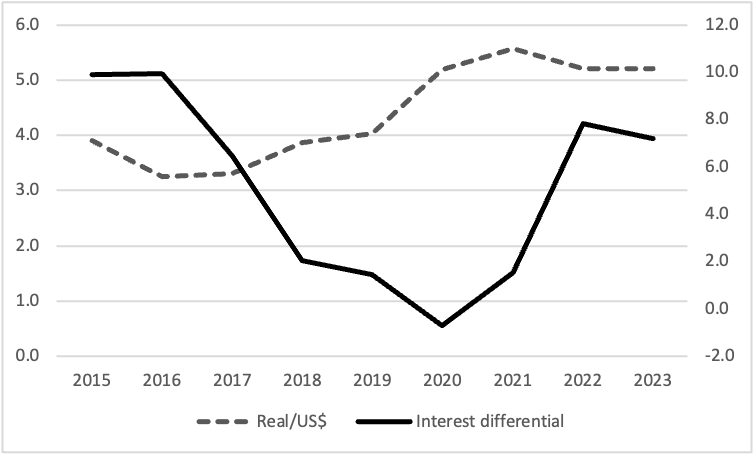
At any rate, the notion is that the higher interest rate is inimical to growth, even though Brazil did grow with relatively high interest rates in his first two mandates. The important thing to note is that Brazil had back then a relatively high and positive interest rate differential, that is a domestic nominal interest rates higher than the sum of external interest rate (the US rate) plus the risk premium (e.g. J.P. Morgan's Emerging Market Bond Index, EMBI), plus the expected nominal devaluation. In fact, as the interest rate differential (here just the difference of the BCB's Selic rate, the Fed Funds plus the EMBI) was coming down, the exchange rate depreciated.

Note that inflation accelerated and has been above the BCB's target only in more recent times, and the exchange rate is only one component of that. The higher prices of energy commodities, and the snags on the supply chain matter in the Brazilian case too. But the higher interest rate, and the higher and positive differential, did allow eventually for the stabilization of the exchange rate.

There is ample space to discuss how high the rate should be, but I'm doubtful that it can be close to zero or very low as suggested recently by André Lara Resende (that since my last post on his views, see here, has move away from Cochrane's fiscal theory of the price level, and closer to MMT; I just read his new book and that seems to be the case; on Cochrane's views on inflation see this video, also with John Taylor and Kevin Warsh).

Below the BCB's Selic rate and the Fed Funds for a longer period, starting after the stabilization of the Real Plan in the 1990s.

 
As one can see (Selic on the left, and Fed Funds on the right), the hike in the Brazilian rate has accompanied the hikes in the US, which are totally unnecessary, in my view, since inflation is cost push and not demand pull, but that's another story. But the fact remains that the ability of central banks in the periphery to conduct monetary policy independently from what happens in the center is still curtailed. Note that the reduction of Brazilian rates, from higher levels (since a positive differential must be maintained to avoid capital flight and depreciation), was possible because the Fed Funds for the most part has been very low.
 
That's probably the more important discussion about the CBI. Not just independence from financial interests, as John Kenneth Galbraith used to suggest, but also the degree of independence in a world with a hegemonic currency.

PS: In the Brazilian case, the really important question for the Lula government will be his ability to increase spending beyond the fiscal ceiling. That, and the ability to eliminate hunger, and reduce poverty rates, would determine the political success of his administration.

Saturday, January 15, 2022

On the origins of Sraffa's equations

Giancarlo de Vivo suggests that the Sraffian equations come from Marx's schemes of reproduction, and that the inspiration was in a footnote from the editor, Karl Kautsky, in the Theories of Suplus Value. Here a letter from Maurice Dobb and Piero Sraffa to Kautsky, from 1929, asking to use his edition as the basis for an English translation (originals in Kautsky's archives):


De Vivo's views are discussed in a book edited by Massimo Pivetti, which is certainly worth reading (I have the Spanish edition). I never thought of this genealogy of the Sraffian price equations as being controversial, but I have been re-reading some discussion about Sraffa's contributions between Pierangelo Garegnani and Marxist authors (from the 1970s) as a result of the events related to the latter's ten year death anniversary, and it did strike to me that it is unclear to most Marxists how closely related the prices of in the Production of Commodities are with Marx's work.

Thursday, November 19, 2015

Misconceptions about Heterodox Economics in general and Sraffian in particular

I had discussed before the meaning of heterodox economics. I suggested a definition based on positive contributions (rather than as a critique of the mainstream) and based on concepts rather than schools of thought. In my view the two principles that were central for defining heterodoxy were the Principle of Effective Demand (PED), based on Keynes and Kalecki's ideas, and the idea that distribution is the result of class conflict, which in my view is best expressed in Sraffa's recovery of the surplus approach. And I suggested that several authors within various schools of thought (Post Keynesians, Marxists, Institutionalists, Sraffians, Feminists, Ecological economists, Structuralists, and even some Evolutionary or Schumpeterian economists) could probably accept both propositions (not Austrians, which are a fringe version of Marginalism, and as a result not an heterodox school per se). In that sense, there could be a view of heterodoxy as not necessarily fragmented set of Schools of Thought.

However, it is a different proposition to suggest that something like a consensus between heterodox schools is really emerging. That I actually doubt. John King suggests that this would be Fred Lee's position in his new book Advanced Introduction to Post Keynesian Economics (there is no direct quote, but I always interpreted Fred as suggesting that a more cohesive heterodox approach was possible rather than it was actually taking place in reality, but I might be wrong).

In fact, it is my view that, in general, not only heterodox groups, which by definition tend to be small and often concerned with specific topics, but the mainstream is quite fragmented. On macro issues, even with the New Neoclassical Synthesis, there is a lot of disagreement between New Keynesians and RBC types, particularly on policy issues. So it should not be surprising that heterodox groups are quite fragmented too. Sometimes the fragmentation within the mainstream gives the false impression that some groups are breaking away, or on the edge (see my view on that here). And it is not just fragmentation, but also confusion. Even in the mainstream there is lack of understanding about the meaning of the mainstream (see here for example).

So it should not be surprising that, given the fragmentation of the heterodoxy, several misconceptions arise. Sraffians are particularly vulnerable to this since Sraffa wrote so little, and even though his Production of Commodities is not a difficult book to read, it is one that has been often misunderstood. Marc Lavoie has responded, from a Post Keynesian and friendly standpoint, to some of these misconceptions (the fact that some people consider Austrians heterodox, but are not certain about Sraffians speaks volumes about confusion among heterodox groups too).

Yet, I was a bit surprised by some of the misconceptions in John King's book. He says that: "There is no role in Sraffian models for fundamental uncertainty, money or the principle of effective demand." In the quote he suggests that this is the position of Hart and Kriesler (2014), but if he disagrees he does not say anything. So it is safe to assume that he concurs. He complements this by arguing that: "since the relationship between the wage rate and the rate of profit in Sraffian models is monotonically declining, it is difficult (if not impossible) for the their models to incorporate a 'wage-led' growth regime." Hm, were to start.

So Garegnani pointed out long ago (in the 1960s, but the English publication was in the late 1970s; links to the English versions of both the 1960s and 1970s papers here) that not only Sraffians believe in effective demand, but that a coherent presentation of the Principle of Effective Demand requires the abandonment of marginalism (particularly the marginal efficiency of capital argument). Not only that, Garegnani is very clear in his 1960s papers that (from link above):
"As regards consumption, increases in real wages lead to a rise in consumption and hence, provided the economy has accumulation capacity that is not fully utilized, to an expansion of the productive system and to an increase in employment. Given the level of productivity in the economy, the increase in real wages will in fact cause a redistribution of income in favour of a class that consumes a major portion of its income, and with that an increase in the first component of final demand... 
a steady and continuous rise in real wages along with the consequent steady and continuous increase in consumption can serve to instil in entrepreneurs a confidence in the continuous expansion of the market for their products, inducing them to undertake investments and increases in employment and output that will in turn help to raise final demand."
So yeah the economy is wage-led. Actually, in Garegnani's debates with Marxists, with Joan Robinson and other authors on the causes of long run growth, he could be seen exactly as taking the position that profit-led regimes are not possible, in the sense that he understood that firms would not invest because of a higher rate of profit. Firms are interested in adjusting capacity to demand, and to maintain a normal level of capacity utilization. Also, one should note that Garegnani wrote his paper in the 1960s under the direct influence of Sraffa, who might also have understood the idea of the accelerator. That is why Franklin Serrano is correct in suggesting the supermultiplier is Sraffian. Not only Sraffians have effective demand, they do in the long run (not in the short run as a result of imperfections).

Two things are important in this context. First, in Sraffa's price equations, which uses the method of given quantities developed by classical political economy authors, imply that there is class conflict, and an inverse relation between the real wage and the rate of profit. However, in a theory of the determination of output in the long run, output by definition is not given and the effects of income distribution on output might be ambiguous, even if the demand regime is wage-led (for example, higher wages might lead to loss of external competitiveness, and lower exports than more than compensate the increase in consumption associated to higher wages). Second, as I noted on my previous post on Garegnani's 1960s paper, the Sraffian project was the revival of the classical theory of distribution, concomitantly with the extension of the Keynesian Principle of Effective Demand to the long run.

On the absence of money in the Sraffian system also a lot of ink has been wasted. In his Production of Commodities Sraffa famously suggests that it is the rate of interest, as determined by the monetary authority, which is the exogenous variable. So prices and real wages are determined for given technical conditions of production and the long term interest rate as set by the monetary authority. Pivetti referred to this as the monetary theory of distribution. So monetary policy has important distributive implications, and this view is perfectly compatible with Keynes' views on a normal, conventional and not psychological, rate of interest. It is also compatible with endogenous money views, that hark back to Tooke and other Banking School authors. There is money, and not in the sort of Monetarist way in which the central bank controls its quantity.

Finally, on uncertainty. True for Sraffians uncertainty is not central for unemployment (one in three), yet that does not mean is completely irrelevant or that it does not play any role. Here it is important to note that any good discussion of uncertainty suggests that the one that is central is the uncertainty about future demand. See for example Davidson in this example. So the problem is lack of demand. Autonomous demand that is. And that works, as it should, with the supermultiplier.

Tuesday, October 14, 2014

Massimo Pivetti on Interest Rates and Gross Profit Margins In Recent Experience of Advanced Capitalism

From a paper prepared for the colloquium “What have we learnt on Classical economy since Sraffa?” Paris, October 2014
According to the monetary explanation of distribution, as elaborated over the past 25 years on the basis of a well known suggestion by Sraffa, the normal rate of profit would be arrived at in each sphere of production by adding up two autonomous components: the rate of interest on long-term riskless financial assets, plus a normal rate of profit of enterprise, viewed as a component of normal production costs and reflecting objective (or widely perceived as objective) elements of risk attached to each different productive employment of capital. Since the normal margins for profit, given production techniques, depend on normal profit rates, the same two variables, the rate of interest and the rate of the profit of enterprise, would govern also the course of net normal profit margins in the different production spheres. For any given set of profits of enterprise, the long-term rate of interest would thus act in the economy as the regulator of the ratio of prices to money wages. Once the normal profit of enterprise in each sphere of production is taken as given, in that it is determined separately from both the rate of interest and the rate of profit, attention is focused in this approach on the rate of interest.
Read rest here.

Saturday, February 1, 2014

Pivetti on Advanced Capitalism and the Determinants of the Change in Income Distribution: A Classical Interpretation

Massimo Pivetti
Technological change, though paramount in the dominant theoretical approach to distribution in terms of the relative scarcity of factors, also plays a significant role in the alternative classical surplus approach.
See rest here

Thursday, July 25, 2013

The gloomy European project

I don't know for how long, but if you go here now you can get for free the papers of the symposium at Contributions to Political Economy, by Pivetti, Sawyer, Palley, Varoufakis, Barba and De Vivo, Boyer, Bibow, and Singh and his co-authors. Pivetti notes in his introduction that:
"The austerity policies of the last five years can hardly be regarded as a true policy shift. They should rather be seen as a continuum with respect to the entire European Monetary Union (EMU) experience, to whose overall policy stance they just contribute a toughening up. Ever since the Treaty of Maastricht in 1992, and even more from the birth in 1999 of the European Central Bank (ECB) as a monet- ary authority, the average rate of growth of real income in the Euro area has been very low by historical standards, contributing to the persistence of the area high levels of unemployment, largely as a result of the inflation rate having been the ECB’s overriding policy objective."
Note that the austerity imposed on almost every European country is part of a larger project of dismantling the Welfare State. In fact, Pivetti refers to the Euro as: "the infernal machine: a machine born out of a deliberate continental project to undermine wage earners’ bargaining powers."

If you can, given the topic, enjoy these great and penetrating papers!

Tuesday, March 19, 2013

Thomas Tooke and the Gibson Paradox

The Gibson Paradox is the name that Keynes suggested for a particular empirical regularity, namely: the positive correlation between the rate of interest and the price level. He had read about in a series of articles in the Banker's Magazine by A. H. Gibson, hence the name. Keynes suggested in his Treatise on Money that the Gibson Paradox was "one of the most completely established empirical facts in the whole field of quantitative economics." The graph below is from Gibson's 1926 piece.
However, the correlation was first noted by Thomas Tooke (for more see Pivetti's entry in the New Palgrave; subscription required), the leader of the Banking School, in the 19th century, and author of the massive and underappreciated History of Prices ( Vols. 1, 2, 3, 4, 5 and 6 available on-line).

In that book, and contrary to Ricardo and the Bullionist authors (the precursors of the Currency School), he argued that inflation during the Napoleonic Wars (1793-1814) was not caused by money printing by the Bank of England (bank notes were inconvertible from 1797 to 1821), but the result of bad crops and higher prices of agricultural goods, import restrictions associated to the blockade and higher import prices, and exchange rate depreciation that added to the costs of imported goods. The last cause he cites is associated to what Keynes called the Gibson Paradox (p. 347):
"A higher rate of interest, in consequence of the absorption by the war loans of a considerable proportion of the savings of individuals; such higher rate of interest constituting an increased cost of production."
In other words, the rate of interest enters the costs of production [some heterodox authors, like Lance Taylor, have referred to this as the Cavallo-Patman effect]. Note that there is no particular paradox in the effect, which according to Lawrence Klein [yes the same that won the Sveriges Riksbank Prize, aka the Nobel] is still doing fine (and yes also needs subscription; sorry).

The reason that the correlation seemed like a paradox to Keynes is because he thought along marginalist lines and assumed that a higher rate of interest would lead to lower investment, and hence reduce demand pressures on prices. He expected a negative correlation between the two variables. Wicksell noted that if the economy was hit by a real shock (to the marginal productivity of capital, for example) then you would have a bank rate of interest lower than the new and higher natural rate of interest (implying higher remuneration for the more productive capital), and the excess investment associated to this situation would lead to higher prices. Eventually, banks would note that the bank rate was too low, and would raise it, leading to an increase in the rate of interest together with higher prices (a positive correlation). Of course Wicksell and the natural rate cannot survive the capital critique. For more on Wicksell go here.

Tuesday, August 28, 2012

A reply to Wray - Part I

By Sergio Cesaratto (Guest Blogger)

“The fact that individual countries no longer have their own currencies and central banks will put new constraints on their ability to run independent fiscal policies. … But more disturbing still is the notion that with a common currency the ‘balance or payments problem’ is eliminated and therefore that individual countries are relieved of the need to pay for their imports with exports. Quite the reverse: the existence or a common currency makes a country more directly dependent on its ability to sell exports and import substitutes than it was before…” Wynne Godley 1991
There are two aspects of the discussion that has taken place in the last weeks (here, here, here, here). The first mainly concerns my first post and regards whether monetary sovereignty is a condition both necessary and sufficient for any country to pursue development and full employment policies; the second concerns the Eurozone (EZ) crisis and was the subject of my second post. Wray mainly focuses on the second issue, and I will do the same. In part 1 of my reply I will, however, briefly dwell on the first aspect that is anyway preliminary and which will lead us to touch upon the EZ troubles anyway. The two questions we deal with in part 1 will, respectively, be: are balance of payments (BoP) preoccupations irrelevant for countries endowed with full monetary sovereignty? Can a currency union suffer of internal BoP troubles? Part 2 (will be posted later) will then be devoted to Wray’s explanation(s) of the EZ crisis.

1. Born in the US
The main argument of my first post was that monetary sovereignty, although a necessary condition for development and full employment policies, is not the magic wand to solve the foreign constraint to those policies. This constraint can be summarised as the necessity for peripheral countries – a set that include from developing countries to highly developed countries like France or Italy – to acquire enough international liquidity to finance the amount of imports generated by a satisfactory level of growth [a useful critical discussion of the theory of the balance-of-payments-constrained growth as presented by Thirlwall - and inspired by Kaldor - is in Palumbo (2012)]. Unless a country issues an internationally accepted currency, no monetary sovereignty would automatically allow fiscal policy to sustain domestic demand in peripheral countries without risking the vicious circle of a falling foreign exchange rate and high inflation. When Mitterand took power in 1981 with strong Keynesian ideas, few month were enough to change his mind – that is to realise that without the German cooperation, that was not there, no expansion in a single country was possible (unless you are ready to adopt more radical measures like import restrictions that, indeed, were in those years proposed by Godley). And that was France! This is not to say that full monetary sovereignty is not relevant, quite the opposite, in the first place in order to pursue a competitive exchange rate and in order to release more space to policies in support of domestic demand consistently with current account (CA) equilibrium. Unfortunately, at least until the late 1990s, peripheral countries have traditionally tried the shortcut of stabilising the nominal exchange rate and financial liberalisations in order to attract foreign capital inflows. In a meaningful sense the poor experience of a number of peripheral countries in the European Monetary Union (EMU) – including Spain, Ireland and Portugal - has been similar and is described on similar lines by Roberto Frenkel (2012), Cesaratto (2012a), Bibow (2012) and many others. We shall come back on this.

From the ensuing debate on blogs, FB etc, it seems that my position has convinced a number of people, likely opening the eyes to some.[1] This was very important for my country in which is very dangerous that too simple formulas enter into the political debate, already suffering of the mainstream vulgarities also influential on the left (see Cesaratto and Pivetti), and of “Berlusconism”. Of course, “Modern Monetary Theory” (MMT) as such has nothing to do with this.[2] I have also been careful to isolate the important messages that come from it, e.g. that a country with full monetary sovereignty cannot default on its sovereign debt if denominated in its own currency. This is important and refreshing, but we cannot stop there.

MMTs recognise of course that CA imbalances can be a source of troubles, but are likely not convinced. With which arguments? Let us quote in this regard a revealing passage by Wray:

“So, yes, the US (and other developed nations to varying degrees) is special, but all is not hopeless for the nations that are “less special”. To the extent that the domestic population must pay taxes in the government’s currency, the government will be able to spend its own currency into circulation. And where the foreign demand for domestic currency assets is limited, there still is the possibility of nongovernment borrowing in foreign currency to promote economic development that will increase the ability to export.

There is also the possibility of international aid in the form of foreign currency. Many developing nations also receive foreign currency through remittances (workers in foreign countries sending foreign currency home). And, finally, foreign direct investment [FDI] provides an additional source of foreign currency.”
So Wray recognise the particularity of the U.S. and of some other developed countries that, as Australia, have enormous endowments of natural resources and stable institutions. What the normal countries might do is then to appeal to official aid, to rely on remittances or on FDI,[3] or finally … to liberalise finance and commit to a stable nominal exchange rate in the attempt to attract foreign capital (what is implied by Wray’s suggestion of “nongovernment borrowing in foreign currency”). A similar position expressed by Bill Mitchell is quoted by blogger “Lord Keynes” (who has words of appreciation for my posts, thanks!) as a possible MMT reply to my view. What Mitchell says is that we should have a new and progressive IMF that alleviates the foreign constraint. But we have not it and we shall not have it, even admitting that it would be sufficiently powerful to solve the problems of big countries.[4] Well, anybody can judge the frailty of these replies.[5] So we remain with a single result: a sovereign central bank is a necessary, essential step, but is not the solution to any problem in all countries.[6]

2. Born in the EU
Of course, the renunciation to full monetary sovereignty is at the bottom of the EZ crisis, but as I argued in my posts, in the first place from the “external” point of view of the ensuing loss of competitiveness for peripheral countries and not-so-peripheral countries like Italy (we shall see in the second part, posted later, that Wray is close to recognise this in his reference to Kregel; monetary unification and financial liberalisation created further troubles on which we shall return in the second part). Wray tends, however, to deny that the origin of the EZ crisis is mainly in the foreign imbalances.

His main argument is that had the EZ been a currency area like the US, it could not have balance of payment crisis. This is so because in the US “we use fiscal policy [that is fiscal transfers] to try to overcome the negative effects on standards of living across states due to different multipliers and other factors related to these current account flows.” (Wray here). So the conclusion is that the EZ crisis “it is not a simple current account story. It is an MMT story about the constraints imposed due to the setup of the EMU, which separated fiscal policy from the currency.” Consider also (Wray here): “We went on to examine the claim that the Euro crisis is a simple BoP problem. That, too, is fallacious. If the EMU had been designed properly, it would not matter whether some member nations ran current account deficits—much as many US states run current account deficits.” So the problem is that the EZ is not the US, since if it were, no BoP crisis would have occurred! It is as one warns not to drive a car with three wheels and somebody else replies: don’t worry, just assume you have four. Warren Mosler’s (implicit) reply to my posts admits it: the CA imbalances are a problem that a sovereign central bank cannot solve and one solution is for the EU to have fiscal transfers of the size of the US and nobody would talk anymore of the EU imbalances. Well, but we have not this Europe and we shall never have it (I clearly myself wrote, as “Lord Keynes” correctly recalls, that the EZ could be a perfect MMT country).

To sum up, Wray’s reasoning is the following: the monetary unification might well have created CA problems (see in Part 2, to follow tomorrow, of this post his reference to Kregel). Transfers from a substantial federal European budget backed by a genuine European central bank (CB) could compensate those imbalances without much pain for the richest local states but as a component of full employment policies.[7] We may then deduct from this that since Europe has not this framework, then it suffers of a CA crisis (although a specific one, as Frenkel or myself have pointed out, we shall return on this). Wray, however, infers that since the EZ could have avoided the crisis, had it the right framework, then it is wrong to talk of a CA crisis. This sounds rather illogical, isn’t?[8] However, once the argument is presented in an ordered way – a wrong institutional design of a non-OCA precisely produces a (specific) BoP crisis – the distance be Wray and me may disappear (see Godley 1991 and Kregel). Notably, the origins of this “wrong institutional design” are not in the ignorance of the political designers. The same inventor of the OCA, the conservative economists Robert Mundell, has recently pointed out that the Euro has not been a failure as long as the ensuing disasters are leading to the destruction of trade unions and the social state, but I suppose this is also an area of broad agreement.

Notes:
[1] A commentator wrote: “The balance of payments position is MMT’s Achilles hell and more and more people are starting to realise it”. I do not think this implies that MMT has not very interesting things to say once it becomes less self-referred.

[2] Things have changed in the meanwhile. Stephanie Kelton has showed great understanding for us, and I believe that her feeling is shared also by other MMTs. We are thinking about having an event together in Rome during her visit to Italy (with Auerbach and Mosler). Even if we shall not be able to organize it, the very fact that we tried is very encouraging."

[3] In an old paper, that I quote in Cesaratto (2012), Kregel warns that FDI is a dangerous form of foreign debt.

[4] I found particularly timely the reference by Ramanan, in the discussion of one of my posts, to the Mexican case of 2008 that well illustrates a typical case of a country with full sovereign monetary that has to recur to the IMF and accept its conditionality to avoid an exchange rate crisis. He rejects the thesis, that "with floating rate currency there are always takers [of the currency] at some price” since eventually it “would become extremely profitable for some to buy stuff from Mexico." To this Ramanan retorts that if “that were the case there would have been no need for Mexico to have gone to the IMF. Now you can start arguing that the central bank didn't use this huge line of credit offered but it’s the availability of this line of credit which gave confidence to the currency markets. In this case the IMF helped but it is not bound to rescue every time. And whenever such events happen, domestic demand has to give in to stabilize the external debt. You can't simply say that there is a price and the markets clear and this is the end of the story. A fall in the currency can stabilize temporarily but this is in expectation of something happening such as an intervention. Now, if the central bank doesn't react to this, it could have created a further outflow of funds depreciating the currency further. Also banks - most importantly - have liabilities in foreign currency and an outflow can further increase this with depreciation leading to banks ending up in trouble rolling over their liabilities. It is for this reason as well that Mexico used the Fed's swap lines. In other circumstances, there is sale of reserve assets, incurring of liabilities of the government in foreign currency etc to help the currency markets function. If what you think is true there would have been no need for Mexico to have gone to the IMF at all. Unfortunately that is pure fantasy stuff. There's a huge literature on how the growth of nations is explained by the balance of payments constraint and its funny how ‘modern monetary theory’ suddenly appears as Magic Pudding Economics!” Italy, a leading industrialised country, in a similar situation had to recur in 1975 to an official German loan (that the social-democrat Chancellor Schmidt accorded using nasty expressions about Italy)

[5] I wish to be conciliatory and avoid sarcasms in this note, but these replies remind me the sentence that Rousseau attributed to Marie Antoinette: « Enfin je me rappelai le pis-aller d’une grande princesse à qui l’on disait que les paysans n’avaient pas de pain, et qui répondit : Qu’ils mangent de la brioch » . Unfortunately, like Marie Antoniette’s brioches, neither conspicuous official aid, nor a progressive IMF, nor democratic FDI that distribute or reinvest profits in the host country, nor successful currency board are there to help.

[6] The non generality of the MMT’s view has been acknowledged by “Lord Keynes”: “MMT would work very well for (1) the US, (2) those nations with strong trade surpluses (say, Germany and Japan), (3) those nations that seem to run near perpetual current account deficits but attract a lot of foreign capital (say, Australia), and (4) even the Eurozone, if it were suitably reformed with a union-wide fiscal policy, would be able to achieve full employment via MMT-style policies. In short, for most of the Western world: it certainly makes sense, and can be regarded as just a more radical form of full employment Keynesian economics. That is why Post Keynesians, by and large, are reasonably receptive to it.

To this Ramanan replied that "for most Western nations" is inexact: “Most Western includes Spain as well which obviously has a constraint. You guys will always make overkills to prove a wrong point.” Interestingly Dan Kervick added: “On neo-chartalist principles, the scope of a county's ability to generate demand for its currency would be determined by the scope of its power to tax. If the Duchy of Grand Fenwick can successfully impose and collect a tax on its people payable in Fennies, then it can successfully create demand inside its country and among its own people for Fennies. That doesn't mean it can create demand for Fennies in Indonesia simply by imposing the tax on Grand Fenwickians”. And “Bruce said”: “MMT is not a magic pill that can convert a country that is deficient in vital scientific and business skills into a wealthy nation.” (I do not believe these people are Trolls, although I much preferred that everybody would use their proper name, particularly of academics, that are without problems of professional privacy). All quotations from here.

[7] The direct intervention of the ECB to sustain the public debts of uncompetitive peripheral EZ countries is a surrogate of fiscal transfers, as Wray alludes in a discussion with Ramanan (who, of course, fully agree): “’transfer’ is the wrong word. Uncle Sam issues the currency and does not have to reduce income in one state to increase it elsewhere. … If we had a fixed economic pie then in real terms we'd be transferring real stuff to the poor regions. But that ain't true, either, as outside WWII we've never operated continuously at anything approaching capacity”. In other words, it would be equivalent if, using the MMT’s wording, a federal Bruxelles “writes a cheque” (creating a deposit at the ECB) financing “fiscal transfers”, or if the ECB directly buys the deficit countries public debt (for a clarification of the MMT’s view see Lavoie).

[8] So the presentation of my thesis that Wray provided is rather unfair: “As discussed at GLF recently, Sergio Cessaratto [sic] (and others) think we got it wrong–our claim is ‘spurious’. MMT is not useful for helping to understand the crisis. It is not a sovereign currency crisis, it is a balance of payment crisis. They have not yet explained why South Dakota or Alabama or Mississippi is not suffering the fate of Greece.” Precisely because Greece is not South Dakota, that country is suffering that fate.

Further references:
Barba A., Pivetti M. (2009) Rising Household Debt: Its Causes and Macroeconomic Implications-A Long-Period Analysis, Cambridge Journal of Economics, Vol. 33, Issue 1, pp. 113-137, 2009.

Cesaratto S. (2012b), Neo-Kaleckian and Sraffian controversies on accumulation theory, Università di Siena, Quaderni del Dipartimento di Economia politica e Statistica, forthcoming Review of Political Economy.

Cynamon B.Z., Fazzari S.M. (2008) Household Debt in the Consumer Age: Source of Growth—Risk of Collapse, Capitalism and Society, vol. 3, article 3.

Palumbo A. (2012), “On the Balance-of-Payments-Constrained Theory of Growth”, in Sraffa and Modern Economics (R. Ciccone, C. Gehrke, G. Mongiovi eds), London: Routledge.

Monday, November 14, 2011

Income distribution in advanced capitalist economies

Massimo Pivetti has been central for the development of the so-called monetary theory of distribution, which develops the work of Piero Sraffa. The link (here) is to a talk at UNAM, in México last week (intro in Spanish, but Pivetti gives the talk in English starting at around minute 3). A good paper to follow what he says can be found here. You can see all the videos and other good stuff here.

PS: The classic book on the topic here.

Monday, May 2, 2011

Is the American economy profit-led?


In a recent post I showed the evolution of real wages and long-term real rates of interest in the United States from 1950 until now. The figure below shows the real rate of output (GDP) growth for the same period. Between 1950 and 1973 the average (red line) rate of growth was 4.2% and in the subsequent period it was 2.7%. In other words, the change in income distribution dynamics, with a significant slower rate of growth of wages, was accompanied by a significant reduction in the pace of economic growth (we also saw in the previous post that it also went hand in hand with higher real rates of interest).


Many authors (e.g. the late David Gordon), in particular when looking at the evidence post-1970s, argued that the American economy is profit-led. In other words, as profits (some emphasized profit shares while others prioritized profit rates; the profit rate time the level of capacity utilization gives the profit share) expanded, it stimulated investment, and this, in turn, led to output growth. Growth was driven by profits.

The idea is that, even though the reduction in wages has a negative effect on consumption and output growth, this is more than compensated by the increase in investment. However, there are some empirical problems (there are some theoretical issues that I’ll deal with in another post) with this kind of model (often referred to as Kaleckian, even though it seems that their origin should be traced to Joan Robinson’s Accumulation of Capital and the influential formalization by Bob Rowthorn in the early 1980s).

For starters, growth actually fell significantly after real wages stagnated. Also, the output-to-capital ratio (shown from 1960 to 2008 using a OECD measure), as can be seen in the graph below, does not indicate a marked shift in the 1970s. The output-to-capital ratio goes up in the Johnson and Clinton booms, and falls otherwise. The Reagan boom was mild at best. This is consistent with the accelerator. As the economy moves closer to full employment, the output-to-capital ratio, a proxy for capacity utilization, moves close to its maximum. The accelerator would suggest that investment adjusts capacity to output. Investment is not the locomotive of the system, is the rear car (the idea behind the accelerator principle).


Since the 1970s the drivers of accumulation in the United States have been consumption booms driven by debt accumulation. In other words, as Barba and Pivetti have argued, increasing debt has allowed American families to continue to consume, in spite of stagnated wages. This has been mistaken in the empirical literature as a profit-led boom. The suggestion here is that the booms have continued to be driven by consumption (as in more traditional wage-led cases), and that the benefits for capital have been financial and associated to higher interest rates. The last three booms have been more Wall Street debt-led booms, rather than profit-led investment booms. Wall Street, not the Silicon Valley, defines the current American economy. After all, we all remember Gordon Gekko’s “greed is good” (uttered in real life by Ivan Boesky) and nobody remembers an iconic phrase by Bill Gates!

Tuesday, April 26, 2011

The ECB is throwing gas on a fire

Professor Massimo Pivetti has recently commented on the European Central Bank's (ECB) interest rate increases, that add monetary contraction to the brutal fiscal adjustment that several countries in the periphery of Europe have been subjected to. He says:

"The ECB increased the rate of interest – in what is very likely the first one of a series of increases expected in the next months – with the objective of controlling inflation that accelerated to 2.6% in March from 2.4% in February. Given that this inflation bout has external origins, caused by the increase in the international price of energy, raw materials and foodstuff, the reasoning behind the anti-inflation policy based on dear money is not immediately obvious.

First of all, according to the currently dominant versions of the orthodox point of view about monetary policy, an increase of the rate of interest by the central bank would be only justified if the reasons for the greater inflation including also monetary wages rises would be attributable to imbalances in the conditions of domestic aggregate demand and supply. But certainly not even Trichet would think that today, within euro-system, aggregate demand is pressing beyond the limits of potential product.


He goes on to argue that the ECB policy is like trying to put out a fire by throwing gasoline on the flames, since higher rates of interest translate into higher costs, which firms would pass to their prices.  He notes correctly that the anti-inflationary impact of this policy comes from the appreciation of the euro, which reduces the cost of imported goods, and the reduced wage pressures from an even more depressed economy.  The rest can be read here (if you read in Italian).