Showing posts with label Accelerator. Show all posts

Friday, February 6, 2026

The bridge to austerity and stagnation

I have always emphasized in the blog the importance of  the Principle of Effective Demand and the pitfalls of Say’s Law, as central to understand Keynesian economics. Keynesianism is about that and NOT about the rigidity of wages, or the interest rate, or even fundamental uncertainty (something to which Keynes had to appeal to defend his ideas from 1937 on, as a result of retaining the marginalist notion of the marginal efficiency of capital). Very often that is an abstract discussion, hard to follow for students. I'm in the middle of teaching this again this semester (first time I taught Intermediate Macro was in 1993 at the Universidade Federal Fluminense, UFF).

A recent paper by Guilherme Haluska, Franklin Serrano, and Ricardo Summa (2026) provides a good empirical look at these theories in action. The authors analyze the period from 2015 to 2022 in Brazil, a phase marked by a radical shift toward fiscal austerity, labor reforms, and a rigid constitutional cap on government spending. This policy shift, famously dubbed "The Bridge to the Future," was predicated on the neoclassical belief that cutting public spending would boost confidence and reduce interest rates, thereby triggering an explosion of private investment and export-led growth.

The results, as the authors demonstrate, were exactly the opposite: the bridge led straight to stagnation. By utilizing a demand-led growth framework, they show that the sharp contraction in public investment and social spending actually dragged down aggregate demand. Far from being crowded in, private business investment fell as a share of GDP because firms, facing a shrinking domestic market and stagnant consumption, had no incentive to expand capacity. In other words, the accelerator works. As often emphasized in this blog.

The paper serves as a powerful contemporary reminder that, as Keynes argued and as we have noted in many prior posts (too many to link), when the state retreats from its role in managing demand, the market often fails to find a natural path back to prosperity, leaving the economy trapped in a low-growth equilibrium.

PS: A version of that, linked in the blog before, here. For a few similar posts suggesting Brazil has no fiscal problems, see this from 2024, or this one, this one from 2019, and this one from the beginning of the Brazilian stagnation period in 2015 (check how correct, in your view, my predictions were).

Thursday, February 1, 2018

Investment Rate, Growth and Accelerator Effect in the Supermultiplier Model: the case of Brazil

A new paper by Julia Braga, that she will present at the next Eastern Association Economic Meeting in Boston. From the abstract:

"This paper investigates the role of demand in the productive investment evolution in the Brazilian economy. First, it assesses the long-run relationship between investment rate and GDP growth, taking annual data since 1962 until 2015. We then construct a “Final Demand” index and estimate its impact on productive investment growth rate, taking quarterly data since 1996q1 until 2017q2, highlighting a shift in the aftermath of the 2008 world economic crisis. The results support two hypotheses of the Supermultiplier model of Freitas and Serrano (2015) and Serrano, Freitas and Behring (2017) for the Brazilian economy: 1) non-capacity creating expenditures lead productive investment; 2) there is a very slow adjustment of the investment rate to demand growth, as described by the flexible accelerator process."

Read full paper here.

Monday, October 19, 2015

Causality and the new World Economic Outlook (WEO)

I often say that causality is the main, but not the only, difference between mainstream and heterodox approaches in macroeconomics. It's true for differences between Say's Law versus the Principle of Effective Demand, for discussions of exogenous/endogenous money, and also for interpretations of the relation between growth and productivity.

The new WEO is out (here). This one the first under Maurice Obstfeld, who substituted Oliver Blanchard. The explanation for lower growth in Obstfeld's intro says the following:
What underpins forecasts of moderating growth? First, the ongoing experience of slow productivity growth suggests that long-run potential output growth may have fallen broadly across economies. Persistently low investment helps explain limited labor productivity and wage gains, although the joint productivity of all factors of production, not just labor, has also been slow.*
So low productivity growth causes low output and employment growth, rather than vice versa. Further, lower investment is what causes low labor productivity, which is actually a plausible mechanism. No new machines, no increase in labor productivity.

But as the IMF has recently noticed, the accelerator is the mechanism that explains investment behavior (see here on the previous WEO rediscovery of the accelerator, and also Obstfeld says in the following line: "low aggregate demand... discourages investment"), and that implies that growth is what determines investment and, as a result, labor productivity. So low growth is caused by low growth. Good job!

* I'll leave out the problems with total factor productivity, which have been extensively discussed in the blog before.

Wednesday, April 15, 2015

IMF wants austerity and social security reform in the US

Blanchard presenting the WEO Report at the Spring Meetings

The new edition of the bi-annual World Economic Outlook is out (there is one in April and one in October). Olivier Blanchard, from MIT, and the IMF's Economic Counsellor since 2008, is the intellectual force behind the report. In the IMF's view, in the case of the United States:
"The next prominent policy challenge will be a smooth normalization of monetary policy. Building political consensus around a medium term fiscal consolidation plan and supply-side reforms to boost medium-term growth—including simplifying the tax system, investing in infrastructure and human capital, and immigration reform—will continue to be a challenge." [Italics added]
Fiscal consolidation is IMF speak for austerity. Austerity is really about less spending, and higher taxes, but fiscal consolidation should be about the results, meaning lower deficits and debt. Note that austerity is NOT the best way to get fiscal consolidation. Also, normalization of monetary policy can only mean higher interest rates. So for the IMF we are at the natural rate, or so it seems.

In the case of the US labor markets are seen as flexible enough, so immigration is seen as central for keeping real wages low, rather than further deregulation. Yes, supply side reforms are often about lowering real wages. They do not provide much in terms of what austerity would mean. Again from the report:
"Addressing the issue of potential growth will require implementation of an ambitious agenda of supply-side policies in a fractious political environment. Forging agreement on a credible medium-term fiscal consolidation plan is a high priority... [This] will require efforts to lower the growth of health care costs, reform social security, and increase tax revenues." [Italics added]
Reform social security is IMF speak for cutting and delaying benefits, and increasing payroll taxes. Not necessarily privatize it, although some might be in favor of that at the IMF. So supposedly in the US the priority is to promote austerity by reforming social security. The New IMF is great.

On the plus side, the IMF has rediscovered the accelerator (I checked a few older versions and have seen no trace of the accelerator in the last couple of reports) and the report shows:
"estimates of how much investment weakness can be explained by output dynamics based on investment models estimated at the individual-country level. The analysis is based on the conventional accelerator model of investment... A key assumption is that firms adjust their capital stock gradually toward a level that is proportional to output. In addition, firms are assumed to invest to replace capital that depreciates over time... The empirical literature has found strong support for this model, as in Oliner, Rudebusch, and Sichel 1995 and Lee and Rabanal 2010 for the United States, and, more recently, in IMF 2014a and Barkbu and others 2015 for European economies."
Funny, so supply responds to demand, that is, firms adjust their supply capacity to expected demand, but all reforms for growth are based on supply side factors. Yeah, way to use the right theory, but keep the wrong policy advice.

Tuesday, March 10, 2015

"The Question of Confidence" According to Marriner Eccles

From an address at a Conference on "Debt, Taxation, and Inflation" organized by the Wharton Institute of the University of Pennsylvania in May 8, 1936, and held at the Waldorf-Astoria in New York. In his words:
"Leaving aside plans which involved fundamental and far-reaching changes in our whole economic organization, the solutions offered to the country in 1933 were of two main types. On the one hand there were those who contended that all that was needed was the restoration of confidence. They insisted that it was essential to balance the budget... On the other hand there were those who, like myself, felt that recovery in the present situation could only be achieved by bold and aggressive intervention by the government, largely through underpinning the entire private credit structure which had collapsed, and undertaking to restore purchasing power through relief, public expenditures and other measures.
...
What businessman would have added to his plant, when he already possessed a great amount of excess capacity, merely because he read that the budget had been balanced? It is difficult to understand why people would be expected to invest money in new enterprise when existing investments were becoming less profitable every day. It should not require any great insight to understand that a reduction of government expenditures while everybody else as a matter of self-protection was being forced to reduce expenditures, could only accentuate the processes of deflation by reducing buying power.
...
A belief that industry would have voluntarily entered upon capital expenditures in 1933 if the government had restricted its expenditures and raised taxes is unrealistic to the highest degree. It displays an utter miscomprehension of the considerations that influence a business man in planning expenditures. There must be reason to believe that capital expenditures can be profitably made before they are undertaken."
Note that this argument builds on a clear comprehension of the accelerator mechanism. Firms buy machines when  they expect demand to increase and, hence, higher profits. In this sense, the empirical evidence on the accelerator should be relevant not just to show that low interest rates are not sufficient for expanding demand, but also to put a nail in the coffin of the confidence fairy. Austerity hurts confidence and private investment.

Wednesday, February 4, 2015

Multiplier-Accelerator and Business Cycles

 That would be long indeed (100 years or so for the US)

Keynesian theories of the business cycle start from the notion that the changes in income equilibrate savings to investment, and the level of activity is determined by effective demand. In that sense, the economy can fluctuate in the long run, with wage and price flexibility, around a normal position that is below full utilization of labor and capital. Unemployment is the norm. Keynes was not concerned in the GT with business cycles per se, even though he discussed the issue at the end of the book. His main concern was with what he referred to as unemployment equilibrium. It is clear in his terminology, unemployment equilibrium, instead of disequilibrium as Patinkin suggested would be more appropriate, that Keynes meant that unemployment was not the result of some type of imperfection, wage or interest rate rigidities, for example, which became the leading explanation for unemployment among the mainstream Neoclassical Synthesis or New Keynesian authors.

Keynes suggested that it was the cyclical changes in investment, which he associated with the marginal efficiency or productivity of capital, in marginalist fashion, that determined business cycle fluctuations. His correspondence with Harrod on the growth model, and Tinbergen's method, suggests that he disliked the accelerator, which was probably too mechanical for him. In that sense, cycles in Keynes own conception depended on shocks, which were associated to the state of long-term expectations, and the state of confidence.

Kalecki, which independently from Keynes advanced the Principle of Effective Demand (PED), developed an early theory of the cycle based on the interaction of Keynes’ multiplier process with the concept of the accelerator. Kalecki emphasized the role of time lags between the placing of investment, the demand for new equipment, and the delivery of the new equipment, indicating the dual role of investment as part of demand, but as creating productive capacity in the future. Further, Kalecki suggested that investment orders are a positive function of autonomous demand and a negative function of the existing capital stock.

Assuming that expectations about future demand are high, then investment would increase and through the multiplier effect it would have a reinforcing effect on income. The increase in income, in turn, would lead, according to the accelerator, to an increase in investment, leading to an economic boom. However, as investment increases, eventually new investment orders would exceed the replacement requirements, and the capital stock would also rise. This would have a negative effect on the rate of increase in investment, and new investment orders would slowdown first, and then decrease. The decreasing orders would have a negative impact on demand, and through the multiplier, lead to a reduction in the level of income, creating the conditions for a recession. The falling income would imply lower investment, following the accelerator, and even further collapse of income. In the depression, investment orders would collapse and at some point they would fall below the replacement requirements associated to depreciation, leading to a reduction in the stock of capital. Finally, the falling stock of capital would make the need for investment inevitable, and that would lead to more demand and a recovery.

The essential mechanism of the business cycle in the Kaleckian model was connected to the lags between the demand effect and the capacity effect of investment. Kalecki assumed that shocks would provide the initial spark for the business cycle, and the multiplier-accelerator mechanism would keep it going. He noted also that only under very specific circumstances would the cycle recur, and that additional shocks would be necessary to avoid a dampened cycle.

Kaldor developed a model, later formalized by Goodwin and Hicks, which allowed for the economic cycle to recur even in the absence of external shocks. The central difference in the Kaldorian model was the introduction of non-linear investment and savings functions. The idea was not to deny the existence of stochastic shocks or time lags, but to demonstrate that the economic system would also fluctuate in their absence, and that in a broad sense the capitalist system was inherently unstable.

This view of the cycle was dominant and basically accepted by the mainstream Neoclassical Synthesis in the 1950s and 60s. Yet, the notion of an endogenous cycle was one of the first victims of the attack on Keynesian economics in the 1970s. Eventually leading to the Real Business Cycles (RBC) school. Today most macroeconomic textbooks do not even mention the accelerator, even though the empirical evidence for it is overwhelming.

Monday, October 27, 2014

Ideology, theory and investment

Krugman is basically correct in today's New York Times to argue that investment is low because of ideology. In his words, the "inability to invest doesn’t reflect something wrong with 'Washington'; it reflects the destructive ideology that has taken over the Republican Party", which ultimately is based on "an overwhelming hostility to government spending of any kind." And he is also correct that the solution would be the "obvious policy response to this situation: public investment."

The graph below shows Gross Capital Formation (investment) as a share of GDP. It is at a low level indeed. And the recovery since the Great Recession has been moderate at best.
Krugman in his post seems to suggest that, since "America has been awash in savings" and there is a "mismatch between desired saving and the willingness to invest", then this is what "has kept the economy depressed." Notice that this diagnostic would be perfectly compatible with the confidence fairy that he argues always against. If the government didn't cause investors to be unwilling to invest, everything would be okay, or so the argument would go (remember that Krugman likes his fairies too; in his argument the Fed has to increase the expectations of future inflation and that would lead to investment), since savings are large enough to finance investment.

Note that, as discussed several times in this blog, investment basically responds to income growth (in all fairness sometimes Krugman remembers this, and his column today says correctly that "Corporations are earning huge profits, but are reluctant to invest in the face of weak consumer demand"). The accelerator works. So investment is low because the recovery is weak. That's why government spending is the solution. Because the Federal government can inject autonomous spending. That also means that savings is the endogenous variable (autonomous spending, which includes public investment, determines income, and the part not consumed of income would be saved).

It is important to get this right to avoid the confidence fairy argument. Not just ideology has been a problem, but also the reluctance of reasonable mainstream economists to part with the neoclassical theory of investment, in which the latter depends on its productivity and, hence, its remuneration (or expected remuneration). In this sense, as I have said before, Krugman's arguments would be more coherent, and stronger from the point of view of evidence, if he parted with neoclassical theory. On the ideology front he is fine, he knows that sometimes government is the solution.

Tuesday, February 11, 2014

Investment, interest rates and the accelerator: more evidence for the US

Not that is really necessary. But the evidence continues to be overwhelming. Christian Schoder in a recent paper (here; subscription required), following in the steps of the classic paper on the subject by Fazzari et al. (1988) and looking at the micro data on investment concludes that:
"Overall, demand constraints seem to be crucial factors contributing to the slowdown of accumulation in times of economic distress relative to credit market conditions. In contrast to the prediction of the financial accelerator literature that credit constraints tighten in the downturn (relative to demand constraints) as net worth deteriorates, the cash-flow coefficient does not exhibit a clear counter-cyclical pattern.

We further find that the most tremendous declines in business investment which occurred in the contexts of the recessions in 1982, 1990, 2001 and 2008/09 were driven by the demand side of the capital market rather than the supply side since, during these times, an improvement of investment opportunities reflected by an expansion of sales growth and Tobin’s q, on average, induced firms to raise investment to a disproportionately large extent whereas an easing of credit constraints, on average, provoked only a disproportionately small expansion of investment."
In other words, cost of capital variables, that are measured at the firm level using a CAPM model and approximating by the ratio between interest payments and stock of debt, are not significant. Sales, i.e. demand, is what drives investment. And yes that means that more government demand was needed. In his words:
"The results suggest that investment tended to be driven by adverse demand rather than supply conditions during the most severe recessions. Especially, the decline of investment after the financial meltdown in 2007–2008 is associated with inferior demand conditions compared to supply conditions. This view is consistent with the chronicles of US fiscal and monetary policy stance regarding the management of aggregate demand and credit flow. Our policy evaluation implies that the policy attempts to stabilize demand were insufficient in order to stabilize investment in the recent economic crisis."
That's what the recent evidence suggests. No surprises here.

Monday, January 20, 2014

Polly Cleveland: What’s Crippling the Recovery–Lack of Investment Demand or Too-Big-to-Lend Banks?

By Polly Cleveland
Under incoming Federal Reserve Chair Janet Yellen, the United States Federal Reserve Bank will begin to “taper” its program of “Quantitative Easing” or “QE”. Under QE, the Fed every month buys billions of U.S. Treasury bonds and other Federal securities from the big banks. QE keeps down longer-term interest rates, which will, it is hoped, encourage investment and stimulate the economy. QE has indeed supplied the biggest banks with cheap money for profitable trading in the international financial markets, enabling them to recover from the 2008 crisis—and continue paying big bonuses. It has in fact kept interest rates near zero for big banks and corporations. By purchasing bonds from the “government-sponsored enterprises”, Fannie Mae and Freddie Mac, which buy high-quality mortgages, QE has kept mortgage rates down and hence values up for prime real estate. That’s nice if you qualify, or if you’re a bank holding real estate collateral. By keeping bond yields very low, QE has also sent investors piling into the stock market looking for better returns, creating a stock market boom—nice if you own or issue stocks. So QE has done quite well for big bank executives and other members of the One Percent.
Read the rest here

Monday, December 2, 2013

ISLM: a further explanation and a defense

I noted before  the traditional representation of the ISLM is problematic. Yet as I also noted the ISLM model can accommodate changes that incorporate the criticisms of classical-Keynesian, post-Keynesian and other heterodox groups. There is no need for an investment function based on the marginal productivity of capital and the principle of substitution. The accelerator can be incorporated, and the inverse relation with the rate of interest would result from the effects of interest rates on other components of demand. Also, endogenous money can be incorporated easily, and for the most part this has been done in New Keynesian models (the ISMP).

In the post (linked by David here) that prompted this sort of defense of a changed ISLM, Lars Syll correctly notes that New Keynesians are often right on policy, but incorrect on theory. And I for the most part agree with Lars intentions. Yet, he suggests that the problem lies in that:
"If macroeconomic models – no matter of what ilk – assume representative actors, rational expectations, market clearing and equilibrium, and we know that real people and markets cannot be expected to obey these assumptions, the warrants for supposing that conclusions or hypothesis of causally relevant mechanisms or regularities can be bridged, are obviously non-justifiable."
As I noted in my debate with Noah Smith, the problem with marginalism (neoclassical economics) is NOT rationality, utility maximization or supply and demand (not quite the same list raised by Lars). Here I would add that although one can certainly add heterogenous agents, assumptions that simplify and assume representative agents maximizing profits, for example, are not really problematic at all. Classical political economists and Marx did assume something like that and still did not reach the conclusion that the system was efficient in the sense of providing full utilization of resources.

Also, the idea that agents use all information per se is not necessarily bad (Tom Palley favors some sort of rational expectations, which he refers to as model consistent; see his old manual here). The problem is that the model used, by New Classical and other mainstream authors, has logical problems. Last but not least equilibrium per se is not a bad concept (on this there is the whole thing that Post Keynesians have inherited from Joan Robinson that makes things confusing for many heterodox economists). Equilibrium is actually quite essential for long-term analysis. And I would actually argue that it is relevant since it DOES have real world applications. In other words, real economies do fluctuate around long-term equilibrium positions that are sub-optimal.

The problem with mainstream theory is the notion of a natural rate, which is based on the principle of substitution which allows for 'factors of production' to be fully utilized. These are the problems that Keynes, by negating the idea of a natural rate, and Sraffa, by showing the logical problems of the principle of substitution, undermined. An ISLM without the natural rate is not only possible, but actually reasonably good as a tool for analyzing real economies.

PS: Note that Keynes wrote to Hicks on the ISLM that: "I found it very interesting and really have next to nothing to say by way of criticism." Keynes did not criticize the investment function in Hicks model, but note that this problem also was integral to the General Theory (GT). And yes Keynes was being nice, but he was nice too about Harrod's review of the GT, but did tell him that he did not mention effective demand.

Tuesday, July 16, 2013

Crowding out and the Industrial Revolution

A while ago I posted on Bill McColloch's paper on the role of financial regulation during the 18th century. One of the arguments that Bill's paper tries to refute is the idea that the revisionist views that suggest slower growth in England during the Industrial Revolution (Crafts and Harley here; subscription required) was caused by crowding out (see, for example, Jeffrey Williamson here). Bill correctly points out that interest rates remained low in England.

The graph below, from Dickson's classic book on the Financial Revolution shows that throughout the 18th century interest rates actually fell.
More importantly, British rates remained well below the levels of the French ones, and gave a significant advantage in their quest for global hegemony, as the graph below shows (source here).
Note that even if one accepts the lower rates of growth suggested by Crafts and Harley, the explanation for the lower rates of investment should not be that surprising. Yes, the accelerator. Lower levels of growth imply one needs lower levels of investment in order to adjust supply to growing demand.

Saturday, March 23, 2013

Dude seriously, it's the accelerator

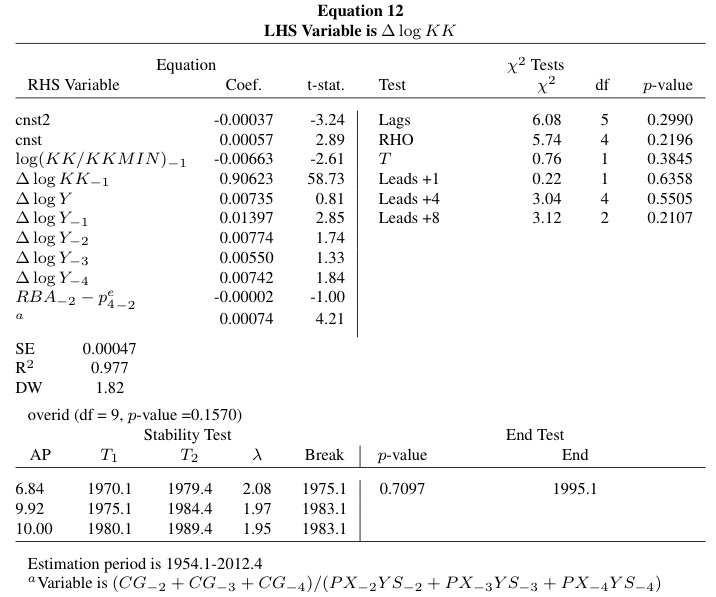
Once again I get to discuss on whether investment depends on 'animal spirits', Schumpeterian entrepreneurialism or other confidence fairies. The evidence, as I noted here before, is quite overwhelming in favor of a simple and logical empirical regularity, namely: the accelerator. Below the last results from the Fair Model.
KK is the capital stock, RBA is the bond rate, and Y is income. Note that the coefficient on bond interests is insignificant, both statistically and in economic terms. What drives the change in the capital stock are the contemporaneous and lagged changes in the levels of income (demand). This is not only in the data, but is also quite logical. It says that firms increase their capital stock when demand increases (note that firms have always some spare capacity, so they are looking for permanent increases in demand). If there is no increasing demand there is no need to invest.

Not a surprising result, unless you for some other reason need the Superman theory of investment, in which the firm, the entrepreneur, the job creator is the hero that will save humanity from its mediocrity [have you been reading Ayn Rand again?].

PS: Ray Fair model uses the old Cowles Commission approach to macroeconometrics, which is much better than the new Dynamic Stochastic General Equilibrium (DSGE) models, that rely more heavily on calibration rather than estimation. He discusses the issue here.

Sunday, December 16, 2012

Krugman and the natural rate again

Krugman again (re-channeling Hicks) restates his argument that the problem with the US economy is that the natural rate of interest is negative. Note that he also admits, as did recently Goldman Sachs or anybody that looks at data, that the accelerator is what determines investment. Not only his stance has serious logical problems, but also it weakens his own arguments about confidence fairies and so on. And there is no empirical evidence favoring the view that in any period, not just now, non residential investment is significantly affected by variations of the rate of interest. But yes we do need more fiscal expansion, even if lack of full employment is not simply a market failure.

PS: Note that Krugman's second graph, showing the equilibrium of I and S with a negative natural rate, implies that either we had a negative shock to I or a positive shock to S. That is, either a negative productivity shock or a change in preferences about present and future consumption. Real shocks. So what, now he is a Real Business Cycle (RBC) guy? Just drop the natural rate already. Evidence and logic require it.

Thursday, December 13, 2012

Goldman and Chinn discover the accelerator

Steve Bannister (where have you gone Joe Di Maggio?) pointed out this nice post by Menzie Chinn on the "puzzle" (sic) of the slow investment recovery during the crisis. Note that it is actually not a puzzle at all. Chinn cites a study by the Vampire-Squid (Goldman Sachs), that concludes that (wait for the surprise) "the accelerator model generally fits well." Chinn also finds that lending conditions and "slow GDP growth (attributable to fiscal drag) are important determinants of low nonresidential fixed investment." Is rain wet?

PS: Lending conditions (which is actually a measure of liquidity) might actually be caused by the level of activity and investment rather than the other way round.

Tuesday, September 25, 2012

Sraffa and the Confidence Fairy

Sraffa's views on macroeconomic issues are difficult to gather since he didn't directly write on the issue. However, there is some evidence that he believed in the accelerator, that is, the idea that investment is induced demand, depending on variations of the level of income. Franklin Serrano points out the following passage in a paper by Terenzio Cozzi (my translation, so remember that in this case it is true that il traduttore è un traditore):
“In the spring of 1963 or in the fall of 1964, I asked Sraffa why he had chosen to take as a given, not the real wage, but the rate of profit, and had suggested that the level of the latter could be influenced in particular by the monetary rate of interest. He replied that in the past entrepreneurs, in deciding how much to invest, were strongly influenced by the general state of economy and how the level of activity evolved in recent periods. At the first sign of a decline in production levels, they decided to stop investing. Now, however – we are in 63 or 64 – the entrepreneurs expect that the authorities will still be able to adjust the performance of the system back to its normal growth path. Even bankers think in this way. That's why the interest rate is an indicator of the normal rate of profit. And that's also why the fluctuations of the past are no more, and economic growth is stabler.” Terenzio Cozzi (1986), “Un teoria con un grado di libertà,” in Riccardo Bellofiore (a cura di) Tra teoria economica e grande cultura europea: Piero Sraffa, Franco Angeli, Milano, p. 208.
In the original:
“Nella primavera del 1963 o nell' autunno del 1964, ho chiesto a Sraffa come mai egli avesso preferito assumere come dato, non il tasso di salario, ma il tasso di profitto e avesse sostenoto que che il livello de quest'ultimo poteva essere influenziato in particolare dai livelli dei tassi dell' interesse monetario. Mi rispose che nel passato gli imprenditori , nel decidere quanto investire, erano fortemente influenziati dall' andamento generali dell' economia e da come si erano manifestati questi andamenti nei periodi ricenti. Al primo accenno di caduta di livelli produttivi, decidevano bloccare gli investimenti. Attualmente invece - siamo nel 63' o 64' - essi si aspettano che la autorità saranno comunque in grado di regolare l' andamento del sistema riportandolo in condizioni di crescita normale. Si aspettano, quindi, che la redditività dei loro investimenti tornerà rapidamente al livello normale. Anche i banchieri ragionano in questo modo. Ecco perché i tassi di interesse rappresentano un indicatori del tasso di profitto normale. Ed ecco perché questo non ha piu' le oscillazioni del passato, e cosi la crescita del sistema è piu' stabile.”
No doubt that Sraffa didn't believe in confidence fairies.

Thursday, June 21, 2012

And here's to you, Mrs Robinson


Jesus loves you more than you will know (wo, wo, wo) ...I know, but I was going to talk about the other Mrs Robsinson, Joan Violet (née Maurice), the main disciple of Keynes,* as I had promised in a previous post. Joan Robinson's contributions to economics demand several posts. She has participated, as Maria Cristina Marcuzzo noted, in three Revolutions, namely: the imperfect competition, the Keynesian and the capital debates ones.

And to reduce her to those three one has to fit her contributions to growth theory into a subcategory of either the Keynesian Revolution (the extension of the Principle of Effective Demand to the long run) or the capital debates (the critique of mainstream growth theory), and omit her various other contributions to monetary theory (e.g. endogenous money and the circuit), methodology (e.g. history vs. equilibrium), Marxist economics and so on. She was prolific for sure.

There are several great reviews of her contributions in all of them, which would make my post irrelevant. But what I want to discuss is the point raised in Sergio Cesaratto’s presentation, that in the last one of those revolutions her contributions might have been seen as negative. In his exposition Sergio emphasized quite correctly her rejection, at least in certain contributions, of the notion of long term normal equilibrium positions, and, hence, the traditional method of economics.

This was done, for the most part, to emphasize the notion that history matters and that path dependency was important, since the process of reaching the equilibrium would affect the equilibrium itself. Arguably, the role of uncertainty, following Keynes and some post-Keynesians, played a role in her rejection of normal equilibrium positions.

Path-dependency is indeed an important feature of real economies, and Robinson was quite right in emphasizing its relevance.++ However, the fact that the normal or long run equilibrium positions might depend on the initial conditions and on the trajectory to its final position would render the very notion of equilibrium irrelevant for the analysis of real historical situations might not be granted.

In her view, the notion of equilibrium originated from a misleading mechanical analogy with movements in space, and shouldn’t be applied to movements in time.  However, nothing suggests that the long run position of equilibrium cannot be path dependent and actually represented by an equilibrium position. Let me suggest that the idea of the supermultiplier is, for example, a case in point. Output depends on the autonomous components of demand, and investment, as derived demand, behaves in a way which leads to the adjustment of capacity (supply conditions) to demand.  It is an equilibrating process, but not a unique one, or one that leads to a determinate path of accumulation, since alternative initial conditions (e.g. sizes of the relevant coefficients) lead to different outcomes.  Also, changes in several factors can affect the trajectory by which capacity adjusts to demand.

Further, uncertainty, or true, fundamental and non-probabilistic uncertainty was also a relevant component of Robinson’s critique of equilibrium positions. Uncertainty also suggests that historical processes are complex and could not be reduced to equilibrium analysis. This was also in line with the post-Keynesian developments in the 1970s, by Paul Davidson and others, that suggested that uncertainty was central for Keynes understanding of the functioning of the economy.

That is again true. Uncertainty was important for Keynes, and is central in the functioning of real economies. However, uncertainty does not preclude the use of equilibrium. Uncertainty implies that agents use conventions, rules of thumb in order to make decisions. In an uncertain world agents stick to social norms, and even if there is significant uncertainty on an individual basis, the institutional framework tends to reduce uncertainty. In that sense, for example, the New Deal reforms decreased to a great extent the degree of uncertainty in the functioning of the economy, and guaranteed a high degree of stability to workers.  Another example of how institutional framework would reduce uncertainty is the use of capital controls (and fixed but adjustable exchange rates) to reduce the pressures on interest rates during the Bretton Woods era. With that framework, fiscal expansion with low real rates of interest produced a normal equilibrium with low unemployment level. In other words, nothing implies that uncertainty suggests that the multiplier and accelerator processes are not operational or that normal positions of equilibrium cannot be achieved.

In my view, the two main problems to Joan Robinson’s critique of the equilibrium method in the latter part of her career are that, on the one hand, by emphasizing the independence of the investment function and of uncertainty it led to the development of a set of models (later incorrectly referred to as Kaleckian) that bring back the entrepreneur as the central figure in economic growth (the so-called profit-led regimes). On the other, and even more problematic, it took place at the same time that (as noted by Garegnani) the mainstream rejected the old notion of long term equilibrium, and started to use dominantly the intertemporal models (this ones in fact terrible mechanical analogies to movement in space).

The old classical (and indeed even the old Marshallian) notion of normal positions, which allowed for historical contingency and path dependency was abandoned by the mainstream, but that was seen by several heterodox authors as an improvement because now mainstream models were ‘capable’ of incorporating multiple equilibria and instability. In fact, Keynes point was that normal situations (and hence stable equilibrium positions) in capitalism were sub-optimal. And Joan Robinson, at least in part, is responsible for some of those heterodox (very confused) views of the development of the mainstream.


* Richard Kahn would be the other candidate, but his contributions to the Keynesian Revolution were considerably less visible, if admittedly incredibly important, with the formalization of the multiplier on the top of the list. Kalecki and Kaldor, although quintessential Keynesians, were not disciples of Keynes in a direct way, and Sraffa, although personally close, and contrary to what some think, very favorable to the idea of effective demand, was not a disciple proper either.

++ Note that path-dependency is not exactly the same as hysteresis, a point raised by Mark Setterfield. I’ll expand on this on another post.

PS: A paper in which some of the pros and cons of Robinson's approach to economics, in particular on money and growth, is available here (subscription required).

Wednesday, May 4, 2011

More on income distribution and growth (wonskish)

Kaldor and Kalecki

A few years back Sam Bowles presented a paper (Kudunomics: Property rights for the information-based economy) at the University of Utah. At dinner he reaffirmed his conviction that Arrow-Debreu General Equilibrium (GE) is compatible with different kinds of behavior and can be a force for progressive economics. Conventional marginalist theory suggests that income distribution is the result of relative scarcities, and, as a result, real wages should equal the marginal product of labor, i.e. labor productivity. When asked how he squares the belief in GE with the fact that wages in the US do NOT follow productivity since the 1970s, Bowles seemed puzzled. And the relation of income distribution and growth remains puzzling for the mainstream and its sycophants.

In the heterodox camp, the discussion has been centered, for the most part, between the so-called Kaleckian and Kaldorian models. First, I should note that from a history of ideas point, the Kaleckian name is a misnomer. Kalecki’s models where about the interaction of multiplier and accelerator, with shocks and lags, to produce fluctuations. In the various forms of his accelerator equation Kalecki included a trend, producing fluctuations around a trend. The so-called Kaleckian models derive from Harrod and Joan Robinson’s attempts to extent Keynes’ Principle of Effective Demand (PED) to the long run.

The PED says that an increase in investment is matched by an exact increase in savings, and that the level of income is the main adjusting variable (rather than the interest rate as in the Loanable Theory of Funds). The Kaleckian models basically normalize the IS identity by the capital stock, assume (in the extreme case) that the propensity to save out of wages is zero, and a propensity to save out of profits (s) between zero and one, and in Keynesian fashion have investment determine savings. The difference with the short-run story is that now accumulation (investment-to-capital ratio) determines income distribution (the rate of profits), a result often referred to as the Cambridge equation.

The various incarnations of the Kaleckian models are defined by the way the investment function is specified. For example, in the influential paper by Bhaduri and Marglin (B-M) (subscription required) they argue that investment and savings are functions of the profit share (h) and capacity utilization (z). In other words:

I(h, z) = shz

Solving for z and deriving with respect to h we have:

dz/dh = (Ih – sz)/(sh – Iz)

Where Ih is the response of investment to profitability and Iz to capacity utilization. Assuming stability, that is, that savings respond to profitability more than investment to capacity utilization and the denominator is positive, the sign of the equation depends on the numerator. If investment is strongly responsive to profitability (Ih > sz), then the system is profit-led (exhilarationist in B-M terms). If not we have the wage-led (stagnationist) regime.

As I suggested in my previous post, there are some theoretical problems with the type of model used to argue that the US economy is profit-led, besides the empirical ones alluded before. The independent investment function suggests that capacity utilization affects capital formation, if capacity is low there is more investment, and vice versa when z is high. In other words, firms would try to adjust capacity to demand. If that is the case you would expect that a normal relation between capacity and demand would be established in the long run (in the neoclassical view demand adjusts to capacity; that’s Say’s Law), which could be seen as the relatively stable output-to-capital ratio over the whole period for the US, in my previous post.

If that is the case, investment is determined by the adjustment of capacity to exogenous demand in order to reach the normal capacity utilization, and it is essentially derived demand (the accelerator principle). It is not instrumental in determining the normal level of capacity utilization, which must be determined by the exogenous components of demand. This is the basis of the supermultiplier models, first developed by Hicks, and then by Nicholas Kaldor, and referred to as Kaldorian in the heterodox literature (for more on that see this paper).

That is the essential difference between the Kaleckian and Kaldorian models, whether investment is partially autonomous and determined by profitability or it is derived demand. Of course income distribution in Kaldorian models might have ambiguous effects on growth, but firms would not investment more if profits went up, if there is no increase in demand. In this sense, worsening income distribution might lead to higher growth if demand keeps going for some reason (say more private debt stimulates consumption; or stimulates the consumption of a higher income group). But in general profit-led growth that stimulates investment, as in the M-B framework seems hard to explain from a theoretical point of view. Hence, the confusion it generates empirically (e.g. in the case of the US the notion that a debt-led consumption boom is a profit-led story).

PS: The typical Kaldorian model is based on Thirlwall's work, but the book by Bortis and Serrano's dissertation (or his paper; subscription required) are essential readings.

Monday, May 2, 2011

Is the American economy profit-led?


In a recent post I showed the evolution of real wages and long-term real rates of interest in the United States from 1950 until now. The figure below shows the real rate of output (GDP) growth for the same period. Between 1950 and 1973 the average (red line) rate of growth was 4.2% and in the subsequent period it was 2.7%. In other words, the change in income distribution dynamics, with a significant slower rate of growth of wages, was accompanied by a significant reduction in the pace of economic growth (we also saw in the previous post that it also went hand in hand with higher real rates of interest).


Many authors (e.g. the late David Gordon), in particular when looking at the evidence post-1970s, argued that the American economy is profit-led. In other words, as profits (some emphasized profit shares while others prioritized profit rates; the profit rate time the level of capacity utilization gives the profit share) expanded, it stimulated investment, and this, in turn, led to output growth. Growth was driven by profits.

The idea is that, even though the reduction in wages has a negative effect on consumption and output growth, this is more than compensated by the increase in investment. However, there are some empirical problems (there are some theoretical issues that I’ll deal with in another post) with this kind of model (often referred to as Kaleckian, even though it seems that their origin should be traced to Joan Robinson’s Accumulation of Capital and the influential formalization by Bob Rowthorn in the early 1980s).

For starters, growth actually fell significantly after real wages stagnated. Also, the output-to-capital ratio (shown from 1960 to 2008 using a OECD measure), as can be seen in the graph below, does not indicate a marked shift in the 1970s. The output-to-capital ratio goes up in the Johnson and Clinton booms, and falls otherwise. The Reagan boom was mild at best. This is consistent with the accelerator. As the economy moves closer to full employment, the output-to-capital ratio, a proxy for capacity utilization, moves close to its maximum. The accelerator would suggest that investment adjusts capacity to output. Investment is not the locomotive of the system, is the rear car (the idea behind the accelerator principle).


Since the 1970s the drivers of accumulation in the United States have been consumption booms driven by debt accumulation. In other words, as Barba and Pivetti have argued, increasing debt has allowed American families to continue to consume, in spite of stagnated wages. This has been mistaken in the empirical literature as a profit-led boom. The suggestion here is that the booms have continued to be driven by consumption (as in more traditional wage-led cases), and that the benefits for capital have been financial and associated to higher interest rates. The last three booms have been more Wall Street debt-led booms, rather than profit-led investment booms. Wall Street, not the Silicon Valley, defines the current American economy. After all, we all remember Gordon Gekko’s “greed is good” (uttered in real life by Ivan Boesky) and nobody remembers an iconic phrase by Bill Gates!

Tuesday, March 29, 2011

Striking inanity

Mankiw thinks that the scatterplot below is striking. He should read an intro textbook (I imagine even his text presents the simple Keynesian model).


What drives both is the expansion of autonomous demand. Demand increases output, and as per Okun’s Law reduces unemployment. Investment follows the accelerator, that is, as output increases firm’s investment also increases to maintain the relation between productive capacity and income. How is this striking?