I said it before, but it's worth repeating when one discusses the so-called Lucas' Critique and microfoundations. Lucas and the New Classical Rational Expectations (and RBC) School are the intelligent design of economics. In their view, markets work and this must be the result of some sort of high power, with which mere mortals and governments should not interfere. Lucas and his followers should have the same status as defenders of intelligent design in the scientific community (for the original claim go
here).
If you have any doubts go check his paper on what should be the priorities of macroeconomic research just a few years before the crisis
(Lucas, 2003), when several heterodox economists had already warned about a bubble and impending crisis. In his own words:
"My thesis in this lecture is that macroeconomics in this original sense has succeeded: Its central problem of depression-prevention has been solved, for all practical purposes, and has in fact been solved for many decades. There remain important gains in welfare from better fiscal policies, but I argue that these are gains from providing people with better incentives to work and to save, not from better fine tuning of spending flows."
Yes, business cycles problems have been solved, and there is no need for counter-cyclical fiscal policy. And this guy got the Sveriges Riksbank Prize, sometimes referred to as the Nobel!
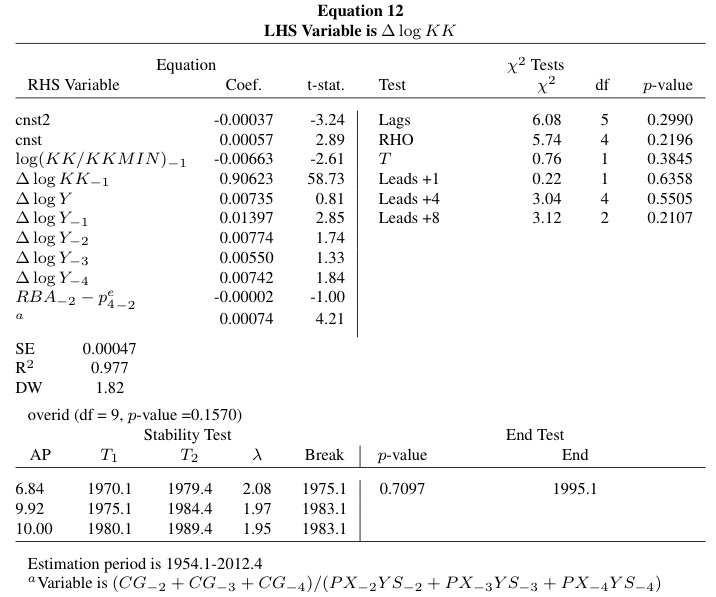
But the point I wanted to make really is that there is less than meets the eye to the so-called Lucas' critique. The problem for Lucas was that the parameters of macroeconometric models (mostly of the Cowles Commission, CC, or the Cambridge-Levy stock flow with coherent accounting, SFCA, types) were not invariant to policy changes, and could not, in fact, be taken as parameters. Even if you take the neoclassical/marginalist approach seriously (meaning forget its logical problems revealed by the capital debates), as noted by
Ray Fair (2012) (one of the last defenders of the CC approach within the mainstream):
"The Lucas (1976) critique says that the coefficients may not be stable if they are based on expectations that change over time or change when a new policy regime replaces an old one. This problem is part of the larger problem of potential coefficient instability, and it may not be the most serious. If expectations are not rational or if regimes do not change very often or by very much, any instability caused by Lucas-critique related issues may be small relative to instabilities caused by other things, like the changing age distribution of the population."
The fact, is that parameters are to a great extent invariant to policy changes, and there are a lot of parametrical regularities in macroeconomics, e.g. Okun's Law, Houthakker-Magee effect, or relations with changes in size that are not dramatic, like the size of fiscal multipliers, accelerator coefficients and pass-through effects, for example. And you can go on, for example, it's not a new thing that expansionary fiscal policy and higher debt levels have almost no impact on interest rates, that is, also, a fairly established macro regularity. That is why one can talk about macroeconomic stylized facts.
And it should be no surprise then, that models that do not use the mainstream assumptions of reversion to mean (to the optimal levels, by the way, the reason why Lucas thought cycles were solved and no macro policies where needed), and that depend on the macro accounting and the proper Keynesian causalities fared better during the last crisis (see
here).