Showing posts with label DSGE. Show all posts

Monday, February 1, 2016

Simon Wren-Lewis on New Classical Economics and the Financial Crisis

New paper by Wren-Lewis titled "Unravelling the New Classical Counter Revolution." It provides a strong New Keynesian critique of the New Classical/Real Business Cycle schools. He argues, correctly in my view, that the problem is the abandoning of the Keynesian method of analysis. I'm less keen on microfoundations. Or at least on marginalist microfoundations. But it is important to understand how much the fundamentalist views of Lucas and Prescott have affected the profession.

From the abstract:
To understand the position of Keynes's The General Theory today, and why so many policy-makers felt they had to go back to it to understand the Great Recession, we need to understand the New Classical Counter Revolution (NCCR), and why it was so successful. This revolution can be seen as having two strands. The first, which attempted to replace Keynesian policy, failed. The second, which was to change the way academic macroeconomics was done, was successful. Before the NCCR, macroeconomics was an intensely empirical discipline: something made possible by the developments in statistics and econometrics inspired by The General Theory. After the NCCR and its emphasis on microfoundations, it became much more deductive. 
As a result, most academic macroeconomists today would see the foundation of their discipline as not coming from The General Theory, but as coming from basic microeconomic theory – arguably the ‘classical theory’ that Keynes was so keen to cast aside. Students are also taught that pre-NCCR methods of analysing the economy are fatally flawed, and that simulating DSGE models is the only proper way of doing policy analysis. This is simply wrong. The problem with the NCCR was not the emergence of microfoundations modelling, which is a progressive research programme, but that it discouraged the methods of analysis that had flourished after The General Theory. I argue that, had there been more academic interest in these alternative forms of analysis, the discipline would have been better prepared ahead of the financial crisis.
Read the whole paper here

Wednesday, July 22, 2015

Who is the real revolutionary figure in modern macro, Friedman or Lucas?

Who's your daddy?

Just finished my summer macro class (last Friday actually; grades were due Monday). One of the things that always becomes important in the course is how to define the break between Keynes, or at least Keynes and the Old Neoclassical Synthesis, on the one hand, and Friedman and Lucas, in the case of the latter both the New Classical models (monetary misperception) and Real Business Cycle (RBC) models, on the other. Many authors suggest that Lucas should be considered, after Keynes himself, the great scientific revolutionary, and that Friedman's break is incomplete. It is the implicit view in Alessandro Vercelli's book  Methodological Foundations of Macroeconomics: Keynes After Lucas or explicitly in the more recent book by Michel De Vroey's Keynes, Lucas, d'une macroéconomie à l'autre.

The reasons adduced are associated to Friedman's model, which remains in many respects similar to the Neoclassical Synthesis one, that is, an ISLM with a Phillips Curve (PC) with gradual adjustment to the equilibrium position. In one sense it is true that in Lucas' equilibrium model endogenous variables are determined on the basis of real phenomenon, technology, preferences, and factor endowments. The model, which was further developed by RBC authors, emphasizes the intertemporal choices of between leisure and consumption, and the fact that production takes time, and requires inputs over several periods, and has led many to label it Walrasian, in contrast to the supposedly Marshallian model used by Friedman and the Neoclassical Synthesis Keynesians. The other significant difference is that stochastic processes, rather than deterministic ones, become relevant, and Dynamic Stochastic General Equilibrium (DSGE) became dominant [more on that in another post; issues have been dealt to some extent here].

Traditionally a Walrasian model is a General Equilibrium (GE) one, while a Marshallian model represents partial equilibrium. In that sense, the label is a bit of a misnomer, since the ISLM cum Phillips Curve model behind the Friedman’s aggregate demand and aggregate supply model is also a GE model. The Neoclassical Synthesis model solves for the simultaneous equilibrium of the goods, labor, money and bond markets. What Friedman added explicitly is the natural rate. The supply constraint.

The difference between Friedman and Lucas is really that in the Neoclassical Synthesis and Monetarist models some behavior is not derived from intertemporal maximization of individual agents, while that is not true in the RBC models. That should be seen not as a Walrasian feature, but as a result of the abandonment of the Principle of Effective Demand (PED), and the use of a Ramsey Intertemporal model to determine consumption. That is, a dynamic version of Say's Law. In that sense, like the New Classical School, the fundamental change, in this context, is that the equilibration between savings and investment is done by changes in the rate of interest, not income, and that only rigidities would deviate investment from full employment savings.

On the basis of these changes, it is hard to say that Lucas is the more revolutionary figure in modern macro. True, in Lucas framework, the main Monetarist conclusions are less effective or irrelevant. Only unanticipated monetary shocks have effects, and those are strange things to conceive. When shocks are anticipated, monetary shocks have no effects. However, when forced to discuss the Great Depression, Lucas admits that there is little evidence for the RBC view.

Lucas asks: “where is the productivity shock that cuts output in half in that period? Is it a flood or a hurricane? If it really happened, shouldn’t we be able to see it in the data?”* Lucas, even though he has accepted that most cycles are explained by productivity shocks remains convinced that the Great Depression resulted from a monetary contraction by the Fed, as in the Monetarist views of Friedman. And one wonders why that monetary contraction was unanticipated.

Also, even if more extreme, the results do not change the situation in the long run. That is, for Friedman too in the long run (anticipated or not) monetary shocks have no effects. The crucial theoretical variable is the natural rate.

In this sense, it seems that Friedman, and the return of the natural rate of unemployment, and implicitly the interest and output ones too, is crucial for explaining the return of the pre-Keynesian Wicksellian framework that is dominant with the New Macroeconomics Consensus (NMC). Even if Friedman had exogenous money, and a quantitative rule, rather than an interest one, and even if he believed in monetary shocks, rather than the real ones that Wicksell and modern macroeconomists emphasize. Modern macro is neo-Wicksellian, but it owes that to Friedman, more than to Lucas.

* Cited in DeVroey and Pensieroso here.

Monday, June 23, 2014

ISLM, ISMP, DSGE and other models

From the Google Ngram Viewer.

Note that even though the ISLM is from 1937 (and yes it is in the GT, and Keynes did endorse Hicks formalization, as discussed here, and here), it is only in the 1970s that the term takes off. The ISMP, which substitutes a monetary policy rule for the LM, and includes as a result endogenous money into mainstream models (note again endogenous money is not central for heterodox models, since orthodox ones can incorporate it, as discussed here) takes over in the 2000s, as does the Dynamic Stochastic General Equilibrium models, in which the IS with a multiplier is substituted by a Ramsey model. So, given the trends, you should miss the good old ISLM indeed.

Tuesday, October 22, 2013

Lawrence Klein author of The Keynesian Revolution has passed away

Lawrence R. Klein (1920-2013)

Lawrence Klein, of Klein-Goldberger US econometric model fame, and author of The Keynesian Revolution (here the Google Books link), and winner of the Sveriges Riksbank Prize in Memory of Alfred Nobel in 1980, has passed away. Klein was a Neoclassical Synthesis Keynesian (often referred to as Old Keynesian now, to distinguish him from the New Keynesians) that made his contribution by developing the empirical applications of the Keynesian model for the US economy.

The seminal work was done in the late 1940s and early 1950s in the context of the Cowles Commission. His book An Econometric Model of the United States, 1929–1952 was further developed in 1955 with his co-author (Arthur Goldberger), published as An Econometric Model of the United States 1929–1952, introduced the celebrated Klein-Goldberger model. The Cowles Commission Model still lives in Ray Fair's macro-econometric model, that maintains essentially the same methodology, resisting to the Lucas critique and the Dynamic Stochastic General Equilibrium (DSGE) models of the Real Business Cycle School (RBC) and their New Keynesian alternatives.

It must be noted that in Klein's original model, expectations did not play a role, since it was complicated to incorporate those, interest rates did not have an impact on investment (basically adopting an accelerator) and that wealth effects (which allow for the Pigou effect, and the return to full employment) on consumption were also absent. So in a sense his model did differ, because of the need to adapt to economic data, from the theoretical versions of the Neoclassical Synthesis, and was closer to heterodox interpretations of Keynes.

Saturday, March 23, 2013

Dude seriously, it's the accelerator

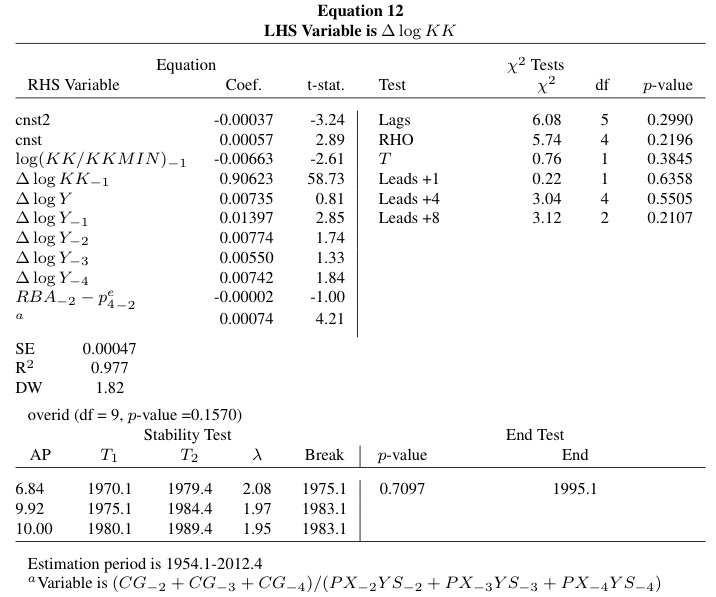
Once again I get to discuss on whether investment depends on 'animal spirits', Schumpeterian entrepreneurialism or other confidence fairies. The evidence, as I noted here before, is quite overwhelming in favor of a simple and logical empirical regularity, namely: the accelerator. Below the last results from the Fair Model.
KK is the capital stock, RBA is the bond rate, and Y is income. Note that the coefficient on bond interests is insignificant, both statistically and in economic terms. What drives the change in the capital stock are the contemporaneous and lagged changes in the levels of income (demand). This is not only in the data, but is also quite logical. It says that firms increase their capital stock when demand increases (note that firms have always some spare capacity, so they are looking for permanent increases in demand). If there is no increasing demand there is no need to invest.

Not a surprising result, unless you for some other reason need the Superman theory of investment, in which the firm, the entrepreneur, the job creator is the hero that will save humanity from its mediocrity [have you been reading Ayn Rand again?].

PS: Ray Fair model uses the old Cowles Commission approach to macroeconometrics, which is much better than the new Dynamic Stochastic General Equilibrium (DSGE) models, that rely more heavily on calibration rather than estimation. He discusses the issue here.

Friday, December 21, 2012

On the state of macroeconomics: fashion versus logic and evidence

Yes there is something rotten in the kingdom of Denmark, and it is macroeconomics; pretty much as in every other country. There has been an ongoing debate on the blogosphere on the topic (see Krugman, Smith, Thoma, Williamson and Wren-Lewis, not in chronological order, by the way). The New Classical versus New Keynesian debate tends to be on two issues the relevance of microfoundations on the theoretical level, and the importance of price rigidities on the empirical side.

Scientists, as Mankiw put it, are the New Classicals that emphasize the microfundations. They have intertemporal maximization models based on rational representative agents. The New Keynesians are the engineers, again using Mankiw's dichotomy, that strive for economic realism. Or so is what you are expected to believe if you read their posts. Of course all of these presumptions are bogus.

Noah Smith correctly points out that they all use the same DSGE models. But Krugman notes that on policy debates the whole difference is based on the assumption of sticky prices. So they use the same models, but reach very different conclusions. Of course the tools are not neutral though. Using DSGE models has hurt the positions that New Keynesian want to take. For example, Krugman has been forced to argue that the reason for the poor recovery is that the natural rate of interest is negative (and hence the current rate is too high to bring investment and savings into equilibrium).

This is a much weaker position than the one taken by heterodox authors that suggest that the crisis is due to lack of demand associated to worsening income distribution over the last three decades, and the consequent expansion of unsustainable private debt to allow for consumption. So the poor recovery is associated to lack of demand, since wages are stagnant and private debt cannot increase (and the GOP is bent in not allowing public demand to grow).

Note that the Godley type models, which follow the heterodox perspective, were much better for understanding and foreseeing the crisis (see here). There is no reason for intertemporal maximization models, and their kind of microeconomics (Sraffians have better stuff for that). New Classicals, Mankiw notwithstanding, are not scientists (or at least not good ones), since their models do have significant logical problems, and you cannot be a good engineer, somebody concerned with practical applications of scientific knowledge, if you share a model that is flawed.

On an interesting note, Krugman's main complain about Noah Smith's position is that he doesn't understand that the New Classicals have basically treated New Keynesians as outcasts. In his words:
"the freshwater [New Classical] types simply didn’t accept the legitimacy of what the New Keynesians were doing — in fact, didn’t even bother to read any of it, because anyone who actually worked with that kind of model would know that fiscal policy can indeed have an effect in that framework."
The problem is that they don't think he is legitimate. In fact, that is true. Williamson says:
"It doesn't surprise me that Paul Krugman isn't up on what is going on in macroeconomic research. Why should we expect him to go to macro conferences, spend time in seminars, and talk to his colleagues at Princeton? He has plenty on his plate, what with delivering two NYT columns per week, blogging, talking to pundits, and giving speeches. But if he's not up on the field, what purpose does it serve to make up outlandish stuff for people to read?"
Indeed Williamson's critique is that Krugman is not up to date, on the cutting edge, Colander would say. So he has missed the last fashion season in macroeconomics. And Wren-Lewis makes a point that he is a Karl Lagerfeld of macroeconomics (not sure if that is a correct fashion quote). Wren-Lewis points out that:
PK [yes, Paul Krugman] was very much at the forefront of analysing the Zero Lower Bound problem, before that problem hit most of the world. While many point to Mike Woodford’s Jackson Hole paper as being the intellectual inspiration behind recent changes at the Fed, the technical analysis can be found in Eggertsson and Woodford, 2003. That paper’s introduction first mentions Keynes, and then Krugman’s 1998 paper on Japan. Subsequently we have Eggertsson and Krugman (2010), which is part of a flourishing research programme that adds ‘financial frictions’ into the New Keynesian model. You would not think of suggesting that PK is out of touch unless you are in effect dismissing or marginalising this whole line of research.
So he is pretty much au courant, according to his New Keynesian friends (and that sounds right to me too, by the way). No fashion problem with Krugman and New Keynesians. They are trendy too. Good for them.

Yet, what it is expected of science is not fashion, but relevance following logic and evidence. And yes Krugman is right, there is evidence for price rigidity, and also no evidence for the sort of theory of distribution implicit in the mainstream neoclassical DSGE models (productivity equals remuneration of factors of production), or for a natural rate for that matter. And that is the problem with Krugman and his New Keynesian friends, too much preoccupation with fashion, not enough with logic and evidence. If the profession remains concerned with fashionable models it will continue to be irrelevant and impractical.

Saturday, July 28, 2012

A Critique of the Lucas Critique

The blogosphere, it seems recently, has been particularly rich in blogoyakking (sp?) concerning microfoundations. Wren-Lewis, Noah Smith, Krugman, Rowe, Plosser, and others just in the week prior to this post.

And this has caused a persistent itch of mine to clamor for scratching. Here goes.

The Lucas critique is fairly widely acknowledged to have at least exacerbated the trend toward insisting on microfoundations in macro theory, and thus the rise of New Keynesian Dynamic Stochastic General Equilibrium models. You know, representative agents showing rational expectations over generations, and all such things, reacting to policy changes. Which individual behaviors we can, more or less simply, just add up in order to understand the effects on the macro economy.

For those needing a brief review on "the" critique, Wikipedia is actually not bad, which I summarize. Lucas said:
"Given that the structure of an econometric model consists of optimal decision rules of economic agents, and that optimal decision rules vary systematically with changes in the structure of series relevant to the decision maker, it follows that any change in policy will systematically alter the structure of econometric models."
This is from his 1976 paper.

And the Wiki article summarizes the implications:
"The Lucas critique suggests that if we want to predict the effect of a policy experiment, we should model the "deep parameters" (relating to preferences, technology and resource constraints) that govern individual behavior. We can then predict what individuals will do, taking into account the change in policy, and then aggregate the individual decisions to calculate the macroeconomic effects of the policy change."
Thus, Bortis-style classical-Keynesianism was pretty much denuded: at best macro policy is effectively toothless, since that pesky agent will simply react to neutralize the policy actions;  and/or react so that the empirical regularities we were observing and making policy on will change. So we need to focus on micro and get that "right," the best we can do. The domination of Methodological Individualism on economic practice was on the rise.

I think Lucas got part of the diagnosis correct: individuals do react to macro policy changes but only indirectly. And he got most of it wrong. For the most part individual behaviors do not  directly change the  structure of the time series, but it is the change in the structure of the time series that changes individual behavior. Aggregate demand falls due to some shock - asset deflation, price shocks, war, pestilence, loss of income due to technology or offshoring. Producers then decrease output, and fire their workers.

This shock mechanism does induce individually optimizing behavior on the part of the business owner, given that what he optimizes is his profit function into which his production output enters.

For the newly unemployed person, since s/he no longer has a source of income, one can stretch and say that reducing consumption is individually optimizing at least of negative deviations from the budget. Of course this mechanism has it's own brutal zero lower bound - subsistence.  And does nothing to maximize utility.

Notice, no macro policy change is required here to start a recession or the recent depression; all we need is a sufficient shock to the system to start the negative feedback cycles rolling along.

We classical-Keynesian macroeconomists characterize these mechanisms as showing the fallacy of composition; the canonical principles of economics example is the paradox of thrift. You cannot use added-up individually optimizing behaviors to determine what is going to happen to the macro economy.

The reason is clear: emergent properties at the macro level have a life of their own. And its is these emergent properties like recessions and unemployment that directly affect the behavior of the economic person. I take here the strong version of emergent: a property or behavior at the aggregate level which cannot be observed or predicted at the individual level.

We do have methods that attempt to model this: the Keynesian aggregate expenditure model, but that is static. Dynamic macro econometric models, but those are difficult, and maybe it was because of these difficulties that the Lucas critique was so successful in attacking them.

I propose two things to restore the dominating importance of emergent macro properties on economic behavior. One is a recommitment to econometric modelling. Ever increasing data and increasingly better tools will continually improve modelling and forecasting results.

The other is a methodology that is vastly underused in economics, but widely used in various other sciences: network system analysis based on the mathematical theory of graphs. These methods lets us directly measure and model emergent dynamic behaviors from groups, like the individuals in an economy. No added up methodological individualism required; no agent-based model needed. Observe, model, and predict directly at the macro level.

While I believe empirical models, properly done, are fundamental to understanding and policy, network models provide us with a dynamic theory, emergent macro behaviors, that  support our correct Keynesian beliefs that it is the macro foundations of micro behavior that matter, not the other Lucasian way around.


Saturday, July 21, 2012

Stock-Flow with Consistent Accounting (SFCA) models


Gennaro Zezza, student and co-author of the late Wynne Godley and currently responsible for the Levy Institute macroeconomic model, gave an interesting talk on the usefulness of Stock-Flow with Consistent Accounting (SFCA) approach to macroeconomic modeling. He refers to the models as stock-flow consistent (SFC), but I prefer to emphasize that the consistency is not just about the relation between stocks and flows, but also the fact that these models provide the full set of accounts (website for those interested in this approach here).

SFCA proved to be considerably more successful than conventional, in particular Dynamic Stochastic General Equilibrium (DSGE) models, in predicting the Great Recession (see here paper by Dirk Bezemer).

As noted by Gennaro, the fundamental principle of SFCA models is that:
"in the economy – and therefore in models representing the economy - everything comes from somewhere and goes somewhere else: 'there are no black holes.' This obvious principle has relevant implications: one is that the debt of somebody is a credit for somebody else."
Note that this fundamental principle has more to do with the fully consistent accounting part of the model, than with the relation of stocks and flows. But stock-flow relations are also essential, since flow decisions of spending are tied to stocks. Private agents can spend if they have access to stocks of credit, of accumulated assets, that is, some stock of wealth. The State often has the power to spend and accumulate a stock of debt, since it can decide (Functional Finance and Chartalist approaches, which are implicit in Godley's work, become important here) the token in which debts are denominated.

One of the questions raised in the presentation was about the supposed lack of behavioral assumptions and expectations in the SFCA (as compared with DSGE models). First, it should be forcefully noted that there are behavioral assumptions, and those are strictly speaking based on Post-Keynesian (classical-Keynesian, I would say) principles. So agents autonomous decisions to spend create income, and in the models, I would add, investment follows an accelerator, so it tends to be derived demand, with the stock of capital adjusting to the flow of income (a relatively stable stock-flow relation, associated to the normal degree of capacity utilization).*

While DSGE models presume that an exogenous potential product (determined by supply side factors in a Ramsey/Solow/Lucas/Romer tradition) drives the economy, and deviations from it are corrected by price and wage flexibility, these models have an endogenous demand-driven output trend, which is really why they do better explaining the real world, including the Great Recession.

On the question of expectations Gennaro was clear, as a Post-Keynesian (PK) he is not particularly interested in expectations. He, however, suggested the possibility of using what Tom Palley refers to as model consistent expectations. That is, agents use expectations that are consistent with model (in this case the PK model, and, hence Lucas's problem is not that agents use all the available information, but that he has the incorrect model). Mind you the introduction of this expectational framework does little to improve the ability of the modeler to understand reality.

Finally, I want to note that while I do think that it is essential that these models, which are an alternative to applied DSGE models used around the world in Central Banks, international organizations, think tanks, and other institutions that managed to miss every single sign of the crisis, are developed and used more by economists, they should not be seen as the only modeling strategy available to heterodox economists.

In my view, the stock-flow and the demand driven (and I should say, the fact that price dynamics is orthogonal to the income flow determination structure)** is the essential characteristic of this approach. But the empirical, macroeconometric models that Gennaro and Wynne build have, more importantly, the full set of accounts, something that is essential for the empirical models, but sometimes too cumbersome for making a theoretical point. Hence, sometimes models that present the stock-flow dynamics (in a classical Keynesian perspective), without the full accounts (see here, for example), are necessary, useful and more directly relevant for the task of providing theoretical insight into a specific problem.

* This means that these are supermultiplier models in the Kaldorian tradition, which should not be a surprise since Wynne was a disciple of Kaldor. In fact, Kaldor was responsible for bringing Wynne to head the Department of Applied Economics at Cambridge in the late 1960s.
** Wynne was a student in Oxford of Andrews, one of the main authors of the Full Cost Pricing School.

Saturday, October 15, 2011

Sims is not Sargent


Below Steve's comment on Sims. Worth a whole post.

Chris Sims' classic 1980 paper "Macroeconomics and Reality" still echoes, or should, among macro model builders and macro econometricians. He could not possibly be clearer about the "incredible" restrictions that models often impose, and proposed a way forward, the VAR in its many forms.
That method has evolved to the point where, for example, good econometricians can recast a DSGE model in VAR form and see if it survives the data. Often they don't, a recent example being Peter Ireland's DSGE so soundly rejected by Katarina Juselius.
The rub is in the qualifier good. This is not easy stuff to do correctly. But its power is worth the sweat. Sims has been homaged over his prize by Mark Thoma here, and by Jim Hamilton, the time series bible author here.
A very favorite story is when Sims, Robert Litterman, and Thomas Doan, all either at the Minneapolis Fed or U of Minnesota in the 80's, "took on" their big models with a small VAR and outforecast them by a bunch. They soon left, maybe excommunicated? But Sims and Litterman at least landed on their feet...Litterman just retired as head statistician at Goldman Sachs. So the Sims triumph validates a reality first approach, meaning data before theory, and with the tools we now have and careful work, this method will become ever more influential in applied macro. Sims has also contributed to Bayesian approaches to macro modeling.
I totally miss the logic of the pairing with Sargent, but such is academic politics.
I agree.

PS: Links are there in the two here in Steve's post, and in the title of Sim's paper and Juselius name.

Thursday, February 17, 2011

ISLM: what is it good for?


The ISLM model persists in most undergraduate textbooks, and even though it has vanished from graduate courses*, it remains central to the way economists think about policy issues.  The main reason it survives is not so much that it allows a relatively simple intro to policy issues to undergrads, as some argue, but the fact that it captures the interaction between real and monetary phenomena which was central for Keynes’ General Theory (still worth reading), and is flexible enough to accommodate divergent views, often reflected in different inclinations of the curves.

It is also true that the conventional interpretation of the ISLM is fraught with problems.  But the ISLM model is incredibly flexible and can accommodate most critiques.  For example, a few years back a reader asked Mankiw why he still taught that the Fed controls money supply, rather than control the rate of interest, which would be more relevant.  His reply was not particularly good (just an ad for his book), but the fact remains that it is easy to change the LM to reflect the fact that central banks control the rate of interest.  The ISLM with a horizontal LM is sometimes referred to as the ISMP, where MP stands for monetary policy rule, and for the most part this is done for the benefit of students (i.e. you can buy the new text with the updated ISMP model for $150!).

The ISLM can also accommodate an investment function in which the level of activity, rather than the rate of interest, is central, which is more empirically accurate, and different consumption functions in which other elements besides disposable income appear.  More importantly the ISLM does not imply a natural rate of unemployment, which often appears in the supply side part of the macro course.  In other words, the ISLM allows for relevant discussion of policy issues, and clarification of policy differences.  Besides, compare this model with the consumption theory you get in micro, and this is still one of the most relevant things you can learn in economics.  The other would be not to trust economists!


* David Colander suggests that it’s not taught in graduate courses because more sophisticated dynamic stochastic general equilibrium models (DSGE) are more important.  DSGE models are based on the aggregation of individual maximizing behavior, and have been less relevant for policy analysis than old fashion macroeconometric models based on the old Keynesian theory.  The whole conference on the ISLM, in which you can find Colander’s paper is available here


.