Showing posts with label Income distribution. Show all posts

Friday, August 8, 2025

Rethinking the determination and long-run evolution of income distribution

New paper by Thomas Palley. From the abstract:

This paper presents a theory and model of long-run cycles in income inequality. The model explains the historical pattern of income distribution identified by Kuznets (1955) and Piketty (2014). It breaks with conventional marginal product theory which claims functional income distribution is determined by the technological conditions of production. Instead, it emphasizes the role of socio-political forces that shape and drive fluctuations in the level of popular political organizations, which then impact distribution. That impact includes assessment and attribution of productivity contributions. The model provides a framework for interpreting the historical evolution of income distribution and inequality, and for reflecting on current conditions and possible future developments. The core message is twofold. First, socio-political developments matter for income distribution. Second, if those developments are cyclical, income distribution will also exhibit cyclicality.

Read paper here.

Thursday, May 4, 2023

The problem with Keynes' General Theory: by Tom Palley


New working paper by Tom Palley. From the abstract:

Keynes' General Theory was a massive step forward relative to classical economics, but it was also a step backward in its denial of the conflictual nature of capitalism. There is need to understand Keynes' technical contributions regarding the workings of monetary economies, but also need to understand the flaws within his thinking and the consequences thereof. Keynes made a fundamental contribution elucidating the mechanism of effective demand, and he also has claim to be the preeminent monetary theorist. However, owing to his denial of conflict, he had a flawed view of capitalism which is why establishment Keynesianism struggles to explain contemporary stagnation. That flawed view also undermines the case for Social Democracy. Contrary to conventional wisdom, his view of capitalism is supportive of Neoliberalism and Keynes can be viewed as a compassionate (Third Way) Neoliberal.

In some ways this is the argument in Geoff Mann's In the Long Run We Are All Dead. I think one way of thinking about it is that Keynes' effective demand as a critique of marginalist (neoclassical) economics needs to be completed by old classical (political economy) ideas, which put the class conflict at the center of analysis. That of course is necessary for a policy break with neoliberalism.

Sunday, March 13, 2022

Some thoughts on inflation and what not to do about it

I have written extensively over the years on inflation and some of that is here in the blog (see this or this, or this more recently on Volcker the inflation dragon slayer, if you believe in fairy tales; there's way more if you search the blog; I also highly recommend this paper by Perry and Cline in ROKE, which is open, btw). My more recent piece on inflation came out recently in Catalyst, just before the war in Ukraine (on the war see this by Palley, and this old piece by Gary Leupp after the Crimean crisis in 2014), and the spike in oil, and foodstuff prices. But although this exacerbates things, the gist of my argument remains the same.

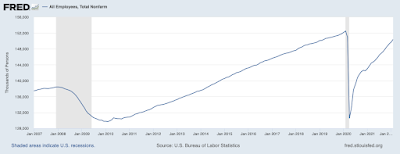
Inflation which had accelerated because of the supply constraints, and not because of the recovery or excess demand (sure the economy recovers fast in the US, but more than two million workers less are employed now than at the beginning of the pandemic; see figure below). It was all related to the pandemic and the problems in the supply chain, and logistic issues. Chips that affected the prices of cars, port and trucking issues, and even then energy prices that explained most of the increase (as I noted in my piece; see also the BLS report here).

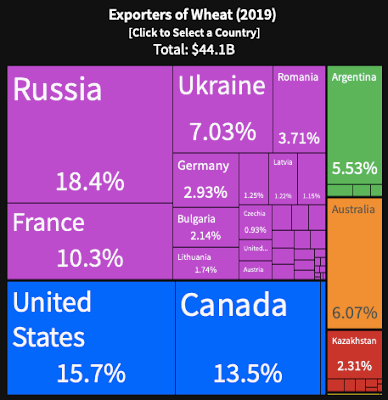
This is all now exacerbated because of the war in Ukraine, which, together with Russia, produces a significantly large amount of oil, natural gas, and key food commodities like wheat. For example, both countries supply about 25 percent of global exports of wheat.

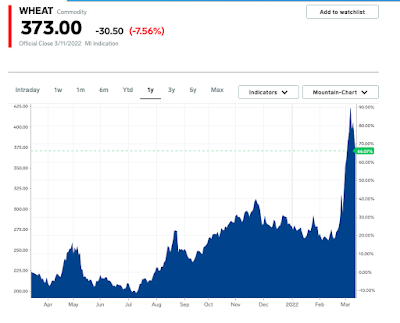
And wheat prices have certainly go up with the crisis (low point there before the spike is less than a month ago). Both energy and food are basic goods that entered in the production of everything, including themselves, and the implications of this are important.

Ricardian rent theory suggested that the extensive use of of lands of lower quality would increase the rent, squeeze profits and (given that wages for him were at subsistence, and accumulation depended on profits) lower accumulation. In this case the higher rents that oil producers, for example, would obtain would impact prices, and given the inability of workers in most places (including the US) to demand higher wages (blame it on years of lack of organization, decreasing unionization and so on, which are hard to reverse even in the current context of heightened mobilization as I suggested in the Catalyst piece), real wages will fall. So this would make the supply side effects of the crisis worse. Inflation will remain higher.

But as I noted in the paper, wage resistance, the propagation mechanism that fueled the distributive conflict back in the 1970s is dormant now, and nobody should expect high inflation (let alone hyper, which is a completely different story). Also, in principle the hike in prices should not have, any direct effect on growth. But the effects of inflation acceleration on the mood for more fiscal expansion in Washington will impact growth. And higher interest rates that are coming will impact too (although I think less) spending, and also cool down the housing market, and that will have effects on consumption too. So the likely effect is higher inflation and lower growth. Btw, in the piece I suggest that this is the return of the 70s, all with a victory of the GOP in the elections and with Biden playing the role of Carter (That 70s Show reunion).

So what to do about all this. Conservatives and orthodox economists have demanded fiscal and monetary restraint. That, of course would only work if inflation was demand driven. I won't say anything else here on that. It would be a waste of time. On the left there have been some alternative policies. Some suggested price controls (and don't get me wrong, I do think they can be effective, and were under certain circumstances, old post here). But price controls would require a bureaucracy capable of controlling prices, and an economy much more organized, and particularly one in which key parts of the supply chain are at home, like the planned economy during World War II, in order to work. This is not the case right now.

Anti-monopoly and regulation policies, which have also been floated by some progressives, are also not particularly useful. I won't go into the whole issue of what in Latin America we called the oligopolistic view of inflation (as I note in my piece the first Gilded Age was a period of deflation, and the this current Gilded Age had been, so far, one of a Great Moderation), but even if you assumed that regulation could do something, the timing would be too long to have any significant short term effect.

Some MMTers have suggested that a Jobs Guarantee (JG) is the way to stop inflation, and while I'm for a JG for employment security reasons, I'm very skeptical about its relevance for price stability (my general views on MMT and inflation in this long post here). The main idea is to control wage increases, but again those will be in the medium term subdued, in my view, and the distributive conflict will not spark a price-wage spiral like in the 70s.

The US will use its oil reserves, and will use its power to try to manage production by OPEC countries, not just Saudi Arabia, but even Venezuela (a mission already went and visited Maduro, and not Guaidó, not surprisingly). And this efforts will probably to some degree contain what could be an even worse increase in global prices.

As it turns out I think that in the short run there is little that can be done. Inflation will remain higher. Not high inflation, but higher than the very low that we experienced for the last 30 or 40 years in advanced economies. The problem is not inflation, but the fact that real wages will fall, and that this will be used as an excuse for contractionary policies. Also, in some parts of the world this would lead to food shortages, and heightened social conflicts. This is inevitable to some extent, and the result of higher prices for basic goods, which do affect distribution as noted by Ricardo (in his case a squeeze of profits). The question that nobody asks is what is the problem with 8 percent annual inflation if real wages kept up with it. There's no evidence that it would affect growth, and in order to have some impact and disorganize relative prices seriously it would have to be much, much higher (classic paper on that by Bruno and Easterly here). Essentially the best thing that can be done is not much, but that is not in the cards.

Tuesday, August 8, 2017

The wage share in Argentina

In his book, Estudios de Historia Económica Argentina, Eduardo Basualdo has several tables with the data for the share of wages in income. Sources seem to be different and not necessarily compatible (although I 'm not sure about that). He also published a paper in 2008 with additional data. The graph below adds the numbers shown here, which I think are also from Basualdo (the newspaper only cites CIFRA; I couldn't find another source in their website).
To the extent that one can trust numbers on functional income distribution, these numbers give a reasonable picture of what happened in Argentina since the first Peronist government back in 1946. It is clear that the military coup in 1976 was implemented to reduce the share of wages. The graph also puts in perspective the last progressive administration of the Kirchners, which brought wages up from very low levels, but not quite to the pre-1976 level. I would expect the decline with Macri, that seems to have started (as I predicted), will go considerably further.

Monday, November 7, 2016

Latin America at a Crossroads

New paper by Carlos Medeiros, with Nicholas Trebat, at the Centro Sraffa (h/t Alejandro Fiorito, and Revista Circus). From the abstract:
This paper discusses the connections established in recent non–neoclassical literature between growth, structural change and income distribution in large developing economies. We argue that though many analyses have the merit of reintroducing income distribution as a factor in economic growth, they rely almost exclusively on macroeconomic theory, and thus ignore the structural changes that have taken place in recent decades and the ways in which structural aspects of an economy (such as resource availability, market size and geopolitical factors) affect policy options and growth. We argue that Latin American countries today face the same challenge that has constrained their development trajectory historically: to diversify their economic structure through new technological capabilities and greater equality and social progress.
Download paper here. 

Friday, April 8, 2016

A Brief Sketch of the Classical-Keynesian Perspective


By David Fields

From a Classical-Keynesian perspective (Bortis, 1997, 2003), rates of interest regulate rates of profits (Panico, 1980, 1985), and, thus, real wages are endogenously determined. The presence of financial instruments, which represent titles to future flows of income, makes it so that the actual center of distributive conflict in capitalism lies not in the technical conditions of production, but is rather governed by the real rate of interest, which is a conventionally-determined exogenous variable that reflects the relative powers of finance capitalists vis-à-vis industrial capitalists & labour (Pivetti, 1985, 1991, 2001).
The rate of profit, as a ratio, has a significance, which is independent of any prices, and can well be ‘given’ before the prices are fixed. It is accordingly susceptible of being determined from outside the system of production, in particular by the level of money rates of interest. (Sraffa, 1960: 33)
In this sense, high real rates of interests induce industrial capitalists to prefer short-term speculative financial investment, instead of long-term productive real investment, since access to credit is expensive. Consequentially, industrial capitalists center attention on the pursuit of immediate surplus value realization, via speculation, in order to handle the burden of costly interest payments—the social cost being nominal wage suppression, which, by implication, exhibits an enlargement of the reserve army of labour.
[…] the credit system, which has its focus in the so-called national banks and the big money-lenders and usurers surrounding them, constitutes enormous centralisation, and gives this class of parasites the fabulous power, not only to periodically despoil industrial capitalists, but also to interfere in actual production in a most dangerous manner— and this gang knows nothing about production and has nothing to do with it. (Marx 1894: 544-45)
Along these lines, heterodox growth and distribution models have been put forward (cf. Hein, 2008), highlighting the need for a redistribution of income from finance/industrial capitalists to labour (Lavoie and Seccareccia, 1999) and making unemployment the primary policy target (Smithin, 2004). Underpinning these models are works that incorporate Keynes’ principle of effective demand and Sraffian price theory in a long-period analysis of capital accumulation (Park, n.d.; Cesaratto et al. 2003). These studies pay considerable attention to the extent to which the Hicksian supermultiplier concept effectively explicates the degree to which induced consumption and investment, via the accelerator, determine average levels of total output (Serrano, 1995) and, thus, normal capacity utilization (Amadeo, 1986; Trezzini, 1998), with the richness of a framework inspired by Kaldor and Pasinetti (Docherty, 2012) that meticulously constitutes the palpability of Kalecki’s famous aphorism that ‘capitalists get what they spend…workers spend what they get’.

Originally published in the URPE blog.

References:

Amadeo, Edward J. 1986. “Notes on Capacity Utilisation, Distribution and Accumulation.” Contributions to Political Economy 5(1):83–94.

Bortis, Heinrich. 1997. Institutions, Behaviour and Economic Theory: A Contribution to Classical-Keynesian Political Economy. Cambridge: Cambridge University Press.

Bortis, Heinrich. 2003. “Keynes and the Classics: Notes on the Monetary Theory of Production.” In Modern Theories of Money: The Nature and Role of Money in Capitalist Economies, (eds.) Louis-Philippe Rochon and Sergio Rossi. Cheltenham, UK: Edward Elgar.

Cesaratto, Sergio, Franklin Serrano, and Antonella Stirati. 2003. “Technical Change, Effective Demand and Employment.” Review of Political Economy 15(1):33.

Docherty, Peter. 2012. “Long Period Interest Rate Rules in a Demand-Led Kaldor-Pasinetti-Sraffa-Keynes Growth Model.” Journal of Post Keynesian Economics 34(3):521–46.

Hein, Eckhard. 2008. Money, Distribution Conflict and Capital Accumulation: Contributions to 'Monetary Analysis'. Basingstoke: Palgrave Macmillan.

Kalecki, Michal. 1971. Selected Essays on The Dynamics of the Capitalist Economy 1933-1970. Cambridge: Cambridge University Press

Kaldor, Nicholas. 1955. “Alternative Theories of Distribution.” The Review of Economic Studies 23(2):83–100.

Kaldor, Nicholas. 1966. “Marginal Productivity and the Macro-Economic Theories of Distribution: Comment on Samuelson and Modigliani.” The Review of Economic Studies 33(4):309–19.

Lavoie, Marc, and Seccareccia, Mario. 1999. “Interest Rate—Fair.” In Encyclopedia of Political Economy, vol. 1, (ed.) Phillip Anthony O’Hara. London: Routledge.

Marx, Karl. 1894. Capital Vol. III. New York: International Publishers.

Panico, Carlo. 1980. “Marx’s Analysis of the Relationship between the Rate of Interest and the Rate of Profits.” Cambridge Journal of Economics 4(4):363–78.

Panico, Carlo. 1985. “Market Forces and the Relation between the Rates of Interest and Profits.” Contributions to Political Economy 4(1):37–60.

Park, Man-Seop. n.d. “Towards a ‘Classical-Keynesian’ analysis of Effective Demand in the Long Period.” Retrieved May 8, 2014.

Pasinetti, Luigi L. 1962. “Rate of Profit and Income Distribution in Relation to the Rate of Economic Growth.” The Review of Economic Studies 29(4):267–79.

Pasinetti, Luigi L. 1974. Income Distribution and Growth. Cambridge: Cambridge University Press

Pivetti, Massimo. 1985. “On the Monetary Explanation of Distribution.” Political Economy: Studies in the Suplus Approach 1(2):73–104.

Pivetti, Massimo. 1991. An Essay on Money and Distribution. London: Macmillan.

Pivetti, Massimo. 2001. “Money Endogeneity and Monetary Non-Neutrality: A Sraffian Perspective.” In Credit, Interest Rates and the Open Economy, (eds.) Louis-Philippe Rochon and Matias Vernengo. Cheltenham, U.K: Edward Elgar.

Serrano, Franklin. 1995. “Long Period Effective Demand and the Sraffian Supermultiplier.” Contributions to Political Economy 14(1):67–90.

Smithin, John. 2004. “Interest Rate Operating Procedures and Income Distribution.” In Central Banking and the Modern World, (eds.) Marc Lavoie and Mario Seccareccia. Cheltenham, UK: Edward Elgar.

Sraffa, Piero. 1960. Production of Commodities by Means of Commodities. Cambridge: Cambridge University Press.

Trezzini, Attilio. 1998. “Capacity Utilisation in the Long Run: Some Further Considerations.” Contributions to Political Economy 17(1):53–67.

Saturday, December 20, 2014

America’s wealth gap is widest on record

From Pew Research Center:
A new Pew Research Center analysis of wealth finds the gap between America’s upper-income and middle-income families has reached its highest level on record. In 2013, the median wealth of the nation’s upper-income families ($639,400) was nearly seven times the median wealth of middle-income families ($96,500), the widest wealth gap seen in 30 years when the Federal Reserve began collecting these data.
Read rest here.

Tuesday, December 2, 2014

Quotes

 
"Of the tendencies that are harmful to sound economics, the most seductive and, in my opinion the most poisonous, is to focus on questions of distribution." Robert Lucas Jr. (see here, last paragraph).

"Political Economy you [Malthus] think is an enquiry into the nature and causes of wealth; I think it should rather be called an enquiry into the laws which determine the division of the produce of industry amongst the classes who concur in its formation." David Ricardo (see here).

Both cannot be right.

Friday, October 17, 2014

Tony Aspromourgos on Piketty, future of capitalism, growth & theory of distribution

By Tony Aspromourgos

From the abstract:
This essay reviews Thomas Piketty’s Capital in the Twenty-First Century (2014). The focus is upon the conceptual framework and theoretical interpretation of the empirical findings assembled in the book, rather than those empirical findings themselves (which are, in any case, broadly incontestable). The core theoretical logic of the distributional dynamics is explained and subjected to scrutiny with respect to the theory of distribution in particular, but also the theory of growth. 
Read rest here. For other posts on Piketty, see here, here, here, here, here, and here.

Wednesday, August 27, 2014

Elise Gould on Why America’s Workers Need Faster Wage Growth

In the previous post, see here, Matias shared an EPI video on the need for significant wage growth to curb inequality, specifically starting with raising the minimum wage. As a follow up, below is from a briefing paper by EPI economist Elise Gould.

By Elise Gould
The last year has been a poor one for American workers’ wages. Comparing the first half of 2014 with the first half of 2013, real (inflation-adjusted) hourly wages fell for workers in nearly every decile—even for those with a bachelor’s or advanced degree. Of course, this is not a new story. Comparing the first half of 2014 with the first half of 2007 (the last period of reasonable labor market health before the Great Recession), hourly wages for the vast majority of American workers have been flat or falling. And even since 1979, the vast majority of American workers have seen their hourly wages stagnate or decline—even though decades of consistent gains in economy-wide productivity have provided ample room for wage growth. The poor performance of American workers’ wages in recent decades—particularly their failure to grow at anywhere near the pace of overall productivity—is the country’s central economic challenge. Indeed, it’s hard to think of a more important economic development in recent decades. It is at the root of the large rise in overall income inequality that has attracted so much attention in recent years. A range of other economic challenges—reducing poverty, increasing mobility, and spurring a more complete recovery from the Great Recession—also rely largely on boosting hourly wage growth for the vast majority.
Read rest here.

Sunday, August 10, 2014

Mishel, Shierholz & Schmitt on Wage Inequality, A Story of Policy Choices

Economists Lawrence Mishel, Heidi Shierholz and John Schmitt have published a new paper in New Labor Forum titled Wage Inequality: A Story of Policy Choices about the causes of wage stagnation and wage inequality in the United States.

Full PDF here.

Thursday, June 5, 2014

EPI | Raising America’s Pay - Why It’s Our Central Economic Policy Challenge

By Josh Bivens, Elise Gould, Lawrence Mishel, and Heidi Shierholz

From the introduction:
Slow and unequal wage growth in recent decades stems from a growing wedge between overall productivity and pay. In the three decades following World War II, hourly compensation of the vast majority of workers rose in line with productivity. But for most of the past generation (except for a brief period in the late 1990s), pay for the vast majority has lagged further and further behind overall productivity. This breakdown of pay growth has been especially evident in the last decade, affecting both college- and non-college-educated workers as well as blue- and white-collar workers.This paper argues that broad-based wage growth is necessary to address a constellation of economic challenges the United States faces: boosting income growth for low- and moderate-income Americans, checking or reversing the rise of income inequality, enhancing social mobility, reducing poverty, and aiding asset-building and retirement security. The paper also points out that strong wage growth for the vast majority can boost macroeconomic growth and stability in the medium run by closing the chronic shortfall in aggregate demand (a problem sometimes referred to as “secular stagnation”). Finally, the paper argues that any analyses of the causes of rising inequality and wage stagnation must consider the role of changes in labor market policies and business practices, which are given far too little attention by researchers and policymakers.
Read the rest here.

Saturday, April 26, 2014

Krugman and the neoclassical theory of distribution: will he recant on the natural rate of interest

In the previous post I noted that Krugman suggests incoherently that: "saying that capital gets its marginal product in no way says that the people who own that capital deserve what they get." The point is exactly that if you receive according to productivity, it cannot be blamed on exploitation or other social factors. Capital gets higher profits because it is productive, and unskilled labor does not for the reverse reason.

If we do not mince words about the meaning of deserve, 'to be worthy' in my dictionary, by the way, it is evident that a theory that says that remuneration is accrued according to productive capacity, and again we take productive to mean, using the same dictionary, doing or achieving a lot: working hard and getting good results, then you have that those that work hard are worthy of their remuneration. But does Krugman believe in the notion that productivity determines pay you, enlightened reader, might ask.

From the 2014 3rd edition of Krugman's Essentials of Economics:
The factor market most of us know best is the labor market, in which workers are paid for their time. Besides labor, we can think of households as owning and selling the other factors of production to firms. For example, when a corporation pays dividends to its stockholders, who are members of households, it is in effect paying them for the use of the machines and buildings that ultimately belong to those investors. In this case, the transactions are occurring in the capital market, the market in which capital is bought and sold. As we’ll examine in detail later, factor markets ultimately determine an economy’s income distribution, how the total income created in an economy is allocated between less skilled workers, highly skilled workers, and the owners of capital and land [italics added].
Fair enough, Krugman said back in 2007 in his book The Conscience of a Liberal that: "there is something wrong with textbook economics." Apparently he has not read his textbook.

So, yes Galbraith, Palley, Syll, and others that have pointed out the connection of neoclassical economics with the specific idea that inequality results from market forces, and represent what people deserve are correct. That is why this blog has insisted that Krugman's notion of a natural rate of interest undermines his own policy views on the need for social policies to redress inequality.

Wednesday, April 23, 2014

The American Middle Class Is No Longer the World’s 'Richest'

While the American rentier class is outpacing global peers, a New York Times analysis shows that across the lower- and middle-income tiers, citizens of other advanced countries have received considerably larger income raises over the last three decades. Mind you, while the report suggests that the majority of Americans made more than their European counterparts thirty years ago, it must be noted noted that their ancestral cousins have long enjoyed the extensive benefits & security of a much stronger well-established welfare-state (though significantly diminished from recent neoliberalization, before & after the crisis of the Euro).
The numbers, based on surveys conducted over the past 35 years, offer some of the most detailed publicly available comparisons for different income groups in different countries over time. They suggest that most American families are paying a steep price for high and rising income inequality. Although economic growth in the United States continues to be as strong as in many other countries, or stronger, a small percentage of American households is fully benefiting from it. Median income in Canada pulled into a tie with median United States income in 2010 and has most likely surpassed it since then. Median incomes in Western European countries still trail those in the United States, but the gap in several — including Britain, the Netherlands and Sweden — is much smaller than it was a decade ago. 
Read rest here

Sunday, February 2, 2014

EPI: Recovery Fails To Reach Escape Velocity in 2013

By Josh Bivens
We now know that the U.S. economy grew at a 3.2 percent annualized rate in the last quarter of 2013, and grew 1.9 percent during all of 2013. This is simply too slow to generate a full recovery from the damage inflicted by the Great Recession in a reasonable amount of time. Too many policymakers seem eager to move on to other economic issues, but the necessary condition for addressing almost every other economic challenge—be it boosting job quality or increasing opportunity or checking the rise of extreme inequality—is a return to full employment, and that should be the nation’s first priority.
See rest here and here

Saturday, February 1, 2014

Pivetti on Advanced Capitalism and the Determinants of the Change in Income Distribution: A Classical Interpretation

Massimo Pivetti
Technological change, though paramount in the dominant theoretical approach to distribution in terms of the relative scarcity of factors, also plays a significant role in the alternative classical surplus approach.
See rest here

Monday, January 6, 2014

Foster & Magdoff: The Plight of US Workers

By Fred Magdoff & John Bellamy Foster
Modern capitalism, sociologist Max Weber famously observed early in the twentieth century, is based on “the rational capitalistic organization of (formally) free labor.” But the “rationality” of the system in this sphere, as Weber also acknowledged, was so restrictive as to be in reality “irrational.” Despite its formal freedom, labor under capitalism was substantively unfree.This was in accordance with the argument advanced in Karl Marx’s Capital. Since the vast majority of individuals in the capitalist system are divorced from the means of production they have no other way to survive but to sell their labor power to those who own these means, that is, the members of the capitalist class. The owner-capitalists are the legal recipients of all the value-added that is socially produced by the labor in their employ. Out of this the owners pay the wages of the workers, while retaining for themselves the residual or surplus value generated by the social process of production. This surplus then becomes the basis for the further accumulation of capital, leading to the augmentation of the means of production owned by the capitalist class. The result is a strong tendency to the polarization of income and wealth in society. The more the social productivity of labor grows the more it serves to promote the wealth and power of private capital, while at the same time increasing the relative poverty and economic dependency of the workers.
Read rest here

For more extensive analyses on the plight of the US working class, see here

Friday, December 20, 2013

Real average family income growth in the last decade

Yep, it went all to the top. But not just the 1%. More like the 0.01%! If you take a 10% real increase (meaning 1% per year) it would be the 0.5%.

Wednesday, December 11, 2013

Gennaro Zezza: Fiscal and Debt Policies for Sustainable U.S. Growth

New paper by Gennaro Zezza

From the abstract:
In our interpretation, the Great Recession which started in the United States in 2007, and propagated to the rest of the world, was the inevitable outcome of a growth trajectory based on fragile pillars. The concentration of income and wealth, which started rising in the 1980s, along with the stagnation in real wages made it more difficult for the middle class to defend its standard of living, relative to the top decile of the income distribution. This process increased the demand for credit from the household sector, while deregulation of financial markets increased the supply, and the U.S. economy experienced a long period of debt-fueled growth, which broke down first in 2001 with a stock market crash, but at the time fiscal and monetary policy managed to sustain the economy, but without addressing the fundamentals problem, so that private (and foreign) debt kept increasing up to 2006, when a more serious recession started. At present, the long period of low household spending, along with personal bankruptcies, has been effective in reducing private debt relative to income, and, given that the problems we highlight have not been properly addressed yet, growth could start again on the same fragile basis as in the 1990-2006 period. In this paper, adopting the stock-flow consistent approach pioneered by Wynne Godley, we stress the need for fiscal policy to play an active role in (1) modifying the post-tax distribution of income, which along with new regulations of financial markets should reduce the risk of private debt getting out of control again; (2) stimulate environment-friendly investment and technological progress; (3) take action to reduce the U.S. external imbalance, and (4) provide stimulus for sufficient employment growth.
Read the rest here.

Tuesday, September 24, 2013

US CEO-to-Worker Compensation Ratio: A Radical Redistribution of Income

As EPI noted in this recent paper on the ratio of CEO to average worker pay, from 1978–2011, CEO compensation grew more than 876 percent, more than double the growth of the stock market and remarkably faster than the growth of annual compensation of a typical private-sector worker, up a meager 5.4 percent. The increased divergence between CEO pay and a typical worker’s pay over time is revealed in the CEO-to-worker compensation ratio, as shown in the figure. This ratio measures the gap between the compensation of CEOs in the 350 largest firms and the workers in the key industry of the firms of the particular CEOs.
See rest here.