Showing posts with label Neoliberalism. Show all posts

Sunday, August 16, 2026

Sunstein on Hayek's Conservatism and Liberalism

 
The Road to Serfdom
 
Cass Sunstein has a new paper on Hayek's famous essay, "Why I Am Not a Conservative." Sunstein takes Hayek's self-description too seriously (see also his Substack post here). Hayek, he argues, was not really a conservative* because conservatives are too willing to use coercion in defense of traditional values, too suspicious of change, and insufficiently committed to pluralism. Hayekian liberalism, by contrast, is supposedly built around freedom and limits to coercion, spontaneous order, and tolerance.

The problem is that Sunstein accepts uncritically Hayek's definition of freedom and coercion. Hayek worried enormously about coercion by the state, but much less about the coercive power exercised through property relations, unemployment, and the dependence of labor on capital. If workers are disciplined by unemployment or if financial markets constrain what elected governments can do, these pressures appear as impersonal market outcomes rather than as exercises of power. Once coercion is defined that way, the conclusion is almost built in. Government intervention threatens liberty, while market relations embody it. No surprise there.

This is one reason why it is misleading to describe Hayek simply as a classical liberal. Hayek was one of the central architects of neoliberalism. Neoliberalism certainly borrowed the rhetoric of classical liberalism -- and tried to claim Adam Smith as a precursor (like Arrow and many General Equilibrium authors, btw)* -- but its theoretical foundations were quite different. Classical political economy did not possess the marginalist conception of markets as mechanisms that generate an optimal allocation of resources (understood here as suggesting that factors of production are fully utilized, that is, full employment and normal capacity utilization). Neoliberalism rests instead on the post-classical idea that markets are the privileged mechanism of social coordination. Hayek's emphasis on dispersed knowledge is simply one influential version of that argument.

And this distinction matters politically. If economic freedom is treated as the foundation of all other freedoms, then democratic attempts to regulate capital, redistribute income, strengthen unions, control capital flows, or guarantee full employment can themselves be represented as attacks on liberty. Political coercion can then be justified in the name of defending economic freedom. And Hayek certainly did, in his defense of both the Pinochet regime and the apartheid regime in South Africa, qualified as it might have been.

This helps explain something that often appears paradoxical about contemporary libertarians, like Javier Milei, who openly places himself in the Hayekian tradition. Milei combines an almost obsessive rhetoric of liberty with a willingness to repress protest and with a political discourse tolerant of Argentina's authoritarian and genocidal past. There is less contradiction here than one might think. If the liberty that matters most is the liberty of markets and property, then coercion directed against those who interfere with the market order can be presented as a defense of freedom. Hayek himself made the hierarchy quite explicit when he argued that a dictatorship could in some circumstances be more liberal than a democratic government. Democracy was valuable, but it was not the fundamental goal. The preservation of the market order came first.**

Keynes' liberalism points in almost exactly the opposite direction. Keynes remained a liberal, but in the New Liberal tradition associated politically with the Asquith Liberals, and New Liberals like Leonard Hobhouse. He did not identify liberty with laissez-faire. Mass unemployment, insecurity, financial power, and extreme economic dependence could undermine the actual exercise of political freedom. Certain economic freedoms could therefore legitimately be restricted -- through public investment, regulation, capital controls, full-employment policies -- in order to preserve a liberal political order.

The contrast can be stated very simply. Hayek (and Friedman too) argued that political freedom depends on economic freedom. Keynes effectively imagined the relation in reverse, and argued that political freedom may require limits on economic freedom.

This is also where Keynesian liberalism connects naturally with Franklin Roosevelt's Four Freedoms. Freedom of speech and freedom of worship belong to the traditional liberal concern with civil and political rights. But freedom from want makes Keynes' liberal argument explicit. Formal political liberty means much less if people lack the material conditions necessary to exercise it. If you are hungry, unemployed, or economically dependent, your political freedom may exist formally while being severely constrained substantively.

That is the issue Sunstein largely misses. The interesting question is not whether Hayek was really a liberal or a conservative. He was a neoliberal, obviously (a term that is absent from Sunstein's analysis; Mirowski suggests that neoliberals avoid using the term. Perhaps there is something to that). The relevant question is which freedoms take priority when freedoms conflict. Neoliberalism places market freedom first and is therefore willing, when necessary, to restrict democratic freedom in order to preserve it. Keynesian and New Deal liberalism reverse that ordering. Markets may have to be constrained so that political liberty remains meaningful.

* There has been a brouhaha over Chiara Cordelli's entry on Capitalism for The Stanford Encyclopaedia of Philosophy. I can see why some economists -- like Jesús Fernández-Villaverde -- have been critical of her use of the concept of equilibrium in Hayek and Friedman's view of the system. However, at the end I think Cordelli's views are vindicated. I responded to some of these critiques here and here. A longer post is probably required to deal with all the issues.

** I should note that Hayek's critique of the negative effects of welfare states owes quite a bit to Carl Schmitt, who had close connections to the Nazi government, and has been an important source for American conservatism, as noted by William Scheuerman. Both associate the welfare state with the destruction of legal generality, and with a tendency towards authoritarian governments. Hayek explicitly invokes this Schmittian formulation, as noted by Scheuerman (see figure above from The Road to Serfdom).

Thursday, August 6, 2026

Stirati on the NAIRU


Surprisingly there was no entry on the Non Accelerating Inflation Rate of Unemployment (NAIRU) in the New Palgrave Dictionary of Economics. There is, and remains there, one on Milton Friedman's Natural Rate of Unemployment, written by Michael J. Pries. Both are deeply interconnected concepts. In fact, Antonella Stirati, who I asked to write it, presents the NAIRU as a reformulation of Friedman's natural rate within models that allow for real wage rigidities and involuntary unemployment.

Despite differences in microeconomic foundations, both concepts imply a vertical long-run Phillips curve and share three central propositions. First, the equilibrium unemployment rate is determined independently of aggregate demand. Also, unemployment below it causes accelerating inflation. Finally, actual unemployment is eventually drawn back toward it.

In the standard wage-setting/price-setting model, the NAIRU is the unemployment rate required to reconcile workers' real-wage claims with firms' desired markup. Labor-market institutions (e.g. unemployment benefits, employment protection and union bargaining power) do not directly determine the real wage, which is constrained by productivity and the markup. Instead, they determine how much unemployment is required to discipline workers sufficiently to make wage claims compatible with the markup.

This framework generates a wage-price spiral whenever unemployment departs from the NAIRU. In New Keynesian versions, stronger aggregate demand first reduces involuntary unemployment. Then lower unemployment raises wage claims, which are assumed to pass fully into prices because the real markup is fixed. Monetary policy subsequently raises interest rates, reduces investment and aggregate demand, and restores unemployment to the NAIRU. Stirati emphasizes that this adjustment mechanism depends on two weak assumptions, one that interest rates reliably control private investment and demand, and then that departures from the NAIRU have a sufficiently strong and predictable effect on inflation.
 
The policy consequences are strongly supply-side. Because the NAIRU is attributed to labor-market institutions, reducing unemployment supposedly requires weaker employment protection, lower unemployment benefits, diminished union bargaining power and, sometimes, greater product-market competition. The whole neoliberal policy agenda. Keynesianism is impossible, since aggregate-demand policy can affect unemployment only temporarily, while permanently changing the inflation rate.
 
Her principal criticism concerns estimation. The NAIRU is unobservable, yet it is central to monetary policy, potential-output calculations and European fiscal rules. In practice, estimates are extracted from the trend of actual unemployment or chosen so that the estimated unemployment gap best explains inflation. Consequently, movements in unemployment that do not produce inflation are simply absorbed into a changing estimated NAIRU and relabeled as "structural." The resulting estimates are highly uncertain, frequently revised and closely track actual unemployment, often without corresponding changes in labor-market institutions.
 
The evidence is really against it. Major historical episodes completely contradict the model predictions. For example, persistently high European unemployment did not produce accelerating deflation. Or the low unemployment of the Clinton boom did not produce accelerating inflation, and the sharp post-2008 rise in unemployment did not cause sustained deflation. This suggests that the estimated NAIRU is less an independent structural attractor than a moving average of unemployment shaped by aggregate demand and capital accumulation.
 
The entry’s central argument is that all three defining properties of the NAIRU, its independence from demand, its role as an inflation barrier and its status as an attractor, are theoretically questionable and empirically unsupported. Nevertheless, the concept survives because it remains embedded in macroeconomic models and policy institutions, especially European fiscal policy.
 
The entry requires access to the Palgrave. But many of the same arguments are discussed in her Godley-Tobin Memorial Lecture, freely available here.

Thursday, July 9, 2026

Right-Wing Populism Did Not Kill Neoliberalism

My new piece is out in Jacobin. I argue that neoliberalism is not dead simply because governments now use tariffs, sanctions, subsidies, or industrial policy more openly. The core of neoliberalism was never only about free trade, but the insulation of markets and capital from democratic control. Right-wing populism has changed the rhetoric, but it has largely preserved the underlying neoliberal order. Contemporary right-wing populism should not be mistaken for a clean break with neoliberalism.

Donald Trump's tariffs, sanctions, and attacks on globalization are often presented as a rejection of the old free-market consensus. But the underlying arguments remain deeply neoliberal. The entrepreneur is still the hero (Tech and crypto-bros). Government is legitimate when it protects national business, punishes foreign competitors, or clears obstacles to private accumulation. Tariffs are sold less as a challenge to markets than as a way of restoring a supposedly fair market order against cheating foreigners, bureaucrats, and global elites.

The same point applies more broadly to the new industrial policy, which was never completely abandoned in the United States or Western Europe, one might add. States may subsidize national champions, direct investment, or protect selected sectors. Yet they can still treat profitability, competitiveness, shareholder value, and private returns as the ultimate criteria of success. Protectionism is not, by itself, an alternative to neoliberalism. Nor is a larger state. States have always intervened in markets. The question is whether intervention changes the social hierarchy of power or merely uses public resources to secure a more competitive capitalism.

Read it here.

Saturday, June 20, 2026

Milanovic and the end of neoliberalism

Branko’s FP piece argues that neoliberalism, understood as the form of globalization dominant from the early 1980s to around 2020, was built on the principles of cosmopolitanism and competition. Cosmopolitanism meant treating individuals everywhere as equally entitled to pursue improvement through private property, free trade, low taxes, and limited government. Competition meant allowing and encouraging people and firms to compete across borders.* In his view, these principles generated exceptional global growth, above all because of Asia’s and especially China’s rapid expansion.

He acknowledges that this period greatly increased global output and income. Average world income per person more than doubled between 1980 and 2020–21. To a great extent as a result of the growth of the East Asian Tigers, and then China and India. Total global production therefore expanded enormously. But Branko notes that this aggregate success did not translate into political support for neoliberal globalization in the rich countries, because much of the electorate there experienced weak real-income growth while the rich did much better. His elephant graph explains this.

For him, this uneven distribution was crucial. Neoliberalism was not merely pro-rich. In the United States and much of the West, it also produced slower broad-based growth than the preceding postwar period. The global gains associated with China’s development and international integration were real, but politically abstract for workers in advanced economies who experienced deindustrialization, stagnant wages, insecure employment, and the erosion of local economic opportunities.

His point is that cosmopolitanism and competition eventually undermined one another. Cosmopolitanism treated the welfare of foreigners and compatriots as morally comparable, while national political systems remain organized around citizens who expect some degree of national solidarity. The winners of globalization, he argues, often appeared indifferent to compatriots who lost from import competition, offshoring, or the reorganization of production. Worse, they tended to interpret failure in competitive markets as evidence of personal or moral inadequacy.

The 2007–08 global financial crisis made these tensions unmistakable. It showed, in his account, that the rich and the financial sector could be rescued while those who had lost economic security were expected to absorb much of the cost. The center-left was poorly positioned to capture the resulting discontent because it was either discredited by the history of “real-existing socialism” or associated, through Third Way politics (New Dems, New Labour, etc.), with the very neoliberal globalization that had alienated working and middle-class voters.

This helps explain why the backlash moved predominantly to the right. Right-wing nationalist parties promised national solidarity, limits on the equal economic treatment of citizens and foreigners, the return of industrial employment, and a restoration of dignity and traditional values. In the international sphere, Milanovic sees neoliberal globalization being replaced by neomercantilist policies, protectionism and the increase in tariffs, import restrictions, the use of economic sanctions, including asset seizures, and a much more politically acceptable restriction of migration.

In somewhat Marxian fashion, he says that the internal contradictions of neoliberal globalization produced the conditions for its own demise. Globalization’s success created global growth but generated domestic inequality, social resentment, and political nationalism in the rich countries. Neoliberalism is therefore being replaced by a more protectionist, nationalist, and economically coercive international order.

Branko thinks neoliberalism has genuinely ended and has been replaced by neomercantilism. I’m more skeptical about that. The United States and Europe may now use industrial policy, tariffs, subsidies, and geopolitical controls, but it’s not clear that they ever stopped using them. Meanwhile a good part of limits imposed on the working class in advanced economies and in the periphery, remains subject to the old neoliberal discipline. In other words, the attachment to free-market ideology was always qualified in the center, and the complete reversal of policies should be taken with a grain of salt.

It is clear that neoliberal globalization generated political discontent, weakened labor, intensified inequality, and helped create the conditions for nationalist backlash. It is also true that the old cosmopolitan language of free trade and borderless markets is no longer adequate to describe the behavior of the major powers. But it doesn’t follow that neoliberalism itself has ended. In my account, the system has adapted remarkably well because its core purpose was never simply free trade or small government. It was the reorganization of society in favor of capital, the discipline of labor, and the restriction of democratic policy space.

The main thing that Branko underestimates is that cosmopolitanism was never the whole substance of neoliberalism, and that the underlying logic of competition was never fully abandoned. That is why the underlying project was the protection of capital, the weakening of labor, and the encasement of markets against democratic control could survive. When the ideology ceases to serve those purposes, neoliberalism can survive through protectionism, industrial policy, militarization, fiscal rules, and geopolitical coercion. Let alone that in good parts of the periphery – certainly in many parts of Latin America, like in Argentina – the old neoliberal free-market ideology and policies are alive and kicking.

The essential point is that the free-market ideology has not been completely abandoned by right-wing populists such as Trump. The celebration of entrepreneurship, of techno-billionaires, and crypto bros, the belief that markets are the most effective mechanism for coordinating information, and the idea that there are no workers, only potential entrepreneurs, remain central to the MAGA revolt. The self-made-man myth is still doing much of the ideological work. Tariffs and sanctions are therefore presented less as a rejection of markets than as a means of leveling the playing field against foreign competitors and unfair practices. Financial deregulation, and Musk's failed Department of Government Efficiency (DOGE), celebrated the efficiency of the private sector, and the waste of the state. In other words, the ostensibly post-neoliberal right maintains core neoliberal ideological commitments, they abandoned cosmopolitanism, but not free-market individualism.

* I’m not sure that people, or more precisely, workers were, at any point in the more recent neoliberal era, allowed to move freely. There was an asymmetry between the mobility of labor and capital for sure. Free labor, in the neoliberal context, often meant free from unions, which are seen as an impediment on the individual bargaining position.

Thursday, June 4, 2026

On Mirowski and neoliberalism

New post on Substack that argues that Mirowski is right that neoliberalism cannot be reduced to textbook neoclassical economics, since it is a broader political and institutional project (see the old debate here). But I defend that, on a theoretical, the reverse point is correct. Neoliberalism also cannot be separated from marginalist economics, that is in a sense broader than neoliberalism. All neoliberals must be in some sense neoclassical, I argue.

The more detailed reasons are in the Substack post. The gist is that the public policy rhetoric of neoliberalism invokes Adam Smith's laissez-faire and classical liberalism, but its analytical core comes from neoclassical ideas about the theory of value and the notion of markets as superior coordinating mechanisms. The key distinction is therefore that classical liberalism provides neoliberalism with political legitimacy, while neoclassical economics provides its theoretical foundation. Mirowski helps clarify neoliberalism as a movement, but the post argues that his account underplays the common marginalist ground uniting its different strands.

Sunday, May 3, 2026

Crisis of Neoliberalism or Continuity of a Transformed Global Order?

The starting point of my short intervention at the conference on The Economy for Life in Colombia, co-organized by the Progressive International and the government of Colombia, was to problematize the dominant diagnostic. Part of the contemporary discourse, particularly that framed around the idea of an economy for life, tends to sidestep a central issue, that neoliberalism has fundamentally been a regime favorable to capital. In that context, proposing an alternative in terms of “life” is excessively vague. If one aims to build a consistent critique, the focus should shift toward an economy explicitly organized around workers. Welfare, ultimately, is not a moral abstraction but the concrete improvement of the living conditions of the majority, who are, in fact, workers. It should counter the neoliberal narrative for whom workers are only consumers and/or entrepreneurs.

From this perspective, my first point is that neoliberalism is not in crisis, at least not in the strong sense often claimed. The dominant narrative suggests that the neoliberal order is broken, yet there is little solid structural evidence to support that claim. What we observe instead is a significant continuity in its core principles, combined with a capacity to adapt to new circumstances. This is, at most, a transformation within the same regime, not its collapse. In fact, as discussed at the conference, governments of the left have have difficulties in overcoming some institutional limitations imposed by neoliberalism. Neoliberalism is doing what it was supposed to do, creating conditions for the accumulation of capital, and making the lives of workers more difficult. Higher inequality does not reflect its failure, but its success.

The second point concerns the frequent comparison between the current moment and the crisis of the 1970s. This analogy is misleading. The crisis of the 1970s was indeed a crisis of the regulated capitalism of the postwar era, the so-called Keynesian consensus, and it was marked by intense distributive conflict. That conflict rested on two pillars. On the one hand, the bargaining power of organized labor, and on the other, the ability of oil-producing countries, grouped in OPEC, to influence international prices. In addition, the United States was then a net importer of energy. None of these conditions hold today. Workers’ bargaining power is much weaker, OPEC has lost relative influence, and the United States has become a net exporter of energy. In this sense, we are not facing a crisis of neoliberal capitalism, but rather tensions within a capitalism that has already disciplined both the labor force and part of the periphery. But exactly because it succeeded, it created important changes. Which brings the issue of the rise of China.

Third, it is important to address the question of China and the so-called new international order. In some respects, this new order already exists. The rise of China as a global productive center, what might be called China 2.0, is undeniable. This was, in part, the result of the opening of China, first by Nixon in the 1970s, and then by Clinton in the late 1990s, by grating Most Favored Nation status and access to the World Trade Organization (WTO).

However, this shift has not fully extended into the financial sphere. The hegemony of the dollar remains intact, indicating a fundamental continuity in the structure of the system. Moreover, this process is neither recent nor abrupt. It has a long gestation that can be traced back to the opening of China in the 1970s, promoted by US foreign policy, and to the demonetization of gold, that actually reinforced the hegemonic position of the dollar. It is therefore a prolonged transition rather than a rupture, and in monetary matters a great deal of continuity.

In this context, Latin America occupies a position of dual peripheral integration. Even progressive governments in the region have largely been forced to insert themselves into this new configuration. They have integrated commercially with China while remaining subordinate to the financial structure, and ultimately to the military power, of the United States. This significantly constrains their room for policy autonomy.

From the standpoint of economic policy, it is crucial to distinguish between what has worked in practice and what orthodoxy prescribes. The strategies that have shown some effectiveness are not fiscal austerity or strict central bank independence, but rather policies aimed at reducing external vulnerability and promoting domestic economic growth. These include avoiding debt in foreign currency, accumulating international reserves, maintaining a relatively stable nominal exchange rate (in a flexible regime), expanding real minimum wages, and sustaining transfer mechanisms to support the most vulnerable. Even tools such as capital controls have produced mixed and, in some cases, limited results (e.g. Argentina). Industrial policy is central to promote technological development at the national level, and that requires, high levels of public investment.

A problematic aspect of current debates is the optimism surrounding the integration of the so-called Global South. the Global South is NOT a synonym of Prebisch's periphery. There is a tendency to assume that deeper ties with China or other Southern countries automatically provide a path to development. However, there is no reason to assume that China has an intrinsic interest in the development of our economies. What we observe instead are national strategies driven by its own priorities. Any development project, therefore, must be conceived from the periphery and oriented explicitly toward the needs of workers.

At the same time, it is important to challenge certain myths about advanced economies. In particular, the idea that the West, and especially the United States, abandoned industrial policy and have now rediscovered it. This is largely incorrect. In practice, state intervention in strategic sectors has been a constant, even if it is often denied at the level of discourse. In many ways it was free markets for the periphery (or part of it), and industrial policy for the center.

In sum, it is possible to agree with many of the goals present in contemporary debates, particularly the need to improve living conditions, while strongly disagreeing with the dominant diagnosis. We are not facing a crisis of neoliberalism in a strict sense, nor a repetition of the crisis of the 1970s, nor a complete transformation of the global order. South-South integration is no panacea. More importantly, without an adequate diagnosis, alternative proposals risk becoming vague or ineffective. For that reason, it is essential to reintroduce the analysis of distributive conflict and the central role of workers into contemporary political economy, and the role of military power in the understanding of the geopolitics of money.

Monday, March 9, 2026

The Wealth of Nations at 250! Misunderstood icon of free markets

Today, March 9th, marks the 250th anniversary of the publication of The Wealth of Nations (WN) in 1776. Adam Smith may also be one of the most misunderstood thinkers in the history of economics. Smith is not the father of modern economics, neither of capitalism, a term he never used.

In modern discussions Smith is often portrayed as a precursor of contemporary economics, something like an early version of the Arrow-Debreu model of competitive equilibrium. I remember Sam Bowles suggesting that (he actually said something to the effect that Smith, Marx and Arrow, all said the same thing) at a talk at the University of Utah. In that interpretation, Smith supposedly discovered that self-interested individuals interacting through markets generate optimal outcomes, the infamous “invisible hand.”

Many books, including most classics on the topic suggest that interpretation. For example, yesterday WAPO had an op-ed (actually two; the other was much less problematic) by Jesse Norman, who will be publishing a book titled, you guessed, Adam Smith: Father of Economics. He correctly notes that the: "250th anniversary is not a moment for hagiography. It is an opportunity to recover a way of thinking that is directly relevant, indeed urgent, to the economic, social and political challenges we face today." He goes on to analyze essentially the question of tariffs with modern economic notions. Note that back in the 1790s, just after Smith passed, Alexander Hamilton, using Smithian ideas and method achieved very different policy conclusions.*

These readings of Smith as a father of modern economics and a champion of free market capitalism tells us far more about modern neoclassical economics than about Smith himself. The conceptual universe of modern economics is fundamentally different from that of classical political economy, the tradition to which Smith belonged.

Smith should be understood as part of a broader intellectual tradition that begins not with him but with William Petty, and continues through Cantillon, the Physiocrats, Ricardo, and ultimately Marx, what later came to be called the surplus approach. This tradition was concerned with the material conditions for the reproduction of society, the generation of surplus, and the process of accumulation.

In that framework, economics was not primarily about individual choice or utility maximization. It was about the reproduction of society. Seen in this light, Smith’s analysis was fundamentally about social conflict and the distribution of income, not about harmonious equilibrium among optimizing individuals. The core problem of political economy was explaining how societies generated and distributed the surplus that allowed accumulation and growth.

Another common myth is that Adam Smith founded economics. In reality, Smith was the great systematizer of a body of ideas of the surplus approach. Political economy emerged gradually during the Scientific Revolution and the early modern period. Petty, Cantillon, and the Physiocrats had already developed crucial insights about value, production, and economic reproduction before Smith wrote the WN. Smith’s real contribution was to organize these insights into a coherent framework and to place them at the center of his critique of the mercantilist system he saw as dominant. His book certainly helped establish political economy as a distinct intellectual discipline.

Nor was Smith the theorist of capitalism in the modern sense. The term itself was not part of his vocabulary. Smith spoke instead of commercial society, a stage in historical development characterized by the expansion of markets, manufacturing, and exchange.** He was certainly against the mercantile system, and believed that Physiocracy had incorrectly limited the creation of wealth to agriculture. But his defense of the system of natural liberty was not a defense of free markets in the modern sense.

Modern defenders of free markets often claim Smith as their intellectual ancestor. But the relationship between the liberalism of classical authors (not classical liberalism, which brings another series of confusions) and neoliberalism is far more complicated. Smith’s defense of laissez-faire was largely a reaction against the mercantilist system and the remnants of feudal regulation that constrained economic activity in the eighteenth century. The liberalism of Smith and Ricardo was historically progressive; it aimed to dismantle the privileges of the Ancien Régime and promote economic development.

Neoliberalism, by contrast, emerged in the twentieth century as a reaction against the Keynesian and welfare-state reforms of the New Deal era. Its central objective has been to limit the ability of democratic governments to regulate markets or redistribute income. In that sense, neoliberalism is better understood as a revival of what Marx called “vulgar economics”, rather than a continuation of the classical tradition.

Perhaps no concept has been more abused than Smith’s invisible hand. In modern economics it is often interpreted as a general theorem about markets producing optimal outcomes. But in Smith’s text the metaphor appears in a very specific context: merchants preferring domestic investment for reasons of security, which incidentally supports domestic employment. That is a far cry from the sweeping claim that all self-interested behavior leads to socially optimal results.***

Smith was also deeply skeptical of concentrated economic power. His famous warning that “people of the same trade seldom meet together… but the conversation ends in a conspiracy against the public” reflects a profound concern with monopoly and collusion. Competition, not the invisible hand, was the mechanism that restrained self-interest. He was anti-monopoly, not anti-state. In fact, he was for taxes to fund public education, a radical proposition back then (and now if you believe libertarian views that education is not a public good).

If you want to understand more about Smith ideas I recommend Tony Aspromourgos' The Science of Wealth: Adam Smith and the framing of political economy. For a book that puts in perspective how the legacy of Smith evolved in the 19th century read  After Adam Smith: A Century of Transformation in Politics and Political Economy by Murray Milgate and Shannon Stimson.

* On the distortions on Smith's views within the American context see my comments on  Glory M. Liu's book Adam Smith's America: How a Scottish Philosopher Became An Icon of American Capitalism

** On Smith's views on history and the four stages of development see the classic paper by Ronald Meek.

*** On that see the revised entry on the Invisible Hand by Tony Aspromourgos for the New Palgrave Dictionary of Economics.

PS: He also did not build up on the ideas of Ibn Khaldun, who, in turn, cannot be seen as a precursor of classical political economy or of Smith. On that see this post.


Monday, August 18, 2025

Marginalist Bastards move center stage

I just finished Quinn Slobodian's new book, Hayek's Bastards. In parallel, I read another interesting book called The Marginal Revolutionaries by Janek Wasserman (Slobodian writes one of the blurb endorsements; Tyler Cowen says it is “the best overall history of the Austrian school”).

They cover slightly different things, but interrelated. Slobodian is looking at the alt-right, the paleo-libertarians, mostly in the United States (some discussion of the Alternative for Germany, AfD, and of Milei, towards the end), and the book is deeply steeped in the theories of Austrian and neo-Austrian authors, in particular since they did have a central role in the rise of both neoliberalism, and the more radical versions of market fundamentalism. The book by Wasserman looks at the history of the Austrian school, its eventual disappearance in its home country, and its development in the United States. Slobodian’s book is relevant in order to try to understand how the alt-right, or the radical right, in the United States, and to a lesser extent globally, has developed.

But at the same time, they have significant problems. I would say both books—particularly Wasserman's book—are more about what one may call gossip. In other words, they are about the relationships between the Austrians themselves, between them and the foundations that finance them, as well as the networks and connections that allow them to have political influence, with politicians and businessmen and wealthy donors. Wasserman spends a lot of time on the divisions and the fights, from early on, between Carl Menger and his disciples, like Böhm-Bawerk, or between Schumpeter and all the others, or between Mises and all the others (they were certainly a difficult bunch). However, one would not learn anything significant about the Austrian theory of capital, or its limitations (even if the topic is mentioned), from reading his book. To use Schumpeter’s useful distinction, there is a lot about vision, and almost nothing about analysis.

In the case of Wasserman, there is no significant  discussion of what theoretical assumptions connect and make Austrians “Austrians,” in a sense. The book goes all the way back to Menger and the developments that come after that, but it makes very little of the connection with the German Historical School (only the methodological debate emerges, but nothing about how many authors of the latter, like Knies, were closer to marginalism than it is often understood; the ties are significantly more important than is implied in the book which delves a lot on the clash between Menger and Schmoller).

Slobodian tries to connect, more deeply, his discussion of the many characters in the alt-right to what he sees as the main characteristics of the new right, on an analytical level, which he refers to as “the three hards”: hard money, hard borders, and hard-wired culture, which is to say, biological racism. Note that two of those are policy measures, not a fundamental analytical category. And biological racism derives from misconceptions about biology, not economics.

My fundamental problem with the two books is that they miss the point that the strength of Austrian economics, perhaps its main advantage, is that it is a non-formalized, more or less accessible version of neoclassical economics, of marginalist economics.* And that that is the foundation of the right-wing views of society, which hinge on the notion that markets do produce optimal outcomes (that is also at the core of neoliberalism). At the end of the day, right-wing policies are based on the notion that markets are efficient, and that government intervention, in particular, to promote some sort of income distribution, will create inefficiencies.

The notion that markets are efficient is not a notion that can be traced back to old classical political economy authors, like Adam Smith and David Ricardo, who were certainly for capitalism, for laissez-faire, and for free markets in general, but for very different reasons than modern neoliberals. There was no notion, in classical political economy, that markets produced an efficient allocation of resources—certainly not labor, meaning full employment of labor; not even in their version of Say's Law. Nobody would have thought that in 18th or early 19th century England that markets produced full employment. The concern with unemployment is from the end of the 19th century. Fabian Socialists and reformists New Liberals were concerned with that. That is one of the key presuppositions of neoclassical economics, efficient allocation of resources, of marginalism, which appeared at that time.

As I noted somewhere else, Austrians are the fundamental basis of neoliberalism. Why? Because while Cambridge neoclassicals—early marginalists from Jevons to Marshall to Pigou—did believe that markets produced optimal outcomes, in terms of policy, particularly Pigou, but to some extent Marshall too, thought that market failures (they didn't use that term) implied that under certain circumstances, government intervention was acceptable. That is the basis of Pigouvian taxes, and the Marshallian notion of externalities plays a crucial role in all of that.

The Austrian school is exactly the one that suggests, first, that markets do produce optimal outcomes and an efficient allocation of resources, in the same way as the British marginalists and the School of Lausanne (Walras and Pareto, and so on). But at the same time, and contrary to the Cambridge marginalists, they believe that government failures (another term not used at the time) are more important than market failures, and therefore, that government intervention is always a bad thing. So, in that sense, it's neoclassical economics and marginalism that are at the core of the alt-right, and the importance of Austrian economics is that they push that argument—Hayek's bastards, if you will—to the extreme. Murray Rothbard (not Milei's dog) plays a crucial role in all that.

In that sense, the “three hards” of the alt-right are not particularly new and not necessarily defining, although certainly many people on the modern alt-right do believe in those three things. I’m not sure one should discount neoliberals that are not biological racists from this group, for example. Cultural racists will do too.

But those three things do not necessarily constitute the foundation upon which they build their arguments. Hard money and hard borders can be defended on the basis of significantly different theoretical views. For example, Ricardo, back in the 19th century, was for hard money, but for reasons that were different from the somewhat monetarist views of modern Austrian economists. They also have some sort of notion of stateless money, in their Bitcoin version and whatnot, which Hayek sort of pushed (but that's another issue). Old Institutionalists like Ely or Commons were for closed borders, and they and other Progressive reformers were certainly not right wingers. Note that those three things—hard money, hard borders, and a scientific racism—were things that Social Darwinists like William Graham Sumner held back in the 19th century. Which would make the alt-right a 19th century phenomenon. Btw, Sumner was a proto-marginalist (Marx’s would probably have classified him as a vulgar economist).

I think the theoretical basis of the right (alt or not) is in neoclassical economics, even though not all neoclassicals are right wingers (far from it). Also, the basis for the alt-right, and the rise of the more radical ideological version of the right-wing should be seen in the long period of increasing inequality and lower growth that started in the 1970s. That is missing in these books. In other words, I would have liked more analysis and less discussion of ideological views.

PS: A lot of the same stuff on the rise of the right in the US is covered in Brian Doherty's Radicals for Capitalism: A Freewheeling History of the Modern Libertarian Movement, cited once in Slobodian's book. I recommend it too, with these two books.

* As such, and there is no doubt that Austrian economics is marginalist (it's in the title of Wasserman's book) and is part of the mainstream (which is neoclassical), even if they were (which they are not) fringe from a social point of view. Austrians are NOT heterodox, no matter what Wasserman or others suggest. Also, I should note, as explicitly discussed by Wasserman, Austrian held positions at Harvard and other elite universities, were close advisors to governments and international organizations, and received financial support from donors and foundations, besides the ultimate accolade, the Bank of Sweden Economics Prize in Memory of Alfred Nobel (to Hayek). In other words, not so fringe after all. That notion is part of a culture of victimization.

Saturday, July 26, 2025

A Bipartisan Neoliberal Offensive

By David Fields

Donald Trump’s fascist political ascent is not a mere historical anomaly or an unpredictable deviation from the norm. On the contrary, it represents a predictable and deeply entrenched political outcome, that is, the logical, albeit unsettling, culmination of a long-standing bipartisan reorganization of the United States political economy. This restructuring can be understood as a coherent and potent neoliberal project, meticulously designed to reorder American capitalism around the central tenets of maximizing corporate power and diminishing the role of the state in social welfare.

In pursuit of these objectives, this neoliberal project systematically dismantled the post-World War II social contract, characterized by relatively strong labor unions, progressive taxation, and the expansion of moderate social safety nets. It aimed to balance capitalist accumulation with, to a certain extent, social equity and economic security for the working class. Over time this foundational agreement was incrementally eroded. Policies favoring deregulation, privatization, free trade agreements, and supply-side economics dogma became paramount, leading to a significant redistribution of wealth upwards for the few and stagnant wages for the many. This long-term trend of prioritizing corporate interests over collective well-being created fertile ground for populist discontent and the rise of figures who, like Trump, could tap into widespread frustration with the established political and economic order.

Read rest here


Wednesday, May 28, 2025

Ken Rogoff on Milei and the IMF

Another Excel... ent work*

This is from a few weeks ago, but only now I had some time to post about it. Ken Rogoff has been doing the rounds of podcasts, after the publication of his most recent book, Our Dollar, Your Problem. He was on Ezra Klein, where he claimed basically that Bernie is as bad as Trump on trade (essentially saying that Biden, that had moved in the direction of Bernie is as bad too; good for Klein that he pushed back on that point). More on that in another post.

He was also on Tyler Cowen's podcast were he discussed, very briefly, the Argentina case. Here a short clip.


Here is the transcript of that bit of the conversation.

COWEN: Is Milei going to make it succeed in Argentina? What does it depend upon?

ROGOFF: I hope so. I think he’s the best chance that Argentina’s had in a long time, which is, fair to say, a very low bar. The thing that he’s done that I have not seen before is balancing the budget. If you’re a big borrower and you keep defaulting, a starting point is figuring out how not to have to borrow money, and he’s managed to do that. I don’t know that all his libertarian visions necessarily will come to pass, but he’s provided some stability, bringing inflation down.

It’s so sad. Argentina, as you know, was one of the richest countries in the world by any measure at the turn of the 20th century in 1900. Now they’re a lower middle-income country. Their per capita income is below Brazil, which is hard to get your head wrapped around. I think there are many reasons, but certainly Peronism, socialism has not done well by Argentina.

COWEN: But has he balanced the budget? I know he announced a balanced budget, but this is April 2025, and they just borrowed $20 million from the IMF. It doesn’t sound like a very balanced budget.

ROGOFF: It’s counting the interest payments on the IMF, and yes, he inherited this big debt. They’re paying the interest. It’s very low interest on the big debt, and I don’t know how that’s ultimately going to get resolved. They have a lot of problems ahead, but there’s a lot of strength in Argentina if they can grow again. I don’t want to sound Panglossian about Argentina, but goodness, they had inflation of 200 percent when he took over. The economy was in free fall. Look, there’s no magic wand you can wave over the last 80, 90 years of Argentina and make everything right.

A few things, that I think are important to contextualize, in particular given the relevance of Rogoff, who was the chief economist at the IMF, and whose textbook, co-authored with Maurice Obstefeld, another ex-chief economist at the IMF, is one of the main graduate texts for international macroeconomics.

First, the notion here is that the problem was fiscal in nature, and the debt in domestic currency is what matters. Of course that is NOT a problem. Inflation was not caused by monetary emissions, and neither was Milei's stabilization. In fact, the IMF first, by forcing a devaluation while Massa was still the minister, and candidate, and then Milei in December of 2023 accelerated inflation. He only managed to stabilize prices so far, because he has held the exchange rate under control, and that has led to many complaints that the real exchange rate is overvalued (that's a topic for another discussion). The fiscal adjustment caused the recession in 2024. That is on Milei, as well as the initial collapse of real wages.

Second, Argentina was never a developed country. It did have a high level of income per capita, but that is true of Saudi Arabia now. Petro-States and Beef-States are not necessarily developed, even if some people might be very wealthy. Peronism (which cannot really be considered socialism) did not cause a decline, not only because there was no glorious past in which the country was developed, but also because it was not in power all the time. There were periods of industrialization with conservative-authoritarian regimes, like Ongania in the 1960s, that did not align with the liberalism that Rogoff seems to prefer.

In fact, Prebisch, the father of the intellectual defense of state-led, import substitution industrialization, was a well-known anti-Peronist, and supported the 1955 coup.

Finally, it is true that Milei inherited a large external debt in dollars, and no significant reserves in the central bank. But that debt was accumulated during the Macri administration, an ally of sorts of Milei, under the same economic team (both Caputo and Sturzenegger were in both governments). This was not caused by the excesses of Peronism (read the Kirchners), but by the excesses of neoliberalism.

I have my issues with the implied notion that laissez faire, both in the US, and even more so in the periphery, is a rational strategy for development. On this Rogoff seems out of sink with the times, that have rediscovered industrial policy, and state-led growth. And I also think that Milei can, in particular with the help of the IMF, hold exchange rates for a while (even longer if external markets help him) and ride a reelection as Menem did in the 1990s. But then things will eventually crash.

* On the Reinhart and Rogoff affair read the piece by Cassidy in the New Yorker.

Monday, July 1, 2024

Podcast with about the never ending crisis in Argentina

Podcast with about the never ending crisis in Argentina with Fabián Amico, and myself and interview by Carlos Pinkusfeld Bastos and Caio Bellandi from the Lado B do Rio Revista, and sponsored by the Centro Celso Furtado (Carlos is the director). In Portuguese (but fine if you speak Spanish or at least Portuñol).

Thursday, June 27, 2024

Trumponomics vs. Bidenomics: The good, the bad and the stupid

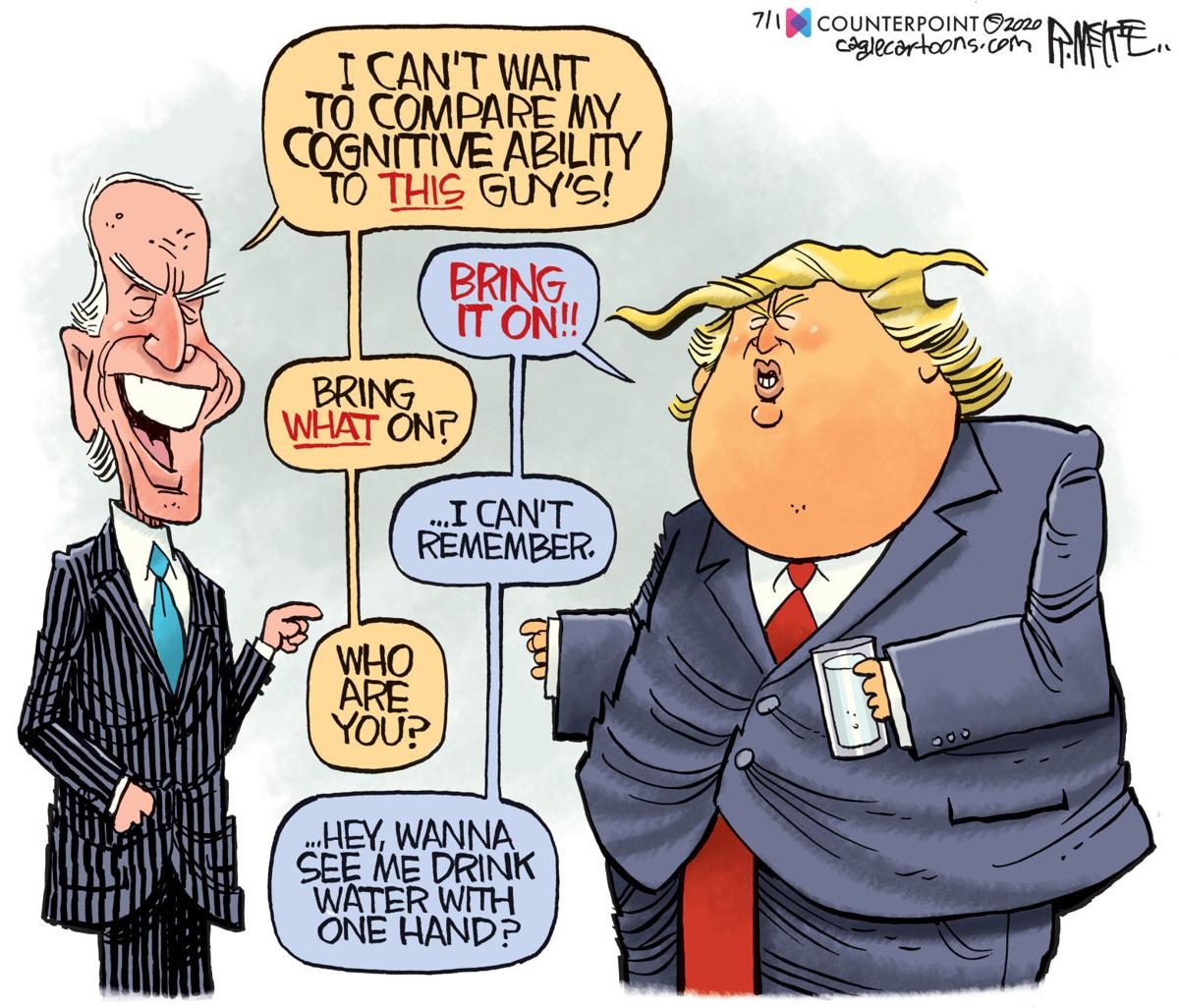
It's a battle of wits between Trump and Biden, in Rick McKee's latest  cartoon

The debate between Biden and Trump is on everybody's mind. And for good reason, the future of the global economy, and the well being of the planet are always at stake in American elections. I, of course, will restrict my brief comments here to the economy, and what the alternatives might entail. But the analysis of the impacts of both programs, if one can talk of programs per se, is very poor, to say the least.

Broadly speaking there has been increasing agreement on a tougher policy with respect to China, what Jake Sullivan referred to as a New Washington Consensus. Many see this as a revival of industrial policy. This is of course suggests some continuity with the Trump policies, even though I would suggest that only with Biden there was a clear plan to re-shore manufacturing jobs, particularly with chips and electric vehicles. Trump basically just hiked tariffs. Both protectionism and the continuity make some liberals (I would say neoliberal progressives, to use Nancy Fraser's term, nervous. For example, Edward Luce's anxiety is that Biden agrees too much with Trump. He says: "both Biden and Trump are vowing to travel in the same direction. But Trump would do so in leaps and bounds."

Note that in all fairness, the US never really stopped doing industrial policy. As noted by Fred Block, even with the problems of the Military-Industrial-Sillicon-Valley Complex, a hidden developmental state. The main new element in the "New" Washington Consensus is really that the US will be less willing to promote economic development by invitation in the case of China. As the IMF policies seem to indicate, for the rest of the world, the old consensus is in place. In that respect, the anxieties of liberals on this are exaggerated.

But that's not all. According to Luce, based on a report* from Moody's, "Trump’s policies would trigger a recession by mid-2025. Unemployment and inflation would jump. The bottom half of US income distribution would suffer the most." He concludes that: "The economic consequences of Trump would be a disaster." This was reinforced letter by 16 Nobel economists warns that: "Many Americans are concerned about inflation, which has come down remarkably fast. There is rightly a worry that Donald Trump will reignite this inflation, with his fiscally irresponsible budgets." This is flatly incorrect. Tax cuts (or their extension) and tariffs wouldn't cause inflation and a recession. Worst case scenario there would be a one time increase in prices, but again the bargaining power of the working class is at low point. So no danger of inflation there. And neither would affect the ability the government to spend. On that Republicans are normally less fiscally conservative when in power than Dems (see old roundtable on that here). And it actually it is a critique that misses the point of why Bidenomics is much better than Trumponomics.

Inflation was not caused by Biden's fiscal packages, as I have insisted several times here (see this paper). And Trump's tax cuts would also not be a problem from that perspective. The point is that Trump would be, in his domestic agenda, more of the trickle down agenda or Republicans going back to Ronald Reagan. Cutting taxes for the wealthy and making it harder for minorities and the poor (often minorities) to access welfare programs. It would be distributively problematic. Inflation is not the risk. The problem with Trump's policies is that they hurt the very working class (many in unions, and certainly white folk) that might vote for him. It would be stupid for unions and other progressives to support Trump.

The good thing about Biden is that he, in part because he had more union connections, and in part because he has moved towards the left (certainly Bernie played a role here), was bold in his fiscal policy, and that might have been instrumental in avoiding a recession (that the Fed was almost engineering). Contrary to Obama, with his mild post-bubble program, and Hillary, Biden has moved to a more traditional Dem (New Deal would be a stretch perhaps) logic of tax and spend.

Eight years ago Hillary had a completely different economic agenda, and that actually explained, to some extent, why Trump ended up winning. I noted that it was likely in this post from before that election, right after a debate, in which I said: "This [election] is going to be way closer than it should be." I also noted that the problem with Hillary was that: "The fact that she has not fully renounced Clintonomics, i.e. financial deregulation, austerity (End of Welfare as we know it) and free trade, is a problem for the progressive base of the party. She walked back some of these, mostly after pressure from the Bernie campaign, but is unclear that these changes would stick."

That these divisions are still relevant within the Democratic Party is clear in the primary in New York that pitied Bowman and Latimer, the former with support from Bernie and the latter from Hillary. Bernie said that "the race 'one of the most important in the modern history of America' and a contest between 'the billionaire class' and ordinary citizens," according to the Financial Times. So if one wants to criticize Trumponomics, the issue is that his agenda is the pro-billionaire one (Wall Street and Silicon Valley agree and have closed the funding gap). Biden is the leftest president since Lyndon Johnson (he is clearly to his right, and LBJ was no commie). He also is not the best possible candidate. He has one unbeatable quality though: he is NOT Trump.

* Mark Zandi is the main author of the report, and he can be seen as another neoliberal progressive, aligned with the pro-business part of the Dems.

Monday, May 20, 2024

Debt cycles and the long term crisis of neoliberalism

My talk at the IDEAS/PERI conference a few weeks ago. As I said there, I hate to be the optimist in the room, but I'm a bit more skeptical about the risks of a generalized sovereign debt crisis in the Global South. The two papers I cite are these (in their PERI Working Paper versions) two (one and two).

Thursday, April 18, 2024

Keynes’ denial of conflict: a reply to Professor Heise’s critique

Tom Palley reply to response about his paper on Keynes lack of understanding of class conflict. In many ways, this is how Tom discusses Keynes lack of understanding of old classical political economy. Tom is correct in pointing out that:

"Kalecki (1933 [1971]) began the process of incorporating conflict into the Keynesian paradigm, but there is much more to be done regarding recognizing conflicts’ implications for economic theory and recognizing the multiple fora in which it appears."

Of course, Kalecki was building on Marx and classical political economy. Read the full reply here.


Sunday, December 31, 2023

Podcast Failures: Friedman and Chile, Hume and Public Debt

I listen to a few podcasts during my commute. Two that I often appreciate are Know Your Enemy, associated with Dissent Magazine,* a series of interviews on mostly right wingers by Matthew Sitman and Sam Adler-Bell, and Past, Present and Future, a series of monologues by David Runciman, sponsored by the London Review of Books.  Both are always entertaining and informative. I'm not a specialist in most of the subjects they discuss. However, two recent episodes (or at least I listened to them recently), one from each, dealt with economic issues, and they did leave a lot to be desired, to say the least.

Very briefly, the issue with the interview with Jennifer Burns about her biography (in many ways, from this interview, and the one with Tyler Cowen, it is hard not to see it as a hagiography; more on that as soon as I read the book; it's been ordered. I hope that's just a perception and that the book provides a more balanced view of his contributions and political views) of Friedman is that the hosts accepted almost all of her very monetarist interpretation of the Allende government, and her whitewashing of Friedman's relation with the Pinochet regime (see on that this and this). In all fairness, at least one of the hosts (sorry, not sure that was Matt or Sam) questions (around 1:16) the validity of her interpretation of the relation of Friedman with the regime. But there seems to be a complacent view according to which inflation in Chile was caused by excessive monetary printing driven by the expansion of the welfare state.

The role of the US sanctions, and Nixon's infamous instruction to "make the economy scream" are never cited. And the lack of dollars was at the center of the depreciation of the currency, inflation and the collapse of the economy. Let alone that the Pinochet period wasn't that good (yes they do claim that it created the basis for future growth, a typical conservative trope, that I should write about; in another occasion). I also recommend this post by Tom Palley. On a general evaluation of the regime see this piece by Jim Cypher in Dollars & Sense.

The issues with Runciman's podcast are considerably more problematic. They don't entail a misrepresentation of the ideas of a crucial intellectual, in this case, David Hume. In fact, Runciman is relatively correct when it comes to Hume's essentially negative views of public debt (which were not all that different than those of Adam Smith, at least according to Donald Winch**; btw it was called public credit at that time, so nothing weird about it). He makes to much of Hume's drastic solution, default, for public debt, and its comparison with suicide, for the nation not the individual. And he does recognize that events essentially proved Hume wrong.

But then he commits all of Hume's (and modern mainstream economics). Presumes that the only way out of debt is to run persistent surpluses, printing money and reducing its value in real terms (endorsing a Monetarist view of inflation; it's amazing how pervasive it is), and default. He misses that debts can fall as a share of income (GDP), that is, the ability to repay, if the economy grows faster than debt (the rate of interest), and that most debt consolidations actually happened that way, while running deficits. He also gives Argentina as an example of a country that has defaulted without noticing the differences between debt in domestic and foreign currency. It's a mess. Worse, in an environment in which many conservatives want to promote default in the US he suggest that talking about it would be reasonable. He is out of his depth, should apologize and invite someone to explain the problems with his analysis.

Again, I'm only commenting on these two episodes, because they do seem off, when compared to the quality of both podcasts in general.

* I published almost 20 years ago on Dissent. Because of this I did search their online archive and my piece, and my name was misspelled. Also, it was published in the Winter of 2004, and not of 1984. In the original magazine it was spelled correctly. Oh well.

** See Donald Winch, "The political economy of public finance in the 'long' eighteenth century," in John Maloney (ed.), Debt and Deficits: An Historical Perspective, Cheltenham: Edward Elgar, 1998.

Sunday, September 10, 2023

The menace of the myth of General Pinochet’s Chilean economic miracle

By Thomas Palley

September 11, 2023, marks the fiftieth anniversary of General Pinochet’s military coup against Chilean President Salvador Allende. While it is now widely recognized that Pinochet authorized large-scale human rights abuses, there is an accompanying narrative that he also unleashed an economic miracle via embrace of Milton Friedman’s “Chicago Boys” vision of a market economy.

The “Pinochet economic miracle” narrative is profoundly misleading. Worse yet, it is a political menace for two reasons. First, it risks tacitly promoting the notion that dictatorship may be legitimate to the extent it offers a road to prosperity. Second, the Pinochet regime embraced Neoliberalism which promotes anti-democratic tendencies by fracturing society. The claim of a Pinochet economic miracle lends support to Neoliberalism, thereby encouraging acceptance of Neoliberalism despite its anti-democratic proclivities.

For those reasons, debate over Pinochet’s economic policy remains of vital importance. The fiftieth anniversary of Pinochet’s coup is an opportunity to challenge the pernicious miracle myth which is increasingly part of the conventional wisdom.

Read rest here.

Thursday, May 4, 2023

The problem with Keynes' General Theory: by Tom Palley


New working paper by Tom Palley. From the abstract:

Keynes' General Theory was a massive step forward relative to classical economics, but it was also a step backward in its denial of the conflictual nature of capitalism. There is need to understand Keynes' technical contributions regarding the workings of monetary economies, but also need to understand the flaws within his thinking and the consequences thereof. Keynes made a fundamental contribution elucidating the mechanism of effective demand, and he also has claim to be the preeminent monetary theorist. However, owing to his denial of conflict, he had a flawed view of capitalism which is why establishment Keynesianism struggles to explain contemporary stagnation. That flawed view also undermines the case for Social Democracy. Contrary to conventional wisdom, his view of capitalism is supportive of Neoliberalism and Keynes can be viewed as a compassionate (Third Way) Neoliberal.

In some ways this is the argument in Geoff Mann's In the Long Run We Are All Dead. I think one way of thinking about it is that Keynes' effective demand as a critique of marginalist (neoclassical) economics needs to be completed by old classical (political economy) ideas, which put the class conflict at the center of analysis. That of course is necessary for a policy break with neoliberalism.

Sunday, January 15, 2023

New book on the crisis of economics and teaching in Latin America


The book (in Spanish) titled "Economía en crisis : la enseñanza de la economía en Latinoamérica y los límites de la teoría ortodoxa" [Economy in Crisis: The teaching of economics in Latin America and the limits of orthodox theory] is edited Andrés Jose Maria Lambertini; Ignacio Silva Neira. The introductory chapter on the role of neoliberalism and its resilience in the region is by Esteban Pérez and myself. There's a webinar with Carolina Alves and Gabriel Porcile, besides the editors.

It will be in Spanish with English subtitles. You can register here.

Friday, May 6, 2022

What is heterodox economics? Some clarifications

Long ago I wrote on the meaning of heterodox economics. I suggested that it should be defined in its own terms, not as a reaction to the mainstream or orthodox approach, and as a unified set of propositions.[1] In other words, heterodox economics would be a set of principles that would be backed by a certain community. Of course, the sociology of that community would lead to some degree of debate and dissent within heterodoxy, as it is in fact the case within the mainstream. There is, one might add, significant confusion about the meaning of marginalist and neoclassical economics, and also there is no monolithic and consensual approach within the orthodoxy. The mainstream is somewhat fragmented, and there are more than a few neoclassical or marginalist schools. Some, like the Austrians, tend to think of themselves as heterodox, and evident confusion.

My preoccupation when I first wrote about this topic had been related to the argument by Colander, Holt and Rosser that heterodox economics should be abandoned, or that the labels orthodox/heterodox themselves meant little or nothing. For them, the mainstream itself was moving on, and that the best within the mainstream, the cutting edge as they called them, were breaking away with traditional neoclassical views. In my reply to them, I suggested that the mainstream was doing fine, and that it was not being abandoned by the best and the brightest. I argued that the mainstream had for a while a dual strategy. It maintained certain principles that purported to show that markets produce efficient outcomes, even if a significant part of the profession does not believe it is true in practice, and then proceeded to discuss a series of imperfections that are better suited for the complexities of the real world.

Read rest here.

Friday, July 9, 2021

Laissez-faire policies, self-adjusting market system, and neoliberalism

Classical political economics was in part a discourse for the rising bourgeoisie, and as such most of its members – that accepted some version of the labor theory of value and that distribution was conflictive – were for laissez-faire policies. That was certainly the case of the Physiocrats, and of Adam Smith and David Ricardo, the two most accomplished of the British political economists.

However, the classical analytical scheme did not assume full employment of labor or that the economic system was self-adjusted. Competition meant that market prices fluctuated around the natural prices, but those did not imply efficient allocation of resources. The notion that markets are self-adjusting with a tendency to full employment was a development of the last quarter of the nineteenth-century, and part of the so-called Marginalist Revolution. Marginalism also implied that each factor of production, capital and labor, received a share of income in accordance with the services rendered in production. Distribution was harmonious and not conflictive.[i] However, that did not imply that marginalist authors were all for laissez-faire.

It is clear that laissez-faire policies – leaving markets to its own devices without government intervention – could theoretically lead to efficient outcomes in the new theoretical scheme. But many marginalists authors believed that imperfections were relatively common in the real world and that under these circumstances some degree of government intervention was required. Market imperfections were a central reason for government intervention, before the Keynesian Revolution. In addition, most marginalists believed that economics was a science, technical in nature and not an art that required understanding of political factors, like class interests, wage bargaining, the power of capitalists, etc. These were imperfections, and they required government intervention. That was certainly the dominant view within marginalism associated with Cambridge University in England, and with its main academic figure Alfred Marshall.[ii]

Marginalists were part of a late nineteenth-century trend that believed in the power of experts, technocrats, in a period in which economics was becoming professionalized, and independent of the moral sciences. They were policy advisors. Simplifying considerably, one may say that classical authors were for laissez-faire, but not for the self-adjusting nature of capitalism, while marginalists were for the notion that markets are self-regulated, but less keen on hands-off governments. The conjunction of the two, the notion that laissez-faire capitalism is self-adjusting, was a distinctive feature of some of the marginalist authors, in particular the ones associated with the Austrian school, with Ludwig von Mises and his disciple Friedrich Hayek. That is, it is only with the rise of neoliberalism that laissez-faire and the self-adjusting nature of capitalism become associated.[iii]

----------------
[i] The notion that distribution is harmonious and not conflictive as assumed by classical authors precedes marginalism or neoclassical economics, and was fundamentally developed in the period after the abandonment of Ricardian economics by pamphleteers and political economists that were afraid of the social implications of the work by David Ricardo, and the development of Socialist theories. Nassau Senior is probably the key author, and Frédéric Bastiat and Harriet Martineau the popularizers of the new dogma. Karl Marx referred to these post-classical authors as vulgar economists, and the term seems fitting.

[ii] Arthur Cecil Pigou, Marshall's main disciple, and John Maynard Keynes' teacher, was concerned exactly with the imperfections caused by externalities that required some sort of government intervention. These would be taxes or subsidies, depending on the nature of the externalities.

[iii] Later, in the 1940s after encountering insurmountable problems with his theory of cycles and the notion of capital, when he distanced himself from economics, Hayek exposed a different argument in favor of laissez-faire policies based on complexity and unintended consequences of government intervention. In this case, the argument was that government failures were worse than market failures or imperfections.