Showing posts with label Price controls. Show all posts

Wednesday, December 11, 2024

Inflation, real wages, and the election results

Almost everybody these days accepts at face value that the result of the election was heavily determined by negative perceptions about Bidenomics, and that, in turn, resulted from inflation. Inflation was high (it wasn't, at least not that much), and people were pissed off. This is not just Larry Summers, who had argued (incorrectly in my view) that inflation was caused the large fiscal packages of an excessive generous government.

In the heterodox camp, many have suggested that more should have been done to control greedy corporations, that caused inflation by hiking their mark ups. In this view, price controls might have been helpful (often some examples of other countries, like Spain are used). While some of these would have been good, they depend on the previous existence of national mechanisms to, for example, control the price of energy (even easier if one has a national oil company),  of a national Value Added Tax on food that could be reduced to alleviate cost pressures. As I noted in the INET video, the best policy would have been to try to increase wages above inflation, and perhaps the best national tool was the minimum wage, but Biden and the Dems in Congress failed to pass an increase (Trump and the GOP are against the existence of a minimum wage, let alone a higher one).

At any rate, as I noted before, real wages at the bottom of the income distribution did go up, going back at least to the Clinton era, as it can be seen below.

However, that about the relative position of the workers at the bottom, nor about the fact that during the Pandemic period (and at the beginning Trump was still the president) real wages for the non managerial workers basically stagnated (even fell a little bit from the peak).

And, as noted before, this does overlook the fact that real wages for an extended period, going back to the 1970s, has more or less stagnated (individuals, obviously, might be doing better, as they get promotions and so on; but people know that their parents could have a better life with a working class salary back in the 1970s).

The key is not inflation, but that real wages have not been growing enough to provide a sense that people's lives are improving. If the left clings to the demonization of inflation, the ultimate lesson would be that fiscal policy was the problem (not the greedy corporations, but the inefficient government; both stories are incorrect, see why on my Catalyst piece). And we will make it so much more difficult for the next Democratic administration and the progressives within that coalition. Many on the left took the wrong lesson from the 1970s, that inflation was a problem, and that balanced budgets were necessary to win elections. That certainly was reinforced by the Clinton administration. To conclude that inflation and excessive spending was the problem with Bidenomics will make things worse.

In terms of feasible strategies that would have positive economic effects, and generate immediate electoral advantages, Dems should concentrate on higher minimum wages as a catalyst for better labor market conditions (the effects spread to other wages, and it is a simple slogan that people readily understand, and Trump would have been forced to remain silent or come out against it).

Sunday, March 13, 2022

Some thoughts on inflation and what not to do about it

I have written extensively over the years on inflation and some of that is here in the blog (see this or this, or this more recently on Volcker the inflation dragon slayer, if you believe in fairy tales; there's way more if you search the blog; I also highly recommend this paper by Perry and Cline in ROKE, which is open, btw). My more recent piece on inflation came out recently in Catalyst, just before the war in Ukraine (on the war see this by Palley, and this old piece by Gary Leupp after the Crimean crisis in 2014), and the spike in oil, and foodstuff prices. But although this exacerbates things, the gist of my argument remains the same.

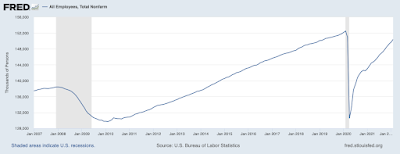
Inflation which had accelerated because of the supply constraints, and not because of the recovery or excess demand (sure the economy recovers fast in the US, but more than two million workers less are employed now than at the beginning of the pandemic; see figure below). It was all related to the pandemic and the problems in the supply chain, and logistic issues. Chips that affected the prices of cars, port and trucking issues, and even then energy prices that explained most of the increase (as I noted in my piece; see also the BLS report here).

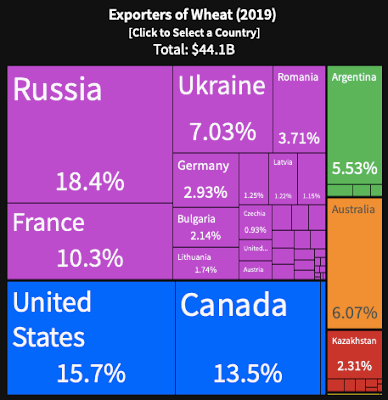
This is all now exacerbated because of the war in Ukraine, which, together with Russia, produces a significantly large amount of oil, natural gas, and key food commodities like wheat. For example, both countries supply about 25 percent of global exports of wheat.

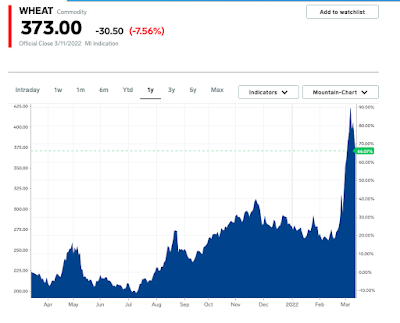
And wheat prices have certainly go up with the crisis (low point there before the spike is less than a month ago). Both energy and food are basic goods that entered in the production of everything, including themselves, and the implications of this are important.

Ricardian rent theory suggested that the extensive use of of lands of lower quality would increase the rent, squeeze profits and (given that wages for him were at subsistence, and accumulation depended on profits) lower accumulation. In this case the higher rents that oil producers, for example, would obtain would impact prices, and given the inability of workers in most places (including the US) to demand higher wages (blame it on years of lack of organization, decreasing unionization and so on, which are hard to reverse even in the current context of heightened mobilization as I suggested in the Catalyst piece), real wages will fall. So this would make the supply side effects of the crisis worse. Inflation will remain higher.

But as I noted in the paper, wage resistance, the propagation mechanism that fueled the distributive conflict back in the 1970s is dormant now, and nobody should expect high inflation (let alone hyper, which is a completely different story). Also, in principle the hike in prices should not have, any direct effect on growth. But the effects of inflation acceleration on the mood for more fiscal expansion in Washington will impact growth. And higher interest rates that are coming will impact too (although I think less) spending, and also cool down the housing market, and that will have effects on consumption too. So the likely effect is higher inflation and lower growth. Btw, in the piece I suggest that this is the return of the 70s, all with a victory of the GOP in the elections and with Biden playing the role of Carter (That 70s Show reunion).

So what to do about all this. Conservatives and orthodox economists have demanded fiscal and monetary restraint. That, of course would only work if inflation was demand driven. I won't say anything else here on that. It would be a waste of time. On the left there have been some alternative policies. Some suggested price controls (and don't get me wrong, I do think they can be effective, and were under certain circumstances, old post here). But price controls would require a bureaucracy capable of controlling prices, and an economy much more organized, and particularly one in which key parts of the supply chain are at home, like the planned economy during World War II, in order to work. This is not the case right now.

Anti-monopoly and regulation policies, which have also been floated by some progressives, are also not particularly useful. I won't go into the whole issue of what in Latin America we called the oligopolistic view of inflation (as I note in my piece the first Gilded Age was a period of deflation, and the this current Gilded Age had been, so far, one of a Great Moderation), but even if you assumed that regulation could do something, the timing would be too long to have any significant short term effect.

Some MMTers have suggested that a Jobs Guarantee (JG) is the way to stop inflation, and while I'm for a JG for employment security reasons, I'm very skeptical about its relevance for price stability (my general views on MMT and inflation in this long post here). The main idea is to control wage increases, but again those will be in the medium term subdued, in my view, and the distributive conflict will not spark a price-wage spiral like in the 70s.

The US will use its oil reserves, and will use its power to try to manage production by OPEC countries, not just Saudi Arabia, but even Venezuela (a mission already went and visited Maduro, and not Guaidó, not surprisingly). And this efforts will probably to some degree contain what could be an even worse increase in global prices.

As it turns out I think that in the short run there is little that can be done. Inflation will remain higher. Not high inflation, but higher than the very low that we experienced for the last 30 or 40 years in advanced economies. The problem is not inflation, but the fact that real wages will fall, and that this will be used as an excuse for contractionary policies. Also, in some parts of the world this would lead to food shortages, and heightened social conflicts. This is inevitable to some extent, and the result of higher prices for basic goods, which do affect distribution as noted by Ricardo (in his case a squeeze of profits). The question that nobody asks is what is the problem with 8 percent annual inflation if real wages kept up with it. There's no evidence that it would affect growth, and in order to have some impact and disorganize relative prices seriously it would have to be much, much higher (classic paper on that by Bruno and Easterly here). Essentially the best thing that can be done is not much, but that is not in the cards.

Wednesday, July 3, 2013

Price controls once again

I was off for a few days. In a previous post on price controls, in the comments, I suggested the book by Hugh Rockoff "Drastic measures A history of wage and price controls in the United States" and posted the following quote, which suggests under which conditions they were efficient in the 1940s (1984, p. 108):
"In a sense the democratic process wrote its own evaluation of controls: Selective controls were a failure; the hold-the-line policy was initially a success; but failed when, at the end of the war, the constraints on collective bargaining and rationing became too confining. The statistical record, on the whole, tends to confirm this judgment. Perhaps the simplest question is, Did controls "work" in the elementary sense that the rate of inflation was kept below some arbitrarily small figure, say 5 percent per year? The answer that emerges (Table 4.3) depends on the particular subperiod one examines. From April 1943, when President Roosevelt issued the Hold-the-Line Order, until June 1946, when controls temporarily expired, inflation was held to a measured rate of only 2.3 percent per year. The true rate was probably somewhat higher, but even with an allowance for errors in the published index - an estimate of inflation partially corrected for these errors is in parentheses - controls were a success in this elementary sense. On the other hand, under less than total control the rate of inflation was not effectively restrained. Of particular interest are the periods April 1942 to April 1943 and February 1946 to June 1946 which give the rate of inflation under the General Maximum Price Regulation and under President Truman's reconversion policy, respectively. In both cases the economy was under extensive price controls, but in neither case was the rate of inflation held down. The difference seems to be that during the high tide of price controls, they were backed up by a vigorous enforcement effort and three important supplementary measures - wage controls, the seizure of noncomplying industries, and rationing both of resources and of final products."
The book is available here.

Tuesday, February 5, 2013

Price controls and horseshit

Argentina has announced that informal price controls will be in place for the next few months. A good thing if you ask me. Yet, you can expect a barrage of criticism about the inefficiency of price controls in the media, and by 'expert' economists to follow. Note, however, that from 1941 to 1946, during World War II, the United States applied a very successful program of price controls. A good description can be found in John Kenneth Galbraith's A Theory of Price Control, in which he describes his experience as Commissioner of Prices.

An interesting story Galbraith used to tell (see here) is that they would have a sign to tell when some industrialist that wanted to hike prices tried to suggest that he would go broke if that didn't happen. They would move their index and middle fingers like the antennas of ants. The story went that this little ant rolled a dung of horseshit up a mound, and when it lost control of it, and the dung rolled down in the direction of the anthill, all the ants nervously signaled each other (moving their antennas) to "stop that horseshit."

Prices increased on average 5.8% annually between 1941 and 1946 (they accelerated a bit in 1947, after price controls were lifted, but didn't get out of control). Note that the rate of unemployment was at very low levels reaching 1.2% in 1944. This is not to say that all price control systems work perfectly, but that under certain circumstances they might be a useful way of controlling inflation.

PS: By the way, the US had an extensive bureaucratic machine to enforce the application of price controls. Also, certain shortages were considered acceptable during a war period. But note that similarly certain shortages should be normal in a developing country with a balance of payments constraint.

Tuesday, November 20, 2012

More on the Indian Economy

In Mumbai for a conference sponsored by the Reserve Bank of India (RBI) and the Asian Development Bank (ADB). On my way, I read an op-ed by Arvind Panagariya in the Times of India, in which he defends that the Bharatiya Janata Party (BJP) should embrace the reform agenda, followed by Congress and by the same BJP when in power. His views [remember that Panagariya is a fairly conventional free trade mainstream economist] are fairly conventional, but interestingly he suggests that "the Indian public today fully appreciates the benefits of reforms."

The notion that the majority of the Indian people are for the Washington Consensus reforms is surprising to say the least. The basis for his proposition is very flimsy indeed. He suggests the following:
"The opposition parties had claimed that the latest package of reforms would damage millions of shopkeepers (FDI in retail), transport workers (diesel price hike) and urban households (subsidised LPG cylinders). Yet, none could translate that supposed harm into sustained anti-reform demonstrations in the public space."
In other words, the evidence for the support for the reforms is the lack of protests on the streets against the reforms. It is far from clear, however, that the absence of protests are a sign of support. Note that for good or bad the Indian economy, even with a slowdown, continues to grow fast, so it would be surprising to find a lot of protesters in the streets.

And yes India has been growing relatively fast since the 1980s, that is a whole decade before liberalization started in 1991. Also, note that one of the key areas in which India has not followed the liberalization and deregulation policies of the neoliberal agenda is in the financial sector, preserving capital controls (even if there have been pressures and a certain amount of liberalization it is way less than what happened in Latin American economies, for example).

The current debate in India has been very heated, following the revelations that Wal-Mart has paid bribes (as much as it happened in Mexico). At any rate, the process of liberalization proceeds with parties being for once in power, but against when in the opposition. This system has been perfect in order to guarantee that no matter who wins the elections, yes this is the largest democracy in world, the process of economic liberalization is not affected.

PS: On a slightly different matter, the RBI study has an interesting study that shows a 10% increase in minimum support price (MSP) of wheat raises wholesale inflation by 1%. That is, price controls, in this case on food supplies, is an important element of anti-inflationary policy in India.