Thursday, March 30, 2023

Review of Crotty's "Keynes Against Capitalism" (forthcoming in ROKE)

It should not be a surprise that John Maynard Keynes is often seen as being relatively conservative by many progressively inclined or radical economists, that often tend to prefer the views of Michal Kalecki, or the more radical approach of Keynes’ favorite disciple, Joan Robinson. That is not the case in James Crotty’s book Keynes Against Capitalism, who takes a diametrically opposite view. He tells us that: “It is almost universally believed that Keynes wrote his magnum opus, The General Theory of Employment, Interest and Money [GT from now on], to save capitalism from the socialist, communist, and fascist forces that were rising up during the Great Depression era”, but in his view, that “was not the case with respect to socialism. The historical record shows that Keynes wanted to replace then-current capitalism in Britain with what he referred to as ‘Liberal Socialism’” (Crotty, 2019: 1-2). His Keynes was anti-capitalist and, in some sense, a socialist. The notion that Keynes was a socialist often encounters as much resistance as the notion that he was somewhat conservative, of course.

The book is divided in three parts. The first part of the book traces the development of Keynes’ ideas in the inter-war period starting with his significant role during the negotiations of the Treaty of Versailles, and the publication of his instant bestseller, The Economic Consequences of the Peace, that made him a worldwide celebrity, to development of the revolutionary ideas in the GT. The second part analyzes the theoretical ideas of the GT, and how they provide the foundations for a radical and socialist remaking of British capitalism. The third and last part discusses Keynes’ program in action, in the buildup to the war, and during World War-II, and its relevance for our days.

The first part of the book suggests that the Keynesian Revolution started in the 1920s with the slow evolution of Keynes’ thinking about the problems of the British economy, and his rethinking of neoclassical economics. Crotty uses the term classical, as did Keynes, creating unnecessary confusion, in particular because of his own sympathies with Marxist economics, that builds critically on the classical surplus approach. Crotty makes an important point, often neglected in the discussions of Keynesian economics. For Keynes the need for a new theory derived from an appreciation of the historical and institutional changes of British capitalism. Crotty argues: “Keynes’s core belief [was] that the West had entered a completely new historical era in which the institutions and policies currently used to regulate economic life were totally inappropriate. He associated himself with the American institutionalist economist John R. Commons’s view that Europe and America were currently in transition to a new historical epoch in which the main task was to create a new ‘regime which deliberately aims at controlling and directing economic forces’” (Ibid.: 81).

The doctrines of laissez-faire, that were well adapted to the Victorian Era, were not suited for the world that emerged from World War-I, in which mass production, mass consumption and the rise of organized labor required a certain degree of government intervention to manage the economy. This is the best and most original part of the book, in which Crotty reminds us that: “Keynes’s enthusiastic and consistent support for state control of most large-scale capital investment is not the only ‘radical’ policy position overlooked by mainstream ‘Keynesian’ economists; his support of detailed industrial and labor-market policy has escaped their attention as well” (Ibid.: 87). The emphasis on the importance of industrial and labor policies, in particular, their direct connection with Keynes’ opposition to the return to Gold Standard and his support of the coal miners’ strike of 1926, are central to understand his need to rethink his economic theory.

However, even in this part, there is a neglect of an important element of Keynes’ trajectory, and for the development of the ideas exposed in the GT. Crotty forgets to note that Cambridge monetary theory was quite underdeveloped in the 1920s, and was based mostly on an Appendix to Alfred Marshall’s Principles of Economics, and his evidence to some Royal Commission, and was in fact being developed by Keynes and his colleague Dennis Robertson during the 1920s. At that point it was unclear that this was a complete rupture with Marshallian economics on monetary affairs, as much as Piero Sraffa was starting to break with the marginalist theory of value and distribution with Keynes’ support. In fact, Keynes’ thought that his book A Treatise on Money was the culmination of the development of the alternative theory, which he defended as a member of the Macmillan Committee, and that argued that the Depression resulted from the high interest rates, that prevented investment from adjusting to full employment savings, as a result of the Gold Standard. This view was perfectly compatible with neoclassical economics, even if Keynes already advocated for public works, an unorthodox policy, as a solution for the crisis.

However, it was at this point, exactly as a result of the criticism of his book by the young economists of the Circus – a group that included besides Sraffa and Robinson, the latter’s husband, Austin, Richard Kahn, and James Meade – that Keynes finally developed in 1932, relatively late, his main theoretical contribution to economics, the Principle of Effective Demand. In other words, while the 1920s were formative, it was only with the Great Depression and his immersion in pure theory in the early 1930s that Keynes finally broke with orthodoxy in theory. The fact that he changed his diagnosis of the Depression, and adopted a whole new theory right after the publication of what should have been his major theoretical work to the date, led to the traditional complain that Keynes was inconsistent and held more than one view at the same time. Friedrich Hayek and Keynes’ opponents at the London School of Economics would make a of this inconsistency one of their main criticisms of Keynesianism.

This is also relevant because it shows that Peter Clarke is correct when he argues that: “The Suggestion that he [Keynes] wrote The General Theory because he had an axe to grind in immediate policy arguments is wide of the mark” (Clarke, 1991: 163). In other words, Keynes’ views on policy issues could be defended, and in fact he did defend them in the 1920s as noted by Crotty, even before he developed the notion that changes in the level of income were the mechanism by which savings adjusted to investment, and not the other way round. The fact that Crotty suggests that the GT was written: “to convince economists and members of Britain’s intellectual, business, and political elites that the theory that informed their economic worldview and provided essential support for the disastrous conservative economic policies of the era was fundamentally flawed” (Crotty, 2019: 161) seems incorrect.

This is compounded by the fact that Crotty accepts Keynes’ theory of interest and the notion of a marginal efficiency of capital in the second part of the book, and as such is forced, as Keynes was, in particular in the famous 1937 paper in the Quarterly Journal of Economics (QJE) amply cited by Crotty, to use the argument of fundamental uncertainty to preclude the possibility that a sufficiently low interest rate would equilibrate investment to full employment savings. Crotty centers his analytical interpretation of Keynes on chapter 12 of the GT, and his defense of the GT in the QJE paper. The argument is essentially one associated with uncertainty and financial instability. In his words: “The outbreak of pessimism and the loss of confidence in the conventions that underlie expectation formation will also cast a pall over the bond market, a point Keynes also stressed in his 1937 defense of The General Theory in the QJE” (Ibid.: 266). It is clear that the abandonment of the marginalist, or neoclassical, notion of a marginal efficiency of capital would actually strengthen Crotty’s point, but for some reason he neglects the important results that followed from the capital debates in the 1960s, which were central for the completion, on a theoretical level, of the Keynesian Revolution in theory.

On the issue of Keynes’ adherence to some form of socialism, Crotty also makes a valiant case for his position. He provides copious circumstantial evidence, and quotes the famous phrase by Keynes in which he says that: “I am sure that I am less conservative than the average Labour voter; I fancy that I have played in my mind with the possibilities of greater social changes than come within the present philosophies of Mr. Sidney Webb, Mr. Thomas, or Mr. Wheatley. The republic of my imagination lies to the extreme left of celestial space” (Keynes, 1926: 308-309). The part that Crotty forgets to cite is the subsequent phrase, in which he tells us: “Yet—all the same—I feel that my true home, so long as they offer a roof and a floor, is still with the Liberals” (Ibid.). Certainly, many of Keynes’ policy proposals were radical. They moved in the direction that was compatible with socialist or social democratic views. And he recognized he had many common goals with Labour and the Fabian Socialists. But he called his views liberal socialism, and remained an Asquith New Liberal all his life.

Liberalism also spoke to Keynes political and social outlook in ways that Labour or Socialism never did. He was an elitist, the product of Eton and King’s College, Cambridge, and a member of the Apostles and the Bloomsbury group. To some extent Labour reciprocated. Philp Snowden, Labour’s first chancellor of the exchequer, was a committed defender of the Treasury View, and an avowed anti-Keynesian. Hugh Dalton, Clement Atlee’s first chancellor of the exchequer, was averse to Keynesian policies, and for him Keynesianism: “was virtually a deathbed conversion, for only in his fourth, final, fatal Budget of November 1947 did he explicitly relate his measures, which stepped taxes across the board, to the problem of controlling inflation… The paradox is that a Keynesian approach was directed chiefly to the problem of keeping demand down, not up” (Clarke, 1991: 186-87). But if there is a future for socialism, Crotty’s view that Keynes’ ideas remain relevant is correct, and there could be no sensible socialism without a good dose of Keynesianism.

References:

Clarke, P. 1991. A Question of Leadership: Gladstone to Thatcher, London: Hamish Hamilton.

Crotty, J. 2019. Keynes Against Capitalism: His Economic Case for Liberal Socialism, London: Routledge.

Keynes, J. M. 1926. “Liberalism and Labour,” in A. Robinson and D. Moggridge (eds.), The Collected Writings of John Maynard Keynes: Essays in Persuasion, Volume IX, Cambridge: Cambridge University Press, 1972.

Friday, March 24, 2023

Argentina on the verge: some very brief reflections

Brief visit to Argentina to visit my dad. Some brief reflections here. At any rate, it was perfectly timed with the news of the collapse of exports associated to the draught, which will lead to a decline in export revenues of the order of somewhere between 15 to 20 billion dollars. A problem, since Argentina already doesn’t have reserves and dollars are tightly controlled. This came with the news that the IMF had eased the international reserve targets, which were somewhat hard to reach even before the export news.

The drama was heightened by the banking crisis, and the additional rise of interest rates in the US, which makes a recession in the US, with global consequences, more likely. That was followed by the defense, by some well-known economists, of the notion that the country will not reach the fiscal targets either, and that a break with the IMF is in order. Note that the two things are not disconnected. The fall in exports, implies directly a fall in fiscal revenues from export taxes, and indirectly it reduces the ability to import that leads to a slowdown of the economy.

It should be clear that, although the short run situation is truly unsolvable, and that the issue is external, the lack of dollars, and not a fiscal problem, the situation does not require despair. Even inflation is associated to the depreciation of the currency, and the need for wage readjustments, leading to wage-exchange-rate spirals (yeah it is distributive conflict, even if now some heterodox economists think that is blaming workers). The reason for that is that the IMF knows as well as everybody that the fiscal revenues are going to collapse and that the targets will not be reached. My mom used to say, nobody can do the impossible.

So, the fiscal target will be eased for sure. Also, it is my understanding that there are no significant payments to be done this year to private creditors. And the only money that the IMF would give the country would be to pay the IMF anyway. The question is what happens after the elections this year, and with a new government, that will face significant external obligations in dollars.

A default cannot be discarded. But export revenues are bound to go up, not just because a fourth year of draught in a row would be incredible bad luck. Also, part of the gas pipeline that will allow the more intensive exploitation of natural gas in Vaca Muerta might be finished, and the export of lithium might get a boost. In other words, who ever gets elected might face a much brighter scenario next year. Hope springs eternal.

Monday, March 20, 2023

The Problem with the Problem with Jon Stewart (and Larry Summers)

Everybody in the heterodox community, in the United States at least, seems very happy with Jon Stewart's performance interviewing Larry Summers. And of course, Stewart is very good at this kind of stuff. But in all fairness, in this he is canalizing some of the ideological views of the left, which on inflation are fundamentally incorrect. 

Stewart presents at the beginning the adding up theory of inflation, thirty percent demand, twenty five percent wages and the rest corporate greed. His argument is that not all of inflation was caused by demand (I would say none of it was). He is correct on the fact that the stimulus during the pandemic was good and not exaggerated, and that monetary policy (the interest rate hikes are wrong). But he accepts the notion that the labor market is tight, which I think is less clear. I’m definitely in the minority on that. That’s perhaps something for a loner post. Below just the employment-population ratio, which suggests things are less rosy in the labor market.

Worse, Stewart’s explanation of inflation as price gauging by Exxon and Apple is simply incorrect, and here he is getting some progressive arguments that have logical problems. Higher oil prices were not caused by Exxon, that certainly benefited from them, and had higher margins. Note that firms certainly will pass any increase in their costs, including wages, to their prices. And, hence, margins might be readjusted and that plays a role in the increase in prices, that is the level. But firms cannot continuously increase prices, without passing the limit that would trigger the entry of competitors. Barriers to entry work so much.

Note that the problem with this kind of confused thinking is made clear by Stewart. For many progressives the idea that inflation is conflictive, and that there are wage-price spirals, is interpreted as suggesting that inflation is caused by workers. They are the bad guys. Hence, the need for an alternative bad guy, evil corporations (and corporate power is certainly excessive and should be curbed).* This is not the best way to think about the economy. Of course, there is nothing wrong with workers demanding higher wages, and it is only to be expected that corporations would resist, and without great government intervention and protections of workers’ rights, might often win. Conflict over wages is inherently also about the share of profits too.

If anything, it is the mainstream that has more difficulty in introducing conflictive inflation into their models, since distribution is ultimately endogenous and determined by relative productivity. At any rate, there is little reason to be concerned with conflict inflation. Workers are relatively weak, and that has not changed. On all of this see my paper forthcoming in ROKE here.

* Arguably Summers is blaming the bad government for excessive spending during the pandemic, and is just another case of good vs bad guys. That Summers knows a thing or two about the role of bargaining power and the macro-economy, and is less naïve that some heterodox economists have suggested, is given in this paper on the declining power of workers as an explanation of the problems of the US economy.

Sunday, March 19, 2023

Tom Palley on the Causes and Consequences of the War in Ukraine

 By Thomas Palley

(1) The origins of the Ukraine conflict lie in the ambitions of US Neocons. Those ambitions threatened Russian national security by fuelling eastward expansion of NATO and anti-Russian regime change in the Republics of the former Soviet Union.

(2) The Ukraine conflict is now a proxy war. The US is using Ukraine to attack and weaken Russia.

(3) Russia will eventually prevail. We may already be approaching “game over” because Ukraine’s forces have been eviscerated. Ukraine is now press-ganging military conscripts in Kiev and Lviv.

(4) Once Russia imposes its will, the US will be forced to step back but it will have achieved its strategic goal of weakening Russia and separating Western Europe (especially Germany) from Russia.

(5) Ukraine will be effectively destroyed. It will be half-occupied by Russia; hundreds of thousands of Ukrainians will have died; millions will have fled; and the Ukrainian Nazis will be in charge of what is left.

(6) We have all been played by the Biden administration and the US Neocons.

The biggest losers are the ordinary people of Ukraine. They were cheated by the US Neocons of the possibility of a peaceful accord with Russia.

But we have all lost, especially Western Europe. Higher inflation and energy prices today; lost future economic opportunities; a worsened outlook for climate change; a dangerously deteriorated global security outlook that includes risk of nuclear war; and renewed militarism that will disfigure our societies for decades to come.

(7) Western Europe’s political elites are deeply culpable for their venal capitulation to US Neocon pressures.

(8) The US is guilty of provoking the war. But it will never be charged because this is a proxy war and it tacitly controls the International Court in The Hague.

Published originally here.

Tuesday, February 28, 2023

Neoliberalism, Keynesian Economics, and Responding to today's Inflation


Q&A Session

The lecture here. Note that it missed a few minutes at the beginning and the slides are not showing, with Professor Stiglitz at the upper right corner. It is still pretty engaging and wroth reading. There is a link to the slides that are not showing up. The actual lecture will be published in the first issue of ROKE in 2024.


I'll post link to the published version when it's done.


Tuesday, February 21, 2023

The American Political Economy Tradition

If Cohen and De Long (2016) are to be believed, there is an American Political Economy tradition, that harks back to Alexander Hamilton, that goes against the free market canon of the profession. In their view, the American Political Economy tradition consist of an interventionist approach to economic policy, that arguably should be seen as neomercantilist [1]. Classical political economy, as represented by their main figures in the United Kingdom, Adam Smith and David Ricardo, upheld the laissez-faire and free market tradition, and in this view the same would be true for the marginalist or neoclassical tradition. In that respect, some might see a continuity between both schools of thought and the American Political Economy tradition would be a somewhat heterodox tradition from its inception, at least on policy issues.

Read rest here.

Sunday, February 19, 2023

On central bank independence, and Brazilian monetary policy

The issue is back in the news. This time in Brazil (it was briefly an issue here when Trump did not reappoint Yellen, and then complained about Powell's interest rate where too high). At any rate, I always thought that there were good reasons for skepticism about central bank independence (CBI). As noted by Massimo Pivetti in this old piece on the Maastricht Accord and the, at that time, plan for the euro, the main reason to be doubtful is related to the interaction of monetary policy and fiscal policy. And as Quantitative Easing in the post-Global Financial Crisis has shown, central banks have become again fiscal agents of the state (never stopped being that, in all fairness).

The other important reason alluded by Pivetti for doubting CBI is the effects of the interest rate on the exchange rate and balance of payments. This is a quote from Pivetti:

And one could add, through the exchange rate, the effects on inflation also matter. This can be illustrated by the discussion of the Brazilian case. Lula has been very critical of the policies of the Brazilian Central Bank (BCB), and of the higher interest rates, since the campaign last year, and some sort of a truce has been in the works, with him being less direct (or at least that has been reported).

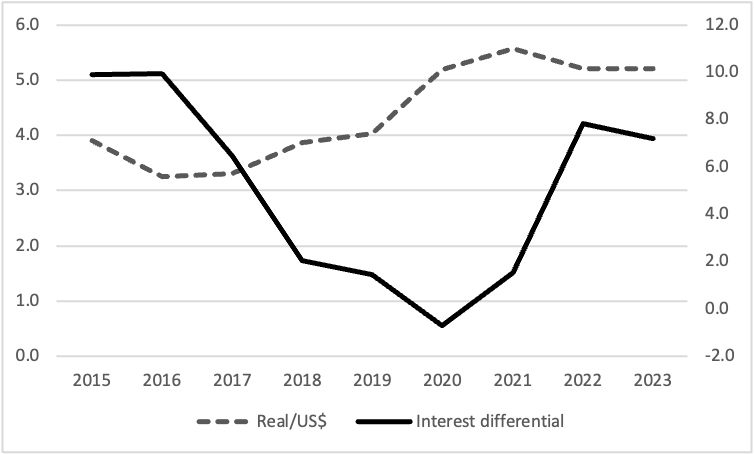
At any rate, the notion is that the higher interest rate is inimical to growth, even though Brazil did grow with relatively high interest rates in his first two mandates. The important thing to note is that Brazil had back then a relatively high and positive interest rate differential, that is a domestic nominal interest rates higher than the sum of external interest rate (the US rate) plus the risk premium (e.g. J.P. Morgan's Emerging Market Bond Index, EMBI), plus the expected nominal devaluation. In fact, as the interest rate differential (here just the difference of the BCB's Selic rate, the Fed Funds plus the EMBI) was coming down, the exchange rate depreciated.

Note that inflation accelerated and has been above the BCB's target only in more recent times, and the exchange rate is only one component of that. The higher prices of energy commodities, and the snags on the supply chain matter in the Brazilian case too. But the higher interest rate, and the higher and positive differential, did allow eventually for the stabilization of the exchange rate.

There is ample space to discuss how high the rate should be, but I'm doubtful that it can be close to zero or very low as suggested recently by André Lara Resende (that since my last post on his views, see here, has move away from Cochrane's fiscal theory of the price level, and closer to MMT; I just read his new book and that seems to be the case; on Cochrane's views on inflation see this video, also with John Taylor and Kevin Warsh).

Below the BCB's Selic rate and the Fed Funds for a longer period, starting after the stabilization of the Real Plan in the 1990s.

 
As one can see (Selic on the left, and Fed Funds on the right), the hike in the Brazilian rate has accompanied the hikes in the US, which are totally unnecessary, in my view, since inflation is cost push and not demand pull, but that's another story. But the fact remains that the ability of central banks in the periphery to conduct monetary policy independently from what happens in the center is still curtailed. Note that the reduction of Brazilian rates, from higher levels (since a positive differential must be maintained to avoid capital flight and depreciation), was possible because the Fed Funds for the most part has been very low.
 
That's probably the more important discussion about the CBI. Not just independence from financial interests, as John Kenneth Galbraith used to suggest, but also the degree of independence in a world with a hegemonic currency.

PS: In the Brazilian case, the really important question for the Lula government will be his ability to increase spending beyond the fiscal ceiling. That, and the ability to eliminate hunger, and reduce poverty rates, would determine the political success of his administration.

Thursday, February 9, 2023

Price and Prejudice

Working paper on the Post Keynesian Economics Society website. From the abstract:

The current debate on the causes of inflation is dominated by a particular view of what caused the inflationary acceleration in the 1970s, the so-called Great Inflation. In this view inflation is always and everywhere a demand phenomenon and requires contractionary monetary policy to be kept under control. The alternative view put forward by many heterodox authors emphasize what might be termed the oligopolistic view of inflation. In this paper we trace the limitations of both views for the center and the periphery. 

Download paper here.

Tuesday, February 7, 2023

Barkley-Rosser Jr. (1948-2023)

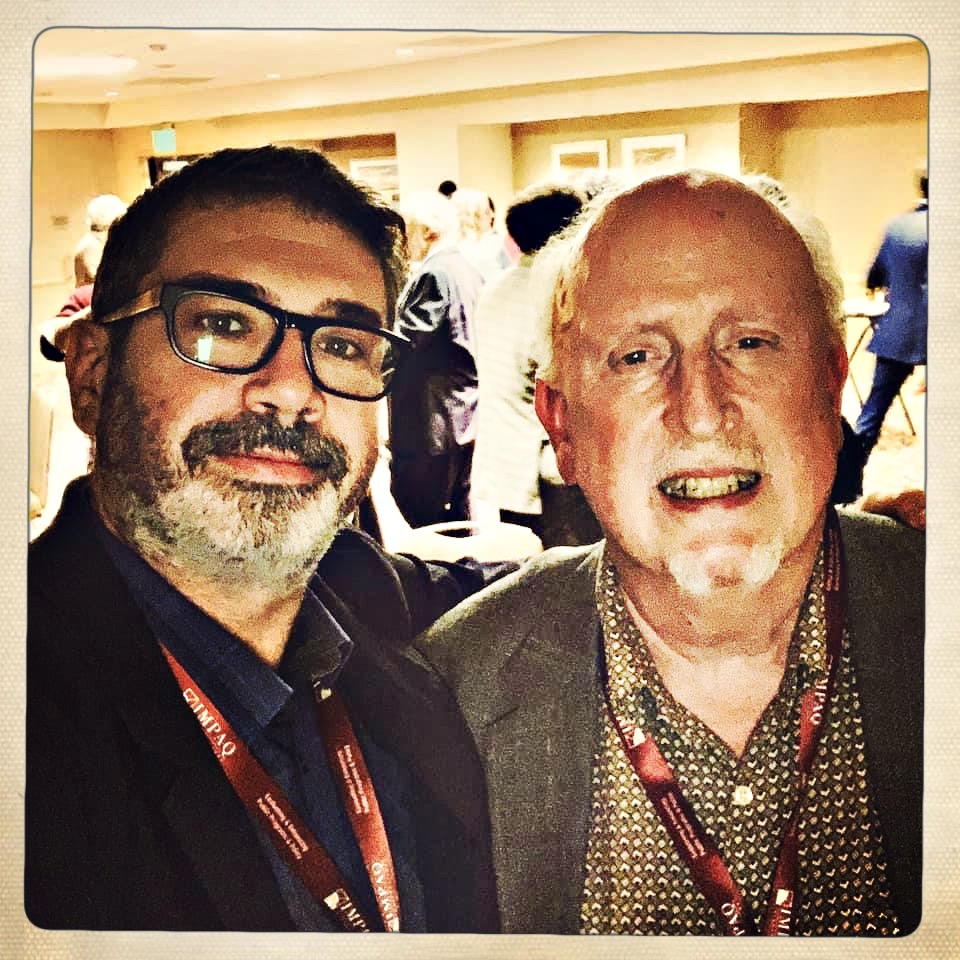
At the ASSA in San Diego, before the pandemic

It is hard to believe that Barkley has passed away. I met Barkley long ago, when I was still a PhD student in the 1990s, at the Eastern Economic Association Meeting, which still is one of the organizations that congregates both mainstream and heterodox economists with some degree of interaction. Perhaps the only such conference that still exists in the US. Barkley moved in between the mainstream and the heterodoxy. He should be seen, to a great extent, in the way he described the heterodoxy, as trying to break away from orthodox thinking. Although I disagreed about that definition as a description of heterodox economics, I think his definition reflected very well what he was trying to do.

His view of heterodoxy was based on the idea that the mainstream was ossified and didn't capture the complexity of actual economies. In part, he dealt with that by assuming non-linearities, and discontinuities and noting the unrealistic character of rational maximizing assumptions in a complex world. However, I think some of his most interesting work had an institutional character and was based on his joint work with his wife Marina on comparative economic development, in its third edition now.

He was the founding editor of the Review of Behavioral Economics, having been before the editor of Journal of Economic Behavior & Organization, he was interested in Econophysics (he wrote the entry for the New Palgrave). He was also a blogger for one of the oldest and best established econ blogs, EconoSpeak (a short entry after his death). He was, of course, the co-editor of the New Palgrave. A great loss for the profession and all that knew him.


Paul Krugman's Godley-Tobin Lecture

 
Krugman and the editors of ROKE
 
Paul Krugman's lecture, reflecting on the contributions of James Tobin is now published by the Review of Keynesian Economics. The paper can be downloaded here.

Friday, February 3, 2023


The 6th Godley-Tobin Lecture will be delivered by Professor Joseph Stiglitz. More information will be made available soon. Registration here.

New book: Varieties of Capitalist Experience

Over the past twenty years there has emerged a compelling new discourse on varieties of capitalism. That discourse has an appealing common sense which challenges the view there is no alternative to free market capitalism. The initial view had a microeconomic focus that made firms the fulcrum of analysis. It distinguished between liberal market and coordinated market economies. Subsequently, there has emerged a second-generation literature which adopts a macroeconomic perspective that emphasizes differences in drivers of growth. This book provides a collection of essays that engage those second-generation concerns and questions. 

More info here.

Wednesday, February 1, 2023

Luigi Pasinetti (1930-2023)

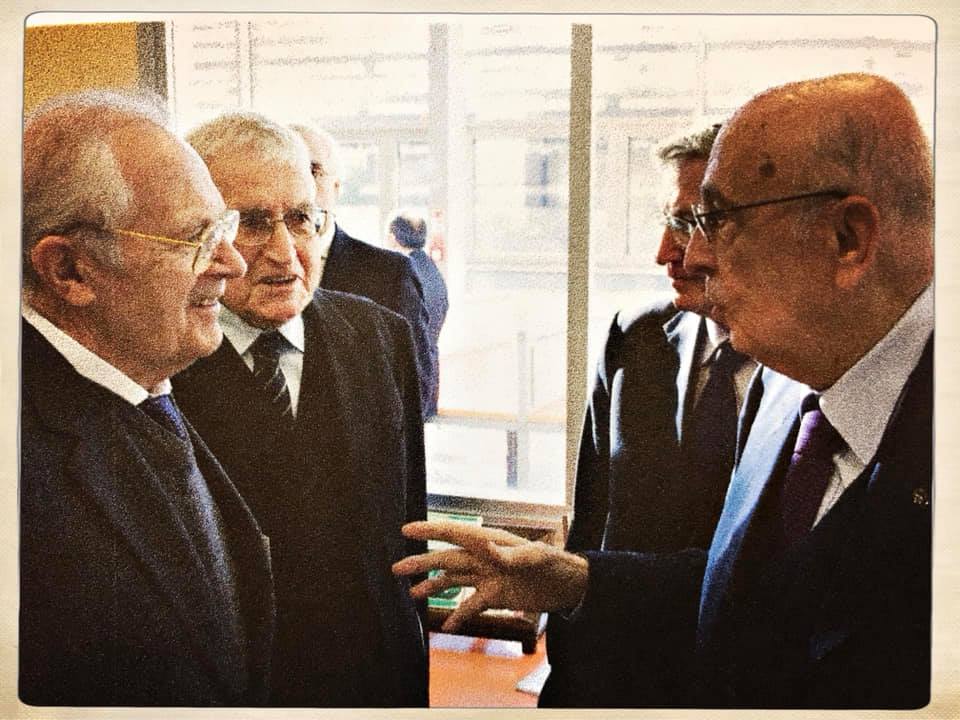
Pasinetti, Garegnani and the president of Italy in 2010

Last week, in my senior seminar on the history of economic thought, I made the kids read a paper by Pasinetti on "Progress in Economic Science", which was published in a book edited by Boehm, Gehrke, Kurz and Sturn. It's a short defense of pluralism in economics on the basis of the co-existence of Kuhnian paradigms, with a relatively optimistic view of the possibility of progress, in a discipline in which, as he noted, the object of analysis is changing continually, the ideas of the researchers might affect the functioning of the object of study, and value judgments cannot be avoided, in part because they affect everyday material conditions. As he said: "It is enough to think of the devaluation of a currency, or of the movements of wages and salaries, to realize how deeply these phenomena affect everybody’s pocket."

Sadly Pasinetti has died yesterday. He was perhaps the last great name of the Anglo-Italian Cambridge School, that tried to put the works of the classical authors and Marx and the Keynesian Revolution together, and intimately associated with the work of Piero Sraffa. I remember reading a paper on how the school could be divided in a more Marxian strand (with Pierangelo Garegnani as the main author) and a Ricardian one, around Pasinetti. This also had political implications with Pasinetti representing the center right Christian Democrats, and Garegnani on the left, linked to the Communist Party. I once told that to Garegnani, who dismissed the idea of Sraffian schools.*

Pasinetti will be remembered for his work on the Cambridge distribution models, the famous Kaldor-Pasinetti model, the participation in the capital debates, and his work on a classical model of structural growth. Personally, his book on the theory of production (Lectures on the Theory of Production) and his discussion and critique of the Maastricht fiscal limits remain the two of his contributions that influenced me the most.

I should note that this comes after a series of deaths in the profession that have significantly affected the heterodox community, and me personally. Vicky Chick, with whom I was supposed to work for my PhD, and Jim Crotty, two of the more creative thinkers within Post Keynesian economics have passed. Also, on a personal note, Nilüfer Çagatay, my colleague in Utah, and Barkley Rosser, the co-editor of the New Palgrave passed away this month. The heterodox community is in mourning.

* The other would be the Smithian one, with Sylos-Labini as the main leader, and a Socialist bent in politics.