Must see video (but I'm sorry to say in Portuguese). The talk at the last Demand-led Growth conference not yet available was in English, but much shorter. Once that is published I'll link it here.
Monday, September 4, 2023
Serrano on conflict inflation and inertia (in Portuguese)

Sunday, September 3, 2023
Lulismo’s Past and Present

Lula da Silva’s return to the presidency in Brazil has opened up the possibility of deepening democracy and expanding the scope of egalitarian advance for the Brazilian working class. In what ways might his administration pursue expansionary fiscal and redistributive policies that would improve the conditions of his political base?
In the latest print issue of Catalyst, Matías Vernengo explores the historical and contemporary contours of Brazil’s political economy and outlines how the Lula administration can trade a restrictive economic policy for a broadly redistributive one.
Read more here.
Tuesday, August 22, 2023
On Milei's economic plans for Argentina

Sturzenegger thanks Milei for his support while he was at the BCRA
Javier Milei's victory in the primary election has set alarms in Argentina. Many suggest that this was unexpected, and in a sense, given the more recent polls, it was. Also, many have suggested that his strong showing represents a protest vote, since he is a complete outsider, and that this is a repeat of the 2001/2 protests that demanded that all established politicians were ousted (que se vayan todos). But these are at best half truths.
Sure enough the vote on Milei represents a protest, but he is not really an outsider, even if he does come from the lower middle class. He is ensconced within the Argentine establishment that nurtured him in more than one way. He is at best an eccentric outcome of that Argentine establishment.
Note that he studied at the Universidad de Belgrano, and Universidad Torcuato Di Tella, both private universities, that normally cater to the elites in the country. He worked in several financial sector institutions, including Estudio Broda, founded and managed by Miguel Ángel Broda, a Chicago economist that has been part of the Argentine financial establishment for more than five decades. He was invited and interviewed in all the main media outlets of the country for years, and always treated as an economic expert, even if often he was there for his more colorful ideas and behavior.
Also, many of his current advisors had key positions in previous administrations. Roque Fernández, for example, was both president of the central bank and finance minister during the Convertibility period in which the exchange rate of the peso and the dollar was fixed, in a similar way to dollarization.
Milei and his plans, the two relevant ones (forget some of the crazy stuff that won't happen, like stopping all trade with China), namely, dollarization and closing the central bank, are not alien to the Argentine elites that he has served over the years, and that has provided him with jobs and media space. At the end of the day, all neoliberal experiments (the Military one between 1976 and 1983, the Peronist one with Menem between 1989 and 1999 and a bit beyond, and the Macri one between 2015 and 2019) included people that share similar ideas to Milei and his advisors, and some of them were involved in the previous neoliberal turns.
Last year, at a Milei event, Federico Sturzenegger, who worked for Domingo Cavallo at the end of Convertibility and was the head of the Central Bank (BCRA) during the Macri government, while noting that dollarization was not the best solution, and suggesting that central bank independence is not enough, went on to defend a common currency (interestingly enough the same plan of Grabois, the lefty in the Peronist primary). Milei's victory, if it happens (which is still not a sure thing), and his plans would not be significantly different than the previous neoliberal plans, and the consequences would be as negative as before.*
I have written quite a bit on the negative effects of dollarization (old book on that here). I'll leave a more detailed discussion for a later post. The important thing I want to note at this point is that, if there is a way of obtaining the dollars necessary for dollarization, then that would also allow for holding the exchange rate stable, precluding a large devaluation, and even to bring down the difference with the parallel (blue) dollar. Of course, that would imply resolving not only the financial external constraint that Argentina faces now, but also dealing with the payments (in dollars) to the IMF, which, at least at this point, seem to be beyond the country's capacity to repay. Formal dollarization wouldn't solve those problems, and would generate many new ones.
* That's not the only connection with the other neoliberal experiments. In all of them there were direct violations of human rights, or explicit support for the violators of human rights, and that's true also in Milei's case.
Thursday, August 17, 2023
Some brief thoughts on Bidenomics

There has been a lot of writing about Bidenomics (a name that might stick, like Reaganomics; nobody really thinks of Clintonomics as a thing) recently. It is fundamentally about the return of industrial policy, even if I personally think that this is less momentous than what people think. Don't get me wrong, both the rediscovery of fiscal policy after the 2007-9 recession (no fiscal packages after the 1990-91 or 2001 recessions, but packages after both 2007-9 and Pandemic in 2020), and the rediscovery of industrial policy, in part because of the rise of China, and in part because of the Pandemic/Chain supply shock, are important. And Bidenomics might stick because it announces a New Washington Consensus, that at least in theory abandons the neoliberal stances of the old one (see Jake Sullivan's speech).
My concern is that on both counts, the macroeconomic or fiscal front, and on the microeconomics, or industrial policy front, rhetoric is stronger than action. Or that it will be, at any rate. I'm not trying to blame Biden (or his team) for not breaking (or not enough) with conventional views. I mean I might have my views on how lefty or progressive (or even pro labor) Biden is (he did sign vote for every Free Trade Agreement possible, but he is allowed to change his mind). My concern is how much the common sense within the Democratic Party has changed. And while the the 2007-9 recession had moved many Dems and their advisors to rethinking about the macroeconomic consensus (not long ago Larry Summers was saying posties were right, and the economy had no tendency to full employment), the Pandemic inflation has done the opposite, as I noted here.
If the lesson was that Summers had been wrong (and Christina Romer right) on the size of the fiscal package needed for a fast recovery back then, now it seems that most economists (in the mainstream) agree with the notion that excess demand (particularly the last fiscal package early in 2021, and less the Pandemic ones, but that's another story) caused inflation, and the Fed fell behind and was correct in raising rates substantially. Note that the mechanism by which the Fed would reduce inflation is the conventional one, higher unemployment, less demand, lower prices (Summers, ironically, is one of the few actually that brings up the issue of bargaining power of workers with lower unemployment). And this diagnosis remains even though the level of unemployment didn't go down (after the recovery) at the same time that inflation came significantly down.
Of course, there's room still to discuss whether the Fed (together with the freezing of fiscal spending growth for next year by Congress) will end up throwing the economy into a recession or not. But either way, part of the legacy of the last crisis will be to reinforce the conventional new consensus model. Note, however, that the political risk is huge. Because Biden is forced to defend the notion that the economy (that recovered fast from the pandemic, no doubt) is doing great. And of course, the pre-Pandemic situation was far from ideal, and there's a reason why over the last decades a right-wing, blue collar movement has emerged. On that, trade policies were central, and the new industrial policy should play a role.
On the industrial policy front, it is worth remembering the existence of what Fred Block called the hidden developmental state, which suggests that the US always did industrial policy. But I doubt that the main effect of the New Washington Consensus will be to bring back many manufacturing jobs. Most of the ones that the establishment wants to move away from China (or at least part of the establishment, Adam Posen's views suggest that some are in doubt, about the movement away from the old one) will move to other Asian countries, like Vietnam and India.
At any rate, there are some reasons to be mildly skeptical about Bidenomics from a progressive perspective. Of course, I do think this is a huge improvement on Clintonomics, which was just Reaganomics, but more fiscally conservative.
Wednesday, August 16, 2023
On Milei's victory in Argentina for Portuguese TV (in Portuguese)
I'll post more on this soon. A few things, his economic ideas show a complete lack of understanding of basic principles. That he is taken seriously by a good chunk of the Argentina media (which is responsible for his rise) is appalling. I also don't think that it is certain that he will win, but in truth the mere possibility is frightening.
Tuesday, August 15, 2023
Inflation Paranoia and the Return of the New Consensus in Macroeconomics

And inflation will remain high, very high
This was published a while ago. I forgot to link it here. Their summary:
Economists have proposed two main theories to explain the recent spike in prices. Progressives have attributed the rise in inflation to corporate greed and have suggested price controls in response. Other economists have turned back to the New Consensus in Macroeconomics that arose in the 1970s in response to steep inflation blamed on the large Keynesian fiscal expansion of the preceding decades. Matías Vernengo writes that neither camp has correctly diagnosed the problems with current inflation. Proponents of Greedflation overlook the price stability of the last few decades even as market concentration increased. On the other hand, advocates of the New Consensus similarly forget their history and the commodity shocks and price-wage spiral that were the real culprit for inflation in the 1970s.
From my conclusion:
The inflation acceleration of the 1970s did not show that Keynesian policies were inefficient or had caused the acceleration of prices. As noted by James Tobin back then, inflation resulted from the oil shocks and the price-wage spiral. But inflation reinforced the social problems that led to the collapse of the old New Deal coalition and the Keynesian Consensus, ushering the Conservative Revolution and the New Consensus in Macroeconomics. The Pandemic inflation acceleration has undermined the revival of Keynesian ideas, and the revision of the New Consensus model that was under course. Instead of the concern with secular stagnation, we are back to inflation paranoia.
Friday, July 7, 2023
What’s driving inflation? Bucknell prof says maybe not what you think
My interview with Scott LaMar from WTFI, on inflation and the problems with demand-pull and oligopolistic inflation, for those interested in another iteration of the same. It's a bit longer than previous ones, and we go on some additional detail.
Thursday, June 29, 2023
Review of Keynesian Economics New Impact Factor

I am pleased to let you know that the 2023 Impact Factor for ROKE has gone up to 1.6 from 1.219. This puts us as one of the top heterodox journals. There are a few above, in my understanding, like the Cambridge Journal (2), and some incredibly good ones that were not ranked until recently, like the Review of Political Economy (now 1.5). One, of course, should take those ranks with some degree of caution. And old post on that here.
Friday, June 23, 2023
New directions in the Sraffian approach

Call for Papers (ROPE)
65 years after Production of Commodities by Means of Commodities: new directions in the Sraffian approach
Guest Editor: Santiago José Gahn
Internal Editor: Sylvio Kappes
The year 2025 marks the 65th anniversary of the publication of the book Production of Commodities by Means of Commodities by Piero Sraffa (1960). Not all economists are capable of transforming their name into a legacy, into a school. Piero Sraffa belongs to this select group. Exiled from fascism, he built his entire academic career at Cambridge University, where, from a profound analysis of the classical authors, he constructed a powerful critique of the dominant marginalist theory. But Sraffa's legacy has evolved into something much more powerful over the years, where some of his disciples have extended his criticism of marginalist theory, applied his ideas to international trade, and constructed alternative theories of economic growth.
65 years after Sraffa's publication, we believe it is necessary to launch a special issue that calls for reflection on his life, his political thoughts, his friendships, his lessons at Cambridge and his archive; his intellectual legacy, and that of his followers, and the impact on economic theory today; as well as possible guidelines for extending Sraffa's thought to other fields in the future. In recent years, Sraffa's legacy has had a boom that was born mainly in the periphery or the "global south", in particular in Argentina, Brazil and India. Recently, many authors have taken Sraffa's basic outlines and combined them with Latin American structuralist thinking in an attempt to explain the limits to growth and income distribution; they have developed and extended mathematical models of economic growth such as the Sraffian supermultiplier; they have presented the main limitations to Real Exchange Rate-led strategies, among other topics. Sraffa's legacy is alive and growing.
As a way of paying tribute to Production of Commodities by Means of Commodities (Sraffa, 1960) Review of Political Economy (ROPE) is preparing a special issue. This special issue intends to collect scientific articles that present or reinforce new lines of research within a Sraffian (or classical-Keynesian) perspective.
This special issue welcomes articles on a number of topics, including:
a. Sraffa's personal history, his relationship with Gramsci and his political thought.
b. Issues related to Sraffa's intellectual development, such as: extensions of PCMC, critique of mainstream theory, analysis of Sraffa’s archive.
c. Sraffa’s intellectual legacy: the direct impact on their followers such as Garegnani and Pasinetti, among others.
d. New directions in the Sraffian approach: extensions of the Sraffian supermultiplier model, endogenous money, international trade, imperialism and unequal exchange, the method in economics, impact of economic policies on gender, race or climate change. Articles that can extend Sraffian school to Anthropology and Sociology are also welcome.
Of course, all these topics can never cover the vast universe of the impact of Sraffa's intellectual legacy, but all articles that relate to Sraffa's thought are welcome, including critical ones as well. Finally, this special issue will attempt to have a gender balance.
If interested in submitting a paper, please send a short abstract by September 15th, 2023 to both Santiago J. Gahn (santiago.gahn@uniba.it) and Sylvio Kappes (sylviokappes@gmail.com). Decisions will be made by September 25th, 2023. If selected, the complete paper must be sent by May 1st, 2024.
Deadline for submitting abstracts: 15th September 2023
Deadline for submitting papers: 1st May 2024
References
Sraffa, P. (1960). Production of Commodities: Prelude to a Critique of Economic Theory. Cambridge University Press.
Wednesday, June 21, 2023
Unmasking Inflation: Why the Conventional Wisdom is Failing Us
Interview I gave for INET in January. From their website:
Matías Vernengo navigates the complex topic of inflation, discussing its implications on workers, and the economic policies that can potentially mitigate these effects. He explains the inflation of the 1970s and compares it to the more recent inflationary scenario provoked by global events. Vernengo evaluates the mainstream explanations - demand-pull and cost-push theories - and presents an alternative, heterodox explanation that views inflation as a result of distributive conflict and corporate power. While he acknowledges the role of corporations, he emphasizes that it’s the effects of inflation, primarily on workers’ real wages, that require addressing. He argues that the best policy would be to compensate workers for these effects. Vernengo’s analysis covers not just the American context, but also examines inflation in peripheral economies like Argentina and Turkey, identifying a link to exchange rates. He also critiques the “one-size-fits-all” theory approach to understanding inflation, underscoring the need for a heterodox economics perspective that could offer more nuanced insights and potential solutions.
Monday, June 19, 2023
Special Issue of the Review of Keynesian Economics

- The relevance of the center-periphery analysis and/or its limitations;
- Income and/or wealth distribution: the distributive and redistributive effects (in central and peripheral countries) of the neoliberal globalization;Debt tolerance/financial crises: the destabilizing role of central monetary policies on the peripheral economies;
- International political economy: the ongoing reconfiguration of center-periphery relations;
- Decoupling of a global West from an emerging Asia; future and crisis of globalization;
- The inherent fragility of global supply chains;
- Any other topic related to the center-periphery analysis in a classical-Keynesian perspective.
Submissions should be made using the usual channels of the journal, and they will be managed jointly by editors and guest editors. All accepted articles will be published in the special issue.
Deadline for submissions: November 30, 2023. For further information, please contact the Guest Editors: Matias Vernengo (Bucknell University, U.S.A.; mv012@bucknell.edu) and Roberto Lampa (University of Macerata, Italy; r.lampa@unimc.it)
Sunday, June 18, 2023
A New Turn to the Left in Latin America?

Friday, June 16, 2023
How tight is the labor market?
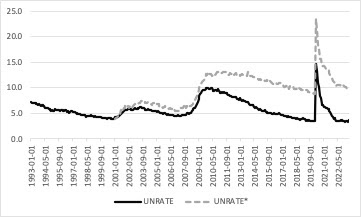
Inflation is coming down, as the last BLS report shows. I'm not going to get into that into this (very short) post. The disinflation has taken place while the official unemployment remains very low. However, we all know that unemployment measures very poorly the situation in the labor market. My alternative measure, which I make students calculate in macro classes, is what would be the unemployment rate be if the participation rate, which has been declining since the early 2000s (when China entered the WTO; see on that and deindustrialization this very old post), was the same of the last peak (back at the end of the Clinton era) when it was at about 67 percent (see below).

Note that the unemployment rate has a negative relationship with the participation rate, everything else constant. The result below.
Subscribe to:
Posts (Atom)