
Read rest here.
Read rest here.
The issue is back in the news. This time in Brazil (it was briefly an issue here when Trump did not reappoint Yellen, and then complained about Powell's interest rate where too high). At any rate, I always thought that there were good reasons for skepticism about central bank independence (CBI). As noted by Massimo Pivetti in this old piece on the Maastricht Accord and the, at that time, plan for the euro, the main reason to be doubtful is related to the interaction of monetary policy and fiscal policy. And as Quantitative Easing in the post-Global Financial Crisis has shown, central banks have become again fiscal agents of the state (never stopped being that, in all fairness).
The other important reason alluded by Pivetti for doubting CBI is the effects of the interest rate on the exchange rate and balance of payments. This is a quote from Pivetti:

And one could add, through the exchange rate, the effects on inflation also matter. This can be illustrated by the discussion of the Brazilian case. Lula has been very critical of the policies of the Brazilian Central Bank (BCB), and of the higher interest rates, since the campaign last year, and some sort of a truce has been in the works, with him being less direct (or at least that has been reported).
At any rate, the notion is that the higher interest rate is inimical to growth, even though Brazil did grow with relatively high interest rates in his first two mandates. The important thing to note is that Brazil had back then a relatively high and positive interest rate differential, that is a domestic nominal interest rates higher than the sum of external interest rate (the US rate) plus the risk premium (e.g. J.P. Morgan's Emerging Market Bond Index, EMBI), plus the expected nominal devaluation. In fact, as the interest rate differential (here just the difference of the BCB's Selic rate, the Fed Funds plus the EMBI) was coming down, the exchange rate depreciated.
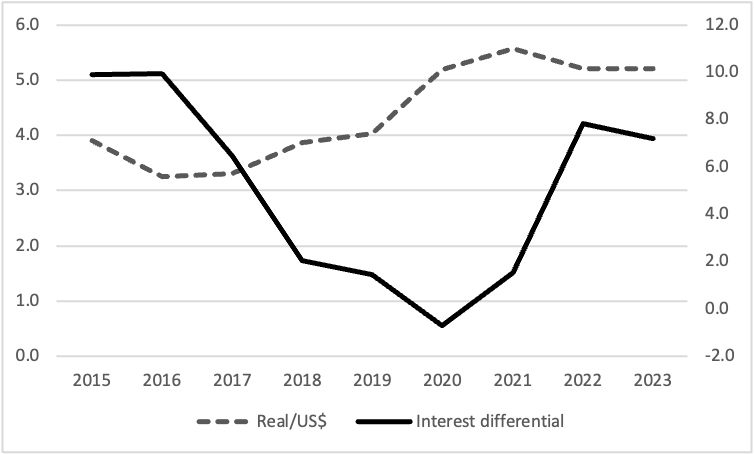
There is ample space to discuss how high the rate should be, but I'm doubtful that it can be close to zero or very low as suggested recently by André Lara Resende (that since my last post on his views, see here, has move away from Cochrane's fiscal theory of the price level, and closer to MMT; I just read his new book and that seems to be the case; on Cochrane's views on inflation see this video, also with John Taylor and Kevin Warsh).
Below the BCB's Selic rate and the Fed Funds for a longer period, starting after the stabilization of the Real Plan in the 1990s.

Working paper on the Post Keynesian Economics Society website. From the abstract:
The current debate on the causes of inflation is dominated by a particular view of what caused the inflationary acceleration in the 1970s, the so-called Great Inflation. In this view inflation is always and everywhere a demand phenomenon and requires contractionary monetary policy to be kept under control. The alternative view put forward by many heterodox authors emphasize what might be termed the oligopolistic view of inflation. In this paper we trace the limitations of both views for the center and the periphery.
Download paper here.
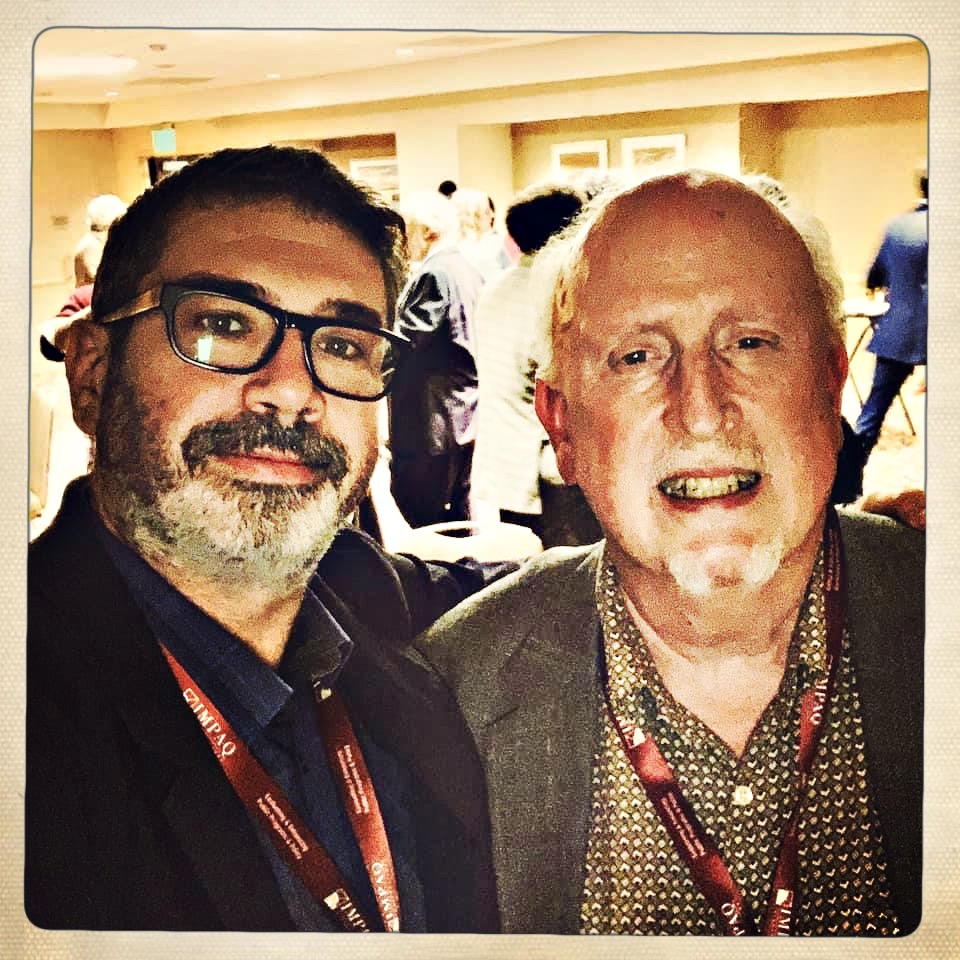
It is hard to believe that Barkley has passed away. I met Barkley long ago, when I was still a PhD student in the 1990s, at the Eastern Economic Association Meeting, which still is one of the organizations that congregates both mainstream and heterodox economists with some degree of interaction. Perhaps the only such conference that still exists in the US. Barkley moved in between the mainstream and the heterodoxy. He should be seen, to a great extent, in the way he described the heterodoxy, as trying to break away from orthodox thinking. Although I disagreed about that definition as a description of heterodox economics, I think his definition reflected very well what he was trying to do.
His view of heterodoxy was based on the idea that the mainstream was ossified and didn't capture the complexity of actual economies. In part, he dealt with that by assuming non-linearities, and discontinuities and noting the unrealistic character of rational maximizing assumptions in a complex world. However, I think some of his most interesting work had an institutional character and was based on his joint work with his wife Marina on comparative economic development, in its third edition now.
He was the founding editor of the Review of Behavioral Economics, having been before the editor of Journal of Economic Behavior & Organization, he was interested in Econophysics (he wrote the entry for the New Palgrave). He was also a blogger for one of the oldest and best established econ blogs, EconoSpeak (a short entry after his death). He was, of course, the co-editor of the New Palgrave. A great loss for the profession and all that knew him.


The 6th Godley-Tobin Lecture will be delivered by Professor Joseph Stiglitz. More information will be made available soon. Registration here.
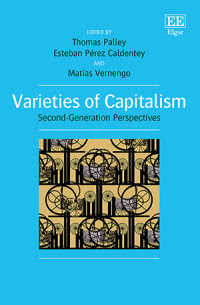
Over the past twenty years there has emerged a compelling new discourse on varieties of capitalism. That discourse has an appealing common sense which challenges the view there is no alternative to free market capitalism. The initial view had a microeconomic focus that made firms the fulcrum of analysis. It distinguished between liberal market and coordinated market economies. Subsequently, there has emerged a second-generation literature which adopts a macroeconomic perspective that emphasizes differences in drivers of growth. This book provides a collection of essays that engage those second-generation concerns and questions.
More info here.
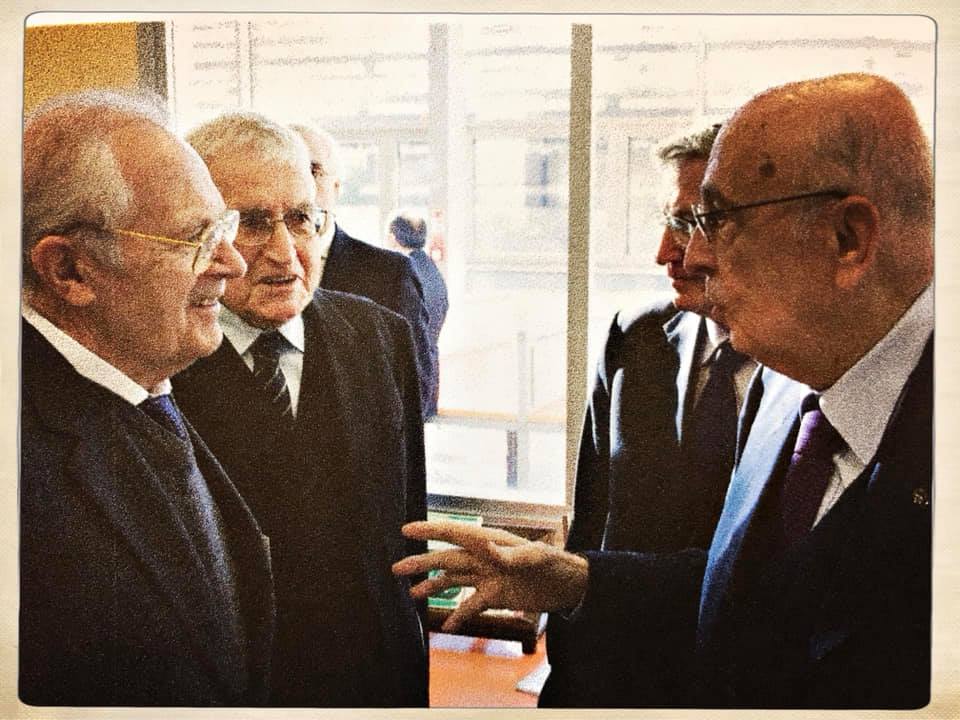
Last week, in my senior seminar on the history of economic thought, I made the kids read a paper by Pasinetti on "Progress in Economic Science", which was published in a book edited by Boehm, Gehrke, Kurz and Sturn. It's a short defense of pluralism in economics on the basis of the co-existence of Kuhnian paradigms, with a relatively optimistic view of the possibility of progress, in a discipline in which, as he noted, the object of analysis is changing continually, the ideas of the researchers might affect the functioning of the object of study, and value judgments cannot be avoided, in part because they affect everyday material conditions. As he said: "It is enough to think of the devaluation of a currency, or of the movements of wages and salaries, to realize how deeply these phenomena affect everybody’s pocket."
Sadly Pasinetti has died yesterday. He was perhaps the last great name of the Anglo-Italian Cambridge School, that tried to put the works of the classical authors and Marx and the Keynesian Revolution together, and intimately associated with the work of Piero Sraffa. I remember reading a paper on how the school could be divided in a more Marxian strand (with Pierangelo Garegnani as the main author) and a Ricardian one, around Pasinetti. This also had political implications with Pasinetti representing the center right Christian Democrats, and Garegnani on the left, linked to the Communist Party. I once told that to Garegnani, who dismissed the idea of Sraffian schools.*
Pasinetti will be remembered for his work on the Cambridge distribution models, the famous Kaldor-Pasinetti model, the participation in the capital debates, and his work on a classical model of structural growth. Personally, his book on the theory of production (Lectures on the Theory of Production) and his discussion and critique of the Maastricht fiscal limits remain the two of his contributions that influenced me the most.
I should note that this comes after a series of deaths in the profession that have significantly affected the heterodox community, and me personally. Vicky Chick, with whom I was supposed to work for my PhD, and Jim Crotty, two of the more creative thinkers within Post Keynesian economics have passed. Also, on a personal note, Nilüfer Çagatay, my colleague in Utah, and Barkley Rosser, the co-editor of the New Palgrave passed away this month. The heterodox community is in mourning.
* The other would be the Smithian one, with Sylos-Labini as the main leader, and a Socialist bent in politics.

Lula's visit to Argentina, during the Community of Latin American and Caribbean States (CELAC) meeting, brought about a brief discussion of the possibility of a common currency. I have discussed here (as well as many guest bloggers) both currency unions, in particular the euro, and it's consequences. Note that the FT piece linked suggested that the common currency was the first step in a long process. I doubt it, in part because, if the end goal is a real currency union, it would be a terrible idea. The actual proposal by the current finance minister, Fernando Haddad, and one of his collaborators, Gabriel Galípolo, falls short of a common currency area. It is still a bad idea.
The idea is to reduce the use of the dollar for bilateral transactions, and Haddad and Galípolo, in their piece for Folha de São Paulo last year, suggested that this would stimulate integration and trade. It is unclear that even that is correct. And there are other experiences with that kind of instrument in the region (e.g. the SUCRE in Ecuador, not the old currency, but the compensation mechanism).
The question about the proposal, which includes the creation of a digital currency and a central bank of the south, is what purpose does it serve. Haddad and Galípolo had suggested that it would further integration. That seems unlikely. Most of the integration has been done with Mercosur, and the most important way to integrate the countries in the region would be productively. The common currency won’t solve the Argentine external problems associated to the lack of dollar reserves either. And it won’t solve the Brazilian issue of how to deal with the political problem of the self-imposed fiscal ceiling limit, which make no sense, and constrains the ability of the government to promote growth and reduce inequality.
It is also unclear that anything beyond some general discussions would take place, and not just because the conditions are very different, and Argentina does not have dollar reserves, and hence the peso would depreciate considerably more with respect to the sur (the tentative currency) than the real would (note that the peso has depreciated way more than the real with respect to the dollar, and that to some extent explains the inflation differentials).
More importantly, Argentina has presidential elections this year, and it has to avoid a default on external obligations, something that is not the case in Brazil, obviously. In my view, the point of this announcement was purely political, and to suggest that the integration between the two countries, one with a threatened economy, the other with a threatened democracy, is a priority. Both left of center presidents stand together. Of course, the right place for this is UNASUR, not the Mercosur, and talks should be explicitly political. There is no circumstance in which a movement in the direction of a common currency makes any sense.

Teaching two history of thought classes this semester. One more traditional, focusing on the evolution of the theories of value and distribution, and another one, my regular senior seminar, on the co-evolution of ideas and policy in the United States. For the former I used a short piece by Peter Boettke on the reasons for reading the original sources (and they do read a fair amount in my class). The blackboard (pictured above) is based on his discussion. I changed the titles and the definition of the logic a little bit.
The archeological approach tries to understand the analytical views of authors in their own historical context, while the theoretical reconstruction tries to understand its relevance for modern theory. BTW, the divide between archeological and theoretical reconstruction was basically what students came up by themselves when asked why one would read the original contributions. The second one corresponds to the Whig version of the history of economic thought, and the contrarian or radical view, with the former seeing linear progress in the development of the discipline (a history of mistakes), and the latter presuming that there are important contributions that have "been submerged and forgotten" and that should be recovered for a critique of economic theory.
I would put Donald Winch as a representative of the Archeological/Whig view, and Blaug as the Theoretical/Whig one, even though I put there Stigler and Schumpeter (in part because Boettke talks about Stigler; it is not clear where he would put him, at least to me). My suggestions for the Radicals are Ronald Meek and Piero Sraffa (the former a student of the latter), respectively, for the Archeological and Theoretical.

Calvin Coolidge and Andrew Mellon
A new paper by Ahmad Borazan on the 1920-21 recession, often seen in libertarian and Austrian circles as an example of a laissez-faire recovery. From the abstract:
The US recovery from the 1920–21 recession has been presented as a triumph of laissez-faire policies and a serious challenge to Keynesian economics. This study interrogates this claim by using previously unutilised data and examines the historical development of the early 1920s recession and recovery. The study refutes the laissez-faire view and shows that the recovery indeed fits Keynes’s perspective. The deflationary recession was largely engineered by the Federal Reserve a la 1980s Volker disinflation. The recovery closely followed the reversal of tight monetary policy and was propelled by exceptionally long pent-up private consumption and residential spending. The recovery initiated the Roaring Twenties boom of weakened organised labour, rising income inequality and mounting private debt. This private debt-led boom proved unsustainable and was fraught with risks that contributed to the severity of the Great Depression. Although the recovery was not driven by fiscal policy, it cannot be seen as driven by price flexibility either.
Full paper here.

The book (in Spanish) titled "Economía en crisis : la enseñanza de la economía en Latinoamérica y los límites de la teoría ortodoxa" [Economy in Crisis: The teaching of economics in Latin America and the limits of orthodox theory] is edited Andrés Jose Maria Lambertini; Ignacio Silva Neira. The introductory chapter on the role of neoliberalism and its resilience in the region is by Esteban Pérez and myself. There's a webinar with Carolina Alves and Gabriel Porcile, besides the editors.

It will be in Spanish with English subtitles. You can register here.

New paper on the empirical evidence of the relevance of the supermultiplier for explaining economic cycles by Ricardo Summa, Gabriel Petrini, and Lucas Teixeira. From the abstract:
The demand-led supermultiplier growth model proposes that business investment is induced by income while autonomous expenditures determine economic growth. The most known versions of the model are presented at high levels of abstraction, focusing on general analytical properties and dynamic stability conditions. Based on those versions, Nikiforos et al. (2021) argue that the supermultiplier model cannot generate business cycles compatible with the empirical observation. In this paper, we show that this conclusion is a consequence of the misspecification of the variable chosen to represent the investment share, which includes business and residential investment. As the separation of those expenditures is a central point in the supermultiplier theory, we estimate a VAR model for the US economy (1967-2020) using only the data on business investment share instead. This procedure re-establishes an important feature to the supermultiplier theory, the mechanism of capital stock adjustment, as the empirical results points to the business investment share generally lagging the cycle. Finally, we make some remarks on how to discuss the business cycle from the supermultiplier perspective. We argue that for the supermultiplier, the business cycle depends less on the mechanism of capital stock adjustment than on the behavior of the autonomous components of demand and changes in the multiplier components. As the latter two are influenced by political, social and institutional factors, each business cycle has its own narrative.
Download here.
