Monday, September 29, 2014

New Book: "Towards a New Understanding of Sraffa" Edited by Bellofiore & Carter

Towards a New Understanding of Sraffa examines the legacy of Piero Sraffa by approaching his ideas in a new light, thanks to the insights gained from the opening of the archive collection of his papers at the Wren Library (Trinity College, Cambridge, UK). It provides a refreshing perspective into Sraffa's approach to money, the role of equilibrium and of the surplus in economic theory.  The study is backed by previously unpublished, original, archival material. It provides an appraisal of the discontinuities in the path leading to the publication in 1960 of Production of Commodities by Means of Commodities since its conception in the late 1920s. It unlocks significant new perspectives about the connection of Sraffa to Marx regarding Standard commodity, the macro-social and monetary theory of exploitation, the tendency of the rate of profit to fall, and the transformation of values into prices of production. It also offers insights on how Sraffa dealt with money in the various phases of his thinking, and explores his ideas about the role of equilibrium and of the surplus in economic theory. It concludes with an account of some recent Sraffa scholarship and points towards future research avenues. 
See rest here.

PS: (Matías here) There was a special issue of the Cambridge Journal of Economics on the topic here, with a response by Heinz Kurz here (subscriptions required). (David here) And here is an earlier piece by Kurz on Sraffa's unpublished manuscripts, in relation to the history of economic thought.

Friday, September 26, 2014

History versus equilibrium: a false dichotomy

The title comes from Joan Robinson's famous essay. However, the motivation is to clarify some comments on a previous post on what Keynes meant by unemployment equilibrium (sent to me, but not published). There is a relatively widespread notion among some post-Keynesians that neoclassical economics assumes always a single unique equilibrium, and that Keynes, or at least his closer followers like Robinson, believed in multiple equilibria. The idea is that post-Keynesians believe in an unstable, uncertain capitalist system in which full employment is only one possibility.

Beyond what one may think about equilibrium, there is no basis in the history of economic ideas for that view. Keynes was a Marshallian, and as such did believe in the notion of a single stable long run equilibrium of the system. The radical element in Keynes analysis is that such equilibrium might be suboptimal, that is, one in which resources are not fully utilized. He is very clear when he says in the General Theory that:
"it is an outstanding characteristic of the economic system in which we live that, whilst it is subject to severe fluctuations in respect of output and employment, it is not violently unstable. Indeed it seems capable of remaining in a chronic condition of sub-normal activity for a considerable period without any marked tendency either towards recovery or towards complete collapse. Moreover, the evidence indicates that full, or even approximately full, employment is of rare and short-lived occurrence. Fluctuations may start briskly but seem to wear themselves out before they have proceeded to great extremes, and an intermediate situation which is neither desperate nor satisfactory is our normal lot."
So what Keynes said is pretty clear, fluctuations around a normal equilibrium. Unemployment is the normal position, the long run equilibrium around which the system fluctuates. Like the old classical political economists (e.g. Smith, Ricardo, and Marx) and the marginalists of his time (e.g. Pigou, and Marshall) Keynes believed in a single stable long run equilibrium position. Note that nothing in Keynes analysis implies that the long run equilibrium is ever attained, or that it cannot be affected by the process by which it is approached, and, hence that it would be path-dependent [the supermultiplier story with a Kaldor-Verdoorn process is path dependent and is still a long run equilibrium position].

The problems associated to the negative impact of uncertainty, and failed expectations, and the institutions and conventions that are relevant in a certain historical context to minimize the effects of instability are all part of the normal operation of the economy for Keynes, and not, like in neoclassical models, superimposed on an essentially stable system. In other words, Keynes equilibrium theory is not a-historical, and hence does not require the addition of more realistic (historical?) elements to provide explanation of say why the system is stuck below full employment equilibrium.

For example, lack of demand (caused by stagnant wages and not enough fiscal stimulus) means that the US economy will the near future fluctuate around levels of unemployment that are above the previous normal levels. In the graph below (source) that is visible in a trend that was lower in the 1950s and 1960s, and goes up in the 1970s and 1980s, only to go down (as a result of a series of bubbles) in the 1990s, and, as I suggested, is likely to go up again. This trend represents the normal position to which Keynes alluded in the passage cited above. Unemployment fluctuates, but is not violently unstable (sometimes it might be; asks the Greeks). In the neoclassical model, in contrast, without imperfections, be that price rigidities or lack of information or any other kind, the system would move to full employment. That's why they often resort to change what the meaning of full employment is (the natural rate goes up; nudge, nudge; wink wink).
However, the interesting thing is that while the old neoclassical authors shared the classical political economists and Keynes notion of a stable long run equilibrium (optimal for the neoclassical, and not so for Keynes and the classical authors), they have departed from that view after the capital debates. In fact, it is in the Walrasian world of Arrow-Debreu's intertemporal equilibrium, that the notion of multiple equilibria becomes relevant (for the reasons why the mainstream changed their views on equilibrium go here; Garegnani classic paper titled "On a Change in the Notion of Equilibrium in Recent Work on Value" is the source of this idea). But in that world, anything could happen, it is wildly unstable and there no forces bringing the economy back to its normal position. Certainly not what Keynes thought, and also not an accurate description of the graph above.

More importantly, the very idea of long run equilibrium is central to our ability to theorize about the functioning of real, historically and institutionally specific economies. It is the fact that there are persistent forces, with regularities, which allows to say something meaningful about the functioning of the economy. If uncertainty rendered economic calculation impossible, then even Keynes' theory about how effective (autonomous) demand determines income, would be irrelevant, and in that case post-Keynesians would have (notice I said would have, since I don't think this is the right way to describe post-Keynesian economics) more in common with the modern neoclassical economists that have embraced multiple equilibria and all sorts of imperfections.

Jane D'Arista: An Appreciation

By Tom Schlesinger

Throughout her career as an author, analyst, congressional staff economist and teacher, Ms. D’Arista has brought together several strands of heterodox economics. While she may be characterized accurately as one of the last great institutionalists, her work also defies easy classification. Perhaps the clearest way to view Jane is as a tough-minded empiricist who has produced critical, original insights into the functioning of the financial system and economy – and done so with the uncompromising goal of improving human welfare.

From the Introduction to the book Banking, Monetary Policy And The Political Economy Of Financial Regulation: Essays in the Tradition of Jane D'Arista. Read rest here. Jerry Epstein posted this on Elgar's blog too.

PS: Jane is also a poetess, see her book here. The drawing of her above was done by Robert D'Arista, her late husband.

Tuesday, September 23, 2014

Mark Blyth and Eric Lonergan on Why Central Banks Should Give Money Directly to the People

Sunday, September 21, 2014

Giancarlo Bertocco on Keynes’s criticism of the Loanable Funds Theory

Recently, Lars P. Syll posted a critique of the loanable funds theory (see here), and Matias Vernengo provides his take here. Below is a paper by Giancarlo Bertocco, in which he provides an analysis of Keynes' criticism of LFT.

From the abstract:
Contemporary monetary theory, by accepting the theses of the Loanable funds theory, distances itself from Keynes, who considered the rate of interest as an exclusively monetary phenomenon, and overlooks the arguments Keynes used, following publication of the General Theory, to respond to the criticism of supporters of the Loanable funds theory such as Ohlin and Robertson. This paper aims to assert that the explicit consideration of the role of banks in financing firms‘ investments connected with the specification of the finance motive does not imply acceptance of the LFT, which holds that the interest rate is a real phenomenon determined by saving decisions, but makes it possible to elaborate a theory of credit alternative to the LFT and a sounder theory of the non neutrality of money than the one based on the liquidity preference theory. 
Read rest here and here.

Saturday, September 20, 2014

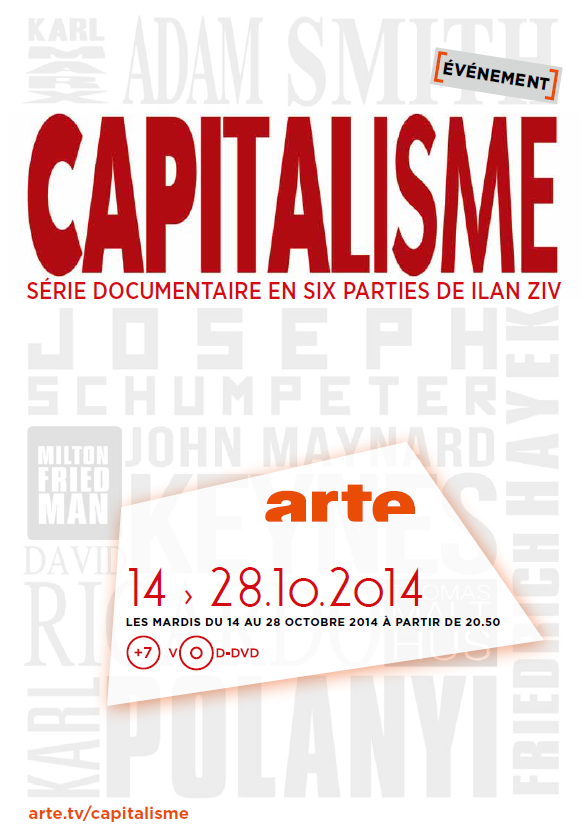
Capitalism, soon in a theater near you


"Economics is a science or a series of beliefs? The current crisis foretells the end of a system or its umpteenth transformation? Is the economy at man’s service or is it his master? What is the relationship between capitalism and democracy?

Through the reflections of many international experts (Robert Boyer, Ha-Joon Chang, James Galbraith, David Graeber, David Harvey, Kari Polanyi Levitt, Eric Mielants, Thomas Piketty, Robert Skidelsky, Yanis Varoufakis and Matías Vernengo) and thanks to a great wealth of archives we analyze the backstage and the contradictions of a system that underpins our everyday lives."

See more here and here.

Friday, September 19, 2014

Everything Must Change so that the IMF Can Remain the Same

Recent paper reviewing the role of the IMF after the Global Crisis and the supposed changes in its theoretical views and policy stances, co-authored with the late Kirsten Ford. We concluded that: "The IMF remains fundamentally an instrument of advanced and creditor countries, to force contractionary adjustments on poor, indebted countries."

On the theoretical front, it is worth remembering what Blanchard, the current IMF economic counsellor, said back in 2010:
"It is important to start by stating the obvious, namely, that the baby should not be thrown out with the bathwater. Most of the elements of the pre-crisis consensus, including the major conclusions from macroeconomic theory, still hold. Among them, the ultimate targets remain output and inflation stability. The natural rate hypothesis still holds, at least to a good enough approximation... Stable inflation must remain one of the major goals of monetary policy. Fiscal sustainability is of the essence." [Emphasis added]
So the whole change is a slightly higher inflation target, and a bit more expansionary fiscal policy, when the rate of interest is close to zero. You can read the rest, but if you have doubts about policy check what are the ones promoted by the IMF in the European periphery. As we argue: "If there is any change in the IMF policy advice it is difficult to find in its policies."

In defense of backwater economics


Jamie Galbraith on why the distinction between Saltwater and Freshwater (at minute 26 or so of the video) is not a good one, and why we need Backwater economics. Backwater is actually a good name, since it may be caused by an opposing current, and that's what heterodox economics should be, a counter current to the main stream. The other parts of the panel with Krugman and Buiter here and here. This was during the INET Rethinking Economics conference, by the way.

Thursday, September 18, 2014

Jamie Galbraith on The End of Normal


Interview on Charlie Rose on his new book.

Independence and monetary unions

So, as the map above shows, independence from the UK is nothing new. And I personally have no particular opinion on whether independence is good or bad for Scots, although many on the left seem to think it's a good idea. However, it is undeniable that independence and maintenance of the pound is a terrible idea. Here is Wynne Godley, who I should add was in favor of the European Union, but not of the currency union as it was organized, in 1992 (from a previous post available here).
"the power to issue its own money, to make drafts on its own central bank, is the main thing which defines national independence. If a country gives up or loses this power, it acquires the status of a local authority or colony. Local authorities and regions obviously cannot devalue. But they also lose the power to finance deficits through money creation while other methods of raising finance are subject to central regulation. Nor can they change interest rates. As local authorities possess none of the instruments of macro-economic policy, their political choice is confined to relatively minor matters of emphasis – a bit more education here, a bit less infrastructure there."
So much for the possibility of a more social democratic Scotland after independence. A bit more spending on education, in exchange for a lot of austerity.  Mind you, these effects my take a long time. Wynne predicted the problems of the Euro in 1992.

Tuesday, September 16, 2014

Lars P. Syll on how wrong Krugman & Mankiw are on loanable funds

By Lars P. Syll
Earlier this autumn yours truly was invited to participate in the New York Rethinking Economics conference. A busy schedule didn’t allow me to “go over there.” Fortunately some of the debates and presentations have been made available on the web, as for example here. Listening a couple of minutes into that video one can hear Paul Krugman strongly defending the loanable funds theory. Unfortunately this is not an exception among “New Keynesian” economists. Neglecting anything resembling a real-world finance system, Greg Mankiw — in the 8th edition of his intermediate textbook Macroeconomics — has appended a new chapter to the other nineteen chapters where finance more or less is equated to the neoclassical thought-construction of a “market for loanable funds."
Read rest here.

For an explication and presentation of the extent to which LFT is derivative of modern neo-Wicksellian macroeconomics, see here.

Monday, September 15, 2014

Ben Fine on the Material Culture of Financialisation

A FESSUD Working paper by Ben Fine.

From the abstract:
The purpose of this paper is threefold. First is to comment upon the nature of financialisation. Second is to frame how this leads financialisation to be understood whether consciously or otherwise. And, third, is to draw out implications for surveying households as their experiences and understandings of, and reactions to, financialisation without specifically designing a questionnaire itself for this purpose. As should already be apparent, underpinning this contribution is the presumption that financialisation is a characteristic of contemporary capitalism (and that the term is also an appropriate category for representing this characteristic). The material culture of financialisation is addressed by drawing upon the 10 Cs approach that was developed for the study of consumption, highlighting how it is Constructed, Construed, Commodified, Conforming, Contextual, Contradictory, Closed, Contested, Collective, and Chaotic.
Read rest here.