Showing posts with label recession. Show all posts

Wednesday, December 24, 2025

On vibecession and progressive thinking about the macroeconomy

The numbers for the American economy are finally out, with a delay of two months. Growth was 4.3 percent in the third quarter, which is fundamentally related to an expansion of consumption. Investment is flat (a bit negative actually, so much for the AI investment boom), and government spending is positive (but not much), mostly defense. In the previous two reports it was barely positive. There is also a contraction of imports. Normally, that would imply a slowdown of the economy, but in this case part of it might be associated with the tariffs.

At any rate, what I had suggested all along throughout the year, in many debates, often against the grain, was that we were not on the verge of a recession because of tariffs, nor that tariffs would be inflationary. And I was correct. What happened is what I had suggested: we are seeing a continuous slowdown that had already started under Biden, simply after the expiration of many of the measures associated with the Pandemic and the fiscal expansion that followed it. Tariffs have not had a significant impact on quantities, and only a limited impact on prices. If they had an effect, it would be a one-off increase in the level of prices, not in the rate of growth of prices, meaning inflation. And inflation remains subdued.

There are a couple of things worth pointing out. First, there is this whole discussion about a “vibecession,” or whatever people want to call it. Most of the discussion, including this piece in the Financial Times, is not really about quantities. A recession is a decline in the level of output and employment. Employment numbers are not great, they reflect the slowdown of the economy. The last report in September, which I discussed here, does suggest that the economy is slowing down. Those things are connected. One of the few laws we have in macroeconomics, Okun’s law, tells us that a slowdown in the economy should be reflected in a softening of the labor market. But unemployment remains relatively low, so we are not in a recession, for what it’s worth.

The vibe is not one of recession, and it is also not really about inflation (really). The graph above from the Financial Times suggests that wages grew less than rents (shelter), largely due to high mortgage rates that feed into higher rental prices. Wages also grew less than food prices. So food and shelter are supposedly getting more expensive. But the wages shown there are average wages. Once you look at the wages of non-supervisory workers, those seem to be growing more or less at the same pace, still above average CPI inflation, and particularly close to rental inflation.

Wages at the bottom have not really lost much (red line). They did lose a little during the pandemic, but they recovered fast enough and have been growing at roughly the same pace as inflation.

Of course, there is a perception that things are not good, and things are not good for working-class people, but that does not mean that the problem is inflation. By suggesting that the problem is inflation, something Trump used against Biden, progressives miss the point. I have discussed how Bidenomics had been good in several respects, with many policies favoring working-class people, although many of them expired before the end of his term. The perception that things were not good was not because of inflation, but because the quality of jobs and the conditions facing the working class have been deteriorating for a generation, going back to the 1970s.

For a long period, productivity gains have not translated into better living standards or higher wages for people at the bottom. This is not a recent phenomenon. Anger has increased over time, and in particular after the failure to redress the injustices and unfairness of the system following the global financial crisis of 2007–2009, the so-called Great Recession. There was great hope that Barack Obama would bring a different kind of politics and economic policy, and the disappointment contributed to the backlash we see today.

People are now angry at Trump because of affordability issues, but this reinforces the idea that if Dems win and bring in someone not particularly different from Obama or Clinton, although Biden did move to the left of them, they may face the same problems. The issue is NOT inflation. I want to be absolutely clear: the issue is NOT inflation. That is what my graph above indicates.

The issue is the long run stagnation of wages, the quality of jobs, about future prospects, and about the inability of Dems to show that people will have a better quality of life in the future. Addressing this requires policies that promote higher minimum wages, that would have demonstration effects that would help lift wages more broadly; policies that tax the wealthy at higher rates so they are seen as contributing proportionally to the system; and policies that provide accessible healthcare. Healthcare in the United States is incredibly expensive and of poor quality compared to other advanced nations. The United States is the only advanced country without a single-payer national public health system, which makes it look, frankly, like an underdeveloped nation in this respect.

Also, progressives overemphasis on inflation will have a negative impact on macroeconomic debates, reinforcing very conventional views about how the economy works, as I noted in a piece I wrote for ProMarket, the magazine of the Stigler Center. This focus misses the real dangers facing the American economy. The real danger, as I have argued all year, is the Federal Reserve and its interest rate policy.

The slowdown of the economy suggests that the real issue is high interest rates. Shelter prices, which are the highest component in the graph, are being pushed up by high mortgage rates. These impact consumption more directly than any other mechanism. High interest rates may cause a recession in the United States, and the Fed needs to reduce rates much faster than it is willing to do (or at least that;s what it seems). Ironically, these strong GDP numbers may lead the Fed to keep rates relatively high because of the danger of inflation.

This raises another problematic issue: the idea that anything Trump says must be wrong (that's often correct). However, Trump is correct in arguing that interest rates should be lower. He is also correct in saying that there is no particular reason why the Fed should be independent of political power. I would not argue for direct presidential control, but the Fed should be more accountable to Congress, and to the people. Fiscal policy is clearly political, it involves the executive proposing a budget and Congress approving it. The idea that monetary policy is not political, should not be politicized, and should not be subject to democratic scrutiny is deeply entrenched in conventional thinking, but there is no reason it should be. Why is there no representative of labor on the Federal Open Market Committee? Someone who could point out, for example, that high interest rates raise mortgage rates, push up rents, and keep inflation higher. That it affects access to credit and consumption.

In this sense, progressives have played a role in reintroducing very conventional ideas into macroeconomic discussion: the idea that inflation is more central than employment and activity in policy matters, because it counts more for electoral purposes, and that the central bank must be independent of political power.

That’s it for the year. I don’t think I’ll blog again until 2026, so happy holidays to all!

Monday, August 4, 2025

More on the likelihood of a recession (and its causes if it happens)

If everybody was predicting a recession before the employment numbers last Friday,* now it has become an unanimity. The story is of course the uncertainty caused by the tariffs and the collapse of investment (a second story, far behind in popularity, is that profit squeeze, also caused by tariffs to some extent, caused the decline in investment). I should note that most stories in the press are vague about the mechanism for the recession. But when pressed most people fall into the uncertainty story.

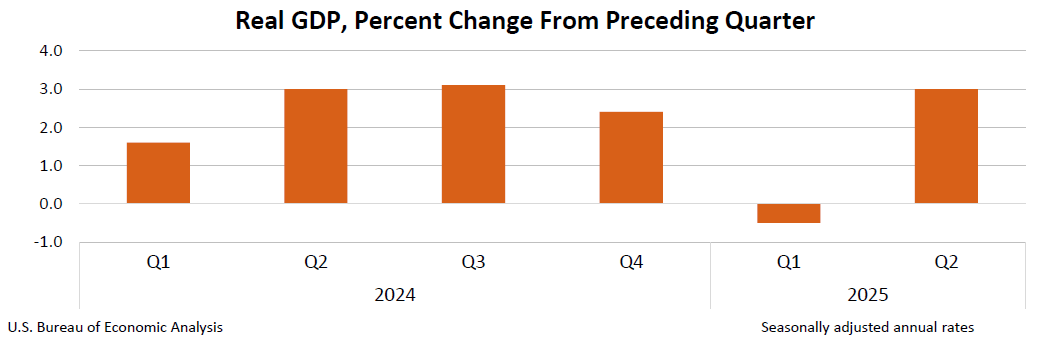
First, let me discuss briefly the numbers. GDP grew significantly in the second quarter, if one looks at the BEA Report, also released last week, at 3% (see figure below). Of course, as noted before, when the numbers of the first quarter come out, the whole story was in the import numbers. Huge increase in the first quarter (imports subtract from GDP, making growth negative), and large decline now, explaining the growth spurt. As noted before, in that same post, GDP is simply slowing down. Ray Fair has suggested that in the last forecast of his model, before the election last year. No surprises there.

 Real GDP: Percent change from preceding quarter

A better way of looking this is that growth is slowing down after a spurt that was caused by the rapid -- and I must add, bipartisan -- increase in spending after the pandemic, and the infamous (worst mistake in 40 years, according to Larry Summers) US$ 1.9 trillion fiscal package. The economy is sliding into lower rates of growth, now a little below 2% (see below).

Why was GDP slowing down, and even Fair forecasts suggested that before Trump's election victory, one might ask. The reason is that the fiscal expansion had basically given way to a less expansionist stance, and monetary policy had been tightening over the last two years. In fact, the most troublesome part of the two BEA reports this year is the slowdown in the government spending contributions to economic growth (negative in the first quarter, and only slightly positive in the second; and consistently negative at the federal level), with a large fall on non-defense spending in the second quarter (see this table).

Again, whether this would eventually continue is to be seen. It seems that the DOGE/libertarian wing of the GOP has lost internally, but the Big Beautiful Bill was more about cutting taxes (for the wealthy; and spending for the poor) than about expanding spending (even defense spending). This is not exactly Reaganomics (I'm not even talking about the tariffs).

The other thing is the effects of interests rates, which the Fed had also kept in place a couple of weeks ago, prompting lots of insults from Trump, and a renewed defense of the central bank by many progressives (I need to write about the new breed of Free Trade/Central Bank Independence progressives). As I have discussed before, a key variable here is Private Residential Fixed Investment, shown below. As I noted before, only four times this variable became rate of change was negative and a recession did not follow (In the early 50s, because of the Korean War, the late 60s, because of Vietnam, the early 90s, with the dot.com bubble, and in 2023, as a result of Biden's fiscal package, only possible in the post-pandemic context). Now this is again moving dangerously close to the negative space. This is where the big risk of a recession comes from. High interests that affect the ability of households to consume, that is tied to mortgage interest rates (which depend on the Fed policy rates). not surprisingly consumption has also grow sluggishly after an initial decline (even with wages at the bottom still growing more than inflation).


Interestingly enough, on this (and only on this), Trump seems to be right, and Powell wrong, even if you think that Powell is a decent man (I'm not sure anyone would be confused about Epstein... I mean, Trump). Lower interest rates would be important to avoid a recession. So it would be the case with a more robust round of spending on social transfers like we did during the pandemic. But that is certainly not happening. The mood has turned against fiscal policy, even among progressives. Not that there is any risk of a fiscal crisis. On this the MMT crowd is correct.

But as a conclusion: it is NOT the uncertainty of tariffs, or its effect on profits and investment (which is merely reactive to the level of activity). It is macroeconomic policy, or the mismanagement of the macro policy to be more precise, that might cause a recession.

* And yes, before anyone says anything, it was nuts to fire the BLS head. I doubt, however, that he will be able to cook the numbers, and think that even with a crony (I hope not) the BLS is a strong institution that will basically report the numbers, as it has done so far. 

Thursday, May 1, 2025

On the GDP data and the risk of a recession

For the most part what I suggested here, a month ago or so, seems to be essentially correct [the video is not very good, and it continued sharing the previous PowerPoint rather than mine]. What I said was that the objective or actual data on government spending, consumption and imports did not suggest a recession. I noted that the Atlanta Fed GDP Now prediction of a massive recession (2.8% of GDP) was probably incorrect and all predicated on the increase in imports, which were most likely an anticipation as a result of the announced tariffs, and that the economy would probably slowdown, as it was already slowing down, but that a recession was (at least immediately) unlikely. This is essentially what happened.

As I noted, these imports (say imported cars in a parking lot) are actually inventories, and more akin to investment. Jason Furman noted that if one looks at what he calls core GDP, then the economy grew at a more normal 2.4% in the first quarter. Note also, as I said in the above talk, that imports are pro-cyclical, and the rise in imports is NOT a sign of a recession.

Again, that does NOT mean that a recession should be ruled out. But the two mechanisms by which it would happen, if it does, should be properly understood. Uncertainty, per se, is not the central story. One channel as I noted in the presentation is the effect of possible higher rates (or simply no reductions) of interest on the housing market and from that on consumption. The Fed has been moved to a more hawkish stance, and even the possible new chairman, Kevin Warsh, seems even more hawkish. The other channel is in my view the big surprise of this report. Government spending fell, in particular a pronounced fall in defense spending. How much of that is caused by DOGE is unclear. The GDP tracker, when one looks at the monthly data, suggests a decrease, after February, even if overall spending since the beginning of the year is up when compared to 2024. But that seems to be the norm, and if they keep on track it should go up soon. Certainly no marked anomalous decline yet.

 
If the Trump administration takes a hawkish fiscal stance, then for sure we can expect a recession. I am somewhat skeptical that this is the case. Trump himself is not particularly concerned with fiscal issues beyond making his previous tax cut permanent. Republicans, except a tiny minority are not fiscal hawks. Actually, it is most likely to find fiscal hawks among Dems these days (and that is their problem; or one of them). But those would be the two channels that might cause a recession. To be seen.

Wednesday, April 16, 2025

Recession, Stagnation, Inflation, Debt Crises and more (with Franklin Serrano, Ricardo Summa, and Nathalie Marins)

Slow at posting. This should have been uploaded before, but it wasn't on my Zoom account. At any rate, I think the panel holds well even after a couple of months (from late February).

Monday, March 31, 2025

Policy Parlor with Franklin Serrano


My conversation with Franklin during his visit to Bucknell University. We talked about the supermultiplier and its applications to understanding real economies. The quality of the sound is better than I had expected, even if the camera is moving somewhat, and could be distracting.

Sunday, March 30, 2025

On the coming American Recession: Some skeptical notes

Everybody, including Trump, is talking about the forthcoming recession. In Trump's case, he suggests that while painful in the short run, it would be good in the long (when possibly will be dead). At any rate, I did comment (mostly on social media and podcasts) that most of that is based on subjective perceptions of what might happen, which is certainly not impossible if government spending is truly slashed by the Department of Government Efficiency (DOGE). But again, most evidence so far has been based on impressions, things like consumer confidence.

Most of the objective data, at least for now, does NOT suggest a recession, but rather a slowdown at worst. The new data that came out last week suggests still the same. The personal income and outlays report of the Bureau of Economic Analysis (BEA) suggests that real personal consumption remains more or less steady, a little below December, but with a minimal increase in February.

On the other hand, spending seems to be still on target to continue to grow at the same pace (in fact faster so far) even if many of the categories have changed, and winners and losers should be expected. If you cut Medicaid spending, and delay payments on Social Security while expediting government contracts to Space-X this might have distributive consequences, even if the level of activity does not fall.

The Brookings Institution real time federal spending tracker suggests that spending is higher in 2025 than in 2024, at least so far. Something that has been reported by several other outlets. Sure enough the Fed kept interest rates up, but there is no evidence that this has affected the housing market yet. Maybe the key word is yet. But there is a reasonable scenario that this Trump presidency, at least on this, will look like that previous, a slow expansion pushed by regressive tax cuts and higher spending on military/space contracts, with negative social consequences.

By the way, the Post indicated that on deportations, something similar is happening. Numbers are not up, with respect to Biden, even if the targets and methods have changed (and are certainly nastier). No doubt in other areas, the second term might be more problematic.