Showing posts with label Poverty. Show all posts

Tuesday, September 8, 2015

Jayati Ghosh on the Poverty-turn in Development Economics

As much as there has been an institutional turn in mainstream economics, since the 1980s, which is not completely dissociated from the anti-Keynesian turn that started in the 1970s and led to the segregation of heterodox groups within the profession, there has been a poverty-turn in the development economic literature, as noted by Jayati Ghosh.

Particularly important in this shift is that:
"Macroeconomic processes are entirely ignored: patterns of trade and economic activity that determine levels of employment and its distribution and the viability of particular activities, or fiscal policies that determine the extent to which essential public services like sanitation, health and education will be provided, or investment policies that determine the kind of physical infrastructure available and therefore the backwardness of a particular region, or financial policies that create boom and bust volatility in various markets. No link is even hinted at between the enrichment of some and the impoverishment of others, as if the rich and the poor somehow inhabit different social worlds with no economic interdependence at all, and that the rich do not rely upon the labour of the poor. This shuttered vision is particularly evident in the neglect of the international dimension in such analyses, and of the way in which global economic processes and rules impinge on the ability of states in less developed countries to even attempt economic diversification and fulfillment of the social and economic rights of their citizens."
The notion that development, and that meant industrialization, is central for elimination of poverty has vanished. But the mainstream has adopted a pro-poor stance. And who is really against reducing poverty?

Saturday, April 18, 2015

Sanford Schram on how the welfare system is designed to keep the poor poorer

Sanford Schram, professor of political science at Hunter College, argues that the welfare system in the United States, as it is currently institutionalized, marks the poor as deviant, and, thus, manufactures their otherness in order to reinforce, or buttress, anti-welfare antipathy.

Sunday, July 27, 2014

CEPR on "Minimum Wage Workers Pay Cut Clock"

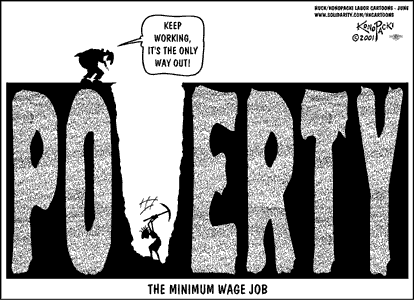
The last time the federal minimum wage was raised was July 24, 2009, to $7.25 per hour. Workers making the minimum wage have been facing a continual pay cut since then, as inflation has eroded the purchasing power of the minimum wage.

The first minimum wage pay cut clock shows how many dollars America's minimum wage workers have lost since July 2009. Every second it shows how much more money they're losing, as long as the federal minimum wage remains stuck at $7.25. Mind you, even if the federal minimum wage were to catch up to its July 2009 level, it would still be far below its historical level. The peak year for the U.S. minimum wage was 1968.

The second clock shows how many dollars America's minimum wage workers have lost since July 24, 2009 if the minimum wage had instead been raised to its 1968 level and then kept pace with inflation since then. Every second it shows how much more money they're losing, as long as the federal minimum wage remains below its historical peak.

See here.

Wednesday, June 11, 2014

EPI | Over 1/4 of men 25-34 years old earned poverty-level wages in 2013

By Elise Gould
In honor of Father’s Day, we looked at the wages of male workers at the prime age for raising young children. While women have always been more likely to earn poverty-level wages than men (wages less than what a full-time, year-round worker needs to sustain a family of four at the official poverty threshold), women have seen some improvement over the last three-and-a-half decades, as their rates of poverty-level wages have declined, especially among those 35 to 44 years old. On the other hand, men between 25 and 44 have seen precipitous increases in the share working at such low wages, with the share more than doubling between 1979 and 2013. This trend has been particularly stark among the younger age group. The figure below shows the share of male and female workers between 25 and 34 and between 35 and 44 years old who earn poverty-level wages. In 2013, that hourly wage was $11.49. Over one-fourth of men 25-34 years old earned poverty-level wages in 2013. The bottom line is there are a great many adults, and an increasing share of men, stuck in very low-paying jobs, and they are the same people who are responsible for raising the next generation.
See rest here.

Friday, January 31, 2014

Living Paycheck to Paycheck: Nearly 44% of Americans Have Less Than 3 Months' Worth of Savings

 
The 2014 Assets & Opportunity Scorecard finds that liquid asset poverty rates have barely budged. The percentage of households in the US who lack the savings needed to weather a financial storm like a job loss or medical emergency is holding tight at 44%, suggesting that almost half of Americans are on the brink of financial calamity. The Scorecard also found that problems like growing student loan debt and high rates of consumers with sub-prime credit—especially among households of color—are to blame for Americans’ lingering inability to get ahead and build a more secure financial future for themselves and their families.

Wednesday, January 29, 2014

Obama's Minimum Wage Hike Excludes Thousands and Fails to Look at Roots of Income Inequality

David Cay Johnston:
It's important that we restore the minimum wage. We're not talking about raising it. We're talking about restoring it. Back in the mid '60s, it was almost $11 an hour. And education is certainly very important and too much neglected in this country. We put huge barriers to bright but poor and middle-class children getting first-rate educations, especially at college. But we have much more fundamental problems than that. Many of these problems involve things like government rules that hardly anybody knows about that take money from the many and redistribute it to the few, the use of tax dollars to build factories, office buildings, and shopping malls, the rules that allow multinational corporations--not domestic, not mom-and-pop corporations, but multinational corporations-- to actually profit off their corporate income taxes by delaying payment of them for 30, 40, 50 years and having you and I let them deposit that money with the government to collect interest while the value of the tax they owe erodes.

Sunday, January 12, 2014

Honduras Since the Coup: Economic and Social Outcomes

By Jake Johnston and Stephan Lefebvre of CEPR. From the abstract:
This paper presents a broad overview of economic and social trends in Honduras since 2006, including the years following the military coup of June 2009. It finds that economic inequality in Honduras has increased dramatically since 2010, while poverty has worsened, unemployment has increased and underemployment has risen sharply, with many more workers receiving less than the minimum wage. While some of the decline was initially due to the global recession that began in 2008, much of it is a result of policy choices, including a decrease in social spending.
Read rest here.

Thursday, November 14, 2013

"In Bernie, I Trust" - Sanders Goes on Offense Against Austerity with 'Progressive Budget Blueprint'

Fighting back against the continued demand that nonsensical deficit reductions be achieved by slashing the nation's cherished social programs, Vermont's Independent (and perhaps the nation's only reputable) Senator Bernie Sanders says enough is enough.
1. Stop corporations from using offshore tax havens to avoid U.S. taxes. 
Each and every year, the United States loses an estimated $100 billion in tax revenues due to offshore tax abuses by the wealthy and large corporations. The situation has become so absurd that one five-story office building in the Cayman Islands is now the “home” to more than 18,000 corporations. 
2. Establish a Robin Hood tax on Wall Street speculators. 
Both the economic crisis and the deficit crisis are a direct result of the greed and recklessness on Wall Street. Creating a speculation fee of just 0.03 percent on the sale of credit default swaps, derivatives, options, futures, and large amounts of stock would reduce gambling on Wall Street, encourage the financial sector to invest in the job-creating productive economy, and reduce the deficit by $352 billion over 10 years, according to the Joint Committee on Taxation. 
3. End tax breaks and subsidies for big oil, gas and coal companies. 
If we ended tax breaks and subsidies for big oil, gas and coal companies, we could reduce the deficit by more than $113 billion over the next 10 years. The five largest oil companies in the United States have made over $1 trillion in profits over the past decade. Exxon Mobil is now the most profitable corporation in the world. Large, profitable fossil fuel companies do not need a tax break. 
4. Establish a progressive estate tax. 
If we established a progressive estate tax on inherited wealth of more than $3.5 million, we could raise more than $300 billion over 10 years. In 2010, Sen. Sanders introduced the Responsible Estate Tax Act that would reduce the deficit in a fair way while ensuring that 99.7 percent of Americans would never pay a penny in estate taxes. 
5. Tax capital gains and dividends the same as work. 
Taxing capital gains and dividends the same way that we tax work would raise more than $500 billion over the next decade. Warren Buffet has often said that he pays a lower effective tax rate than his secretary. The reason for this is that the wealthy obtain most of their income from capital gains and dividends, which is taxed at a much lower rate than work. Right now, the top marginal income tax for working is 39.6 percent, but the top tax rate on corporate dividends and capital gains is only 23.9 percent. 
6. Repeal all of the 2001 and 2003 Bush tax breaks for the top two percent. 
In January, Congress finally repealed the Bush tax breaks for the top one percent — households making more than $450,000 a year. But the Bush tax breaks have been continued for the top two percent — households with incomes between $250,000 and $450,000 a year. Repealing the Bush tax breaks for all of the top two percent would reduce the deficit by about $400 billion over the next decade. After President Clinton increased taxes on the top two percent, the economy added over 22 million jobs. After President Bush reduced taxes for the rich, the economy lost over 600,000 private sector jobs. 
7. Eliminate the cap on taxable income that goes into the Social Security Trust Fund. 
If we are serious about making sure that Social Security can pay all of the benefits owed to every eligible American for the next 50 to 75 years, we don't do that by cutting benefits, we do that by scrapping the cap on taxable income so that a millionaire and a billionaire pays the same percentage of their income into Social Security as someone making $40,000 or $50,000 a year. Right now, someone who earns $113,700 a year pays the same amount of money in Social Security taxes as a billionaire. This makes no sense. Applying the Social Security payroll tax on income above $250,000 would ensure that Social Security remains solvent for the next 50 years. This plan would only impact the wealthiest 1.3 percent of wage earners; 98.7 percent of wage earners in the United States would not see their taxes go up by one dime. 
8. Establish a currency manipulation fee on China and other countries. 
As almost everyone knows, China is manipulating its currency, giving it an unfair trade advantage over the United States and destroying decent paying manufacturing jobs in the process. If we imposed a currency manipulation fee on China and other currency manipulators, the Economic Policy Institute has estimated that we could raise $500 billion over 10 years and create 1 million jobs in the process. 
9. Reduce unnecessary and wasteful spending at the Pentagon. 
We should reduce unnecessary and wasteful spending at the pentagon, which now consumes over half of our discretionary budget. Much of the huge spending at the Pentagon is devoted to spending money on Cold War weapons programs to fight a Soviet Union that no longer exists. Lawrence Korb, an assistant secretary of defense under Ronald Reagan, has estimated that we could achieve significant savings of around $100 billion a year at the Pentagon while still ensuring that the United States has the strongest and most powerful military in the world. 
10. Require Medicare to negotiate for lower prescription drug prices with the pharmaceutical industry. 
Requiring Medicare to negotiate drug prices, similarly to what the VA currently does, would save more than $240 billion over 10 years.
Read rest here.

Friday, November 1, 2013

The Hidden Benefits of Food Stamps

From Mother Jones
Although the Republican-controlled House cuts are unlikely, given a promised veto from President Obama, food stamps will still be slashed by $5 billion on Nov. 1, when the 2009 Recovery Act that increased the aid along with other stimulus spending expires. The 13.6 percent temporary boost in food stamp dollars helped more than half a million Americans escape food insecurity, and millions more to climb out of poverty—4.7 million in 2011 alone, according the Center on Budget and Policy Priorities (CBPP).The Nov. 1 reduction means $36 less per month for a family of four and $11 less for a single person.
See rest here

Friday, August 30, 2013

Poverty, Cognition, and Human Potential: Another Crack in The 'Bell Curve' Myth

New research published in Science on how poverty affects mental capacities, in many respects, supports Maslow's pyramid of needs theory, namely, less demands for basic needs opens the mind to higher-order cogitation and creativity. Economic deprivation imposes such a massive cognitive load that little brain bandwidth is left over to maximize human potential.
In a series of experiments run by researchers at Princeton, Harvard, and the University of Warwick, low-income people who were primed to think about financial problems performed poorly on a series of cognition tests, saddled with a mental load that was the equivalent of losing an entire night’s sleep. Put another way, the condition of poverty imposed a mental burden akin to losing 13 IQ points, or comparable to the cognitive difference that’s been observed between chronic alcoholics and normal adults. 
The finding further undercuts the theory that poor people, through inherent weakness, are responsible for their own poverty – or that they ought to be able to lift themselves out of it with enough effort. This research suggests that the reality of poverty actually makes it harder to execute fundamental life skills. Being poor means, as the authors write, “coping with not just a shortfall of money, but also with a concurrent shortfall of cognitive resources.”
Read rest here.

Friday, May 31, 2013

Actual US Poverty Twice Official Figure: 1 in 3 Americans Cannot Meet Basic Needs.

Jeannette Wicks-Lim
"The official poverty statistic comes from a measure that was created in the mid--well, early 1960s. And it was really put together quickly, and it was kind of considered a placeholder, just 'cause the federal government wanted to have some way to measure poverty and basically took a very low-cost food plan and just multiplied it by three and decided that that was what would account for what a family would need just to be at a poverty-level standard of living. So that has been the measure over all this time, so about 50 years now [...] But, this official count has been criticized widely."

Sunday, May 26, 2013

The Real Numbers: Half of America in Poverty -- and It's Creeping toward 75%

The Census Bureau has reported that one out of six Americans lives in poverty. A shocking and despicable figure, to say the least. The extent of deprivation, however, is much (much) worse - see here.

Saturday, May 4, 2013

The strange persistence of poverty in the United States

I should confess my ignorance. I never actually looked at the time series of poverty in the United States. The graph below shows poverty from the late 1950s to the most recent data (source here).
Around 1960, close to 22% were poor, while after the War on Poverty, brought about by the new consciousness after Michael Harrington's The Other America, and arguably by John Kenneth Galbraith's The Affluent Society, during the Kennedy-Johnson administrations, the poverty rate was closer to 11%. That is, poverty was halved in a decade. [Talk about the failure of progressive policies!]

Note that since then poverty has more or less maintained its level, with an increase in the recessions, reaching around 15% after the Reagan one, and again after the current crisis, falling during booms. The absolute number of poor is now higher than in 1960, with more or less 46 millions in poverty. The composition has also changed, with the proportion of poor living in female-headed households being larger than before, and the number of extremely poor, in the total poor population, also being larger.

Mind you, a lot of the poor are working poor, and some of the explanation for the persistence of the poverty rates are associated to wage stagnation, no doubt. If nothing else, the poor performance of the labor market and the slow recovery hurt disproportionally the working poor. Only one more reason for repealing the Sequestration, and for expansionary fiscal policy, including some kind of work program.