John Cassidy is one of the best economic journalists around (together with Jeff Madrick probably). And not only because he has written about one of my mentors, Wynne Godley. In his last column he tackles the issue of productivity. And again I should say he is on the right track. He first gives a simple example of technological change from the donkey to the truck delivery system. Almost imperceptibly he tells you that you would change from one to another technology if: "you can find enough customers." Exactly, why would you invest in the new technology, the truck, if nobody is demanding more deliveries which would make the truck cost effective.
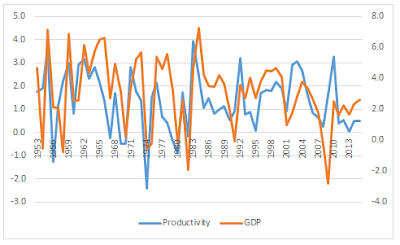
At any rate, he suggests three explanations for the current productivity slowdown (or the new concerns about it, since the Great Recession; this had temporarily vanished in the late 1990s when productivity picked up as a result of the so-called New Economy, i.e. information technology). The first, is that it's all a measurement problem, which in all fairness is not very credible. Then there is the Robert Gordon story that the third Industrial Revolution is less technologically dynamic. A supply-side story. And lastly, he hits the nail with the Kaldor-Verdoorn story. It is the slowdown in growth, mostly resulting from austerity. As the figure below shows productivity and GDP growth are highly correlated, and the question is whether you believe Gordon (with causality from productivity to GDP) or vice-versa, like Kaldor (Godley's intellectual hero, btw).
On Marx and other 19th century critical economists he might be wrong. But that is a topic for another post. On the calculations for Kaldor-Verdoorn go here (my method avoids the need to calculate potential GDP; on potential GDP see this interesting posts here, here and here by JW Mason).
At any rate, he suggests three explanations for the current productivity slowdown (or the new concerns about it, since the Great Recession; this had temporarily vanished in the late 1990s when productivity picked up as a result of the so-called New Economy, i.e. information technology). The first, is that it's all a measurement problem, which in all fairness is not very credible. Then there is the Robert Gordon story that the third Industrial Revolution is less technologically dynamic. A supply-side story. And lastly, he hits the nail with the Kaldor-Verdoorn story. It is the slowdown in growth, mostly resulting from austerity. As the figure below shows productivity and GDP growth are highly correlated, and the question is whether you believe Gordon (with causality from productivity to GDP) or vice-versa, like Kaldor (Godley's intellectual hero, btw).

On Marx and other 19th century critical economists he might be wrong. But that is a topic for another post. On the calculations for Kaldor-Verdoorn go here (my method avoids the need to calculate potential GDP; on potential GDP see this interesting posts here, here and here by JW Mason).
