Showing posts with label growth. Show all posts

Tuesday, July 8, 2014

Stop bashing GDP!


So everybody hates the Gross Domestic Product! The New York Times and the Financial Times have recently published articles criticizing the main measure of production in the economy. This is certainly not new, and criticism of the value of GDP for certain purposes, as a measure of well-being, for example, have led in the past to the creation of other variables like the United Nations Development Programme's Human Development Index, which includes GDP per capita (actually Gross National Income per capita), life expectancy at birth and average years of schooling for adults.

In fact, the NYTimes article basis for the supposedly dramatic "Rise and Fall of the GDP" is it's inability to measure well-being, and in it the author emphasizes its disadvantages when compared to the HDI. The NYTimes piece quotes Sen, the godfather of HDI, complaining about the "silliness about identifying growth with development." Of course, since GDP is only about the material growth of the economy, it would be an incomplete measure of development.

The most common type of critique is that GDP does not count many things, like environmental degradation, or happiness (yep, I know; check Putnam's ideas in the NYTimes piece; talk about silliness), or almost all non-market transactions for that matter, or is slow to adjust to new products and services introduced in the market, and that it's not particularly good for understanding inequality (Robert Reich's complaint in FT's piece; check the full list of complaints in both articles linked above). The best defense is provided by William Nordhaus, who argues compellingly that: “if you want to know why GDP matters, you can just put yourself back in the 1930 period, where we had no idea what was happening to our economy.”

First, GDP is not a measure of everything, and it certainly has limitations. But it does measure relatively well the material production in a given year, and provides the basis for understanding the process of accumulation, which is central for understanding the dynamics of capitalism. And actually, if you look at functional distribution of income in the National Income and Product Accounts (NIPA), which are used to calculate GDP, you do have one of the best measures of income inequality! Yes growth of the flow of goods and services produced in a country in a year is not tantamount to development, but without growth developing countries cannot achieve the levels of well-being of advanced economies, so growth is kind of a pre-requiste (and yes, growth involves environmental degradation, and we should try to minimize it). Further, with GDP one can obtain a fairly good measure of productivity (labor productivity), which is the basis for the Wealth of Nations, if you believe that dude Adam Smith.

My beef with the profession is not the use of GDP growth as a measure of material progress, but the fact that a limited, supply-constrained, individual maximizing utility, market-friendly, neoclassical version of the process of growth and development is the dominant one. But GDP is fine. Like price indexes, which also are limited and sometimes inaccurate, is an essential tool for understanding the real world.

Friday, November 8, 2013

Despite Upshot in Employment, No Real Changes in Long-Run Trends

Source: EPI's analysis of Bureau of Economic Analysis National Income and Product Accounts (Table 1.1.1 and Table 1.4.1)

By Josh Bivens
The Bureau of Economic Analysis (BEA) reported today that gross domestic product (GDP)—the widest measure of overall economic activity—grew at a 2.8 percent (annualized) rate in the third quarter of 2013. This was a slight increase relative to the second quarter’s 2.5 percent growth rate. 
However, there is little reason to celebrate today’s GDP numbers. For one, they remain disappointingly weak for an economy with so much productive slack. Further, growth in final demand—GDP stripped of the contribution of volatile inventory investments—grew at just a 2.0 percent rate in the third quarter. This arguably better indicator of underlying economic strength indicates that growth in the second quarter is essentially on the same disappointing trend that has characterized most of the recovery phase since the official end of the Great Recession. Additional evidence that third quarter growth was insufficient to soak up the economy’s productive slack is the continuing very low rates of core inflation measures. All in all, this is a status quo GDP report, and it clearly remains the case that the economy needs further support from both fiscal and monetary policy to generate growth sufficient to spur real improvement in the U.S. labor market.
See rest here.
By Heidi Shierholz
The jobs report released this morning by the Bureau of Labor Statistics showed the labor market gained 204,000 jobs in October, along with an upward revision of 60,000 to prior months’ data, bringing the average growth rate of the last year to 194,000. There appears to be no discernible impact on the payroll numbers of the partial government shutdown in October; in the payroll survey federal employees on furlough during the partial government shutdown were still considered employed. Importantly, the labor force participation rate dropped 0.4 percentage points to its lowest point of the downturn, 62.8%. The unemployment rate was little changed in October, ticking up slightly to 7.3%. The partial government shutdown may have played a role in the unemployment numbers, since federal employees on furlough during the partial government shutdown should have been counted as unemployed on temporary layoff in the household survey.
See rest here.

Wednesday, September 18, 2013

US Income Growth Has Stalled for Most Americans


The US Census released new income data, which revealed more evidence of the widening income gap between the rich and poor, prolonging the trend of the last 40 years.

See more data here and here.

Tuesday, September 17, 2013

Income Grew More When It Grew More Equally


Note: The light blue is the average annual growth rate during the earlier time period, and the dark blue is the average annual growth rate during the later time period. For each pair of bars represents a different income quintile.

Source: Economic Policy Institute

Friday, August 23, 2013

Geography, culture, institutions and economic growth

Acemoglu, Johnson and Robinson (p. 406) used a very effective visual aid to show that institutions and not culture of geography are the main or fundamental determinants of economic growth. A version of the graph using Maddison's data is shown below.
The graph does show that even though South and North Korea share the same culture and geographic conditions, they do have significantly different growth patterns after the 1970s, with GDP per capita in South Korea reaching more than US$20,000 by 2008, while North Korea never takes off, and after the collapse of the Soviet block reverts to the initial levels. This would suggest that institutions are central for growth.

There is the whole issue of which institutions are relevant, of course. Acemoglu et al. emphasize private property rights and the rule of law, which would allow entrepreneurs to invest. In their view, supply side factors are central. I would argue that demand forces are more relevant, and that symbiotic relation with US has played a role in South Korean success, in particular in lifting the balance of payments constraint that is the major hurdle for developing countries. At any rate, the figure below is meant to put the notion of South Korean success in perspective.
Note that both Koreas are unified in the graph (again using Maddison's data). Chile is a good comparison in Latin America in terms of GDP per capita. Yes Korea, both of them, were catching up in the 1950s and 60s, but from the mid-1980s onwards, all the growth of South Korea means that they keep the pace with Chile.

I am certainly not suggesting that the Chilean model, which relies on the export of commodities (fundamentally copper), which the neoliberals never privatized after Allende's nationalization by the way, and strict integration to world markets with Free Trade Agreements (FTA) with the US and everybody else, is a good strategy. Yet, the alternative of diving your country in two and becoming a satellite of the dominant hegemon at best makes you a middle income country. And of course is not open to all.

Thursday, May 23, 2013

Big news, maybe very big, in alternative energy sources

I have taken to calling my beliefs on the future of energy sources "weird energy." Why? Because the sources I am most interested in seem to violate the Second Law of Thermodynamics. Notice: this is so inviolable, we capitalize it. But they don't.

Why am I so interested in other energy sources? The obvious reason is a quest for zero carbon intensity, so getting rid of the big greenhouse gas. The other one is that the correlation between energy consumption and economic output, no matter how you measure it, and probably no matter when in history you look, is so tight that you could hang wallpaper by it. Some folks think I am weird because of this but, ya' know, data are data when used wisely. And this is really important.

Why think about "weird" sources? Minimally, because none of the current clean alternatives are cheap enough to really matter. They may get there, but if there are cheaper sources that work, why not go for them, even if they seem to violate physical laws. Beyond that, the energy potentials for these sources are difficult to logically digest, they are enormous, and should have enormous effects on economic systems.

With that, this week an independent group of physicists published the results of three series of tests starting in September last year and concluding in March this year on the so-called E-Cat of Andrea Rossi, an Italian entrepreneur.

The big news from the report, found here, is with the most conservative assumptions, the device produces over extended periods a minimum of an order-of-magnitude more energy output than is input or can be explained by any known chemical process. This is very conservative.

How conservative? The most eye-opening story is the first test in September 2012. The independent scientists did not have any participation from Rossi or his people; on their own they (accidentally) drove the device to failure in a fairly spectacular manner: the inner steel container of the device melted; the melting point of steel is ~ 1470 C. An outer ceramic container also melted. Ceramics have a melting point of ~ 2000 C. The active component producing this energy is a card-deck size core with powdered nickel, hydrogen, and some unspecified catalyst. No conceivable set of chemicals can produce such a chemical reaction, so something else is going on.

I won't go into theory here, as there are many and none which are yet sufficient. I will say this report has caught the attention of a wide group of skeptics who are properly evaluating the result.

Here is an image of the device about to destruct:


I believe the image on the left is from a thermal camera.

If this result holds, and Rossi successfully commercializes the device, the world will change dramatically. Possibly soon.

I will continue to use this space for updates that are significant.

Saturday, February 23, 2013

It's NOT just the external conditions

Frankly, it's a bit boring. But every time you show the actual data on Argentina's growth someone says it's just good luck. The terms of trade boom. Data below compares terms of trade in Argentina and Brazil in the same period, 2003-12 (Kirchner-Kirchner and Lula-Dilma).
Not very different, and if something terms of trade improved a little bit more in Brazil (33% against 22% approximately, for the whole period). Note that metallic commodities (Brazil is a big exporter of iron ore) increased more than agricultural goods (both Brazil and Argentina are big exporters of soybean and derived products, for example). So did Brazil grew more than Argentina, which is what you would expect if external conditions determined growth? See graph below.
As it turns out Argentina grew 5.8% against 3.6% in Brazil. Further Brazil has a larger current account deficit. Fiscal and monetary policy were more expansionary in Argentina, and the nominal and real exchange rates more devalued. Let alone that the average real wage grew more in Argentina. So no it was NOT all external conditions.

Can we please, pretty please, with sugar on top, stop just venting prejudices and get the data before we talk. You are entitled to be against the policies of the government, you might even be for the policies of the Washington Consensus (people have defended crazier ideas). But, as Daniel Patrick Moynihan used to say, you are not entitled to your own facts.

Thursday, September 13, 2012

Trade and Development Report 2012

The United Nations Conference on Trade and Development has just published the TDR 2012, on growth and inequality. Not surprisingly the TDR says that "rising inequality is [not] a necessary condition for sound economic growth." The table below shows the regional evolution of inequality since the 1980s.
As the report shows: "Empirical evidence shows that increasing income inequality has been a feature in the world economy since the early 1980s. However, in the 2000s in Latin America and in parts of Africa and South East-Asia income inequality fell in a context of improved external conditions. The evidence suggests that the relationship between growth and inequality is complex and can be altered by proactive economic and social policies."

Wednesday, September 5, 2012

Is Growth Still Possible?

Paul Krugman has recently pointed out a very pessimistic, but very instigating paper by Robert Gordon, about the possibilities of long run growth. Gordon suggests, very boldly, that the: “rapid progress made over the past 250 years could well turn out to be a unique episode in human history.” In his view, long-term stagnation is a very possible outcome. The reasons are associated to the effects of technical progress on investment.

Gordon argues that, while the first (steam, cotton textiles, railroad) and particularly the second (automobile, chemicals, electricity, oil) Industrial Revolutions (IR) led to a significant increase in investment, the third IR (information technology) has been less prone to lead to significant increases in investment. Further, the advantages of the first and second IRs were incremented by demographic changes and the process of urbanization, which created the need for investment in infrastructure.

Read the rest here.

Sunday, June 17, 2012

The Overton Window for game changing exotic energy technologies


Political scientists invoke something called the Overton Window to describe the range of possible political conversations. Forget for the moment that the political right is trying to control this window.

I want to discuss a different 'Overton Window,' one which involves the possible conversations around truly radical, even exotic, energy sources. A small group of economists, including me, believe that much of what is to be understood in growth and development has a large energy component. So possibilities to radically change the supply and cost of energy causes great consternation. But moving the conversation window even a tiny bit will have great benefits.

Geographically for me, it is truly ironic that in 1989 Professors Pons and Fleischman were tarred and feathered and ridden out of town on a rail over their forced, though admittedly premature, assertion at a University of Utah press conference of low energy nuclear reactions, a.k.a. cold fusion, in their laboratory.

Well, some two decades later several very serious, very credible, scientists have come out of the closet in support of the so-called FP discovery. Scientists from MIT, NASA, and, especially, the US Naval Research and Development arm (SPAWAR), based in San Diego. If you have an open mind, some scientific aptitude, and a life-changing hour, try this. If you want to discuss it, I can follow some of it and guide you, especially around the implications of the high-energy neutron depositions. This is very good and careful science.

Further, at least a half dozen known commercial ventures are underway, one of which (Broullin) received $2 million in venture funding this week. Another, the Andrea Rossi E-Cat project, reports just this week self-sustaining 600C output from their current reactor. The implications of this, if supportable, are profound in two senses: self sustaining implies both electricity output and infinite over-unity possibilities.

Now this sounds all very speculative and even specious, and you may question why it even appears on an Econ blog. Fairly simple in an Overton way: as my research and dissertation leads me to believe there is no more important component of an economy than its energy availability and consumption, these discoveries are game changers, and Economists should try to understand, discuss, and even model the implications. I will leave it there for the moment.

So, if true, we are on the cusp of a radical energy transition. One which 'fixes' global warming and changes all of our Economic growth models. Not a bad time to be an economist. Or a human. Put away your tars, feathers, and rails.


Tuesday, May 8, 2012

Why economists fail

The new book (and the accompanying blog) by Daron Acemoglu and James Robinson Why Nations Fails is a popular version of their academic papers (several with Simon Johnson, the ex IMF chief economist) on the topic [brief summary here]. The main idea is that institutions and not geography or culture are the key to economic development. That is for the most part true.

They use South and North Korea (and Nogales, México and Arizona) as an example of countries that share the same culture and geography, but have very different institutions, and, as a result, a huge disparity in income per capita. Jared Diamond is correct to point out that, in part, technology is geographically determined. No plants and animals to domesticate, and provide for a large surplus (Diamond uses the old classical notion of surplus), and higher population density (with the diseases and immunities associated to those Germs) and no advantages associated to a more developed division of labor (Diamond is also Smithian in that sense), with the consequent development of technology (Guns and Steel). But the problem is that this won’t help you understand why England and not China industrialized (the opposite extremes of the Eurasian continent).

Read the rest here.

Sunday, April 22, 2012

The reform of the central bank charter was necessary for growth and stability


By Sergio Cesaratto, Marc Lavoie and John Weeks

“Give me a one-handed economist! All my economists say: on the one hand… on the other…” once famously said the U.S. President Truman. In his interview to La Nación professor Lance Taylor provides the perfect example of a two-handed economist: he supports growth, but he warns of the dangers of inflation; he approves of a central bank that cooperates with fiscal authorities, but he warns of excessive public spending; he gives his support to import controls, but he warns of their possible “micro-inefficiencies”. Professor Taylor thus plays the two-handed game of criticizing whatever the Argentineans could possibly do, even if we are not completely convinced that he actually said in the interview that he is in favor of an Independent Central Bank, as the headline would make you believe.

Of course we share, and we are sure that the Argentinean government shares, some of these preoccupations – although we are less concerned with the idea that import controls only protect domestic inefficient sectors. To begin with, comparing Argentina with Europe, where the inability of the Central Bank to cooperate with the national treasuries has created the crisis, Argentina looks pretty good, with a central bank that is mandated to cooperate with the democratically-elected government to pursue growth and employment rates that are consistent with the lowest possible inflation rate. In Europe, a non-cooperative European Central Bank has let interest rates on sovereign debt jump to unsustainable levels. In that respect the Argentinean central bank acts more like the North American Federal Reserve.

In addition, European central bankers and political leaders have advocated austerity measures that are causing a serious recession and that exacerbate the public budget problems caused by the financial crisis, very much like Argentina did during the Convertibility period, in which the former Central Bank Charter was imposed. By contrast, in Argentina now, there is a pro-growth central bank that carefully uses its foreign exchange reserves to reduce the needs of the government to borrow on international financial markets, and that wishes to sustain domestic investment through a public investment bank. This can only be good news.

Nobody would deny the importance of a competitive real exchange rate to sustain exports and favor the development of a competitive manufacturing sector. We believe that the reliance of exports on the vagaries of soya prices and harvests is a preoccupation of the Argentinean authorities too. Many Argentinean economists are however skeptical about the positive effects of currency depreciation on manufacturing exports; instead they are more concerned about the inflationary effects that exchange depreciation might have in a country like Argentina, with its strong tradition of labour militancy in defending real wages. They also warn that a policy of real wage compression through a depreciating exchange rate, if successful, would depress domestic consumption, growth and unemployment, with little compensation from an unlikely export-led boom. So, in any case, the objective of a competitive exchange rate should not be accompanied by restrictive fiscal and monetary policies, but rather should be accompanied by income policies that would preserve real wages.

Finally, the government with the support of many economists, in its attempt to diversify the export sector and reduce the import dependence, is relying on a pro-active industrial and trade policy, rather than relying on the real-exchange-rate-depreciation cum fiscal-contraction model proposed by critics. One cannot forget that Brazil has public control of long-term finance through BNDES, and that given Argentina’s higher GDP growth rate, the Argentinean government might have legitimate reasons to impose imports controls. As to the inefficiencies allegedly brought about by import substitution policies and import controls, the de-industrialization outcomes of decades of neo-liberalism are a much worse heritage. We do favor, in general, a more depreciated exchange rate to reduce the external constraint, but because devaluation is inflationary, on the cost side, and there often is wage resistance, one must be moderate. Exchange rates are only one price, and the notion that there is a perfect level that would solve everything, leading to growth, stability and sustainable current account by itself, might be a chimera.

Originally published in Página/12 (in Spanish).

Saturday, December 24, 2011

The risks for Latin America in 2012

Nope, not a collapse of China, and also, not clear that it would be a severe collapse in the center, in particular Europe, although that one cannot be completely ruled out. The big risk comes from the macroeconomic policies adopted by Latin American economies.

A study by Esteban Pérez and Ramón Pineda, from ECLAC, shows that Latin American economies are, from a regional comparative perspective, good at withstanding the negative effects of contractions and bad at taking advantage of expansions to achieve convergence with the developed world.

While it is true that during this last crisis Latin American economies did recover fast, and pursued counter-cyclical fiscal policy, it is also true that the willingness to maintain expansionary policies has waned pretty fast. The IMF fear about overheating and the obsession with inflationary pressures has become dominant in the region (see my discussion of that earlier this year here).

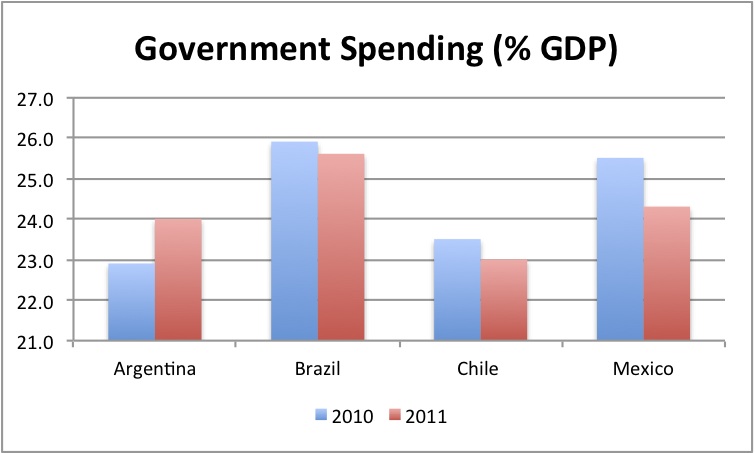
The graph below shows government spending as a share of GDP in the big four (Argentina, Brazil, Chile and Mexico). As it can be seen only in Argentina spending did not shrink in 2011 (an election year by the way), whereas in the other three the reduction were of 0.3, 0.5 and 1.2 of GDP. With a multiplier of around 2, ceteris paribus, there is a potential for a significant slowdown in the region.


In fact, in Brazil the economy already stalled to almost zero growth in the third quarter of the year (see here). Following Pérez and Pineda, one could hope for 2012 that countries in the region "instead of viewing expansions through the lens of ‘crisis management,’ expansions should be seen and understood as an opportunity to grow and expand and promote greater levels of well-being, employment and equity in the region." That's this blogger's hope for the New Year. Happy Holidays!

PS: Data from ECLAC here.

Wednesday, November 23, 2011

C02 emissions and fertility rates


Finally, a short break. I have been working on my main topic, the nexus of energy and development. And eventually of course the implications for the surplus approach. As part of a recent department environmental sustainability seminar centering on the models of Armon Rezai (and Lance Taylor and Duncan Foley), I presented data and (gasp!) forecasts using the Kaya model of carbon intensity. Surprisingly, there is hope in the data.

One of the points that leapt from the data is that population dynamics are a far greater weight on carbon emissions than the greening of the energy supply ("carbon intensity") and efficiency of energy consumption ("energy intensity"). Respectively, population is seven and three times more important in carbon emissions than either of those.

So, fertility becomes an (the?) important issue in climate debates. The data on global GDP per capita growth are among the most stable, and therefore predictable, that I have seen in macroeconomic series. In one hundred years, each of us will be earning $70,000 in 2005 USD (up from $7,000). Every one of us. Place your bets. So how many will that be?

The great news is that global fertility levels are plummeting, headed toward population decreases. One can see that in this Hans Rosling inspired motion chart using mainly World Bank data (with a recent addition of Jamie Galbraith's world inequality data based on Henri Theil indices). For those who may be concerned, I have no data on global coitus rates; I presume they remain healthy.

The data indicate that per capita GDP increases, female education, and more equal income distribution correlate with reduced fertility. This is great news since the first two are clearly "in train" around the world based on the data. Distribution, the great economic problem, jeopardizes climate as it becomes less equal in major economies.

Note that China has a current fertility rate of 1.6, below the 2.1 population sustainability rate. The biggest surprise is India, whose fertility at 2.7 was achieved without autarchy, a powerful endorsement of economic progress in damping fertility rates.

So we can have growth with some hope for climate given declining fertility rates even at current projected levels of carbon and energy intensities. My data intensive slides are here (including a discussion of the Kaya model). I gladly take questions. I will defer policy proposals. I need to refine the idea of global Fed helicopter drops of family planning supplies. (the interrupter of last resort?)

In a future post, with some trepidation, I will investigate the possibility of radical energy regimes and their implications for our economic and respiratory future. Are we approaching the end of the fossil energy epoch? An incredibly interesting question.
Link

Monday, August 22, 2011

One graph is worth...

The graph below shows the relation between the percentage change in hourly wages across all sectors of the economy in local currency adjusted for inflation and real GDP growth between 2003 and 2011 (last year is obviously a forecast), using data from the Economic Intelligence Unit (EIU, access is restricted).


Even if one does not completely trust the data on real wage growth in China and India, or the relevance of real wages (considering the size of informal markets) in developing countries when compared to the developed countries closer to the axis like France, Germany, Japan and the US. But clearly one way out of the crisis is to redistribute income, and promote a healthier increase of real wages and domestic demand.

Friday, June 17, 2011

Is Growth in China Investment-Led?


The general confusion, in both the mainstream and some heterodox groups, about the Asian development model is surprising, to say the least.  Martin Wolf, in a recent column (subscription required or here for free), says regarding the Chinese growth prospects that:
"Happily, China has close cultural and economic similarities with these east Asian successes. Unhappily, China shares with these economies a model of investment-led growth that is both a strength and a weakness. Moreover, China’s version of this model is extreme. For this reason, it is arguable that the model will cause difficulties even before it did in the arguably less distorted case of Japan."
The notion is that high rates of savings, associated to repression of consumption, and the absence of a social welfare net, lead to high rates of investment, which explain the incredible performance of Asian economies over the last 60 years or so, starting with Japan, followed by the Tigers, and then China.  The danger would be that, as the share of consumption grows, and:
"this pattern of growth is to reverse, as the government wishes, the growth of investment must fall well below that of GDP. This is what happened in Japan in the 1990s, with dire results."
Although, it is not quite expelled out, one would imagine that the problem is that with higher levels of consumption not enough savings would be left to 'finance' investment.  Further, the argument in the column suggests that as a result of the high levels of investment, returns "at the margin" are low, and "much of the investment now undertaken would be unprofitable."

In heterodox circles there used to be talk about an investment-profit nexus in the Asian development model. This was the main point of a famous paper by Akyuz and Gore (subscription required). The idea was that government policy accelerated the process of capital accumulation by creating rents and pushing profits over and above those that could be attained under free market policies, and higher profits generated incentives for investment and economic growth. Also, Asian economies displayed an ability to upgrade exports continuously through the "flying geese" path, and to their ability to generate the high levels of savings and investment required for this upgrading.

Further, Gabriel Palma, a well known heterodox economist at Cambridge University, argued that savings in an economy, necessary for capital accumulation and investment in his view, is not voluntary or spontaneous but needs a governmental role and that the general failure in Latin America to grow as fast as East Asia results, in part, to the fact that domestic savings have gone into consumption and not in investment. In other words, while the frugal Asian elites invested like ants, the spendthrift Latin American elites emulated the patterns of consumption of the developed world, like the grasshopper (see for example his paper on the Chilean bourgeoisie here; subscription required).

There are problems with both the neoclassical and the heterodox accounts of the Asian development model.  The conventional model suggests that the flow of savings somehow funds, investment.  Somebody should show this people the System of National Accounts (SNA-2008), which shows that savings are a residual.  Further, if the model shifts from export-led to domestic demand-led, in particular with higher levels of consumption, investment will continue to react, through the accelerator, and will not stop growing.  If consumption grows faster than output, and its share increases, either investment, government consumption or net exports, as shares will have to fall, but that would not signal any particular problem to the growth process.  Investment is the result of growth, in Asia as in any other part of the globe.

One possible danger is that if net exports become negative, an external constraint may become binding.  However, the Chinese have maintained a closed capital account, and manage their exchange rate, which suggests that there is is clear awareness that external constraints should be managed.  Also, they aggressively have searched sources of inputs, trying to secure favorable trading terms, so that access and ability to pay for imports will not force a slowdown of their economy. So a likely outcome is simply that the consumption share will increase while the investment will shrink, with no significant effect on growth.  The Japanese stagnation has nothing to do with a fall in the share of investment in total GDP, and is related, in part, to the collapse of a financial bubble.

For the heterodox story I suggest reading my post on whether the United States is profit-led. The problem is essentially the same with the general profit-led argument.  The problem is that investment is derived demand.  High profits do not lead to investment if demand growth is sluggish.  The central element in the Asian development model was the growth of exports, and their privileged access to American markets.  Carlos Medeiros (reading in Portuguese here) and Franklin Serrano have referred to this as "development by invitation."  Both the Chinese have benefited from access to American markets, as the Americans, with cheap consumption goods. More importantly for American corporations (besides access to the Chinese and other Asian markets) is the use of relocation as an effective threat against labor at home.

In sum, not only China is not investment-led, but additionally there is no significant risk from a Chinese development strategy that is more reliant on domestic sources of demand.  Consumption is not inimical to growth, particularly if it results from sustained increases in real wages, rather than the accumulation of private debt, as in recent American booms.  That is the Chinese challenge, to incorporate an increasing number of workers into the formal economy with higher real wages.

Monday, May 2, 2011

Is the American economy profit-led?


In a recent post I showed the evolution of real wages and long-term real rates of interest in the United States from 1950 until now. The figure below shows the real rate of output (GDP) growth for the same period. Between 1950 and 1973 the average (red line) rate of growth was 4.2% and in the subsequent period it was 2.7%. In other words, the change in income distribution dynamics, with a significant slower rate of growth of wages, was accompanied by a significant reduction in the pace of economic growth (we also saw in the previous post that it also went hand in hand with higher real rates of interest).


Many authors (e.g. the late David Gordon), in particular when looking at the evidence post-1970s, argued that the American economy is profit-led. In other words, as profits (some emphasized profit shares while others prioritized profit rates; the profit rate time the level of capacity utilization gives the profit share) expanded, it stimulated investment, and this, in turn, led to output growth. Growth was driven by profits.

The idea is that, even though the reduction in wages has a negative effect on consumption and output growth, this is more than compensated by the increase in investment. However, there are some empirical problems (there are some theoretical issues that I’ll deal with in another post) with this kind of model (often referred to as Kaleckian, even though it seems that their origin should be traced to Joan Robinson’s Accumulation of Capital and the influential formalization by Bob Rowthorn in the early 1980s).

For starters, growth actually fell significantly after real wages stagnated. Also, the output-to-capital ratio (shown from 1960 to 2008 using a OECD measure), as can be seen in the graph below, does not indicate a marked shift in the 1970s. The output-to-capital ratio goes up in the Johnson and Clinton booms, and falls otherwise. The Reagan boom was mild at best. This is consistent with the accelerator. As the economy moves closer to full employment, the output-to-capital ratio, a proxy for capacity utilization, moves close to its maximum. The accelerator would suggest that investment adjusts capacity to output. Investment is not the locomotive of the system, is the rear car (the idea behind the accelerator principle).


Since the 1970s the drivers of accumulation in the United States have been consumption booms driven by debt accumulation. In other words, as Barba and Pivetti have argued, increasing debt has allowed American families to continue to consume, in spite of stagnated wages. This has been mistaken in the empirical literature as a profit-led boom. The suggestion here is that the booms have continued to be driven by consumption (as in more traditional wage-led cases), and that the benefits for capital have been financial and associated to higher interest rates. The last three booms have been more Wall Street debt-led booms, rather than profit-led investment booms. Wall Street, not the Silicon Valley, defines the current American economy. After all, we all remember Gordon Gekko’s “greed is good” (uttered in real life by Ivan Boesky) and nobody remembers an iconic phrase by Bill Gates!

Saturday, April 9, 2011

Is there something in the water at the IMF?


via Mark Thoma, Economist's View
The paper:IMF on inequality and growth

Whilst I haven't yet taken the time to delve into the 'metrics, this looks to be an interesting survey and addition to one of the fundamental macro questions: whence growth. Interestingly, the authors highlight the finding of the importance of (the lack of) inequality for continuation of "growth spells."

Given its history, it's fairly stunning that this would emanate from the IMF. Further, I think it's time to do a really good syllabus on the topic of growth and inequality. Inequality mavens, send us your links!

I'll be reading this one more closely, especially in the context of Matias' immediately preceding post.