Showing posts with label Unemployment. Show all posts

Saturday, November 22, 2025

Labor numbers (or lack of) and the Trump economy

The elephant in the room? 

The long-delayed September employment numbers are finally out, and the news is mixed, much as expected. The economy added 119,000 jobs, while the unemployment rate ticked up slightly from 4.3% to 4.4%, still close to what the profession calls the natural rate, or what most people would simply call full employment. That's obviously not the best picture of the labor market. As always, the broader U6 measure gives a clearer picture of labor market slack (in my understanding), and it stands at 8%. We still don’t have the official October numbers, but private-sector estimates suggest a much weaker figure, around 40,000 jobs, driven partly by continued losses in manufacturing and in federal employment. The only clearly expanding sector remains health services.

This labor-market softness, that led to the earlier firing of the head of the BLS (will Trump fire someone else?), reinforces something I’ve said for a while here in the blog. The economy is slowing, but we are not yet in a recession.

Meanwhile, inflation continues subdued rather than accelerating. The September CPI report shows year-over-year inflation at 3%. Importantly, the largest price increases, electricity and utilities, used cars, and medical care services, other than shelter (more on that below), have nothing to do with tariffs. Studies suggesting tariffs added roughly 0.7 percentage points to inflation seem plausible, but that is far from the stagflation many predicted. If there is a remaining inflationary concern, it is shelter costs, driven not by tariffs, but by structural housing shortages and, in the short run, the Fed’s high interest-rate policy, which keeps mortgage rates, and rents, elevated.

Paradoxically, the Fed is now sustaining inflation by keeping rates high, and by bringing them down too slowly (perhaps the only thing I would agree with Trump*), while also risking a recession by tightening consumer credit and depressing construction. Consumption has already flattened (from last CEA report). At the same time, government spending, which continues at a healthy pace, and bubbles in crypto and AI continue to prop up activity.

Affordability concerns (see Mamdani's election and Trump's decision to reduce tariffs) remain real, but they have less to do with inflation per se, which has fallen sharply since late 2022, and more to do with the fact that real wages at the bottom, although rising (above CPI for non-supervisory employees), start from very low levels. People feel squeezed because they are squeezed.

That won't change any time soon. Trump is bound become very unpopular (in many ways, he already is), and his policies will not help people at the bottom. Dems don't need to do much, actually. Perhaps avoid self-inflicting wounds. [Unpopular view here: the shutdown was a mistake they should have avoided, since there was no way of winning; Trump wanted to shutdown the government, because Republicans do NOT care if it doesn't work. Cut medicare? No problem. Cut SNAP? Go ahead. But these callous policies will make them very unpopular].

Let me conclude in a more cheerful mood. For me that is. So here’s a small victory lap. The dire predictions that high tariffs would produce stagflation were wrong. Tariffs are now at their highest average level since the 1930s, around 17%, up from 2%, according to Yale's Budget Lab, yet they did not trigger either runaway inflation or a recession on their own. Stagflation is NOT the elephant in the room. Slowdown of the economy, which was already under way, and subdued inflation, close to the target. If we want to avoid a recession, and if we are serious about affordability, for both reasons, contrary to conventional wisdom, the Fed should begin cutting rates sooner rather than later.

* Obviously that doesn't mean I'd agree with his intervention at the Fed (we will know more on that once the SCOTUS rules on that next year). 

Sunday, March 10, 2024

Atonella Stirarti's Godley-Tobin Lecture

There was a problem during the 7th Godley-Tobin Lecture. I disconnected everyone when I was trying to fix a problem with Professor Stirati's presentation, and I didn't notice until much later. The worst part is that the recording was lost. I'm posting here the PowerPoint presentation for those interested. We will also post the link for the published version of the lecture, which will be open also on the website of the Review of Keynesian Economics (ROKE).

Friday, June 16, 2023

How tight is the labor market?

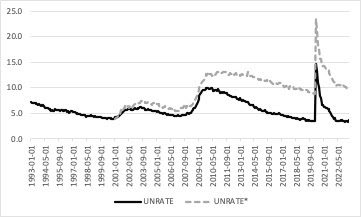
Inflation is coming down, as the last BLS report shows. I'm not going to get into that into this (very short) post. The disinflation has taken place while the official unemployment remains very low. However, we all know that unemployment measures very poorly the situation in the labor market. My alternative measure, which I make students calculate in macro classes, is what would be the unemployment rate be if the participation rate, which has been declining since the early 2000s (when China entered the WTO; see on that and deindustrialization this very old post), was the same of the last peak (back at the end of the Clinton era) when it was at about 67 percent (see below).

Note that the unemployment rate has a negative relationship with the participation rate, everything else constant. The result below.


The answer is, not 3.7 percent, but around 10 percent. In other words, there's a lot of what Joan Robinson used to call disguised unemployment. Discouraged workers that are not searching for a job, because they can't find anything worthwhile, and, hence, do not count as unemployed. This can be seen as the extra unemployment that we have because of the neoliberal policies of the last four decades, but in particular after the more radical opening to China starting in the 1990s.

Friday, May 26, 2017

Technological progress is NOT the cause of unemployment and inequality

Or that is what the recent Economic Policy Institute (EPI) Report by Lawrence Mishel and Josh Bivens says. Their study is essentially a critique of a recent study by Acemoglu and a co-author that suggests that robotization would have a large effect on employment generation. Note that this is not a requirement in mainstream neoclassical (marginalist) theory. Actually, technological progress should generate higher real wages and higher employment in the conventional model of the labor market (which is fraught with logical problems; yep capital debates apply here).

The reason, I mean the probable underlying ideological reason, for the narrative about robotization is that one cannot blame unemployment and inequality (wage stagnation) on policy decision made by conservative (neoliberal)   policy makers. It's the result of the inevitable changes in technology that are dictated by competition. The argument is not very different from the idea that it was not trade, but skill biased technical changed that caused most of the disruptions related to globalization. At any rate, below you can see the growth in labor productivity has actually slowed down in the last decades, and capital investment that incorporates the new technologies slowdown in tandem with productivity.
As Mishel and Bivens note, if automation and robotization were behind lower growth of output and employment you would need an acceleration of those trends in the recent period. Actually, productivity and investment were higher in the 50s and 60s, the Golden Age of capitalism, when employment growth was relatively high. There are many reasons for that, and I would point to the Kaldor-Verdoorn Law as the relevant regularity that explains why productivity is structurally connected to economic growth and employment generation.

Friday, May 6, 2016

Jobs numbers and slow recovery

Jobs report (BLS, Employment Situation Summary) confirms a relatively weak month in April with total nonfarm payroll employment increasing by 160,000. Also, the labor force participation rate decreased and the employment-population ratio both decreased a bit. Mining employment continued to decline, something that Trump promised to reverse and Clinton noted there might not be much we can do about (the implications might not be minor, see here). Also, while unemployment remains at 5% a broader measures of unemployment remain high. For example, total unemployed, plus all persons marginally attached to the labor force, plus total employed part time for economic reasons, as a percent of the civilian labor force plus all persons marginally attached to the labor force is at 9.7%.

Friday, August 7, 2015

Unemployment is unchanged and so is the Republican Party

So nothing new in the last report. 215k jobs created and unemployment rate at 5.3%. Below the employment to population ratio.
https://research.stlouisfed.org/fredgraph.jpg?hires=1&type=image/jpeg&chart_type=line&recession_bars=on&log_scales=&bgcolor=%23e1e9f0&graph_bgcolor=%23ffffff&fo=verdana&ts=12&tts=12&txtcolor=%23444444&show_legend=yes&show_axis_titles=yes&drp=0&cosd=1990-06-30&coed=2015-07-01&height=445&stacking=&range=Custom&mode=fred&id=EMRATIO&transformation=lin&nd=&ost=-99999&oet=99999&lsv=&lev=&scale=left&line_color=%234572a7&line_style=solid&lw=2&mark_type=none&mw=2&mma=0&fml=a&fgst=lin&fgsnd=2007-12-01&fq=Monthly&fam=avg&vintage_date=&revision_date=&width=670
It has started to go up. But there is a long way to go. By the way, in the Republican debate I didn't hear anything different as a solution for the economic problems. Tax cuts, presumably for the wealthy (job creators is not used anymore), a flat tax and even tything instead of income taxes. Deregulation always. They are for military expansion too. And yes military Keynesianism might help the economy, but... Apparently no lesson from the 2008 Global Crisis has been incorporated into the GOP's economic discourse.

Friday, April 3, 2015

Job market still terrible


BLS report shows that employers added only 126,000 workers in March, and the rate of unemployment remained at 5.5%. Labor force participation and employment population ratio basically unchanged. I want to see how inflation hawks are going to spin the need for raising the rate of interest now.

Monday, March 16, 2015

Janet Yellen and the weak labor market

Janet Yellen, basically in the same vein of what I suggested here, used the broader unemployment measure, called the U-6 by the Labor Department, which was 11% in February to argue that the labor market is not that well in the US.
Note that U-6 is total unemployed, plus all persons marginally attached to the labor force, plus total employed part time for economic reasons, as a percent of the civilian labor force plus all persons marginally attached to the labor force. And the number is very similar to my calculation of what unemployment would be if the participation rate had remained constant. One more reason not to hike the rate of interest any time soon.

Thursday, March 12, 2015

How bad is unemployment?

So the unemployment rate is 5.5%, which some suggest is the upper limit of the calculations for the natural rate (some estimates suggest between 5.2 and 5.5%). And yes those measures are plagued by logical problems, let alone the empirical problem that the natural rate seems to be tied to the actual rate. At any rate, given the relevance of actual unemployment for the Fed policy it would be nice to know what the actual rate of unemployment means.

It is worth remembering that the rate of unemployment depends on the participation rate that, as can be seen below, has been falling since the late 1990s. The question is how would the unemployment rate look like if the participation rate remained at the same level it reached at the end of the Clinton boom.
This calculation was done before (here and here), and the new graph is below showing that unemployment would be at a much higher rate.
In fact, the rate of unemployment (u*) would be a bit more than double the current rate of unemployment (u) if the participation rate remained at 67% of the labor force. That might explain why real wages have not increased much in this recovery. The recovery is even weaker than it looks. 

Friday, January 9, 2015

Unemployment down, participation rate too

The Bureau of Labor Statistics has published the new Employment Situation Summary. The unemployment rate is down to 5.6%, and again (like in November 2014) more than 200K (252K in December, in fact) jobs were created (as I noted here a healthy recovery should create more or less double that number). But, at the same time, labor force participation rate edged down by 0.2%, and the employment to population ratio remained constant. The number of employed workers increased by a bit more than 110K, so now the rate of unemployment is falling both because some additional workers find jobs, but also as a result of less workers in the labor force. Not terrible, not good enough. My concern is that as we edge towards what the mainstream believes is full employment (aka the natural rate), somewhere closer to 5.2% or so, the pressure for less stimulative monetary policy (fiscal is a lost case right now) will increase.

PS: Note that average hourly earnings decreased a little bit. So no indication that we are close to full employment and wages are going up.

Monday, December 1, 2014

Dean Baker on The Paid Vacation Route to Full Employment

 
By Dean Baker:
The economics profession has hit a roadblock in terms of being able to design policies that can help the economy. On the one hand we have many prominent economists, like Paul Krugman and Larry Summers, who say the problem is that we don't have enough demand to get us back to full employment. There is a simple remedy in this story; get the government to spend more money on items like infrastructure, education, and clean energy. This is a simple story, but politically it is a non-starter. Few Democrats are prepared to push for anything more than nickels and dimes in terms of increased spending, nothing close to magnitudes that would be needed. As far as the Republicans in Congress, it would be easier to convert the Islamic State folks to Christianity. (We could also boost demand by lowering the dollar and thereby reducing the trade deficit, but economists don't talk about that one.) The other side of the professional divide in economics doesn't have much to offer on full employment because they say we are already there. The argument goes that people have dropped out of the labor force because they would rather not work at the wage their skills command in the market. In this story, we may want to find ways to educate or train people so they have more skills, but unemployment is not really a problem in today's economy. The notion that seven million people (the drop in population adjusted employment since the start of the recession) just decided they don't feel like working, doesn't pass the laugh test outside of economic departments and corporate boardrooms. This leaves us stuck with a policy prescription - more stimulus - that has zero political prospect any time in the foreseeable future. There is an alternative.
Read rest here

Monday, November 3, 2014

Foster and Yates on Piketty & The Crisis of Neoclassical Economics

Michael D. Yates kindly asked me to post a link to his new MR article, co-authored with John Bellamy Foster, on Piketty & the current state of mainstream economics; comments & feedback are welcomed.
Not since the Great Depression of the 1930s has it been so apparent that the core capitalist economies are experiencing secular stagnation, characterized by slow growth, rising unemployment and underemployment, and idle productive capacity. Consequently, mainstream economics is finally beginning to recognize the economic stagnation tendency that has long been a focus in these pages, although it has yet to develop a coherent analysis of the phenomenon. Accompanying the long-term decline in the growth trend has been an extraordinary increase in economic inequality, which one of us labeled “The Great Inequality,” and which has recently been dramatized by the publication of French economist Thomas Piketty’s Capital in the Twenty-First Century. Taken together, these two realities of deepening stagnation and growing inequality have created a severe crisis for orthodox (or neoclassical) economics.
Read rest here.

For other posts on Piketty, see here, here, here, here, here, and here.

Friday, September 5, 2014

Employment growth still slow

For those still in doubt on whether the Fed should or should not raise interest rates, the news today send a clear message. Only 142K jobs created in August, and unemployment steady at 6.1%. BLS report here. Graph below shows monthly change in non-farm employment.
Employment, as noted before, is above the pre-recession level, but not by much, and given the growth of population, it's not surprising that the labor market is not doing particularly well. So inflation hawks have clearly misplaced expectations.

Wednesday, August 27, 2014

Gerald Epstein on the Fed Signaling a Possible Policy Shift

Jerry Epstein was interviewed by the Real News Network. Among other things he said that:

"Typically in the past the Federal Reserve has been inviting a lot of investment bankers and financial market economists to the Jackson Hole Conference. This year's a little different. Janet Yellen and the Fed people didn't invite so many investment bankers. Instead, they invited a bunch of labor economists, which was a big change. Nevertheless, despite signals of an apparent shift in attention towards bringing unemployment down, Fed policy still remains toothless in helping out working Americans."

Full transcripts here.

Monday, August 25, 2014

Why interest rates will (likely) stay low

Or they need to stay low. That's what the editorial board of the NYTimes says, quite correctly in my view, after the Jackson Hole speech by Janet Yellen last Friday. Yellen is more cautious and it is not exactly clear what will happen next. She said:
Earlier this year, ... with the unemployment rate declining faster than had been anticipated and nearing the 6-1/2 percent threshold, the FOMC recast its forward guidance, stating that "in determining how long to maintain the current 0 to 1/4 percent target range for the federal funds rate, the Committee would assess progress--both realized and expected--toward its objectives of maximum employment and 2 percent inflation." As the recovery progresses, assessments of the degree of remaining slack in the labor market need to become more nuanced because of considerable uncertainty about the level of employment consistent with the Federal Reserve's dual mandate.
I'm not going to try numerology or any other dark science to foresee the future decisions of the FOMC, but it is clear that pressures for tightening are increasing.

I think overall the speech suggests slightly more weight to the dovish view, and that interest rates, at least for now, will remain low. She said:
... the decline in the unemployment rate over this period somewhat overstates the improvement in overall labor market conditions... [and]... wage inflation, as measured by several different indexes, has averaged about 2 percent, and there has been little evidence of any broad-based acceleration in either wages or compensation. Indeed, in real terms, wages have been about flat, growing less than labor productivity. This pattern of subdued real wage gains suggests that nominal compensation could rise more quickly without exerting any meaningful upward pressure on inflation.
Yes, then she cautioned that "the current very moderate wage growth could be a misleading signal of the degree of remaining slack." But that's basically to say that they will act if inflation signals appear. The interesting thing is that although the whole discussion of the risks of inflation is associated to the slack (or lack of) in the labor market, and other measures of the current level of activity vis-à-vis the optimal level (unemployment or output or GDP gap), she admits quite candidly that: "historically, slack has accounted for only a small portion of the fluctuations in inflation." It is a remarkable admission of the absence of evidence for the dominant model that orients monetary policy. The natural rate is dead, long live the natural rate!

Tuesday, May 20, 2014

Class of 2014, You're Screwed

By Heidi Shierholz, Alyssa Davis, and Will Kimball
The Great Recession officially ended in June 2009, nearly five years ago. However, the labor market has made agonizingly slow progress toward a full recovery, and the slack that remains continues to be devastating for workers of all ages. The U.S. labor market still has a deficit of more than 7 million jobs, and the unemployment rate has been at 6.6 percent or higher for five-and-a-half years. (In comparison, the highest unemployment rate in the early 2000s downturn was 6.3 percent, for one month in 2003.) The weak labor market has been, and continues to be, very tough on young workers: At 14.5 percent, the March 2014 unemployment rate of workers under age 25 was slightly over twice as high as the overall unemployment rate, 6.7 percent. Though the labor market is headed in the right direction, it is improving very slowly, and the job prospects for young high school and college graduates remain dim. A key finding of this paper is that there is little evidence that young adults have been able to “shelter in school” from the labor market effects of the Great Recession. Increases in college and university enrollment rates between 2007 and 2012 were no greater than before the recession began—and since 2012, college enrollment rates have dropped substantially. This means there has been a large increase in the share of young high school and college graduates who are idled—neither employed nor enrolled in school—by the weak economy. This represents an enormous loss of opportunities for this cohort that will have lasting consequences.
Read rest here.

Thursday, April 10, 2014

US Economy Adds 192,000 Jobs in March; Long-Term Unemployment Rate Unchanged

In two recent posts (here and here), it was noted that educational credentials have had next to zero significant causal influence on structural unemployment, and that stagnation is primarily due to lack of adequate effective demand and appropriate fiscal policy. According to CEPR,
[with] population growth implying labor force growth in the neighborhood of 90,000, the economy is cutting into the backlog of unemployed workers at the rate of 90,000 a month. With the economy still down close to 7 million jobs from trend levels, this would imply that we would reach full employment some time in 2020. 
Read rest here

Wednesday, April 9, 2014

Long-Term Unemployment High, Regardless of Education

By Heidi Shierholz
Job opportunities have been so weak for so long that jobless workers continue to get stuck in unemployment for unprecedented lengths of time. Currently 3.7 million unemployed workers have been searching for a job for more than six months, more than three times the number of long-term unemployed there were in 2007, before the recession began. We often hear the claim that long-term unemployment in this recovery is due to unemployed workers not having the education or skills for the jobs that are available. A look at the data, however, shows that this is not what’s driving today’s long-term unemployment crisis. 
Read rest here
And for another post on the issue, see here 

Wednesday, February 26, 2014

CEPR: North Carolina Proves Cutting Unemployment Insurance Pushes People Out of the Labor Force

By John Quinterno and Dean Baker
Last year North Carolina undertook a radical overhaul of its unemployment insurance system. Among the changes, legislators sharply reduced the amount and length of regular unemployment insurance, cutting the maximum weekly insurance amount by 35 percent and reducing the maximum duration of compensation from 26 weeks to, currently, 17 weeks. By implementing the cuts in weekly benefit amounts in July, North Carolina forfeited  its ability to participate in the federally-funded Emergency Unemployment Compensation program, and consequently, an estimated 70,000 individuals immediately lost long-term unemployment insurance, while another 100,000 individuals who still would have been eligible through the fall saw their insurance lapse  sooner than would have happened.
According to the legislation’s elected supporters, the overhaul was a “difficult decision” needed to fix “a welfare-dependent program” and push unemployed workers to get serious about finding a job--any job.  
We’ve now had some time to test this view and the initial results do not look promising for proponents of the cuts. The statewide unemployment rate has in fact fallen sharply since the cuts were implemented, dropping from 8.8 percent in June to 6.9 percent in December.  
This drop, however, did not come about because people rushed out and found jobs. Employment as measured by the household survey used to determine the unemployment rate rose by 41,364 persons (1 percent) between June and December, far too little to explain the sharp drop in the unemployment rate. According to the household survey, only 13,414 more persons (0.3 percent) were at work in December 2013 compared to a year earlier.
Read rest here

Monday, February 3, 2014

Mosler on Krugman, The Unconcious Liberal

 By Warren Mosler,
Yes, unemployment- source of the greatest economic loss as well as a social tragedy and a crime against humanity, is always the evidence deficit spending is too low. There is no exception as a simple point of logic. The currency is a simple public monopoly, and the excess capacity we call unemployment- people looking to sell their labor in exchange for units of that currency- is necessarily a consequence of the monopolist restricting the supply of net financial assets. 
Read rest here.