Showing posts with label China. Show all posts

Wednesday, June 3, 2026

Chokepoints and the resilience of American power

Quinn Slobodian has a good review in the New York Review of Books of Edward Fishman’s Chokepoints: American Power in the Age of Economic Warfare. Fishman’s book, as discussed by Slobodian, suggests that the old geography of imperial power, associated with control over maritime chokepoints, has been displaced, or at least supplemented, by a new kind of geopolitical chokepoint embedded in the infrastructure of globalization itself.

The old strategic passages, Suez, Hormuz, Malacca, have not ceased to matter, of course. But the new chokepoints are less visible. They are located in dollar payment systems, correspondent banking networks, shipping lists, insurance, transaction data, export controls, semiconductor supply chains, and the legal mechanisms that allow American sanctions to reach firms and governments well beyond U.S. territory. The empire is not only in the fleet, but also in the spreadsheet, the compliance office, the server, and the bank account.

Slobodian’s central point, a moral or ethical one, is that Fishman is too complacent about the American use of these instruments. Sanctions and export controls are presented too easily as clever instruments of policy, when in fact they are instruments of economic warfare. They often miss ruling elites and impose enormous costs on ordinary people. They restrict access to medicines, raise the cost of living, reduce growth, and produce humanitarian consequences that rarely enter the calculations of the sanctioning power. No surprise there. Fishman is an insider of the US bureaucracy.

More importantly, he notes that there is also a paradox. Sanctions and economic warfare reveal American power and erode it at the same time. In the short run, they demonstrate the extraordinary coercive capacity of the United States. Washington can freeze assets, cut access to dollar payments, block technology transfers, threaten third-party firms, and punish countries that do business with the wrong partners. In the longer run, however, the repeated use of these instruments encourages both adversaries and allies to search for alternatives. Russia, China, Iran, and even European firms and governments learn that dependence on US-controlled networks is a vulnerability (The Chinese already knew that; see Jake Sullivan’s piece in the last issue of Foreign Affairs).

That is certainly right. But it is also incomplete. Slobodian’s critique captures the self-undermining logic of financial and technological chokepoints, but it underplays the military dimension that makes those chokepoints effective in the first place. The dollar system, the control over payment systems, the ability to impose secondary sanctions, and the capacity to define who can and cannot participate in global markets are not simply instruments of market power or legal jurisdiction. They are embedded in a broader imperial architecture.

That architecture includes US military reach, naval dominance, intelligence capabilities, alliance systems, bases surrounding potential rivals, and the capacity to enforce rules globally. The chokepoint is not only financial or technological. It is also geopolitical and military. The old geography of power has not disappeared. It has been internalized into the institutional and technological infrastructure of globalization. This is important because otherwise one ends up with an overly pessimistic view of American hegemony.

It is true that the strength of the system creates vulnerabilities. The more the United States weaponizes interdependence, the more other countries have incentives to escape from it. China’s efforts to build technological autonomy, Russia’s attempts to find payment alternatives, and the search for non-dollar channels of trade all reflect this dynamic. However, as Tim Barker notes in a recent piece in Phenomenal World, American declinism has often been less a description of terminal weakness than a political language for imperial renewal.

Further, hegemony also reproduces American power. The dollar is not simply a convenient currency that survives because markets trust it. Nor is its dominance ultimately explained by gold, credibility, or some spontaneous market convention. The willingness of agents across the world to accept dollars, to denominate contracts in dollars, to hold reserves in dollars, and to organize their calculations around the dollar rests on power. More precisely, it rests on the capacity of the United States to enforce the rules of the global system.

Monetary hegemony (the role of key currency) depends on military technology, which in turn depends on access to key commodities (mostly energy) and technological dominance (mostly in sectors related to the military), but then access to commodities and military power depend on the ability to spend without significant limits, which is based on monetary hegemony, in a circular and self-reinforcing way.

In a simplified way, since the transition to capitalism, there have been essentially three monetary standards. A silver standard, dominated by the Spanish silver peso (which anchored global trade), and was mostly managed by Italian (Genoese) and then Dutch bankers (Bank of Amsterdam), a gold standard, dominated by British pound (that anchored the Industrial Revolution, 1st and 2nd), and was managed by the Bank of England, and a fiat standard, dominated by the dollar, and managed by the Federal Reserve and the multilateral organizations (IMF, World Bank, BIS, etc.).

The rise of the pound was associated to the demonetization of silver, and the end of Bretton Woods to the demonetization of gold. The end of Breton Woods, in this sense, did not represent the beginning of the end of dollar hegemony. Quite the opposite. The collapse of the dollar-gold link created the first genuinely global fiat standard and enlarged the policy space of the United States. Freed from the gold constraint, the United States could use its currency, its public debt, and its central bank in ways unavailable to other countries. The dollar standard allowed the United States to spend, borrow, and sustain its military and technological capacities on a scale that others could not replicate.

This is the fiscal-military side of dollar hegemony. The hegemonic currency allows the state to spend without the same external constraint faced by peripheral countries. That spending supports the military-industrial complex, government procurement, research & development, and the hidden developmental state. In turn, military power sustains the international order in which the dollar remains central. Monetary power and military power are not separate. They are mutually reinforcing.

This is why the rise of China must be analyzed carefully. China has changed the geography of global production. It is no longer simply a low-wage assembler of cheap consumer goods. It is now a central actor in high-tech manufacturing, electric vehicles, batteries, solar panels, telecommunications, and other strategic sectors. The old complacent view that the United States would innovate and design while China assembled is gone. That was one of the illusions of the pro-globalization cheerleaders.

There is an argument, the energy-hegemony argument,, we may call it, made recently by Danny Bessner in David Sirota’s podcast, and in a more systematic way by Helen Thompson in her book Disorder,* that suggest that China is to become dominant because of its control of clean energy sources. Bessner said that “the country that is the leader in new energy technologies is the country that is going to dominate global economics,” and he frames the present as a possible hinge point in which countries begin shifting toward a different energy base. Britain with coal, the United States with oil, and perhaps China with batteries, solar panels, electric vehicles, and the supply chains required for electrification.

There is something to this. Energy transitions are never merely technical, and they reorganize production, finance, and geopolitics. But one should be cautious about moving too quickly from China’s lead in renewables to the end of American hegemony. Energy leadership matters, but monetary and military power have their own inertia. The dollar system, the Treasury market, US military reach, and the legal-financial architecture of sanctions do not disappear because China sells more electric vehicles.

In other words, China’s productive rise has not displaced the financial and military architecture centered on the United States. The geography of production has changed much more than the geography of money. China remains deeply constrained by the dollar system, while the United States does not need to hold renminbi reserves. The United States has military bases around China’s neighborhood and China does not have anything comparable around the United States. China has become a great manufacturing power, but it has not become the issuer of the world’s hegemonic currency.

This asymmetry is central for understanding the current world order as I suggested in my Jacobin piece. In that sense, the discussion of chokepoints should not lead to the conclusion that American hegemony is disappearing. It should lead to a better understanding of how that hegemony operates. The United States no longer relies only on the direct control of territorial routes, although naval power remains essential. It also controls the institutional and technological circuits through which trade, finance, and production are organized. The sea is supplemented by the payment system, the microchip, the export license, and the sanctions list. In a sense, the notion that finance was central to hegemony not just trade, was true (with technological differences) about the pound centered world of the 19th century.**

The overuse of these instruments may indeed generate resistance. But resistance is not the same thing as successful displacement. Alternatives to the dollar system are costly, partial, and difficult to build. Technological autonomy takes time. Financial autonomy requires deep markets, political power, and geopolitical protection. The capacity to escape American chokepoints is unevenly distributed, and most countries remain trapped in the networks they would like to avoid.

The danger, then, is not that American hegemony is about to vanish. The danger is that it becomes more openly coercive as its legitimacy declines. The veneer of politeness associated to the liberal rhetoric of a rules-based order gives way to the crass use of direct interventions, sanctions, export controls, industrial policy for the center, and austerity for the periphery. The old ideology of globalization promised interdependence and efficiency, gives way to more openly nationalist discourses. The reality of coercive interdependence is the same.

* On the energy-hegemony nexus Thompson says: “Geopolitically, an energy change will necessarily result in upheaval. If Britain were the power that climbed to dominance during the age of coal and the United States the power that ascended during the age of oil and coal, the spectre haunting Washington is that without a decisive American strategic turn to renewables and electrification, the new energy age that depends on metals and minerals will belong to China.” Her statement is more nuanced than Bessner, and less categorical about the rise of China, but certainly linked to the energy transition.

** See my article on the use of central banks as weapons of hegemony, and why Ha-Joon Chang's kicking away the ladder was also monetary and financial in nature.

Monday, May 18, 2026

A Left Moral Vision Needs a Political Economy to Match

Gustavo Petro’s “economy for life” captures something essential about the planetary crisis. Turning it into a program requires confronting the structures that stand in the way.

Read the whole article, where I challenge some of the myths about the New Global Order, here. 

Sunday, May 3, 2026

Crisis of Neoliberalism or Continuity of a Transformed Global Order?

The starting point of my short intervention at the conference on The Economy for Life in Colombia, co-organized by the Progressive International and the government of Colombia, was to problematize the dominant diagnostic. Part of the contemporary discourse, particularly that framed around the idea of an economy for life, tends to sidestep a central issue, that neoliberalism has fundamentally been a regime favorable to capital. In that context, proposing an alternative in terms of “life” is excessively vague. If one aims to build a consistent critique, the focus should shift toward an economy explicitly organized around workers. Welfare, ultimately, is not a moral abstraction but the concrete improvement of the living conditions of the majority, who are, in fact, workers. It should counter the neoliberal narrative for whom workers are only consumers and/or entrepreneurs.

From this perspective, my first point is that neoliberalism is not in crisis, at least not in the strong sense often claimed. The dominant narrative suggests that the neoliberal order is broken, yet there is little solid structural evidence to support that claim. What we observe instead is a significant continuity in its core principles, combined with a capacity to adapt to new circumstances. This is, at most, a transformation within the same regime, not its collapse. In fact, as discussed at the conference, governments of the left have have difficulties in overcoming some institutional limitations imposed by neoliberalism. Neoliberalism is doing what it was supposed to do, creating conditions for the accumulation of capital, and making the lives of workers more difficult. Higher inequality does not reflect its failure, but its success.

The second point concerns the frequent comparison between the current moment and the crisis of the 1970s. This analogy is misleading. The crisis of the 1970s was indeed a crisis of the regulated capitalism of the postwar era, the so-called Keynesian consensus, and it was marked by intense distributive conflict. That conflict rested on two pillars. On the one hand, the bargaining power of organized labor, and on the other, the ability of oil-producing countries, grouped in OPEC, to influence international prices. In addition, the United States was then a net importer of energy. None of these conditions hold today. Workers’ bargaining power is much weaker, OPEC has lost relative influence, and the United States has become a net exporter of energy. In this sense, we are not facing a crisis of neoliberal capitalism, but rather tensions within a capitalism that has already disciplined both the labor force and part of the periphery. But exactly because it succeeded, it created important changes. Which brings the issue of the rise of China.

Third, it is important to address the question of China and the so-called new international order. In some respects, this new order already exists. The rise of China as a global productive center, what might be called China 2.0, is undeniable. This was, in part, the result of the opening of China, first by Nixon in the 1970s, and then by Clinton in the late 1990s, by grating Most Favored Nation status and access to the World Trade Organization (WTO).

However, this shift has not fully extended into the financial sphere. The hegemony of the dollar remains intact, indicating a fundamental continuity in the structure of the system. Moreover, this process is neither recent nor abrupt. It has a long gestation that can be traced back to the opening of China in the 1970s, promoted by US foreign policy, and to the demonetization of gold, that actually reinforced the hegemonic position of the dollar. It is therefore a prolonged transition rather than a rupture, and in monetary matters a great deal of continuity.

In this context, Latin America occupies a position of dual peripheral integration. Even progressive governments in the region have largely been forced to insert themselves into this new configuration. They have integrated commercially with China while remaining subordinate to the financial structure, and ultimately to the military power, of the United States. This significantly constrains their room for policy autonomy.

From the standpoint of economic policy, it is crucial to distinguish between what has worked in practice and what orthodoxy prescribes. The strategies that have shown some effectiveness are not fiscal austerity or strict central bank independence, but rather policies aimed at reducing external vulnerability and promoting domestic economic growth. These include avoiding debt in foreign currency, accumulating international reserves, maintaining a relatively stable nominal exchange rate (in a flexible regime), expanding real minimum wages, and sustaining transfer mechanisms to support the most vulnerable. Even tools such as capital controls have produced mixed and, in some cases, limited results (e.g. Argentina). Industrial policy is central to promote technological development at the national level, and that requires, high levels of public investment.

A problematic aspect of current debates is the optimism surrounding the integration of the so-called Global South. the Global South is NOT a synonym of Prebisch's periphery. There is a tendency to assume that deeper ties with China or other Southern countries automatically provide a path to development. However, there is no reason to assume that China has an intrinsic interest in the development of our economies. What we observe instead are national strategies driven by its own priorities. Any development project, therefore, must be conceived from the periphery and oriented explicitly toward the needs of workers.

At the same time, it is important to challenge certain myths about advanced economies. In particular, the idea that the West, and especially the United States, abandoned industrial policy and have now rediscovered it. This is largely incorrect. In practice, state intervention in strategic sectors has been a constant, even if it is often denied at the level of discourse. In many ways it was free markets for the periphery (or part of it), and industrial policy for the center.

In sum, it is possible to agree with many of the goals present in contemporary debates, particularly the need to improve living conditions, while strongly disagreeing with the dominant diagnosis. We are not facing a crisis of neoliberalism in a strict sense, nor a repetition of the crisis of the 1970s, nor a complete transformation of the global order. South-South integration is no panacea. More importantly, without an adequate diagnosis, alternative proposals risk becoming vague or ineffective. For that reason, it is essential to reintroduce the analysis of distributive conflict and the central role of workers into contemporary political economy, and the role of military power in the understanding of the geopolitics of money.

Saturday, May 2, 2026

The New Center-Periphery Relations


A new paper (in Portuguese) by Carlos Medeiros and Esther Majerowicz analyzes the economic relationship between China and Brazil using the center–periphery framework developed by Raúl Prebisch. It argues that, in the 21st century, this relationship reflects a dual process: China’s rise as a new global economic “center” and Brazil’s passive adaptation as a peripheral economy, reinforcing asymmetric development patterns.

A key claim is that China has become central not just because of its size, but because it is now a major source of industrial production and technological innovation, influencing global demand, trade patterns, and commodity prices. Its growth has reshaped the world economy, especially by increasing demand for raw materials and lowering prices of manufactured goods. For Brazil, this has led to a reprimarization of exports. The country increasingly exports commodities (soy, iron ore, oil) to China while importing manufactured goods. This pattern strengthens traditional center–periphery dynamics, despite being framed politically as South–South cooperation. This suggests similar problems as identified by myself and Esteban Pérez in a paper discussing the development strategies in Latin America. The main difference is that in the last decade and a half, the central position of China is more clear, even if the typical notion that American hegemony is over has been exaggerated in American liberal circles.

The authors identify two possible development paths. The dominant one is a business as usual strategy, aligned with Chinese demand and Brazilian agribusiness and mining interests, which deepens dependency. The alternative is a developmental strategy based on diversification, industrial upgrading, and technological cooperation, but this path seems currently unlikely. They also emphasize that Chinese investment in Brazil is concentrated in extractive industries and infrastructure, reinforcing the existing specialization pattern, although there are some emerging opportunities in sectors like renewable energy and digital technologies.

Finally, the paper argues that shifting toward a more balanced relationship would require active state planning, political will, and supportive social coalitions in Brazil. Without these, the current asymmetrical structure is likely to persist or deepen.

Friday, June 16, 2023

How tight is the labor market?

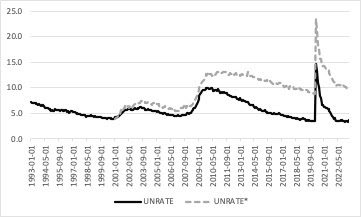
Inflation is coming down, as the last BLS report shows. I'm not going to get into that into this (very short) post. The disinflation has taken place while the official unemployment remains very low. However, we all know that unemployment measures very poorly the situation in the labor market. My alternative measure, which I make students calculate in macro classes, is what would be the unemployment rate be if the participation rate, which has been declining since the early 2000s (when China entered the WTO; see on that and deindustrialization this very old post), was the same of the last peak (back at the end of the Clinton era) when it was at about 67 percent (see below).

Note that the unemployment rate has a negative relationship with the participation rate, everything else constant. The result below.


The answer is, not 3.7 percent, but around 10 percent. In other words, there's a lot of what Joan Robinson used to call disguised unemployment. Discouraged workers that are not searching for a job, because they can't find anything worthwhile, and, hence, do not count as unemployed. This can be seen as the extra unemployment that we have because of the neoliberal policies of the last four decades, but in particular after the more radical opening to China starting in the 1990s.

Friday, September 24, 2021

Debt in foreign currency or Too Much Government Intervention?

Interview with an Argentinean radio (yes, in Spanish) on the Evergrande collapse and its possible consequences. It is clear to me that the dangers come more from having debt in foreign currency than the typical critique about crony capitalism, and the lack of credibility that The Economist, for example, has put forward. In The Economist view:
Evergrande shows the importance of deeper financial reforms. But what might they look like? Liberal reformers have longed for a clean-up of bad debts, a loosening of controls over prices (including the exchange rate), transparency and independent courts that can enforce property rights. Such a system would allocate capital better and be less prey to moral hazard.

Seriously. For those that think that the craze about financial liberalization was over with the 2008 Global Financial Crisis.

Tuesday, September 21, 2021

Tom Palley on Anti-China Fever in the US


Short post by Tom on the Sinophobia that has become more common in the US with the rise of the trade wars and the pandemic. He says: "Much of the United States (especially Washington, DC) is in the grip of a contagious lethal anti-China fever which is spreading fast. Even people I usually admire and respect have become infected. Reason and facts have lost all capacity to inoculate."

Read rest here.

Wednesday, November 18, 2020

Capitalism Alone Against Itself: Liberal Democratic versus Political Capitalism

I finished Branko Milanovic's thought provoking Capitalism Alone this summer. But I haven't had much time to write on the blog, as you might have noticed. This is certainly not a review, and I would definitely suggest that you go and buy the book as soon as you can and read it. It is a serious discussion of the future of capitalism, that word that, as Heilbroner often reminded us, was at the center of the discipline, but seldom discussed openly by economists. He cited, if memory doesn't fail me that it didn't appear in Mankiw's Principles textbook, at least back then in the 1990s, when it was published. I always note that Allan Meltzer wrote a little book titled Why Capitalism? were he makes no explicit effort in defining it, even though a definition can be gleaned from it.*

The definition most economists use leans more on Max Weber than Karl Marx, or the materialist tradition of the surplus approach upon which he built on. Branko is a pluralistic economist, well read and influenced by several authors, not all of them conventional. The discussion of the definition of capitalism is complex, and he separates, in its modern version two archetypes of capitalism, that are in a mortal battle for global hegemonic power, namely: Liberal Meritocratic Capitalism, represented by the West, and particularly by the United States (perhaps more credibly now after the election), and Political Capitalism, represented by the rise of the rest, with China at the head.

When assessing whether China is capitalistic Branko does use the conventional Weberian definition (p. 87), but that seems to be a pragmatic approach to provide the basis for his argument that China (and Vietnam, Malaysia and Singapore too, p. 91) does conform to the Weberian notion of political capitalism, a term used by Weber to discuss ancient forms of capitalism. But there is a concern with how elites maintain control by non coercive forces in Liberal Capitalism, and about the need to create an indigenous capitalist class in Political Capitalism. Both point out to alternative issue of class conflict, of course, and how surplus is extracted from workers, and points to an alternative view of capitalism. There is, in somewhat Marxist tradition a preoccupation with the role of the bourgeoisie, and an nod to Wallerstein that suggested that there are no capitalists without state support, something I would like to have seen more in the book (p. 116).

In fact, the secondary role of the state, to some extent, the absence of a more thorough discussion of the developmental state in the case of the Chinese experience, is one of the problems with the book. Another would be an emphasis with issues of corruption, which seem to me to be of secondary importance, even if the problem might have increased with financial deregulation, and the rise of tax havens. The emphasis of the book is on the changes associated to the increasing mobility of labor and capital and the problems it poses for both systems. Branko thinks that the welfare state is vulnerable with free labor mobility (p.156), undermining the democratic process in liberal capitalism, and that capital mobility, which he sees more through the lens of Global Value Chains, rather than portfolio flows, and that would lead to higher growth in poorer countries, reducing the need for labor mobility. The book also debunks a few myths, like the notion that robots are coming for your job, or the idea that a Universal Basic Income (UBI) would be a panacea for the economic problems caused by globalization and technological change.

* Invariably it is based on notions of the profit motive (some form of rationalization) as required by markets, and private property, or Weber (plus North, if you prefer). For an alternative discussion see this old post on a view based on the surplus approach, including a critique of the Weberian naturalization of capitalism as something that existed in the past and that explains the golden ages of antiquity.

Tuesday, April 30, 2019

Structural Change in China and India: External Sustainability and the Middle-Income Trap

Shouldn't listen to the IMF anyway

New working paper co-authored with Suranjana Nabar-Bhaduri, and published by the Political Economy Research Institute (PERI) from UMass-Amherst. From the abstract:

This paper focuses on the different development strategies of China and India, particularly regarding the role of manufacturing and services for long-run productivity growth, external competitiveness and financial fragility. The findings appear to support the argument that productivity improvements in manufacturing drive productivity improvements in other sectors. They also substantiate previous findings that the Indian services-led growth trajectory has had limited success in transferring surplus labor from agriculture to other sectors. Furthermore, the trajectories have affected the export performances of the two countries with the Indian trade balance and current account revealing persistent deficits, compared to China's surpluses. The paper also argues that the way in which India has sought to sustain these deficits entails elements of financial fragility, and that the Chinese struggles with the internationalization of the renminbi also imply a possibility of financial instability.

Download paper here.

Wednesday, July 25, 2018

Globalization Checkmated? Political and Geopolitical Contradictions Coming Home to Roost

By Thomas Palley (Guest blogger)

The deepening of economic globalization appears to have ground to a halt and the process may even unravel a little. The sudden stop has surprised economists, whose belief in globalization has strong parallels with Fukuyama’s (1989) flawed end of history hypothesis. The paper presents a simple analytic model that shows how economic globalization has triggered political and geopolitical contradictions. For the system to work, politics within countries and geopolitics across blocs must be supportive of the system. That is missing. The model is applied to a global economic core consisting of the US, China, and the European Union. It is revealing of multiple tensions, fracture lines, and contradictions. Within the US, globalization has delivered economic outcomes that have estranged the electoral bases of both major political parties. It has also delivered outcomes that are inconsistent with the US neocon geopolitical inclination. President Trump is a product of those forces, and he will likely prove to be a historically significant figure. That is because he has surfaced geopolitical contradictions that cannot be swept back under the rug. Ironically, his biggest impact may be on the European Union, particularly Germany, which is being compelled to recognize the neocon nature of the US and the vulnerabilities of dependence on US exports and technology. China was already aware of its vulnerabilities in those regards.

Read rest here.

Tuesday, May 8, 2018

Peter Nolan on China's Development and relation with the West


A bit old, from 2016, but not too old, and very apropos given the recent heightened trade disputes between the United States and China.

Thursday, April 12, 2018

More on China and the US

So, if there is a reason for concern regarding China in the US, it is definitely the use of their developmental state to promote technological innovation.

And as the graph shows they are catching up on spending, at least. I'm not sure I agree with the WSJ here, but they are certainly moving into high tech areas like AI.

Tuesday, April 10, 2018

China and US Trade Tensions in one graph

The graph below illustrates the reasons for the concerns in the US and the somewhat erratic, but more combative position of the Trump administration.

Note, also, that China is closing the gap on R&D spending and on the technological front, at a faster pace that I would have predicted (more on that for a later post).

PS: I only got noticed this today, but Wolff's column is also about US-China relations. I suppose it's the topic now.

Monday, September 11, 2017

ReOrient

A graph that shows, for a longer span, essentially the same information presented in Robert Allen's graph of manufacturing production, and discussed before here. It is evident that the rise of China (India is not quite yet visible, even if its share did increase) represents a certain rebalancing, which is inevitable as the income per capita grows in that country, even if it does not scape what mainstream economists refer to as the middle income trap. Source here, and the data is, as expected from Maddison.

Note that the first millennia, where Asia (China and India essentially) is much smaller in terms of the graph, which is a result of the paucity of data. In a sense, the graph shows the relatively brief rise, and now relative decline of Western GDP dominance, as Asia regains a space more proportional to its population share.

PS: On issues with GDP measures see here.

Tuesday, May 16, 2017

Brazil and the entry of China in the WTO

I have discussed here the role of Chinese growth in the decrease of US manufacturing jobs (note that I was, and still am somewhat critical about simplistic stories of deindustrialization). At any rate, for other reasons I was looking at the IMF Direction of Trade Statistics (DOTS) and ended up with the two graphs below.
After the Chinese entry in the WTO in 2001 the rise in Brazilian imports is astounding. Now Chinese imports of manufacturing goods are about the same share as imports from the US and the European Union.

Brazilian exports to  China, on the other hand, only take off after the Global Crisis in 2008, even though an increase after 2001 is also visible. This suggests that, in spite of the slowdown in China, their relatively rapid growth has sustained the external markets for Brazilian commodities (iron ore and soybeans mostly). There is a lot to be said about the patterns of specialization that this South-South integration has shaped, and the problems that it entails for Brazil and other Latin American economies, of course. But that's for another post.

Friday, January 29, 2016

Chinese slowdown and the world economy

The Conference Board argues that Chinese official data should be taken with some skepticism. Nothing new there. They have adopted a new measure, which implies "Chinese economic growth at a more realistic 3.7 percent" for the recent past. In this scenario, interestingly enough, "it’s likely that the bulk of China’s slowdown has already taken place since 2011, even if unapparent in official statistics." So the picture is probably worse than the official one (as shown below, from The Economist)

So China will grow at about 4% and has already been growing at that pace for a while, if one believes the Conference Board (in the official data above one might think there is more space for a slowdown, but clearly it has gone already down too). The big questions are whether this will continue, and what would be the impact for the global economy (and the US).

Arguably the slowdown is the result of the transition from an export-led development strategy to a domestic, consumption centered economy, compounded by the problems of an unregulated banking sector, the infamous shadow banks. Note, however, that most problems are associated to domestic demand, and debt in domestic currency. China still has current account surpluses and huge external reserves, even if the latter have decreased. So the problems of a typical developing country, which cannot grow given the external constraint, are nonexistent. Also, it is true that some firms have debts in dollars (and revenue in yuan), and the depreciation of the yuan poses problems, but again the People's Bank of China has enough dollars that rescuing and absorbing the costs of exchange rate risk should be a minor issue. This is not to say that a further slowdown is impossible, but if it continues it should be counted as a policy mistake, not a structural constraint.

On the effects on the world economy my impression is that there is also a great deal of exaggeration. China is the second largest economy in the world, for sure, and has become central for the global economy in many ways. But its role in the global economic problems has been overstated. In Brazil, for example, the Chinese slowdown played virtually no role, as I discussed here. In the US the usual complain is that the depreciation of the yuan is behind deindustrialization, and that the Chinese crisis, that has led to a more depreciated currency, is hurting the manufacturing recovery. I am skeptical of the argument. The figure below shows manufacturing employment and a broad trade weighted exchange rate for the US.
As it can be seen the decrease in manufacturing jobs, which started in the early 2000s (before that it was more or less constant; see discussion here) is connected to the entry of China in the World Trade Organization (WTO). But the collapse of manufacturing jobs went hand in hand with a depreciation of the dollar. And some of the, admittedly slow and small, recovery since the 2008 recession has gone with an appreciation of the dollar. This indicates that Free Trade Agreements (FTAs) and the WTO play a more important role than exchange rates.

China is important, but the notion that it will derail the US recovery seems incredibly hyperbolic. My bet is the US will continue its slow recovery, and the Fed will increase interest rates at an even slower pace than they suggested, as the last meeting indicated.

Wednesday, November 11, 2015

Down memory lane

Since the blog is now almost 5 years old, and several issues have been discussed before, I decided once in a while to post links to old entries. This one actually with two posts one from Triple Crisis, which started the year before, and in a sense pushed me to start my own blog.

Since yesterday the Donald had an op-ed in the Wall Street Journal on currency manipulation here my two cents on how much China is really a problem.

Currency Wars and Global Rebalancing

On China and Jobs

Tuesday, July 29, 2014

Structural Transformation in China 1952-2013

Just checking the Chinese economic data (subscription required), and decided to look at the structural changes more or less since the Communist takeover, as shown below.
The interesting thing is that while the size of agriculture diminished significantly throughout the whole period, industry more or less reached its current level at the beginning of the opening period. Most of the growth in the post-liberalization period has been in services, which has gone hand in hand with the urbanization process.

Of course the results are a little bit deceiving. The primary sector is basically agriculture and the secondary contains the bulk of manufacturing, but the tertiary includes some industries too. For the definitions go here. Still interesting result. By the way, by 2013 the tertiary sector is finally bigger than the secondary.

Monday, July 21, 2014

Some thoughts on the Bank of the BRICS

The BRICS announced in their last summit a new development bank, with US$ 100 billions in capital, of which US$ 41 billions are from China. There is a certain excitement about the possibilities for South-South cooperation and alternatives to development that this new institution will bring about. First, let me explicitly say that I think in general development banks are a relevant tool for development, that the new bank is a welcome addition that increases South-South cooperation and that reduces the need for developed country dominated institutions.

And yes a lot of the investment that will come will likely (and I would say hopefully) be on infrastructure (I say this since in one of the meetings of the Bank of the South, in Quito years ago, an activist told me I was a neoliberal for supporting infrastructure rather than community based projects; by the way, not against those, but as I said back then, if you want schools or sanitation for local communities, you'll need roads, electricity, sewer facilities and so on, which is what I mean by infrastructure). Stephany Griffith-Jones provides here the sort of defense of development banks I would agree with.

The new arrangements include a Contingent Reserve Arrangement which is more interesting than the bank itself, since it purports to provide “a self-managed contingent reserve arrangement to forestall short-term balance of payments pressures, provide mutual support and further strengthen financial stability.” In other words, not simply provide funding for development projects, but more widely to provide finance for balance of payments problems, which are at the center of developing countries problems. So, all in all, this seems to be something to be celebrated.

My two concerns are not directly connected to the new institutions. The first issue would be implementation. The Bank of the South has been in the works for almost a decade, and has been established since 2009. As I had noted here, barriers to implementation have basically meant that it is an irrelevant institution, at least so far (what I said back in 2009 was that lack of implementation might come from political differences, in the case of the Bank of the South, given its role vis-à-vis the Brazilian National Development Bank, BNDES). Note that in the case of the Bank of South it duplicated to some extent the work done by the Corporación Andina de Fomento (CAF), another regional development bank, also headquartered in Caracas. Not only it has so far failed, but in addition it has precluded the further development of existing institutions.

The second concern is regarding the type of integration between Brazil (member of the BRICS) and other Latin American countries (the same is true with some caveats for India, specialized in services, and Russia and South Africa) with China. If the new development bank is one more instrument to pursue a strategy of development in which Latin American economies specialize in commodity exports, to an increasingly manufacturing based China, then rather than solve our long-term balance of payments problems we will end building a new dependent relation, now with the Asian periphery (for more here). Hope springs eternal.

Thursday, May 8, 2014

Asian and Latin American shares of world GDP

Reading the April World Economic Outlook (WEO), a biannual IMF publication (more to be posted soon). You can download all the data, which is always useful. Just playing around. Note that in the last decade the share of World GDP produced by advanced economies shrunk from around 80% to approximately 60%.
On the other hand, developing countries expanded from 20% to closer to 40% of World GDP. The fact that China might be the biggest economy in the world has been in the news recently. Note that most of this increase in the periphery is in Asia, which increased from around 7% or so, essentially the same level than Latin America, to 20%, while Latin America (which did expand in the last decade; the graph doesn't show it well because of scale) remains at the same level than 1980, recovering from the lowest point in the 1990s.