Showing posts with label Krugman. Show all posts

Friday, May 19, 2023

Soft landing or recession

This is a very short note, prompted by the increasing fears of the default and its consequences, which I think it's greatly exaggerated, and the relatively optimistic views about the effects of monetary tightening. Sure enough, as I noted recently, an adjustment, and lower spending, associated either with an agreement with Congress Republicans (very unlikely) or as contingency plans (14th Amendment of other solutions) are implemented, could certainly through the economy into a recession. But I'm somewhat skeptical about that scenario.

On the other hand, I'm less sanguine than Krugman on the possibility of a soft landing. Note that I don't think our situation is as good as the unemployment numbers show, and that the recovery, while fast, brought is back to a position with underutilized capacity, and more slack in the labor market than what the official numbers suggest. But that's another story (discussed before several times). At any rate, the number I would look is the one below: New Privately-Owned Housing Units Started. Basically, construction.

As it can be seen, new constructions fall before every recession since 1960, with the exception of the 2001, recession. Also, it fell in 1966, without causing a recession. It is not a necessary or a sufficient condition for a recession. In 1966, the military spending with the Vietnam war, and the expansion of social programs more than compensated the negative effects of the monetary tightening that was taking place at that time. In 2001, the collapse of the dot-com bubble is what explains the recession.

However, the current and fast increase in interest rates by the Fed, with direct impact on mortgage rates, not only affects the construction of houses (less people willing to buy, less construction), but also affects the patterns of consumption of a large share of the population. And construction is already declining. Sure enough the Fed might stop the interest rate increases, and Biden might continue spending, even expanding his social agenda (that's were this gets iffy), and this might look like 1966. But I wouldn't expect a lot from fiscal policy at this point, and the Fed is not helping. My two cents.


Saturday, April 22, 2023

On Re-Industrialization: Brief Comment on Krugman's column

I have written on deindustrialization before (see here and here), and commented on the CHIPS Act, and how it was one of the first, if not the first, re-shoring of manufacturing jobs into the US. Krugman just wrote a column on that, noting that the concern with manufacturing is now bipartisan, as Biden policies follow Trump's, he argues the former more successfully than the latter. Also, I should note that the the pressures for US corporations to reorganize their supply chains away from China is bipartisan, but that might take a long while.

I mostly agree with Krugman's take. But there are two issues with his argument, in my view. One more conceptual, and the other just observational. Krugman says that

"we shouldn’t fetishize manufacturing. A good job is a good job; there’s nothing inherently superior about manufacturing as opposed to health care or even entertainment."
This smacks me too much as an acceptance of the post-industrial society myths. Kaldor's laws suggest that you should care about manufacturing. For example, a great deal of the increases in productivity both in health care and entertainment are associated to the rise of productivity in manufacturing sectors, like pharmaceuticals, medical equipment, electronics, computers, etc. And exactly because the US still is important in all these manufacturing sectors, in spite of the decline of the share of manufacturing jobs in total jobs the nature of deindustrialization in the US was different than in other parts of the world, like Latin America. That was my argument a decade ago.

However, something happened in the intervening decade. While before manufacturing jobs declined, and production increased, in the last decade the trend changed. Now manufacturing production stagnated.


So manufacturing output never recovered from the 2007-8 recession, and effectively stopped increasing. Even the fast recovery from the pandemic seems to have stalled. Again, I don't think this spells disaster for the US economy, since US corporations are still dominant in many sectors that are crucial for the future of Industry 4.0 or whatever that is called. My example during the pandemic was the video conferencing platforms I use (zoom, teams, google meet, webex, and skype) are from US corporations. But it does say something about how difficult it will be for the US to disentangle from the Chinese supply chains.

Also, I think that the reason for this change in attitude regarding manufacturing and China are less connected to electoral politics, than Krugman suggests (he said: "it’s not at all clear whether these policies will succeed in their implicit political goal: winning back working-class voters who have gone down the MAGA rabbit hole). If the implicit goal was political it wouldn't be bipartisan, and the solution would require recovering manufacturing jobs, not production, and that will not happen, at least not a recovery to the previous peak. This is revaluing of manufacturing is not about winning elections in Pennsylvania (even if it might not hurt Biden), it is a geopolitical concern with US hegemony.

PS: And expect a significant backlash against industrial policy, and any "protectionist" measures in the US from the neoliberal establishment, which is still entrenched. See for example Adam Posen here, or this from The Economist, who said that: "America’s openness brought prosperity for its firms and its consumers, both Mr Trump and Mr Biden have turned to protectionism... Subsidies could boost investment in deprived areas in the short term, but risk dulling market incentives to innovate. In the long run they will also entrench wasteful and distorting lobbying." On this I'm with Krugman that is considerably less upbeat about the US's great economic moment.

Tuesday, February 7, 2023

Paul Krugman's Godley-Tobin Lecture

 
Krugman and the editors of ROKE
 
Paul Krugman's lecture, reflecting on the contributions of James Tobin is now published by the Review of Keynesian Economics. The paper can be downloaded here.

Thursday, April 21, 2022

Tuesday, March 22, 2022

Registration for the Godley-Tobin Lecture

Registration for the 5th Godley-Tobin Memorial Lecture, for those that cannot be at Bucknell University for the event, is now open here.

Thursday, January 20, 2022

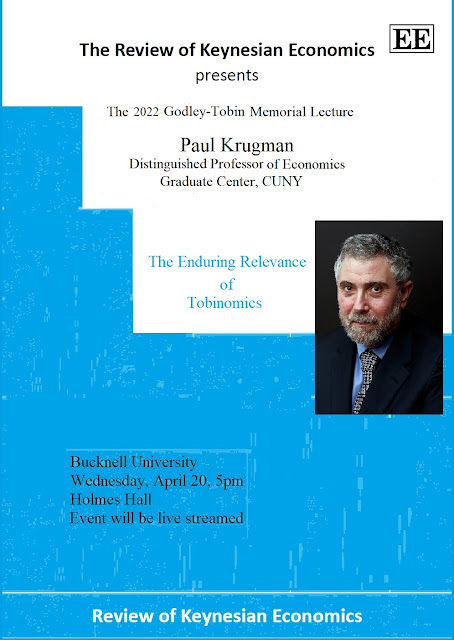
2022 Godley-Tobin Memorial Lecture: Paul Krugman


The editors of ROKE are pleased to announce that Professor Paul Krugman has agreed to give the 2022 Godley–Tobin Memorial Lecture. Professor Krugman is Distinguished Professor of Economics at the Graduate Center of the City University of New York. He has also taught at MIT, Princeton University, and Yale University. Like James Tobin, Professor Krugman was awarded the Nobel Memorial Prize in Economics (2008) and the American Economics Association’s John Bates Clark Medal (1991).

Professor Krugman’s work has focused on international economics and macroeconomics. He is a prominent American public intellectual who is widely recognized for his regular column in The New York Times. The title of Professor Krugman’s lecture is “The enduring relevance of Tobinomics”.

The lecture will be held at Bucknell University, Lewisburg, PA on April 20, 2022, at 5.00pm and it will also be live streamed.

Tuesday, April 27, 2021

Gatekeepers and herd behavior: On Tooze and the radicalization of Krugman

"But that one is holding the poop!"

Adam Tooze, the author of the monumental Crashed (who was, incidentally,  student of Wynne Godley, one of my mentors), wrote a piece for the London Review of Books that has received a lot of praise. While it reviews Paul Krugman's latest book, it provides an overview of the radicalization of New Keynesians, or at least some, that dominate both in academia, and in the corridors or power. The gatekeepers of knowledge and academic  and intellectual influence, with a close connection to power, so to speak. He tells us at the outset that Krugman, the economist that was a bulwark of free trade, even when the theories for which he received his Sveriges Riksbank Prize (aka the Nobel) suggested that some degree of intervention might be good, and that remained even after the 2008 crisis a defender of the conventional macroeconomic model, not only has moved to the left, but also that "in Joe Biden’s Washington, Krugmanism rules."

This is, however, a misinterpretation of the current situation. Tooze suggests that Krugman is one of the "high-powered centrists inching their way towards seemingly obvious political conclusions." The group includes "three centrists – Biden, Janet Yellen and Jerome Powell [that are] undertaking an experiment in economic policy of historic proportions." And he, also, argues that: "what sets Krugman apart within this cohort is the way he has, since the 1990s, stopped being a gatekeeper of the status quo and instead become its critic. In this respect his closest analogue is Joseph Stiglitz, also once of MIT, a member of the Clinton administration and chief economist to the World Bank. Both men have indisputable standing as members of the elite club of New Keynesians."

I see Krugman as being closer to what Colander, Holt and Rosser referred to as the cutting edge of the profession. The role of cutting edge of the profession, in my reply to them (see the paper in Fred Lee and Marc Lavoie's book here), is to make more reasonable policy propositions, while maintaining the notion that markets do produce efficient outcomes, in spite of the unsurmountable logical problems brought by the capital debates, and that led to the rise of vulgar economics. Krugman in that sense is the epitome of the cutting edge. Of course, in order to make reasonable points he would discard many of his own ideas. But he is no critic of the mainstream. The problem with Tooze's argument lies in there. Krugmanism cannot rule, if he basically had to discard his ideas in order to remain relevant. And relevant here simply means that he can be seen to be on the right side of history, more skeptical of free markets, free trade, and willing to accept significant expansion of deficits and debt.

The ideas that won the day and rule in Biden's America are heterodox ideas, that in fact, until very recently Krugman dismissed as not serious. The possibility of continuous expansion of the welfare state, and the expansion of fiscal deficits and debt were anathema to him. Not only he was against expansionary fiscal policy, but even 'Medicare for All,' the signature proposal of Senator Bernie Sanders, something that is common in all advanced economies, was dismissed as a political nonstarter. And certainly that idea, which is not that radical, has remained in the background, and is unlikely to be pushed by the 'radicalized' Biden administration. Perhaps even Krugman still thinks is far too lefty to be acceptable in the United States.

Biden might be the president, and he has a lot of power about what elements of the agenda to push, and he has certainly moved to the left. No doubt about that. Not surprisingly Heather Boushey and Jared Bernstein, economists with heterodox and labor connections, are defending the fiscal expansion from the Council of Economic Advisers (CEA), while Larry Summers, the quintessential insider of the Clinton and Obama administrations, is criticizing from outside. But the Democratic Party has moved to the left, and the politicians have followed. It is the party of Bernie and Alexandria Ocasio-Cortez (AOC). And the establishment knows they need to move if they want to remain relevant, and have a fighting chance in 2024, since the working class is radicalized, and many will abandon the party if Biden does not deliver.

They are like the French politician that, seeing the masses pass in protest, tells his friends in the café he must leave and follow them, since he is their leader. This is, it goes without saying, more like herd behavior, than leadership. Krugman is, in that sense, the leader of an intellectual sea change about views on the role of the state in the economy.

Tooze may think that these arguments are just the diatribes of those in the left that are angry,* infuriated he argues, with the slow pace of change in the center. The issue is that, even though Krugman is following the herd, he certainly is a central gatekeeper in the economics profession. A profession that has been attacked for good reasons, for its excessive influence in policy, and the recurrent blunders of its luminaries.

Krugman still argues in terms of the conventional model, that he defends, as having done a good job explaining the 2008 crisis. People like Wynne Godley, that truly foresaw the 2008 crisis, often only received the acknowledgement ex-post, sometimes too late, after passing away.** Krugman dismisses heterodox economists as not serious. A type of red-baiting of heterodox economists with significant impact on the ability of the profession to change. He also validates some of worst within the mainstream and is willing to play by their harsh rules.+ This is, of course, because the prestigious teaching positions he held, and still holds, the 'Nobel', that was created to give respectability to certain ideas, the weekly column in the NYTimes are all powerful platforms. The danger in this, in accepting Krugman's narrative that he has been right all along, is to convince ourselves that the profession has indeed changed. Now the dangers of neoliberalism and their main defenders, mainstream economists, are gone. The profession is rehabilitated. But the retreat of neoliberalism is only temporary. Krugman and other gatekeepers will change their tune when the current Keynesian moment passes. If the Bidenomics experiment ends up being of historic proportions, and I do hope it does, although that is still too soon to tell, it will not be a victory of Krugmanism. It will be a victory in spite of it.

* I am not as angry as Paul Romer, though.
** On Krugman critique of Godley's 'hydraulic' model, and my response go here.
+ He famously said: "By the early 1980s it was already common knowledge among people I hung out with that the only way to get non-crazy macroeconomics published was to wrap sensible assumptions about output and employment in something else, something that involved rational expectations and intertemporal stuff and made the paper respectable. And yes, that was conscious knowledge, which shaped the kinds of papers we wrote." [Italics added] See the quote and a discussion of the role of another gatekeeper in France that also won a 'Nobel' here.

Friday, June 19, 2020

Di Bucchianico on Krugman and the Liquidity Trap


New paper on the problems of Krugman and the Liquidity Trap argument (some will be able to download if for free, and I recommend this version; however, there is a previous working paper linked at the bottom for those unable to open).

From the abstract:
Krugman’s ‘liquidity trap’ model constituted a ground-breaking contribution by attributing the long-lasting Japanese stagnation to a negative natural interest rate. Our critique to such a proposal will focus on three aspects. First, we will question the logical structure of the model, providing an alternative interpretation of its closure and arguing that aggregate demand has no crucial role in it. Second, we will argue that a negative natural interest rate can emerge only after a series of overtly restrictive assumptions in a model that does not treat capital and avoids long-run equilibrium analysis. Finally, we will discuss the mainstream literature which followed up until the recent rediscovery of the Secular Stagnation Theory. Within that line of literature, the key features of the ‘liquidity trap’ model continue to occupy a prominent role, thereby letting the critical issues that have been singled out resurface. Our conclusion is that the ‘liquidity trap’ explanation did not provide a satisfying rationale for Japan’s stagnation and cannot describe later economic predicaments either. A comparison with Post-Keynesian models shows their ability to offer insightful policy prescriptions without relying on those shaky theoretical foundations.
Note that an important part of the argument is the critique of the natural rate of interest, something we have done extensively over many years in this blog, and of the notion of a negative one in the context of Summers' discussion of secular stagnation (also done in this blog; see for example here and more recently here in the context of a debate with Stephanie Kelton and MMTers; btw her book is out and anybody wanting to reviewed it for ROKE send me an email; I look forward to reading it too).

The important thing in the paper is that it goes beyond the capital debates critique, and shows the extra restrictions needed for Krugman to get his results, including some interesting thoughts on the problems associated with intertemporal models.

PS: ROKE will soon publish a paper by Serrano, Summa and Garrido Moreira (Fall issue) in which other limitations of the negative natural rate are explored.

PS': Link to working paper here.

Saturday, March 9, 2019

MMT and its Discontents: Again (Wonkish and Longish)

Modern Monetary Theory (MMT) has been in the news again, and for good reasons. I actually had a post with the same title back in February of 2012, hence the again in the title. But now, with the irruption of Alexandria Ocasio-Cortez in the political scene ,and with the discussion of a Green New Deal (discussed here 7 years ago) and the feasibility of higher taxes (here, also long ago, among the many on the topic) taking the center of the political debate, MMT has become trendy. The rise of democratic socialist ideas, since Bernie's 2016 campaign, has brought the fiscal feasibility or responsibility, in the more conservative terminology, of such progressive  plans into the center of economic policy debates. Also, the fact that Stephanie Kelton a prominent MMTer is an advisor to Bernie, has brought significantly more attention on their views.

I have discussed Modern Monetary Theory in this blog for years (going back to April 2011, when I first found use of the term, to the most recent earlier this year after Olivier Blanchard American Economic Association presidential address last January), and have known the main MMTers going back to at least the mid-1990s, when I was at the New School and working as research assistant to Wynne Godley at the Levy Institute. I guess, I can be seen, to use the term employed by Doug Henwood in his recent Jacobin piece, as a fellow traveller (like Jamie Galbraith), even though I've been critical of some aspects, in particular when applied to developing countries (more on both Henwood and MMT issues in developing countries below).

There are many critiques, which deal with both theoretical issues, mostly concerned with the Functional Finance aspects of MMT, and with the policy and political effects of MMT advising to the left of center Democratic presidential candidates. Note that I will not try to define MMT precisely, since it is a hybrid of economic theories and policy proposals. I would assume that at core it is composed by the ideas of Chartalist and Endogenous Monetary views, Functional Finance, and an Employer of Last Resort (ELR) program as suggested by Greg Hannsgen in his recent presentation at the Eastern Economic Association (EEA), in sessions we co-organized (with the presence of Randy Wray presenting Stephanie Kelton's slides and Josh Mason; Stephanie was with Bernie at the rally in Brooklyn).

My comments will be, for the most part, directed at issues that fall within the Functional Finance part of MMT, and mostly about developed economies like the US (although, I'll have something to say about developing countries like Argentina or Brazil). I might add that Randy suggested that Functional Finance was a late addition to MMT, since this ideas were not known by MMTers in the mid-1990s or so. I think that the original source for the Functional Finance story was Ed Nell, who organized a conference at the New School back in 1997, I think, with Bob Eisner, and many other Old Keynesians. I had read Abba Lerner and Evsey Domar foundational papers in Ed's classes, and I think his influence on MMTers in this area is reasonable to assume.

Let me start with Paul Krugman's critiques of MMT, which have been clear and perhaps the most widely read (but there are many, including critiques by Tom Palley and Sergio Cesaratto here in the blog). So Krugman, in one of his most recent posts, starts by showing that there are many levels of the fiscal deficits that are compatible with full employment (not sure who thinks that this is wrong; I would add the same is true about the rate of interest, and that there is no natural or neutral rate of interest, a point that Keynes made back in the 1930s, and that is coherent with the capital debates, and, hopefully, it will be clear why this is relevant below). Then he argues more problematically, in my view, that crowding out is a serious concern, in his words: "The question then becomes one of tradeoffs: would the things the government could buy with a higher deficit be worth the lost private investment due to a higher interest rate?" But he knows well that the crowding out effect is empirically (if not theoretically) irrelevant, since investment is not particularly responsive to interest rates (he knows it's all about the accelerator); then he moves to the issue of the natural rate itself.

He seems to think two things (he can certainly correct me if I'm wrong). One, that MMT requires that you use monetary policy in order to achieve full employment. Two, that if you are in a situation of like the zero-lower bound, then the central bank cannot bring you back to full employment. That is, her assume that, using his own graph, the economy would be in position A.
Note that by his own argument you can go back to a point like B, with full employment by pursuing expansionary fiscal policy (be that an ELR or something else like traditional fiscal policy to expand infrastructure spending, for example; on this I should say that Randy suggested that he thinks traditional fiscal policy might be inflationary, and that's something perhaps would be compatible with Krugman; he noted how Minsky suggested that an ELR can be used as a buffer to control inflation). That is the IS would move up.

So it's unclear what the fuss is all about. If it is because the Fed could, in the MMT story (not sure Functional Finance authors would say that), print money to finance the deficits and bring the economy back to full employment, then the concern might be that it would be inflationary, in a Monetarist sense that printing money might be the cause of inflation. But that does not seem to be his preoccupation (I dealt with the issue of monetization of debt back in May 2011 in a reply to Krugman, who was back then, not surprisingly, criticizing MMT). His concern seems to be that the rate of interest would not go up. But of course, there could be a flat interest rate close to zero, a horizontal monetary policy (MP) line, and the expansion of the IS could be achieved bringing the economy to full employment (right below the C and B points with a zero interest rate).

But that doesn't seem to be the issue either. My guess is that he thinks that the problems is more like the one below, from an older post by him, in which the natural rate of interest is negative (my discussion of that here), and the Fed cannot lead the economy to full employment.

So his point is that the Fed cannot make it because it cannot bring the economy to the natural rate of interest, the one that is compatible with full employment and stable prices. He then goes on to criticize Stephanie on her critique of the natural rate, and tells us that: "So what purpose does claiming that the natural rate is a meaningless concept serve? It looks to me like sophistry – word games intended to confuse what should be a simple issue."

I'm not sure what Stephanie said about the natural rate, but I think it is well-established that the natural rate concept is problematic (note that on this some MMTers have said things I would disagree;  e.g. Forstater and Mosler suggest here that the natural rate of interest is zero; my discussion of that here). So I think the position that Krugman attributes to her is correct. Paul Samuelson would agree, as he did when he admitted that the capital debates had shown that neoclassical parables cannot hold (on the capital debates read this old post). So let me explain it briefly. There is no sophistry, just pure logic.

The capital debates show that with factor price reversals, when one good can be said to be capital-intensive at one level of the wage-profit ratio, and labor intensive at another level of the same ratio, there is no monotonic inverse relation between investment and the rate of interest. The investment schedule could look like the one below (my graph), with portions that have a negative slope and some in reverse, and if savings (determined by the level of income as in Keynes' principle of effective demand, rather than a Ramsey inter-temporal model) is given as in the graph below, then there might be no natural rate of interest. Keynes was explicit about that in the General Theory. That means that the monetary authority can set the rate of interest, what Keynes referred to as the normal rate, that was conventional, and that fiscal policy can be used to bring the economy to full employment. Btw, I think that overall Krugman and Kelton agree on that. Krugman says he's defending the theory, not the policy proposals, since he thinks they agree on that.
The point is NOT that the state can do whatever it wants, even though it has a lot of space, but that at the end of the day monetary policy is central for the ability to pursue fiscal policy, and the monetary authority can keep (unless it's forced by law not to do it; and that would bring up the discussion about the rise of the neoliberal idea of independent central banks) interest rates low enough to allow for fiscal expansion without debt growing at a very fast pace. Think of Marriner Eccles during the New Deal (chairman of the Fed at that time; search the blog for more on that). This is the argument that Josh Mason did, in a different way in our session with Randy at the Easterns. Note, also, that even though politically it was acceptable for the Fed to keep interest rates low, at 2.5 percent during the Depression and World War II, by the 1950s political pressures by financial markets and rentiers forced the Fed-Treasury Accord, and things changed (even though rates remained relatively low).

I'll comment briefly on two additional critiques of MMT, the one by Larry Summers, the ex-Treasury Secretary and advisor to the Clintons and Obama, and the one by Doug Henwood, an influential Marxist (see my discussion of his comments, and others, on Marx for the New York Times here), and writer of a very good book on Wall Street. I am sorry to say that both have too many arguments of authority and ad hominem attacks on some MMT authors, which I'm not interested in discussing. But there are a few substantive issues. One is the danger of inflation (that I'm glad Krugman seemed less keen on) and the others are on MMT and developing countries, and the political relevance and practicality of MMT proposals (here most critics have in mind the Bernie/Ocasio agenda of Medicare for all, cheap or free college tuition in public institutions, a jobs guarantee, and a Green New Deal).

I'll start with Henwood. His major issue is inflation, I would say. He says: "That brings us to the next problem: inflation. When the printing presses run freely, it’s not only reactionaries who think that runs the risk of spiraling prices. As I was researching this piece, many people to whom I described MMT, from Democrats to Marxists, brought it up as a worry. MMTers are coy about the topic — they never say how much is too much, and they profess great confidence in their ability to control it." Let me start by saying that inflation has not been a problem in 40 years, while wage stagnation is a central one. But if one is concerned about it, at least one should get the correct analytical tools to discuss it.

He tells us that: "The standard view of the Weimer inflation is that the German economy, severely damaged by World War I and forced to make huge reparations payments to the victors, wasn’t up to the task — it just didn’t have the productive capacity, and its citizens were both unwilling and unable to pay the necessary taxes. So instead the government just printed money and spent it, not only to pay its own bills, but to support bank lending to the private sector." First, that's NOT the standard view of the hyperinflation in Germany. You can read here the standard story, and I cite even a conservative historian like Niall Ferguson admitting that the monetarist story embraced by Henwood is NOT the dominant view among historians. The notion that the economy was at full capacity (didn't have productive capacity) and that printing money caused inflation is what Cagan thought about it. A more refined and somewhat structural story is the dominant view actually. In my view, it is clear that debt in foreign currency (not domestic), and, hence, the external problems of the current account, that forced depreciation, together with wage resistance are at the core of the hyper., German and many others.

In addition, it's worth emphasizing that the US is not Weimar Germany, in the sense that even with much larger fiscal deficits, debt would still be in domestic currency, and no significant pressure for depreciation would arise. The role of the dollar as reserve currency is not really under significant jeopardy. Certainly, there might be questions of inflation if we reach full employment, and that's a different issue (I'll come back to the topic below when I discuss Summers and the political feasibility of MMT sponsored plans). But the kind of alarmism of even suggesting that the US would be on the verge of hyperinflation is not serious. I won't comment on other primary mistakes like the notion that the rise of Nazism is associated to the hyper, when it is clearly connected to the Depression and deflation a decade later.

Henwood is on firmer ground, actually, when he discusses the external limits. Yes, indeed, for most developing countries like Argentina or Brazil, the ability to pursue expansionary fiscal policy is severely limited by the balance of payments constraint. Considerably before full employment, the patterns of consumption and investment may require too many imports, particularly of intermediary and capital goods, and even with capital controls, interest rates might be hiked to avoid capital flight and depreciation. Depreciation does solve the external problem, often by throwing the economy in a recession, and not because it stimulates exports. There is extensive discussion of that in the blog about it. Sometimes MMTers sounded like New Developmentalists in Latin American suggesting that depreciation would solve the external constraint and that capital controls were not even necessary. I don't think Randy believes that (or Stephanie), but it was certainly something that Warren Mosler believed in the past (whether he changed his mind I can't tell). But again the debate seems to be about the feasibility of MMT in the US (that's why I didn't emphasize in my comments on the roundtable the differences of debt in domestic and foreign currency, something I always do, as noted by Josh).

So that leads me to the last critique, the one by Larry Summers in his recent piece in WAPO. Summers says that: "Modern monetary theory... is the supply-side economics of our time" and that "these new ideas [about the importance of fiscal deficits] are being oversimplified and exaggerated by fringe economists who hold them out as offering the proverbial free lunch: the ability of the government to spend more without imposing any burden on anyone." He also says in Monetarist fashion that printing money would lead to hyperinflation. In his words: "As the experience of any number of emerging markets demonstrates, past a certain point, this approach leads to hyperinflation. Indeed, in emerging markets that have practiced modern monetary theory, situations could arise where people could buy two drinks at bars at once to avoid the hourly price increases. As with any tax, there is a limit to the amount of revenue that can be raised via such an inflation tax. If this limit is exceeded, hyperinflation will result." Again, emerging markets, like Germany, borrowed in foreign currency, that they cannot print. It was often the depreciation of the currency, the increase in the prices of imported goods, and the wage resistance of workers that led to hypers, and the central bank printed money afterwards, with money being endogenous. A foreign debt or external problem, not a fiscal one.

But there might be a danger of inflation (not hyper) if Bernie wins the election and manages to pass Medicare for all, free college, a Job Guarantee and actually spend some money on infrastructure, and to do something about global warming, without significant reshuffling of spending. Here is where I think the question of the supposed naïveté  of MMTers comes to play, with Henwood suggesting that they shirk the question of fiscal choices, and with Summers saying they resemble voodoo economics, the supply-side of the left (mind you supply-siders are many things, but certainly not naïve). I think, first of all, that the dangers of inflation are exaggerated, for several reasons. First, the labor market is not as tight as normally suggested. The number of people discouraged and out of the labor force is relatively large. Second, there are positive effects of growth on productivity (the Kaldor-Verdoorn effect, search on the blog too), so the supply constraint is not fixed, rigid at one given level (people said the natural rate of unemployment was 5 percent or higher just a few years back; again check past blog posts). Third, the bargaining power of unions, and workers in general, is not particularly strong, and it would take sometime to pick up.

More importantly, there is no chance that a Bernie presidency (and that's in and of itself a big if) would have both houses and could implement even a little bit of the program presented. Mind you if it happened we would probably get to full employment in a couple of years, and get increases in wages, and perhaps some inflation. But some inflation might be good, in particular if it allows for higher real wages, something sorely needed. How much inflation? Difficult to say, but the structure of the Fed is not going to vanish, and higher rates would be used to discipline the labor class, with the support of many neoliberal Dems. The limit will come probably before full employment and the capacity limit of the economy is reached (yes inflation happens before the capacity limit, because it's often cost push, and the sort of demand pull stuff Summers and Henwood are afraid about is not that common). In other words, the limits to fiscal expansion would be political, not economic, and there is no reason for the left to be up in arms against an imaginary enemy. Hyperinflation is like the the windmills for the Quijote. The giants to attack are actually the ones pointed out in the progressive agenda, like lack of spending on health, education and the environment, and MMTers have been instrumental in getting these ideas in the political discourse, and moving the Dems to the left.

But taxes matter too. Here is where the MMTers refusal to acknowledge that taxes on the wealthy are necessary is a political mistake (not all I've been told, but some for sure, as I've heard that criticism). Note that from the logical point of view they are not incorrect in suggesting that causality goes from spending to taxes, like it goes from investment to savings. It's implicit in the Keynesian/Kaleckian model in which autonomous spending (government spending is in there) determines income through a multiplier process. And taxes, like savings, grow with income. But it is important to note that politically (again this is not analytically, but politically) countries that went for a more ample Welfare State opted to tax their citizens, particularly their more wealthy citizens, at a higher rate. Tax increases on the wealthy should be (and are) part of the progressive agenda. It has an important distributive effect, and it makes the spending politically acceptable. At this juncture, however, even Blanchard says that we should just borrow, since interest rates are low, and will remain low.

The crucial point is that overall MMTers have been helpful in moving the Dems in the right direction (the right direction is to the left), and that is a good thing. The problem with Dems is not the existence of a few social democrats or socialists in their midst. In fact, even being generous there will probably be just three democratic socialists in the presidential primaries (Bernie, and, perhaps, Warren and Tulsi). The problem is the vast majority of neoliberals that still dominate the party. The same could be said about MMT. The problem is not the exaggerated propositions of MMTers, but the excessive fear of inflation when there are too many relevant problems to be concerned with.

Thursday, March 8, 2018

The left and the return of protectionism

So if you believe a simplified version of conservative views on the economy, Trumponomics is pretty contradictory (and yes they are contradictory, even if one may doubts about why). Tax cuts should lead to growth, via supply side economics, and the recently proposed tariffs on steel and aluminum do exactly the opposite. Protectionism (not a very good name, I prefer managed trade, as I discussed here before) has made a come back, but while many heterodox economists have suggested that 'free trade' is not always beneficial to all, and those concerned with the fate of manufacturing and the working class in the United States have decried Free Trade Agreements (FTAs) over the years, it seems that the association of these ideas with Trumponomics has made them less keen on the recent tariff proposal.

A typical example is the recent op-ed by Jared Bernstein and Dean Baker in WAPO, and I cite them exactly for my respect for their economic views in general, and their commitment to progressive causes. In their view: "The bigger dangers to our economy are twofold. One, that our trading partners will retaliate by taxing our exports to them, thus hurting a broad swath of our exporting industries, and two, by leading an emboldened, reckless Trump administration to enact more bad trade policy." Essentially, they agree that tariffs would have a negative effect on employment, but perhaps not as big as some Cassandras have suggested, and that this 'bad protectionist' policies would continue. A similar argument can be found in Brad DeLong's op-ed, another progressive economist, in which he argues that the tariff is a tax hike for consumers. Brad, I should note, has recently published a very good book in which he praises the Hamiltonian system, that is,  the use of managed trade to promote industrial development (I discussed it here).*

It's worth remembering that while on other issues Trumponomics is essentially Reaganomics (low taxes for the wealthy and increased military spending), on trade his views are a break with more recent Republican positions (and hence the push back in his own party against the tariffs) and closer to what many Dems, particularly those connected with trade unions, often defended. He has not signed TPP, has really started renegotiating NAFTA (something Obama promised to do as a candidate, but did not deliver as president) and now has imposed some tariffs (like, btw, Bush, so I'm not suggesting this is unprecedented; just that he has been more consistent on this topic).

Don't get me wrong, I'm not a big fan of Trumponomics, or even in particular of these tariffs. And this will not work probably, but the reasons are not the ones adduced by progressives. Their basic argument is that retaliation by other countries will make them innocuous. In all fairness, the US is already more 'protectionism' (manages trade) than most people understand. The ability to use trade treaties and organizations for defending the country's own advantage is considerably tilted in favor of advanced economies and their corporations that can use loopholes to creatively avoid rules and continue to subsidize their industries (and agricultural sector). The US use of the defense department, again used by Trump, is typical. Poor countries some times lack the basic technical capabilities (lawyers and economists) to face the trade teams of advanced economies. The complexity of the WTO dispute settlement process, the geopolitical role of the US and the importance of US markets for many developing countries render it a very ineffective tool for the interests of less developed economies.

It should not be a surprise that American corporations continue to thrive in international trade (it's the American working class that is in trouble). Manufacturing is doing well, with the support of what Fred Block has termed the hidden developmental state in the US. So the problem is not that tariffs could not work. In all fairness, tariffs together with significant expansion of domestic spending on infrastructure (and more steel demand), with a vigorous defense of trade unions, with higher minimum wages, with policies to improve income distribution, like progressive taxes on the wealthy, to strengthen the domestic market might actually be part of a Hamiltonian strategy of economic growth. Note also that the whole point of imposing tariffs is to depend less on exports and more on domestic markets, so that to some extent retaliation should matter less. A more closed (not closed, but more so, like Keynes suggested in his National Self-Sufficiency piece of 1933) international economic order, to role back of some of the excesses of the neoliberal, pro-corporate globalization process, used to be be, and should be, on the agenda of the left.

The problem, then is less the tariffs per se, and more the fact that the Trumpian agenda is empty, and has nothing for the working class. That was my biggest concern reading the progressive economists complaints about Trump's trade views. Their solutions are to stop protecting patents and professionals, that is more 'free trade,' and a more depreciated currency (I'll leave my skepticism about this one for another post, at any rate I discussed this before). While I'm more sympathetic to the skepticism on property rights, note that China, in part, thrives, exactly because they do explicitly infringe the rules on patents (the first Geely car was a knock off of a Mercedes, and they bought Volvo to have access to foreign technology; there are many examples; it's worth noticing that the US did that in the past too). That would not necessarily be good for American corporations. To weaken doctors, lawyers and other middle (and upper middle) class professionals is certainly not the way out of the hole for the American working class.

The political danger of these views, which I think still dominate the liberal wing of the Democratic Party, is considerable. I think, that even if his policies turn out not to be very helpful (for the reasons I outlined, meaning lower wages and protections for workers, lower taxes for the wealthy and corporations and so on) his true dislike of globalization and free trade policies would strengthen his position with working people in the Rust Belt, which were central for his victory (maybe you think it was Russia... oh, well). As I noticed before the election, this would make things so much hard for Dems in elections. I said back in September 2016 that: "Note that this doesn't mean he [Trump] is going to win the election. Demographic changes make it harder for Republicans to win now, since Dems get more of the electoral college to start with. And I hope he doesn't, btw. But there are good reasons to be afraid. This is going to be way closer than it should be." And so it was.

I'm afraid that his trade policies, and the Dems position that effectively are to his right (like Hillary, but not Bernie) would make it more likely (hopefully not enough) for a longer period of Trumponomics than it is acceptable. This suggests that a good chunk of Dems are stuck in the model that Mark Lilla has referred to as identity liberalism (see his book here), and have become vulnerable to right wing populism. It's getting increasingly difficult to have hope in the dark.

PS: For discussions of trade policy see this two previous entries which provide a simple discussion of the Ricardian and neoclassical models of trade and its limitations. I would also recommend the paper by Robert Wade linked here.

* There are many others that have written on this in the last couple of days. Paul Krugman could, arguably enter the list of progressives here, but he has been consistently more of a free trade guy. Krugman complain is more macro than the others. In his view, the Fed would hike rates, since we are close enough to full employment and any additional gains from the tariffs will be eroded, even without retaliation from other countries. In part, that would happen because higher interest rates would lead to inflows and an appreciation of the dollar (see here).

Monday, February 13, 2017

Heterodox, Trespasser, Malthusian and other economist labels

I discussed long ago what it means to be heterodox in economics. Bob Kuttner, who I once saw giving a talk at the New School (in the 1990s), a very sharp journalist that knows quite a bit about economics, sings the praises of Dani Rodrik as an heterodox economist. I discussed Rodrik before, in particular his notion that there is only one economics (neoclassical, of course as in the title of his book One Economics, Many Recipes). And he is not subtle about it either. As I noted back then, in his Has Globalization Gone Too Far, that in spite of Kuttner's review is not particularly critical and is indeed mildly for globalization, Rodrik says that: “when I mention ‘economists’ here, I am, of course, referring to mainstream economics, as represented by neoclassical economists (of which I count myself as one).”

Rodrik is, or was a few years ago at least, in what Colander, Holt and Rosser refer to as the cutting edge of the profession (my views on that here), which is to say he is heterodox in the same way that Joe Stiglitz or Paul Krugman are heterodox. They are willing to suggest that some imperfections make the laissez-faire dream of the most fundamentalist neoclassical authors somewhat overstated. But as much as Krugman and Stiglitz accept the conventional macro model, with the natural rate hypothesis, the same is true for Rodrik, which essentially accepts the basic Heckscher-Ohlin-Samuelson trade model (for a critique go here). He is a moderate neoclassical economist; a potty trained one if you will, but certainly not heterodox.

Don't get me wrong, in many policy issues Rodrik, like Krugman and Stiglitz, is on the right side, even if he gets there in ways that I would suggest are contradictory, and can be seen as an ally of heterodox economists on these policy issues. But I think it is a bit much to call him a critic of globalization, in particular because it underplays the role of true critics, that often paid a steep professional price, in terms of prestige and money, to defend their views. For example, his critique of the Washington Consensus was that the policies (essentially austerity cum deregulation, trade liberalization and privatization, or what you would call neoliberal policies) were incomplete and more institutional reforms were needed to make them work. So Rodrik was basically playing the Douglas North New Institutional imperfection card (now used very effectively by Acemoglu, Robinson and co-authors). Summarizing his work I said back then:
"Rodrik (1999b) suggested that five types of institutions, defined as behavioral rules that govern the interaction between economic agents, are relevant to explain successful development experiences: property rights, regulatory institutions, institutions for macroeconomic stabilization, institutions for social insurance, and institutions for conflict management."
The problem, as I noticed back then, was that the institutions he was pushing for (note that property rights are in the original Williamson consensus decalogue) were more harmful than good. They reduced the ability to promote state intervention in the economy and the scope for industrial policy, they were geared for macro stability narrowly focused on price stability (he probably wouldn't disagree with the idea of the natural rate in macro), and even when he was for social insurance policies, didn't seem to notice that his macro policies would make more social spending almost by definition impossible.

I should say that I find it very apropos that Kuttner compares him with Albert Hirschman, and calls the latter one of Rodrik's heroes, even if I think Rodrik is a different kind of trespasser, not interested in interdisciplinarity per se, but in using economics concepts for insights into other social sciences. More like a social science imperialist (for my take on Hirschman's interdisciplinarity go here). Hirschman was a development economists that was against planning, and that thought that there was something relevant about Hayek's Road to Serfdom (a book that says that any intervention by the state ends up in a slippery slope towards fascism*; the same argument Reagan made about Medicare in the 1960s). Hirschman had a serious debate with Currie on the issue of planning, regarding the latter's World Bank mission to Colombia, and was generally seen as friendly critic of the mainstream (see Roger Sandilands views, which are, correctly I would add, very critical of Hirschman). Like Rodrik, Hirschman got hired by Harvard, which is hardly known for hiring controversial lefties that go against the grain, which he only left to the Institute of Advanced Studies because he was a terrible teacher. Also, like with Hirschman's contributions, many heterodox and progressive intellectuals tend to overplay the critical aspects of Rodrik's work.

In my view, the problem with the friendly critic, that accepts all of the main tenets of mainstream marginalism, without taking seriously the heterodox critiques of the internal logic of neoclassical economics, is that they end up validating some of this illogical ideas, and the foundation for the neoliberal policies people like Rodrik supposedly abhor.

On a slightly different note, and I guess once we are in the topic of who should be considered heterodox and who is a follower of Hirschman, here is another question of labels. Dietrich Vollrath comes out of the closet as a Malthusian. That's a bit funny. I know neoclassical economists, in particular, after Clark's A Farewell to Alms, have come to embrace the epithet, but in all fairness, for a reasonably educated person Malthusian is sort of an insult (btw, on my views on some of the mistakes with the ideas of demographic transitions and Malthusian traps see this).

* On this, Jeremy Adelman tells us in his biography of Hirschman that: "when he found a copy of Friedrich von Hayek’s recently published (in London, in March 1944) The Road to Serfdom in a Rome bookstore, a nerve was struck. 'Reading this book is very useful for someone like me who grew up in a ‘collectivist’ climate—it makes you rethink many things and has shown me in how many important points I have moved away from the beliefs I had when I was 18 years old.'" Those would be his more progressive, Marxist, convictions. Hirschman had lived in Germany, not the Soviet Union, by the way.

Thursday, December 15, 2016

Interest rates are up, and what is the real problem with that

Not by much. To 0.75%, and yes it wasn't necessary because we're not at full employment yet (Krugman thinks we're; his point is that wages are increasing again, but not that much and participation rates remain low). Two things worth mentioning. One is that Yellen agrees with Krugman, and that signals that the Fed doesn't get what's the current state of the economy. She said:
"I believe my predecessor and I called for fiscal stimulus when the unemployment rate was substantially higher than it is now. With a 4.6% unemployment and a solid labor market, there may be some additional slack in labor markets but I would judge that the degree of slack has diminished. I would say at this point that fiscal policy is not obviously needed to provide stimulus to get back to full employment."
Again, fiscal policy was needed to get a healthy recovery according to Clinton's plans, and it is also true under Trump. I know Trump won't expand the welfare net, quite the opposite, and some of his spending will help his businesses and his cronies. But some infrastructure spending will do some good. And it's needed.

The other important misconception is that Trump's possible fiscal stimulus won't work. Krugman says:
"Meanwhile, Trump deficits won’t actually do much to boost growth, because rates will rise and there will be lots of crowding out. Also a strong dollar and bigger trade deficit, like Reagan’s morning after Morning in America."
First, that's not crowding out per se. In other words, it's not that the use of funds by the government crowds out private investors. It's more like monetary policy will be used to counter the fiscal expansion. But the previous experience with contractionary monetary and expansionary fiscal (militaristic and welfare cutting and full of cronyism too), yeah the Reagan era, led to significant growth, with increasing income inequality.

I'm skeptical that interest rates will go up by a lot. But let's say I'm wrong and Yellen decides to do that, and Trump does expand military and infrastructure spending. That danger is not an overheating economy and too much inflation. It's increasing income inequality. Higher rates will make the life of workers and debtors (consumers, kids in college, etc.) considerably harder. The stimulus will create jobs, but not good manufacturing jobs with high pay. More McJobs. And yes, economic growth, which might help in a reelection campaign in 2020.

Trumponomics might just be Reaganomics on steroids, but Krugman misreads the main danger. The trade deficits didn't stop growth (and won't this time either). Besides the manufacturing jobs wouldn't come back even with a very large depreciation (we're not about to pay Chinese salaries in the US). It's inequality stupid!

Friday, March 11, 2016

Tom Palley on Paul Krugman and Free Trade

Tom's new post titled 'Self-Protectionist Moment: Paul Krugman Protects Himself and the Establishment' criticizes Krugman's role as an establishment economist and defender of free trade. He says:
Paul Krugman has a new op-ed ('A Protectionist Moment?') in which he tries to walk away from his own contribution as an elite trade economist to the damage done by globalization, while also lending his political support to Hillary Clinton and the neoliberal globalization wing of the Democratic Party. 
His article inadvertently spotlights all that is wrong with the economics profession through the lens of the trade debate. 
On one hand, Krugman writes 'So the elite case for ever-freer trade is largely a scam, which voters probably sense even if they don’t know exactly what form it’s taking. On the other hand, he writes 'In this, as in many other things, Sanders currently benefits from the luxury of irresponsibility: he’s never been anywhere close to the levers of power, so he could take principled-sounding but arguably feckless stances in a way that Clinton couldn’t and can’t.'

Krugman has been a booster of trade and globalization for thirty years: marginally more restrained than other elite economists, but still a booster."
Read full post here.

PS: I had discussed recently Krugman's history as a free trader turned 'protectionist' (note that I personally don't like the terms free trader or protectionist; t's all about managed trade, and how and for what purpose to manage it) here. As I noted, behind the veneer of change "Krugman remains as conventional as he can be. He avoids telling you that trade has negative distributive effects, and that it might negatively affect industrial employment, and potential growth."

Saturday, February 20, 2016

Getting history right: Krugman continues his disinformation campaign

So Krugman continues to argue that Friedman's calculations are implausible. Well sure. But that's the point to some extent as Galbraith discussed here. The Plan involves huge (read yuge; wink, wink, nudge, nudge) spending, and it should have almost by definition implausible results looking from the perspective of recent history. Imagine the implausible effect that Social Security had on old age poverty. Or the incredible reduction in inequality that the New Deal policies had.

If you were in the 1930s, the historical record would suggest that an improvement in income distribution based on higher taxes on the wealthy and cheap college access to the masses would be implausible, and yet by the 1950s things had changed (see graph below). The historical record would say this was not possible.

The guy that used the graph above said: "The middle-class society I grew up in didn’t evolve gradually or automatically. It was created, in a remarkably short period of time, by FDR and the New Deal. As the chart shows, income inequality declined drastically from the late 1930s to the mid 1940s, with the rich losing ground while working Americans saw unprecedented gains." Unprecedented, as in never done before, or implausible. Who said that? Bernie Sanders? Gerald Friedman? No, it was Paul Krugman of course.

What Friedman calculates is what would be the effect of Sanders transformative policies in the real world using fairly conventional assumptions. More spending should lead to higher output, and employment. For example, Krugman has correctly complained all through the recovery what little impact the fiscal package had on the employment-population ratio. A huge increase in spending would basically look like the figure below (not from Friedman's data; but same result).
So what Krugman calls implausible is the unprecedented fiscal expansion necessary to increase the employment-population ratio to the level he has been arguing it would need to be in a strong recovery. Krugman in the 1930s would have claimed that we shouldn't follow the pipe dreams of FDR and his implausible plans. We should probably stick with a Southern Dixiecrat that didn't rock the boat and implemented policies similar to Hoover. Electability is important after all.

PS: That there is nothing implausible about health care for all is shown by the number of developed countries that have something like that, with government spending not much higher than the US. A reasonable increase in government spending would be of about 15% rather than 40% to achieve that.

Tuesday, August 25, 2015

China and secular stagnation

So in the last couple of weeks the Chinese problems have been in the news. And many suggest that the troubles in the US are not unrelated. For example, the New York Times tells us that according to Larry Summers: “The risks of a deflationary, secular stagnation in the US would be increased by a large devaluation of the renminbi.” And Krugman resuscitates Bernanke's global savings glut as the explanation for everything, from China's slowdown, depreciation and stock troubles to the recent turbulence in Wall Street.

I will not discuss again the problems with that view. In Krugman's favor he suggests that the "ideology of austerity, which has led to unprecedented weakness in government spending, has added to the problem." It is not that it added to it, it is the problem. But in all fairness, set aside the drama in the financial press, the Chinese stock market should not be a problem for China's long term growth, since losses in domestic currency can always be compensated by their central bank. And China increasingly grows as a result of domestic markets, which are expanding, with real wages still going up, and migration to the cities also helping.

The devaluation of the yuan certainly has consequences, but the problem isn't the effects on US exports, and weaker markets here. That the US could grow with an export-led strategy doesn't pass the laugh test. The US will continue the very slow recovery, and the recent Wall Street problems will have a negligible effect on consumer spending. Yes financial markets are still unregulated and that is dangerous.

But the real problem now, as discussed (whole book is worthwhile) a while ago when commodity prices had not yet fallen significantly by Franklin Serrano, is that a devaluation of all peripheral currencies, as it has been going on in recent times, would have a negative impact on commodity prices. That would be the supply side mechanism, rather than the demand (Chinese, in particular) one. And that might have negative consequences for commodity exporters.

On the positive side, this turbulence suggests that the Fed is very unlikely to hike the rate of interest in the next meeting. That's not enough to produce a stronger recovery in the US, but it might be sufficient to preclude a global debt crisis in the periphery.

Monday, June 29, 2015

Stiglitz and Krugman on Troika’s Attack On Greek Democracy

By Joseph Stiglitz
The rising crescendo of bickering and acrimony within Europe might seem to outsiders to be the inevitable result of the bitter endgame playing out between Greece and its creditors. In fact, European leaders are finally beginning to reveal the true nature of the ongoing debt dispute, and the answer is not pleasant: it is about power and democracy much more than money and economics. Of course, the economics behind the program that the “troika” (the European Commission, the European Central Bank, and the International Monetary Fund) foisted on Greece five years ago has been abysmal, resulting in a 25% decline in the country’s GDP. I can think of no depression, ever, that has been so deliberate and had such catastrophic consequences: Greece’s rate of youth unemployment, for example, now exceeds 60%.
Read rest here.

By Paul Krugman
It has been obvious for some time that the creation of the euro was a terrible mistake. Europe never had the preconditions for a successful single currency — above all, the kind of fiscal and banking union that, for example, ensures that when a housing bubble in Florida bursts, Washington automatically protects seniors against any threat to their medical care or their bank deposits. Leaving a currency union is, however, a much harder and more frightening decision than never entering in the first place, and until now even the Continent’s most troubled economies have repeatedly stepped back from the brink. Again and again, governments have submitted to creditors’ demands for harsh austerity, while the European Central Bank has managed to contain market panic.
Read rest here.

Saturday, May 23, 2015

US Senate approves fast track authority, and Krugman doesn't


The Senate approved fast track for the Trans-Pacific Partnership (TPP), giving Obama authority to negotiate. It has to be approved by Congress still. On this topic, it is interesting that it is the first time Krugman came out (or here), as a closet 'protectionist', and was against a Free Trade Agreement (FTA). Note that the reason for his Sveriges Riksbank Prize (aka Nobel) was: "his analysis of trade patterns and location of economic activity."

His contribution to the analysis of trade patterns was essentially to introduce imperfect competition in the mainstream trade model. And actually what introducing imperfect competition in the mainstream Heckscher–Ohlin-Samuelson (HOS) model (the limitations of that model were discussed here before) did was to suggest that under certain circumstances trade management might be a good idea. He edited later a book, Strategic Trade Policy and the New International Economics, in which some more vocal defenders of trade intervention were present (I'm thinking of Laura d'Andrea Tyson, and John Zysman, at least at that time, in the early 1990s).

But he remained committed to free trade (he wanted the 'Nobel' badly, is my guess). The logic, presented in his paper "Is Free Trade Passé?" (subscription required) was that free trade was a simple rule, while trade management was too complicated, so even though policy might be required, Occam's Razor suggested that free trade was a better choice. So Free Trade was not passé after all. Note that this is a bogus argument, since trade, even with FTAs is always managed to some degree. Sanitary rules, defense preoccupations, and so on, imply that barriers to trade are usually imposed. The problem is not the complication of managing trade, is who benefits from the rules imposed (cui bono). FTAs favor corporations, mostly in advanced economies.

Now Krugman finally gets that. He suggests that:
"the Pacific trade deal isn’t really about trade. Some already low tariffs would come down, but the main thrust of the proposed deal involves strengthening intellectual property rights — things like drug patents and movie copyrights — and changing the way companies and countries settle disputes. And it’s by no means clear that either of those changes is good for America."
That is not new for those that understood the limitations of the theory behind free trade. A few years back I said on the FTA with Colombia:
"Rather than a 'free trade' agreement, the plan that will be sent to Congress should be understood as a corporate and financial liberalization agreement. Workers, in Colombia and the United States, have little to gain from it." (See also my response to Mankiw on TPP more recently here)
FTAs allow greater mobility to capital, provide all sorts of protection to corporations in terms of ownership and access to courts, at the same time that it limits the abilities of national governments to intervene. However, one of the central things that government should be able to affect is exactly was is locally produced, and what types of jobs are generated as a result of these interventions. Industrial policy is intrinsically tied to commercial policy.

On this Krugman remains as conventional as he can be. He avoids telling you that trade has negative distributive effects, and that it might negatively affect industrial employment, and potential growth. For him, the only reason that TPP might be bad is that it may reduce access to cheap medicines in developing countries and make financial reform more difficult in the US (both true, by the way). Why you ask free trade would not be bad otherwise? In his words: "because, whatever you may say about the benefits of free trade, most of those benefits have already been realized." So there you have, Free Trade already worked, and one would assume it has not been part of the forces that weakened labor bargaining power in the US, according to his views. Or if it was, it was fine, since overall free trade was beneficial. To whom is not a question.

And ask the people in Mexico, left with a pattern of specialization that only allows for the exports of people, directly through immigration or indirectly through maquilas, how much NAFTA has benefited them. The notion that free trade, free markets in general, produce somehow optimal outcomes is a crucial fetish of mainstream economics. And Krugman is very concerned with being taking seriously, and not violating the accepted totem of the profession. As he says it is possible for: "reasonable, well-intentioned people [to] have serious questions about what's going on [the TPP negotiations]." Yes, he still believes in free trade (is not passé and the benefits have been realized), he is 'reasonable, and well-intentioned,' and has 'serious questions.' Not like those dirty hippies that think free trade has no rigorous intellectual foundation.

Thursday, March 26, 2015

Krugman is not a real Keynesian

From The Boston Globe:
Keynes’s insights have enormous practical importance, according to Lance Taylor and Duncan Foley of the New School. Temperamentally opposite — Foley a brilliant theorist, Taylor a pragmatist influential in developing nations — they jointly received the Leontief Prize for Advancing the Frontiers of Economic Thought at Tufts University’s Global Development and Environment Institute on Monday. But isn’t Keynes now mainstream? No, say Foley and Taylor. The mainstream still sees economies as inherently moving to an optimal equilibrium, as Wicksell did. It still says demand causes short-run fluctuations, but only supply factors, such as the capital stock and technology, can affect long-run growth.
Read rest here. Not a surprise for the readers of this blog.

Tuesday, February 24, 2015

Jean Tirole is afraid of heterodox economics

Jean Tirole says heterodox economics encourages "relativism of knowledge" and is "the antechamber of obscurantism" (go here). The response from the Association Française D'Économie Politique (AFEP) is here. The context is the creation of a new section of the National Council of Universities (CNU), which would incorporate heterodox approaches to economics, which was discussed here and here before.

Tirole suggests that unless you publish in mainstream journals, and get the approval of people in authority, that won the "Nobel" (Bank of Sweden), Clark or the Yjro Johannson award, you should not count. Heterodox economists are basically: "a disparate group, in trouble with the assessment standards that are internationally acknowledged."

He uses his authority as a "Nobel" winner, to reduce the space for alternative views on the functioning of the economy. Note that in his pursuit of closing spaces for heterodox economists, which would not per se diminish the space for mainstream views, he uses the book by Piketty to show how concerned the mainstream is with important issues in the real world. And Piketty's book is certainly very problematic as a discussion of inequality.

With the criteria of normal science Galileo was an obscurantist. We all know that the established journals publish the conventional wisdom, and that these are closed to heterodox authors for reasons that have little to do with quality. Scientists too follow customs and conventions, and even fashions, which often are disconnected from logic and evidence, as any reader of Thomas Kuhn would know. Tirole does not address any substantive issue. The idea that the mainstream neoclassical theory suggests that markets produce optimal outcomes, and economies move to the natural rate, even in the face of the current crisis, is basically okay with him, and he does not feel he needs to explain why [this is not just Tirole, Krugman keeps repeating that conventional analysis did well during the crisis too, but at least he deals explicitly with the issue; see this, and for a discussion of how little the mainstream has learned from the crisis go here].

Krugman himself recognized he published things that were not correct, and that was part of a strategy to get published. In his words:
By the early 1980s it was already common knowledge among people I hung out with that the only way to get non-crazy macroeconomics published was to wrap sensible assumptions about output and employment in something else, something that involved rational expectations and intertemporal stuff and made the paper respectable. And yes, that was conscious knowledge, which shaped the kinds of papers we wrote. [Italics added]
Respectability is what gets you published in mainstream journals. Willingness to wrap your ideas in crazy models. So that is the problem with the French heterodox authors. They are not sufficiently hypocritical.

The question is why a powerful economist like Tirole is so afraid about heterodox economists. For one, students, and regular people, know when they are been taught crazy models. And if you have something sensible to compare it to, you might be in trouble. Not only you must wrap sensible ideas in crazy models, you must suppress sensible ideas. If nothing else is an indictment of the Nobel in economics, Tirole attitude is. He might be considered 'respectable', since he has the right credentials, but his behavior is disreputable.

Saturday, January 10, 2015

Is Krugman open to debate?

So I used to post some comments on Krugman's blog, but over the last few years when I post something in it doesn't get published. The Kman likes conversation, provided nobody calls him up on his bs. So in his critique of heterodox economists he said:
"So if you [presumably heterodox economist] go around claiming that model-oriented, quantitative economics gave rise to austerity mania, you’re getting the story all wrong. Worse, you are in effect covering up for the austerians’ intellectual sins."
My comment was:
"Have the courage to publish my comments (which have been banned for years now). If you claim to be a serious person open to debate. Seriously, heterodoxy is NOT about model-oriented, quantitative economics giving rise to austerity. It is about a model that against logic and evidence suggests that the market returns to its natural rate unless there are imperfections. And in that sense, even New Keynesian like you that defend more fiscal stimulus miss the point."
Let's see if he publishes it.* Note that my point is that there are plenty of formalizations of heterodox economics [not all the same; my preferences are well known for readers of the blog, namely: effective demand in the long run with some sort of supermultiplier]. There are some heterodox authors against formalization, but also some neoclassicals (some Austrians, in particular). But the main differences between heterodox and orthodox economists are about causality and NOT about formalization. On debate and monologue in economics see this.

PS: If you want a formalized growth model as an example go here. For one on inflation here.

* Update: Shaming does work. It was published.