Showing posts with label Bidenomics. Show all posts

Sunday, November 10, 2024

The second coming of Trumponomics

Donald Trump will be the first president since Grover Cleveland, also a New Yorker, to have two non consecutive terms in the presidency. The reasons for this are beyond my abilities to analyze, but it is clear that he did get the votes of people in the lower levels of income, that had voted for Biden in 2020 (but not for Hillary in 2016) and went decisively for Trump. One may say that the populist vote in favor of tariffs, often associated with working class interests, was part of the explanation. But Bidenomics (on that see this and this) had incorporated that and more.

I do think that economic factors were central for the outcome of the election. However, I think there is a simplification in suggesting it was inflation. Many people have suggested that, including many progressives, like, for example, Doug Henwood, which is correct in emphasizing the mistake of the Harris campaign in veering right (and that perhaps Dems will mistakenly veer even more to the right).

However, I tend to think that when people say that inflation is one of their main concerns, and that should be taken seriously, what they mean is that their wages are low. Nobody would care if inflation was even a bit higher if their wages increased significantly above inflation. And sure enough the minimum wage that has not increased since 2009 has been at historical lows. However, once we look at the earnings from those at the bottom, as shown below, we that while they did fall from May 2020, even before inflation accelerated, until June 2022, they have recovered and are higher than before the acceleration of inflation. However, they are essentially barely above the levels of the early 1970s.

In other words, real wages recovered, and have been growing more or less since the second Clinton administration, but they have been essentially stagnant, and there are many reasons for the working class to be angry. You could use other variables to show the same (without the issue of inflation), like the share of wages and salaries in Gross Domestic Income (below) that fell from about 50 to close to 42%. Bernie's insurgency on the left was no mere accident, and its interdiction within the Democratic Party has made it possible for a Era of Trumponomics, as it is now clear.

What working class people, that flocked to Trump in 2016 and now, and had voted for Biden in 2020 (and Obama in 2008, and also in 2012 when the candidate was Romney), are saying is our incomes are insufficient. Not that inflation is high. The working class is not Monetarist, even if some of their intellectuals are. Why my caution on inflation, you may ask. Because the main lesson from mainstream Dems will be that inflation caused the defeat (echoed by many progressives), rather than economic hardship and inequality, and that this, in turn, was caused by excessive fiscal expansion, and that balanced budgets are needed. Exactly the wrong lesson.

Inflation was not caused by the fiscal packages, it did not cause the defeat, and it actually is back down and, for the most part, excepting supply-side shocks, will remain low, since the bargaining power of the working class is weak (soon to be weaker), and there is NO significant distributive conflict (all stuff I said on my piece in Catalyst at the beginning of the inflationary bout in the summer of 2022).

In fact, the anti-labor stance (so much for his populist credentials) is the defining characteristic of Trumponomics. The tax cuts for the wealthy are recycled supply-side economics. The tariffs, which everyone sees as his hallmark, and something that he introduced in his first presidency, and in some ways has been maintained by Biden, are less relevant in some ways. First, contrary to some hyperventilating the tariffs will not reignite inflation, but would at worst increase the price level. Second, and more importantly, it is unclear that this is not like the infamous wall, that he would have built, and Mexico would have paid for, in his first term, more imaginary than real. His possible Treasury Secretary has already said in the Financial Times that: "Trump’s pledge to impose sweeping tariffs on imports as a 'maximalist' threat that could be altered during talks with trading partners." In his words: "It’s escalate to de-escalate."

Tariffs are just a tactic to deal with China. The anti-labor stance will be seen soon at full display in the National Labor Relations Board, that during Biden has been the most pro-labor since the 1960s, perhaps. Where we should expect a tremendous backlash, other than labor issues, is on health, and immigration, and these again have significant impact on the working class. His government will make things worse for workers, and will open the opportunity for left wing populism. If the Dems learn the lesson. A big if. Hope springs eternal.


Thursday, October 24, 2024

The Economist and the American Economy

It takes something for me to say that The Economist is probably right. Sure enough the cover of The Economist, which has led to many critiques, sarcastic comments, and plain mockery by some friends on the left, was a bit hyperbolic. But the main argument of the piece -- basically that the American economy did pretty well in the recovery from the Pandemic, and that the United States has done well when compared to other advanced economies, and better than it did in the last few recoveries, which is not the case with China, which still grows faster, but has slowed down -- is correct.

Regarding the recovery, it is clear that the US has outperformed most economies, and it is also true that to a great extent that is due to the fiscal packages from the Pandemic, including the Biden ones, that were derided by many, including many Dems, like Larry Summers (and inflation, which resulted from the supply chain problems, in the absence of significant conflict went down pretty fast).


Not only this was the first recovery that was NOT jobless in a while, as can be seen by the fact that real GDP went back to trend, it also puts in doubt the notion that there is some fundamental secular stagnation problem with the US economy.

There are, no doubt, structural issues, like increasing inequality, and an hegemonic challenge from China*, but no significant reason that dooms the economy to grow less in the long run. The lower growth was a result of policy decisions, not structural problems. As Steindl would have said, stagnation policies. Had Obama (and then Trump) pushed for a more robust fiscal expansion after the 2008/9 Great Recession as Christina Romer wanted (and contrary to what Larry Summers advocated) then the growth rate would have been higher, and perhaps even the deficits (as a share of GDP, with GDP growing faster) would have been smaller.

Trump's victory in 2016 is, to some extent, the result of that choice too (and not prosecuting the Wall Street crooks, in my view), and Kamala has failed to adopt a more populist tone during the campaign, which I hope does not end up leading to another turn to the far right. The limits to growth have been political, and the Dems have played a role in that. Paradoxically, Biden had moved to the left on that (his willingness to promote a more healthy fiscal expansion).

* On the exaggerated fears of the end of American hegemony, also very common on the left, I'll write later.

Friday, September 6, 2024

More on the possibility and risks of a recession

So both the (inverted) yield curve and the Sahm rule indicate a recession. This together with two months of slower employment creation, and the slightly higher unemployment rate, has many wondering whether the economy will crash soon. I discussed before -- a while ago, before the pandemic recession, that had nothing to do with the yield curve -- why an inverted yield curve doesn't necessarily mean a forthcoming recession. The Sahm rule, like the inverted yield curve has an impressive track record. It suggests that if three month moving average of the rate of unemployment rises 0.5 or more above the minimum of the same averages for the previous twelve months a recession is under way. Figure below, although scale doesn't help, shows that we are at 0.57 for last August [ominous music here].

This is essentially an a-theoretical measure, contrary to the yield curve which could have different explanations, including the Wicksellian one used by the mainstream. It expresses basically a trend. Unemployment rates go up in recessions, and after a while going up, you're basically in one. The two episodes in which it fails, as far I can tell, were in 1959 and 2003. No clear reason for why, as opposed to housing market measures that failed in 1951, 1967, and perhaps now (if you believe me), because of two wars (Korea and Vietnam) and fiscal packages (Bidenomics).

In a few weeks now, the Fed is very likely, almost certainly really, going to reduce interest rates. I don't expect that to stimulate the economy much, and it certainly will not create any danger about an inflationary resurgence. Also, as I noted on Marketplace a week or so ago, there are some positive signs about the economy. Real wages at the bottom are growing, and consumption went up. And no, you should not be concerned with the low savings rate. I was a little less sanguine that I sound in that short soundbite, but overall I think that's correct.

Sure enough a recession could certainly imply a return of Trump, and Trumponomics. I doubt that it would cause inflation and that his election would deepen the recession, as some had argued. Not because tax cuts for the wealthy would stimulate the economy. But the truth is that Republicans in power don't care about the deficit or debt. They care about cutting social benefits, and about facilitating the lucrative relations between the corporate sector and government. What Jamie Galbraith called the Predator State. Trumponomics shares with Reaganomics, and other GOP supply side voodoo economics notions, a persistent characteristic. It is always against unions and higher wages, and always for lower taxes for the wealthy.

Dems are less consistent, but certainly less keen on both (and Kamala seems to have accepted Bidenomics and the pro-union agenda). The problem with that is that it has opened the door for right wing populism. The differences with previous versions of conservative economics are subtle, and in some sense rhetorical, since they do very little for working people. On right wing populism economics and their connection to the working class, and the problematic relation of Dems with the working class, I suggest the recent piece by Kim Phillips-Fein on the London Review of Books. She says:

"In 1968 George Wallace talked to a working class that was afraid of dispossession. Trump speaks to workers too, but more directly uses the language of money and corporate success; his appeal derives from identification with the boss -- reflecting the extent to which he seeks to win the allegiance of small business owners. Just as American political institutions have been hollowed out since the 1960s, so has the country's political economy, in ways that have helped to increase Trumps' appeal."

The self-made man myth, an American neologism (Henry Clay, if I'm not wrong), is incredibly corrosive. I hope I'm right and we can avoid a recession, and Trump.

Monday, July 22, 2024

A bad day for whom? The Left for one

I blink, you lose!

Will Rogers supposedly said that he was not a member of any organized political party. He completed that noting he was a Democrat. That feeling is alive and well among Dems. The confusion caused by Biden's withdrawal seems to have led to many peculiar views among pundits and public intellectuals. Two typical reactions are the ones that are certain that Biden would have lost, and now with Kamala the election is in the bag, and the ones that suggest that the lefties in the party were wrong in supporting Biden. It's true that Biden was trailing in the polls, but it is unclear that he had already lost (although the chances were high), and even less that Harris will win for sure. I hope she does, to be clear, given the alternative.

But it seems only reasonable to assume that dropping the incumbent that, at least on domestic issues, presided over a fast recovery, and one that has favored those at the bottom of income distribution, is a bad idea (if he was to drop because of his cognitive issues, which were known, that window probably had closed in March, same date as LBJ stepped down, as some connected with the party had hinted). He was clearly pushed aside by donors, backed by the party establishment. And now Dems will have to defend the record, but also suggest that the person behind that record was not up to the task of running the campaign (not to mention the added problem of explaining how he still remains in the presidency, w/o invoking the 25th amendment, which the GOP is obviously going to call for, if they already didn't).

Blame the left, a winning strategy

As noted, the other common reaction was to suggest that Bernie, AOC and others in the Squad were completely wrong in supporting Biden, and, even with significant differences (and not just on foreign policy), thought that he was the best candidate. It is evident that Bidenomics has been reasonably good because he veered to the left, approved a large fiscal package, contrary to Summers and others associated with the party establishment, and that saved the economy from a recession. To some extent that was the legacy of Bernie's two runs for the presidency. He pushed the party to the left. The internal coup carried by donors and the establishment basically will move the party back to the right. One may dislike Bernie's views on this, but they are perfectly rational.

Finally, now the NYTimes and most party insiders are lionizing Biden as a selfless martyr for democracy. But if Harris loses in November (and again I truly hope she doesn't; as I noted Trumponomics will be much worse) he will be hang out to dry by the establishment and the media. He will be seen as responsible for the defeat, for his stubbornness and delay in leaving (and even, perhaps, for the inflation he caused with his fiscal plans; again, just to make sure, the latter is ludicrous). This is a defeat for Biden, and inevitably for his allies moving the party to the left.

Long ago, in 2016, before the election, I suggested that the results would be closer than they should be, because of the persistence of the neoliberals within the party. And after the election I noticed that Dems refused to learn that lesson. It seems that we are in the exact same place, with the same dangers as in 2016. The fact that Dems are incapable of organizing a coalition that includes the working class, and are dominated by donors in Wall Street and Silicon Valley is problematic. Hope springs eternal.

PS1: Of all the neoliberal Dem's bad ideas, and their willingness to veer right, the best, by far, was Aaron Sorkin's suggestion that they should nominate Mitt Romney.

PS2: Note that no Republican candidate for president has earned 51% the popular vote since 1988. W got 50.7 in 2004, with 9/11 the war and all. And that was the only time a GOP candidate won the popular vote after 1988. Both Bush in 2000, and Trump in 2016 lost it. And Trump is truly unpopular (but might win). But the fact that is going to be close suggests that the Democratic establishment is also very unpopular. Their refusal to learn and promote candidates like Bernie is not a mistake, it is consistent with their own economic interests.

PS3 (8/18): It seems increasingly that Kamala's chances have increased, and that a Trump resurgence is less likely (not impossible, sadly). In part, that is because she seems to have basically accepted the move to the left (on economic issues) that was promoted by Biden, and that is clear from her choice of vice president, someone supported by Unions, and by Bernie Sanders. A pivot to the left, rather than the middle.

Thursday, June 27, 2024

Trumponomics vs. Bidenomics: The good, the bad and the stupid

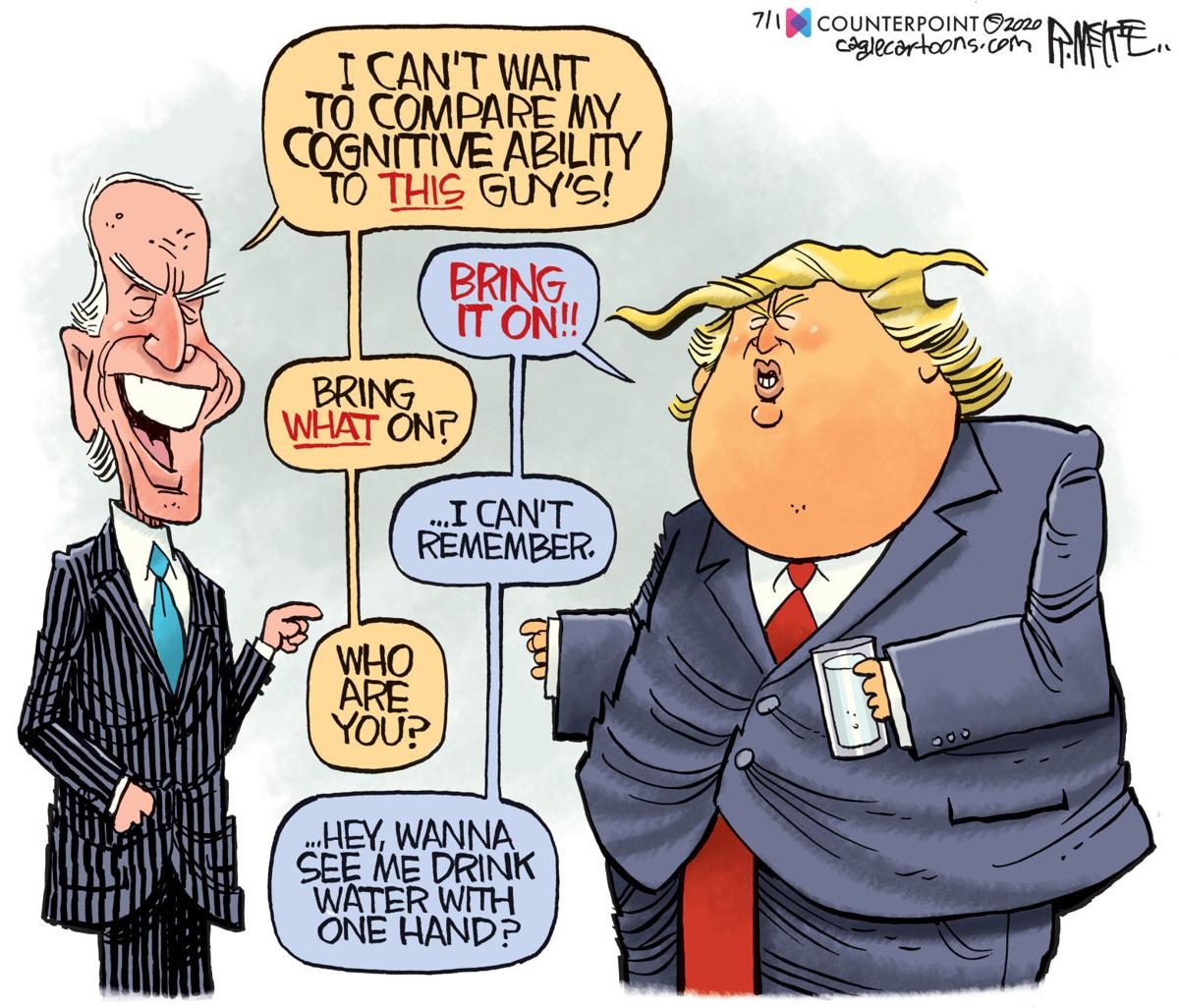
It's a battle of wits between Trump and Biden, in Rick McKee's latest  cartoon

The debate between Biden and Trump is on everybody's mind. And for good reason, the future of the global economy, and the well being of the planet are always at stake in American elections. I, of course, will restrict my brief comments here to the economy, and what the alternatives might entail. But the analysis of the impacts of both programs, if one can talk of programs per se, is very poor, to say the least.

Broadly speaking there has been increasing agreement on a tougher policy with respect to China, what Jake Sullivan referred to as a New Washington Consensus. Many see this as a revival of industrial policy. This is of course suggests some continuity with the Trump policies, even though I would suggest that only with Biden there was a clear plan to re-shore manufacturing jobs, particularly with chips and electric vehicles. Trump basically just hiked tariffs. Both protectionism and the continuity make some liberals (I would say neoliberal progressives, to use Nancy Fraser's term, nervous. For example, Edward Luce's anxiety is that Biden agrees too much with Trump. He says: "both Biden and Trump are vowing to travel in the same direction. But Trump would do so in leaps and bounds."

Note that in all fairness, the US never really stopped doing industrial policy. As noted by Fred Block, even with the problems of the Military-Industrial-Sillicon-Valley Complex, a hidden developmental state. The main new element in the "New" Washington Consensus is really that the US will be less willing to promote economic development by invitation in the case of China. As the IMF policies seem to indicate, for the rest of the world, the old consensus is in place. In that respect, the anxieties of liberals on this are exaggerated.

But that's not all. According to Luce, based on a report* from Moody's, "Trump’s policies would trigger a recession by mid-2025. Unemployment and inflation would jump. The bottom half of US income distribution would suffer the most." He concludes that: "The economic consequences of Trump would be a disaster." This was reinforced letter by 16 Nobel economists warns that: "Many Americans are concerned about inflation, which has come down remarkably fast. There is rightly a worry that Donald Trump will reignite this inflation, with his fiscally irresponsible budgets." This is flatly incorrect. Tax cuts (or their extension) and tariffs wouldn't cause inflation and a recession. Worst case scenario there would be a one time increase in prices, but again the bargaining power of the working class is at low point. So no danger of inflation there. And neither would affect the ability the government to spend. On that Republicans are normally less fiscally conservative when in power than Dems (see old roundtable on that here). And it actually it is a critique that misses the point of why Bidenomics is much better than Trumponomics.

Inflation was not caused by Biden's fiscal packages, as I have insisted several times here (see this paper). And Trump's tax cuts would also not be a problem from that perspective. The point is that Trump would be, in his domestic agenda, more of the trickle down agenda or Republicans going back to Ronald Reagan. Cutting taxes for the wealthy and making it harder for minorities and the poor (often minorities) to access welfare programs. It would be distributively problematic. Inflation is not the risk. The problem with Trump's policies is that they hurt the very working class (many in unions, and certainly white folk) that might vote for him. It would be stupid for unions and other progressives to support Trump.

The good thing about Biden is that he, in part because he had more union connections, and in part because he has moved towards the left (certainly Bernie played a role here), was bold in his fiscal policy, and that might have been instrumental in avoiding a recession (that the Fed was almost engineering). Contrary to Obama, with his mild post-bubble program, and Hillary, Biden has moved to a more traditional Dem (New Deal would be a stretch perhaps) logic of tax and spend.

Eight years ago Hillary had a completely different economic agenda, and that actually explained, to some extent, why Trump ended up winning. I noted that it was likely in this post from before that election, right after a debate, in which I said: "This [election] is going to be way closer than it should be." I also noted that the problem with Hillary was that: "The fact that she has not fully renounced Clintonomics, i.e. financial deregulation, austerity (End of Welfare as we know it) and free trade, is a problem for the progressive base of the party. She walked back some of these, mostly after pressure from the Bernie campaign, but is unclear that these changes would stick."

That these divisions are still relevant within the Democratic Party is clear in the primary in New York that pitied Bowman and Latimer, the former with support from Bernie and the latter from Hillary. Bernie said that "the race 'one of the most important in the modern history of America' and a contest between 'the billionaire class' and ordinary citizens," according to the Financial Times. So if one wants to criticize Trumponomics, the issue is that his agenda is the pro-billionaire one (Wall Street and Silicon Valley agree and have closed the funding gap). Biden is the leftest president since Lyndon Johnson (he is clearly to his right, and LBJ was no commie). He also is not the best possible candidate. He has one unbeatable quality though: he is NOT Trump.

* Mark Zandi is the main author of the report, and he can be seen as another neoliberal progressive, aligned with the pro-business part of the Dems.

Tuesday, June 11, 2024

Bidenomics and other ugly ducklings

The media and a good chunk of the policy wonks are surprised that Biden does not get the deserved recognition for the relatively good state of the US economy, and that as a result he is suffering in the polls. There are two separate, but interrelated, causes for that. The most obvious can be defined in one word, inflation. The second, is related to the fact that, even though the recovery from the pandemic was fast, the economic situation for most working class people has not been great for a long while. In other words, the recovery from the pandemic brought back a situation with which most of the people at the bottom of the income distribution were struggling. I'll deal with inflation, which is the one that everybody is discussing in the news.

Regarding inflation, two things have been negative for Biden. A lot of the mainstream (liberal) and conservative media blames Biden's fiscal package in early 2021 and, perhaps to a lesser extent, the 2022 Inflation reduction Act, for the acceleration of inflation. As do many economists connected to the Dems, more prominently Larry Summers. That view also underpins the Fed's interest rate hikes.

The interest rate hikes could have caused a recession, but now that seems to have been clearly avoided. Traditionally the mechanism is through the impact of the interest rate on residential investment, which is critical for consumption patterns. The graph below show residential investment, that fell before every recession. There were two previous false alarms, in 1951 and 1967, where the Korean and Vietnam wars, and the spending associated to those, came to the rescue. Here, it seems the extra fiscal spending which was highly criticized came to the rescue. Also, the government shutdown, which was always a possibility, and would have reduced spending (and was my biggest fear in terms of a possible recession), never materialized.

The acceleration of inflation, as I discussed several times here (see this paper and this one too, or this INET video),  was caused by supply side constraints during the pandemic, and the shocks to key prices, particularly energy and food commodities after the war in Ukraine. Since there is no significant wage resistance, it was expected that inflation would recede and fall once the shocks passed. No surprises there. And wages are winning against inflation, ad can be seen below. The wages of non-supervisory workers were growing below CPI in the early phase of the inflation acceleration, and are recovering now.

So one may very well ask why are people so angry about inflation. If one looks at the BLS resports it is clear that energy prices, early in the war, and then rents, after the Fed hiked interest rates, had higher increases than the general CPI. The graph below shows that.

This is relevant, since, for lower income people, the impact of higher energy and rental prices impact more than proportionally their ability to spend. In other words, people have less money after paying for gas and housing (and gas impacts transportation and some food items). So most people have felt the inflationary acceleration and they had to tighten the belt somewhat to maintain the same life style.

PS: The yield curve is inverted, and has been for a while and that makes some people nervous. I discussed back in 2019 why an inverted yield curve might not necessarily imply an impending disaster.

Thursday, August 17, 2023

Some brief thoughts on Bidenomics


There has been a lot of writing about Bidenomics (a name that might stick, like Reaganomics; nobody really thinks of Clintonomics as a thing) recently. It is fundamentally about the return of industrial policy, even if I personally think that this is less momentous than what people think. Don't get me wrong, both the rediscovery of fiscal policy after the 2007-9 recession (no fiscal packages after the 1990-91 or 2001 recessions, but packages after both 2007-9 and Pandemic in 2020), and the rediscovery of industrial policy, in part because of the rise of China, and in part because of the Pandemic/Chain supply shock, are important. And Bidenomics might stick because it announces a New Washington Consensus, that at least in theory abandons the neoliberal stances of the old one (see Jake Sullivan's speech).

My concern is that on both counts, the macroeconomic or fiscal front, and on the microeconomics, or industrial policy front, rhetoric is stronger than action. Or that it will be, at any rate. I'm not trying to blame Biden (or his team) for not breaking (or not enough) with conventional views. I mean I might have my views on how lefty or progressive (or even pro labor) Biden is (he did sign vote for every Free Trade Agreement possible, but he is allowed to change his mind). My concern is how much the common sense within the Democratic Party has changed. And while the the 2007-9 recession had moved many Dems and their advisors to rethinking about the macroeconomic consensus (not long ago Larry Summers was saying posties were right, and the economy had no tendency to full employment), the Pandemic inflation has done the opposite, as I noted here.

If the lesson was that Summers had been wrong (and Christina Romer right) on the size of the fiscal package needed for a fast recovery back then, now it seems that most economists (in the mainstream) agree with the notion that excess demand (particularly the last fiscal package early in 2021, and less the Pandemic ones, but that's another story) caused inflation, and the Fed fell behind and was correct in raising rates substantially. Note that the mechanism by which the Fed would reduce inflation is the conventional one, higher unemployment, less demand, lower prices (Summers, ironically, is one of the few actually that brings up the issue of bargaining power of workers with lower unemployment). And this diagnosis remains even though the level of unemployment didn't go down (after the recovery) at the same time that inflation came significantly down.

Of course, there's room still to discuss whether the Fed (together with the freezing of fiscal spending growth for next year by Congress) will end up throwing the economy into a recession or not. But either way, part of the legacy of the last crisis will be to reinforce the conventional new consensus model. Note, however, that the political risk is huge. Because Biden is forced to defend the notion that the economy (that recovered fast from the pandemic, no doubt) is doing great. And of course, the pre-Pandemic situation was far from ideal, and there's a reason why over the last decades a right-wing, blue collar movement has emerged. On that, trade policies were central, and the new industrial policy should play a role.

On the industrial policy front, it is worth remembering the existence of what Fred Block called the hidden developmental state, which suggests that the US always did industrial policy. But I doubt that the main effect of the New Washington Consensus will be to bring back many manufacturing jobs. Most of the ones that the establishment wants to move away from China (or at least part of the establishment, Adam Posen's views suggest that some are in doubt, about the movement away from the old one) will move to other Asian countries, like Vietnam and India.

At any rate, there are some reasons to be mildly skeptical about Bidenomics from a progressive perspective. Of course, I do think this is a huge improvement on Clintonomics, which was just Reaganomics, but more fiscally conservative.


Tuesday, April 27, 2021

Gatekeepers and herd behavior: On Tooze and the radicalization of Krugman

"But that one is holding the poop!"

Adam Tooze, the author of the monumental Crashed (who was, incidentally,  student of Wynne Godley, one of my mentors), wrote a piece for the London Review of Books that has received a lot of praise. While it reviews Paul Krugman's latest book, it provides an overview of the radicalization of New Keynesians, or at least some, that dominate both in academia, and in the corridors or power. The gatekeepers of knowledge and academic  and intellectual influence, with a close connection to power, so to speak. He tells us at the outset that Krugman, the economist that was a bulwark of free trade, even when the theories for which he received his Sveriges Riksbank Prize (aka the Nobel) suggested that some degree of intervention might be good, and that remained even after the 2008 crisis a defender of the conventional macroeconomic model, not only has moved to the left, but also that "in Joe Biden’s Washington, Krugmanism rules."

This is, however, a misinterpretation of the current situation. Tooze suggests that Krugman is one of the "high-powered centrists inching their way towards seemingly obvious political conclusions." The group includes "three centrists – Biden, Janet Yellen and Jerome Powell [that are] undertaking an experiment in economic policy of historic proportions." And he, also, argues that: "what sets Krugman apart within this cohort is the way he has, since the 1990s, stopped being a gatekeeper of the status quo and instead become its critic. In this respect his closest analogue is Joseph Stiglitz, also once of MIT, a member of the Clinton administration and chief economist to the World Bank. Both men have indisputable standing as members of the elite club of New Keynesians."

I see Krugman as being closer to what Colander, Holt and Rosser referred to as the cutting edge of the profession. The role of cutting edge of the profession, in my reply to them (see the paper in Fred Lee and Marc Lavoie's book here), is to make more reasonable policy propositions, while maintaining the notion that markets do produce efficient outcomes, in spite of the unsurmountable logical problems brought by the capital debates, and that led to the rise of vulgar economics. Krugman in that sense is the epitome of the cutting edge. Of course, in order to make reasonable points he would discard many of his own ideas. But he is no critic of the mainstream. The problem with Tooze's argument lies in there. Krugmanism cannot rule, if he basically had to discard his ideas in order to remain relevant. And relevant here simply means that he can be seen to be on the right side of history, more skeptical of free markets, free trade, and willing to accept significant expansion of deficits and debt.

The ideas that won the day and rule in Biden's America are heterodox ideas, that in fact, until very recently Krugman dismissed as not serious. The possibility of continuous expansion of the welfare state, and the expansion of fiscal deficits and debt were anathema to him. Not only he was against expansionary fiscal policy, but even 'Medicare for All,' the signature proposal of Senator Bernie Sanders, something that is common in all advanced economies, was dismissed as a political nonstarter. And certainly that idea, which is not that radical, has remained in the background, and is unlikely to be pushed by the 'radicalized' Biden administration. Perhaps even Krugman still thinks is far too lefty to be acceptable in the United States.

Biden might be the president, and he has a lot of power about what elements of the agenda to push, and he has certainly moved to the left. No doubt about that. Not surprisingly Heather Boushey and Jared Bernstein, economists with heterodox and labor connections, are defending the fiscal expansion from the Council of Economic Advisers (CEA), while Larry Summers, the quintessential insider of the Clinton and Obama administrations, is criticizing from outside. But the Democratic Party has moved to the left, and the politicians have followed. It is the party of Bernie and Alexandria Ocasio-Cortez (AOC). And the establishment knows they need to move if they want to remain relevant, and have a fighting chance in 2024, since the working class is radicalized, and many will abandon the party if Biden does not deliver.

They are like the French politician that, seeing the masses pass in protest, tells his friends in the café he must leave and follow them, since he is their leader. This is, it goes without saying, more like herd behavior, than leadership. Krugman is, in that sense, the leader of an intellectual sea change about views on the role of the state in the economy.

Tooze may think that these arguments are just the diatribes of those in the left that are angry,* infuriated he argues, with the slow pace of change in the center. The issue is that, even though Krugman is following the herd, he certainly is a central gatekeeper in the economics profession. A profession that has been attacked for good reasons, for its excessive influence in policy, and the recurrent blunders of its luminaries.

Krugman still argues in terms of the conventional model, that he defends, as having done a good job explaining the 2008 crisis. People like Wynne Godley, that truly foresaw the 2008 crisis, often only received the acknowledgement ex-post, sometimes too late, after passing away.** Krugman dismisses heterodox economists as not serious. A type of red-baiting of heterodox economists with significant impact on the ability of the profession to change. He also validates some of worst within the mainstream and is willing to play by their harsh rules.+ This is, of course, because the prestigious teaching positions he held, and still holds, the 'Nobel', that was created to give respectability to certain ideas, the weekly column in the NYTimes are all powerful platforms. The danger in this, in accepting Krugman's narrative that he has been right all along, is to convince ourselves that the profession has indeed changed. Now the dangers of neoliberalism and their main defenders, mainstream economists, are gone. The profession is rehabilitated. But the retreat of neoliberalism is only temporary. Krugman and other gatekeepers will change their tune when the current Keynesian moment passes. If the Bidenomics experiment ends up being of historic proportions, and I do hope it does, although that is still too soon to tell, it will not be a victory of Krugmanism. It will be a victory in spite of it.

* I am not as angry as Paul Romer, though.
** On Krugman critique of Godley's 'hydraulic' model, and my response go here.
+ He famously said: "By the early 1980s it was already common knowledge among people I hung out with that the only way to get non-crazy macroeconomics published was to wrap sensible assumptions about output and employment in something else, something that involved rational expectations and intertemporal stuff and made the paper respectable. And yes, that was conscious knowledge, which shaped the kinds of papers we wrote." [Italics added] See the quote and a discussion of the role of another gatekeeper in France that also won a 'Nobel' here.