Showing posts with label James Crotty. Show all posts

Sunday, June 14, 2026

Rod O’Donnell on Keynes and Liberal Socialism

Hits and Mises (click for the joke)

I have been rereading again Rod O'Donnell's work on Keynes' political and social philosophy. I had not read his 1989 book, Keynes: Philosophy, Economics and Politics, in a long while. The occasion is the forthcoming 7th Workshop on Demand-led Growth in Rio, organized by Ricardo Summa, where I will discuss an extension my discussion of Keynes' political views, and in particular of the question of whether Keynes should be understood as a liberal or as a socialist. I had already discussed James Crotty's important contribution to this debate in my paper for Tom Palley's forthcoming Festschrift, available here. Crotty, in Keynes Against Capitalism, argues that Keynes wanted to replace the capitalism of his time with what Keynes himself called "liberal socialism." O'Donnell's case is in some ways older and, in my view, more careful, but it moves in the same direction.
 
O'Donnell's interpretation is that Keynes' economics cannot be separated from his ethical and political philosophy. Keynes was not merely trying to fix some technical problem in the theory of employment. His economics was part of a broader project concerned with the conditions for a civilized life. Keynes' social philosophy was about much more than the level of output and employment. It was about the possibility of reducing insecurity, limiting the power of the money motive, preserving individual freedom, and creating the material conditions for the good life.
 
In the two chapters on political philosophy in the 1989 book, O'Donnell presents Keynes as a liberal, but not as an old laissez-faire liberal. Keynes was not committed to the idea that private interest automatically promoted the public good. He believed that capitalism had to be managed, that the state had to take responsibility for investment, employment, public works, education, health, the arts, and the broader conditions of civilization. According to him, Keynes was also deeply critical of the moral foundations of capitalism, especially of the acquisitive mentality and the social prestige attached to money-making. 
 
That is why O'Donnell sees Keynes as moving beyond capitalism in the long run. For him, Keynes did not admire capitalism. He thought it was ugly, unstable, and morally corrupting. For O'Donnell, the instability is deeply connected to Keynes' views on probability and uncertainty. O'Donnell sees Keynes as believing capitalism is not self-stabilizing, largely because investment and economic life are organized around uncertain expectations, money, and private profit rather than social purpose. In this view, Keynes preferred capitalism to the alternatives available in his own time, above all Soviet central planning and fascism, but not because he regarded capitalism as an ideal social order.
 
O'Donnell is right to insist that Keynes' defense of capitalism was qualified. But I am less sure that Keynes wanted to transition to an alternative social arrangement. His disregard for some aspects of capitalism seems more aesthetic, at least based on his several bios, including Skidelsky's one, and in his writings like 'My Early Beliefs.' He might have thought that the pursue of profit was vulgar, and that the good life resided in the arts and the pursuit of beauty. But beauty and arts were defined in an avant-garde, elitist way. I doubt he saw beauty in a football game (or soccer as people calls it in the US). As I noted in the paper linked above, following Skidelsky, Keynes wanted to preserve the social arrangements in which he was brought up, the presuppositions of Harvey Road, as Harrod would have called them.
 
In his later 1999 essay on Keynes and socialism, O'Donnell pushes this further. Keynes, he argues, should be taken seriously as a "liberal socialist." The term, of course, was used by Keynes himself. O'Donnell's point is that socialism should not be reduced to Marxism, public ownership, class struggle, or revolutionary transformation. If socialism is understood more broadly as the use of social control for public purposes, then Keynes can be understood as a socialist of a particular kind.
 
There is something to this. Many of Keynes' views would now be seen as social democratic. Full employment policy, redistribution, social security, public works, capital controls, the euthanasia of the rentier, the socialization of investment, and the rejection of laissez-faire all became part of the language of the postwar welfare state. In that sense, Keynes does not fit the later caricature of liberalism as simply market liberalism. He is closer to the use of the term in the United States. But he belongs to a different tradition, the New Liberal tradition.
 
Peter Clarke's Liberals and Social Democrats shows that there was a group of left Liberals before Keynes, figures such as L. T. Hobhouse, J. A. Hobson, Graham Wallas, and the Hammonds, who moved British liberalism beyond the Gladstonian night-watchman state. They were all close to the Fabian Socialists, the Webbs, and Shaw, in varying degrees, and they all had a break with Fabianism. They accepted that formal liberty was not enough in a society marked by poverty, unemployment, inherited privilege, and social destitution. In that respect, they were close to what would later be called social democracy. That's Clarke's point to some extent, they were liberals and social democrats.
 
Indeed, one could say that they were among the intellectual ancestors of Keynes' liberalism. They were certainly moving away from liberalism, but, in my view, they fell short of social democracy, certainly as it was defined at that time, since they were averse to class conflict politics, and detached from any conception of the working class as the agent of political change. They were not Fabian Socialists (who mostly accepted marginalist economics), let alone Marxists, and certainly did not join Labour. They felt well represented by the Liberal Party under Asquith, and Lloyd George's People's Budget. In fact, Clarke suggests that Hobson's theories could be seen as shaping the policies of the Liberal administration.

Keynes' own political position is easier to understand in that context. He was not a socialist or a social democrat. He was a New Liberal, or perhaps a late heir to New Liberalism, who thought that liberal civilization could survive only if laissez-faire was abandoned. His political project was not to replace capitalism with working-class power, but to preserve a civilized, decentralized, liberal society by reforming capitalism from above. Managed by an educated elite, and not workers themselves. What distinguished him from the earlier New Liberals was that he developed a theory of why capitalism, although stable in purely economic terms, could settle into persistent unemployment and fail to resolve social conflicts harmoniously, thereby becoming politically unstable. But his theory was far more radical than his politics. He remained, as noted by Palley here, deeply antagonistic to the politics of class antagonism.
 
This does not mean that Keynes was against workers, at least not in any simple sense. On the contrary, his policies were favorable to workers. Full employment strengthens workers. Redistribution improves the bargaining position of workers. Public works reduce unemployment and insecurity. Low interest rates and the euthanasia of the rentier weaken capital. But none of this makes Keynes a socialist if socialism has anything to do with the working class as a political subject.
 
He was elitists and paternalistic when it came to workers. Keynes did not ground his politics in labor. He did not regard trade unions, class struggle, or workers' control as the foundations of a new social order. He certainly did not call for the abolition of private property or the collective ownership of the means of production (well duh!). Indeed, it is not even clear that he would have accepted the more moderate Labourite objective of bringing the commanding heights of the economy under public ownership as desirable in itself.
 
This is why the distinction between policies favorable to workers and working-class politics matters. Keynes wanted full employment, but not because he had adopted a socialist theory of class power, and the need for alternative ways of arranging productive forces. He wanted to prevent capitalism from producing the social conditions that could lead to revolutionary politics, authoritarianism, or collapse. In that sense, the old claim that Keynes wanted to save capitalism remains broadly correct, but it must be qualified. He wanted to save capitalism from laissez-faire capitalism. The educated bourgeoisie, people like him, would be in charge. That was illustrated by his remarks on Bretton Woods conference as a "monkey house" because of the presence of delegates from the dominions and other lesser countries.

This is also why the New Liberal connection is more useful than the socialist label. The New Liberals were reformers who understood that liberty required social conditions. They were critical of poverty and unearned income. They supported social reform and the early welfare state. But they were not socialists in the sense of grounding politics in class struggle, collective ownership or an alternative to the capitalist system. Keynes radicalized this tradition in the context of the interwar crisis, the collapse of the gold standard, mass unemployment, and the failure of orthodox economics. But he did not abandon its basic political orientation.
 
This is the crucial point. O'Donnell is right that Keynes was not a laissez-faire liberal. He is also right that Keynes used the term liberal socialism, and that Keynes' policies moved far beyond orthodox Liberal Party economics. But the problem is that O'Donnell can call Keynes a socialist only by expanding the meaning of socialism so much that it begins to cover what is more precisely called New Liberalism.
 
The paradox, then, is that Keynes' economics was more radical than the economics of many socialists of his time. Labour politicians were often trapped in sound finance and Treasury orthodoxy, while Keynes was willing to experiment with public works, managed investment, and the abandonment of old rules. But Keynes remained, in political terms, closer to the liberal tradition to which he repeatedly declared his allegiance. The confusion comes from the fact, as I emphasized in the paper linked above, that Keynes was never a socialist, but socialists eventually converted to Keynesianism. However, post-war socialists and social democrats used Keynesian tools in the fight to promote labor power. Keynesian means, but not Keynesian ends.

Friday, May 8, 2026

Stiglitz on Keynes and the instability of capitalism

 
Stiglitz delivering the 6th Godley-Tobin Lecture in 2023*

The Economist published a short piece by Joseph Stiglitz on Keynes. I would agree with Stiglitz's on the broad political point that Keynes was not a revolutionary socialist, as I have discussed before. He wanted to save capitalism from itself, as they say. Stiglitz essentially says the same. For him: “Roosevelt’s pragmatism and Keynes’s ideas saved capitalism from the capitalists,” because unfettered capitalism in a prolonged depression might not have survived. He also says Keynes was “no left-wing radical,” believed in the market economy, and saw intervention as a “minor fix” rather than a revolution.

Stiglitz correctly suggests that Keynes remained a liberal, not a socialist, and that he was a moderate in politics even if he was willing to experiment pragmatically with policy. In that he differs from Jim Crotty, and Rod O'Donnell's work on Keynes political views, who suggest he was a socialist. Stiglitz, in contrast, suggests that Keynes understood that laissez-faire capitalism had to be transformed or transcended, but he did not abandon bourgeois liberal society. In my paper I say he was “a revolutionary in economic theory, but a moderate in his politics.”

The key difference between Stiglitz interpretation and my view is on theory. Stiglitz’s Keynes is still, to a significant extent, the Keynes of mainstream Keynesianism. Markets can fail badly, can remain in unemployment for long periods, and government spending is needed to stabilize demand. But he frames the issue partly as one of slow self-correction. Even if there are forces bringing the economy back to full employment, “they worked too slowly” to avoid hardship. That leaves open a conventional reading in which Keynes is mainly an imperfectionist, for whom markets may eventually work, but sluggish wages, prices, interest rates, failed expectations related to uncertainty, or financial frictions that make the adjustment too slow.

The disagreement is not over Keynes’ politics, but over the depth of his theoretical break. Stiglitz emphasizes Keynes as the economist who showed that government could stabilize an inherently unstable capitalist economy. I would emphasize Keynes as the economist who broke with Say’s Law and developed the Principle of Effective Demand. That is why, in my interpretation, Keynes is not simply saying that markets adjust too slowly to full employment, rather he is saying there is no automatic tendency to full employment even with flexible wages and prices. Even if he had to resort to uncertainty at the end, because in many ways he remained too close to mainstream Marshallian principles.

The point is not that Keynes thought capitalism was intrinsically chaotic in the sense of constantly tending toward breakdown. Rather, he thought it could be economically stable in a bad equilibrium, capable of persisting for long periods at sub-normal levels of output and employment. He said so in the General Theory, capitalism is “not violently unstable,” and may remain in “a chronic condition of sub-normal activity for a considerable period without any marked tendency either towards recovery or towards complete collapse."

Stiglitz emphasizes instability in the more conventional economic policy sense. Capitalism produces deep fluctuations, depressions, recessions, and crises, and Keynes showed that government could counteract them. That is true, but it risks making Keynes look like someone whose main theoretical contribution was to show that capitalism is unstable and needs stabilization policy. The Keynes of the 1920s essentially defended that. In my view, Keynes’ more radical theoretical point, only developed in the early 1930s, was different, the system can be stable without being self-correcting to full employment.

Stiglitz stresses Keynes as the theorist of crisis prevention and macroeconomic stabilization, which is fair enough. Certainly that is the dominant view on Keynes. I would stress Keynes as the theorist of stable underemployment capitalism. The danger, for Keynes, was not simply that capitalism would spiral mechanically into economic collapse. The danger was that a system capable of remaining stuck below full employment would generate social and political pressures that could undermine liberal capitalism itself. It was politically unstable, but not necessarily in economic terms.**

Keynes wanted to save capitalism, but not because he thought markets were simply fragile and prone to immediate economic disintegration. He wanted to save capitalism because persistent unemployment and stagnation made the liberal order politically vulnerable, both to Soviet style socialism and fascism. His policy prescriptions aimed at full employment domestically in the face of the rising tide of fascism and communism, both of which he abhorred, as I noted in the paper linked above.

This makes Keynes neither a simple imperfectionist nor a crude instability theorist that believed the system to be on a knife-edge. He was trying to say something subtler. Capitalist economies may be stable enough to survive economically at low levels of activity, but precisely that stability at underemployment makes them politically dangerous. The economic problem is not automatic collapse, but the absence of any reliable automatic mechanism restoring full employment. It was a political problem, and it remains so, even if there are some important changes from his time.

Today, at least in the United States and other advanced economies, the problem is less often mass unemployment in the Keynesian sense than the quality, security, remuneration, and social meaning of employment. Capitalism may deliver low levels of unemployment while still producing precarious, poorly paid, or socially degrading jobs, thereby reproducing a different form of political instability.

* Stiglitz's Godley-Tobin Lecture is free for download here.

** Capitalism would undermine political stability. On a recent post on Schumpeter (the one in the Substack) I suggested that: "The irony is that Schumpeter thought that markets were efficient and capitalism would collapse, while Keynes thought that markets produced suboptimal results, and that capitalism might survive." I would add, Schumpeter thought that democracy would undermine capitalism, Keynes thought that capitalism would undermined democracy.

Saturday, November 25, 2023

Was Keynes a Liberal or a Socialist?

A Socialist Rag

My old Will Lyons  Lecture at Franklin & Marshall College in the Spring of 2021 is now a working paper. Prof. Lyons was a Bucknell Graduate, and a professor at F&M. The topic was based on the, at that time, recent reading of Jim Crotty's book. From the abstract:

Right-wing critics of Keynes have often suggested that he was a socialist. His policy proposals were very often described as a slippery slope that would lead society into a totalitarian nightmare. Alternatively, from the left, Keynes was often seen as a reformist that intended to preserve the essence of capitalism. His reforms were mere window dressing on an exploitative system. The scholarship on Keynes also remained divided. However, in the last few decades a more robust position in favor of Keynes’ socialist affiliation was developed, particularly in the careful scholarship by Rod O’Donnell and James Crotty. This paper suggests that while Keynes was a pragmatist willing to experiment in economic policy, and fully aware of the need to transform and transcend laissez-faire capitalism, he remained a liberal, in particular because Labourites, and most socialists, remained conservative in their economic policy outlook. Keynes was a
revolutionary in economic theory, but a moderate in his politics.

Read paper here.

Thursday, March 30, 2023

Review of Crotty's "Keynes Against Capitalism" (forthcoming in ROKE)

It should not be a surprise that John Maynard Keynes is often seen as being relatively conservative by many progressively inclined or radical economists, that often tend to prefer the views of Michal Kalecki, or the more radical approach of Keynes’ favorite disciple, Joan Robinson. That is not the case in James Crotty’s book Keynes Against Capitalism, who takes a diametrically opposite view. He tells us that: “It is almost universally believed that Keynes wrote his magnum opus, The General Theory of Employment, Interest and Money [GT from now on], to save capitalism from the socialist, communist, and fascist forces that were rising up during the Great Depression era”, but in his view, that “was not the case with respect to socialism. The historical record shows that Keynes wanted to replace then-current capitalism in Britain with what he referred to as ‘Liberal Socialism’” (Crotty, 2019: 1-2). His Keynes was anti-capitalist and, in some sense, a socialist. The notion that Keynes was a socialist often encounters as much resistance as the notion that he was somewhat conservative, of course.

The book is divided in three parts. The first part of the book traces the development of Keynes’ ideas in the inter-war period starting with his significant role during the negotiations of the Treaty of Versailles, and the publication of his instant bestseller, The Economic Consequences of the Peace, that made him a worldwide celebrity, to development of the revolutionary ideas in the GT. The second part analyzes the theoretical ideas of the GT, and how they provide the foundations for a radical and socialist remaking of British capitalism. The third and last part discusses Keynes’ program in action, in the buildup to the war, and during World War-II, and its relevance for our days.

The first part of the book suggests that the Keynesian Revolution started in the 1920s with the slow evolution of Keynes’ thinking about the problems of the British economy, and his rethinking of neoclassical economics. Crotty uses the term classical, as did Keynes, creating unnecessary confusion, in particular because of his own sympathies with Marxist economics, that builds critically on the classical surplus approach. Crotty makes an important point, often neglected in the discussions of Keynesian economics. For Keynes the need for a new theory derived from an appreciation of the historical and institutional changes of British capitalism. Crotty argues: “Keynes’s core belief [was] that the West had entered a completely new historical era in which the institutions and policies currently used to regulate economic life were totally inappropriate. He associated himself with the American institutionalist economist John R. Commons’s view that Europe and America were currently in transition to a new historical epoch in which the main task was to create a new ‘regime which deliberately aims at controlling and directing economic forces’” (Ibid.: 81).

The doctrines of laissez-faire, that were well adapted to the Victorian Era, were not suited for the world that emerged from World War-I, in which mass production, mass consumption and the rise of organized labor required a certain degree of government intervention to manage the economy. This is the best and most original part of the book, in which Crotty reminds us that: “Keynes’s enthusiastic and consistent support for state control of most large-scale capital investment is not the only ‘radical’ policy position overlooked by mainstream ‘Keynesian’ economists; his support of detailed industrial and labor-market policy has escaped their attention as well” (Ibid.: 87). The emphasis on the importance of industrial and labor policies, in particular, their direct connection with Keynes’ opposition to the return to Gold Standard and his support of the coal miners’ strike of 1926, are central to understand his need to rethink his economic theory.

However, even in this part, there is a neglect of an important element of Keynes’ trajectory, and for the development of the ideas exposed in the GT. Crotty forgets to note that Cambridge monetary theory was quite underdeveloped in the 1920s, and was based mostly on an Appendix to Alfred Marshall’s Principles of Economics, and his evidence to some Royal Commission, and was in fact being developed by Keynes and his colleague Dennis Robertson during the 1920s. At that point it was unclear that this was a complete rupture with Marshallian economics on monetary affairs, as much as Piero Sraffa was starting to break with the marginalist theory of value and distribution with Keynes’ support. In fact, Keynes’ thought that his book A Treatise on Money was the culmination of the development of the alternative theory, which he defended as a member of the Macmillan Committee, and that argued that the Depression resulted from the high interest rates, that prevented investment from adjusting to full employment savings, as a result of the Gold Standard. This view was perfectly compatible with neoclassical economics, even if Keynes already advocated for public works, an unorthodox policy, as a solution for the crisis.

However, it was at this point, exactly as a result of the criticism of his book by the young economists of the Circus – a group that included besides Sraffa and Robinson, the latter’s husband, Austin, Richard Kahn, and James Meade – that Keynes finally developed in 1932, relatively late, his main theoretical contribution to economics, the Principle of Effective Demand. In other words, while the 1920s were formative, it was only with the Great Depression and his immersion in pure theory in the early 1930s that Keynes finally broke with orthodoxy in theory. The fact that he changed his diagnosis of the Depression, and adopted a whole new theory right after the publication of what should have been his major theoretical work to the date, led to the traditional complain that Keynes was inconsistent and held more than one view at the same time. Friedrich Hayek and Keynes’ opponents at the London School of Economics would make a of this inconsistency one of their main criticisms of Keynesianism.

This is also relevant because it shows that Peter Clarke is correct when he argues that: “The Suggestion that he [Keynes] wrote The General Theory because he had an axe to grind in immediate policy arguments is wide of the mark” (Clarke, 1991: 163). In other words, Keynes’ views on policy issues could be defended, and in fact he did defend them in the 1920s as noted by Crotty, even before he developed the notion that changes in the level of income were the mechanism by which savings adjusted to investment, and not the other way round. The fact that Crotty suggests that the GT was written: “to convince economists and members of Britain’s intellectual, business, and political elites that the theory that informed their economic worldview and provided essential support for the disastrous conservative economic policies of the era was fundamentally flawed” (Crotty, 2019: 161) seems incorrect.

This is compounded by the fact that Crotty accepts Keynes’ theory of interest and the notion of a marginal efficiency of capital in the second part of the book, and as such is forced, as Keynes was, in particular in the famous 1937 paper in the Quarterly Journal of Economics (QJE) amply cited by Crotty, to use the argument of fundamental uncertainty to preclude the possibility that a sufficiently low interest rate would equilibrate investment to full employment savings. Crotty centers his analytical interpretation of Keynes on chapter 12 of the GT, and his defense of the GT in the QJE paper. The argument is essentially one associated with uncertainty and financial instability. In his words: “The outbreak of pessimism and the loss of confidence in the conventions that underlie expectation formation will also cast a pall over the bond market, a point Keynes also stressed in his 1937 defense of The General Theory in the QJE” (Ibid.: 266). It is clear that the abandonment of the marginalist, or neoclassical, notion of a marginal efficiency of capital would actually strengthen Crotty’s point, but for some reason he neglects the important results that followed from the capital debates in the 1960s, which were central for the completion, on a theoretical level, of the Keynesian Revolution in theory.

On the issue of Keynes’ adherence to some form of socialism, Crotty also makes a valiant case for his position. He provides copious circumstantial evidence, and quotes the famous phrase by Keynes in which he says that: “I am sure that I am less conservative than the average Labour voter; I fancy that I have played in my mind with the possibilities of greater social changes than come within the present philosophies of Mr. Sidney Webb, Mr. Thomas, or Mr. Wheatley. The republic of my imagination lies to the extreme left of celestial space” (Keynes, 1926: 308-309). The part that Crotty forgets to cite is the subsequent phrase, in which he tells us: “Yet—all the same—I feel that my true home, so long as they offer a roof and a floor, is still with the Liberals” (Ibid.). Certainly, many of Keynes’ policy proposals were radical. They moved in the direction that was compatible with socialist or social democratic views. And he recognized he had many common goals with Labour and the Fabian Socialists. But he called his views liberal socialism, and remained an Asquith New Liberal all his life.

Liberalism also spoke to Keynes political and social outlook in ways that Labour or Socialism never did. He was an elitist, the product of Eton and King’s College, Cambridge, and a member of the Apostles and the Bloomsbury group. To some extent Labour reciprocated. Philp Snowden, Labour’s first chancellor of the exchequer, was a committed defender of the Treasury View, and an avowed anti-Keynesian. Hugh Dalton, Clement Atlee’s first chancellor of the exchequer, was averse to Keynesian policies, and for him Keynesianism: “was virtually a deathbed conversion, for only in his fourth, final, fatal Budget of November 1947 did he explicitly relate his measures, which stepped taxes across the board, to the problem of controlling inflation… The paradox is that a Keynesian approach was directed chiefly to the problem of keeping demand down, not up” (Clarke, 1991: 186-87). But if there is a future for socialism, Crotty’s view that Keynes’ ideas remain relevant is correct, and there could be no sensible socialism without a good dose of Keynesianism.

References:

Clarke, P. 1991. A Question of Leadership: Gladstone to Thatcher, London: Hamish Hamilton.

Crotty, J. 2019. Keynes Against Capitalism: His Economic Case for Liberal Socialism, London: Routledge.

Keynes, J. M. 1926. “Liberalism and Labour,” in A. Robinson and D. Moggridge (eds.), The Collected Writings of John Maynard Keynes: Essays in Persuasion, Volume IX, Cambridge: Cambridge University Press, 1972.

Wednesday, February 1, 2023

Luigi Pasinetti (1930-2023)

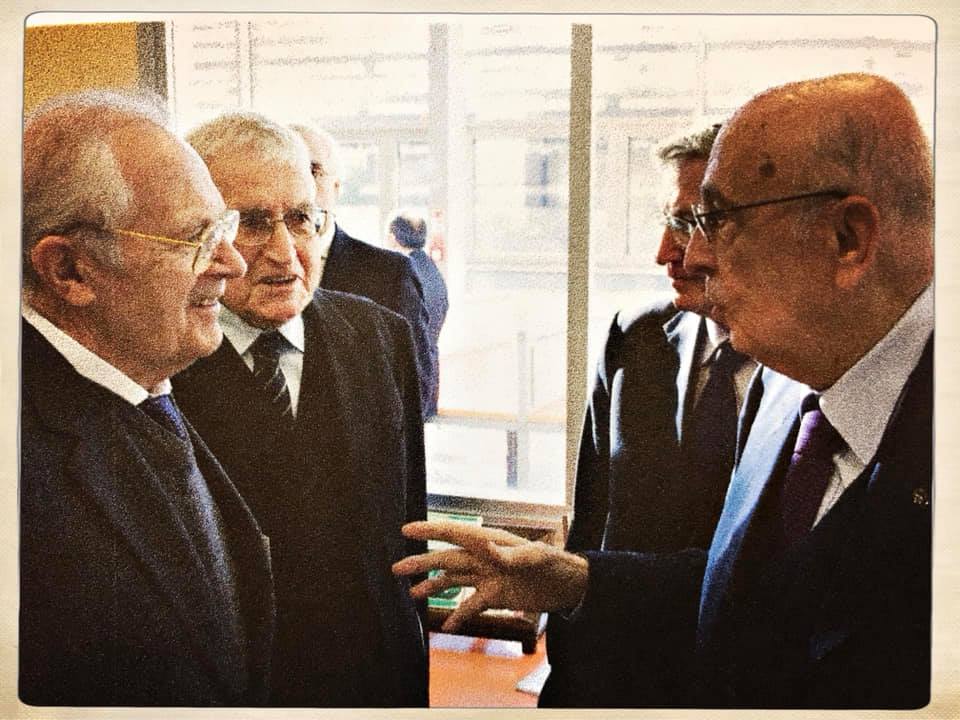
Pasinetti, Garegnani and the president of Italy in 2010

Last week, in my senior seminar on the history of economic thought, I made the kids read a paper by Pasinetti on "Progress in Economic Science", which was published in a book edited by Boehm, Gehrke, Kurz and Sturn. It's a short defense of pluralism in economics on the basis of the co-existence of Kuhnian paradigms, with a relatively optimistic view of the possibility of progress, in a discipline in which, as he noted, the object of analysis is changing continually, the ideas of the researchers might affect the functioning of the object of study, and value judgments cannot be avoided, in part because they affect everyday material conditions. As he said: "It is enough to think of the devaluation of a currency, or of the movements of wages and salaries, to realize how deeply these phenomena affect everybody’s pocket."

Sadly Pasinetti has died yesterday. He was perhaps the last great name of the Anglo-Italian Cambridge School, that tried to put the works of the classical authors and Marx and the Keynesian Revolution together, and intimately associated with the work of Piero Sraffa. I remember reading a paper on how the school could be divided in a more Marxian strand (with Pierangelo Garegnani as the main author) and a Ricardian one, around Pasinetti. This also had political implications with Pasinetti representing the center right Christian Democrats, and Garegnani on the left, linked to the Communist Party. I once told that to Garegnani, who dismissed the idea of Sraffian schools.*

Pasinetti will be remembered for his work on the Cambridge distribution models, the famous Kaldor-Pasinetti model, the participation in the capital debates, and his work on a classical model of structural growth. Personally, his book on the theory of production (Lectures on the Theory of Production) and his discussion and critique of the Maastricht fiscal limits remain the two of his contributions that influenced me the most.

I should note that this comes after a series of deaths in the profession that have significantly affected the heterodox community, and me personally. Vicky Chick, with whom I was supposed to work for my PhD, and Jim Crotty, two of the more creative thinkers within Post Keynesian economics have passed. Also, on a personal note, Nilüfer Çagatay, my colleague in Utah, and Barkley Rosser, the co-editor of the New Palgrave passed away this month. The heterodox community is in mourning.

* The other would be the Smithian one, with Sylos-Labini as the main leader, and a Socialist bent in politics.

Sunday, December 29, 2013

New Title: The Handbook of the Political Economy of Financial Crises

From the abstract:
The Great Financial Crisis that began in 2007-2008 reminds us with devastating force that financial instability and crises are endemic to capitalist economies that lack powerful and dynamically changing financial regulations that can keep the powerful forces of leverage and credit within sustainable bounds. Economists from Marx to Keynes, and Minsky to Kindleberger have well understood this profoundly important fact, yet the dominant mainstream economics of "rational expectations", "efficient markets" and "laissez-faire" that rationalized widespread financial liberalization and still dominates the economics profession has gotten it, literally, "dead wrong". The Handbook of The Political Economy of Financial Crises describes the theoretical, institutional, and historical factors that can help us understand the forces that create financial crises - with an emphasis on the crisis of 2007- 2008 - and the strengths and weaknesses of varying theoretical perspectives and policy approaches that have tried to comprehend and limit these financial tsunamis.
See more here.

NOTE: Although all of the chapters will be invaluable to the reader, one in particular that will be worth much perusing is by Prof. James Crotty on the irrelevance of efficient market hypothesis (EMH), which can preliminarily be seen here .