Showing posts with label Sylos-Labini. Show all posts

Wednesday, February 1, 2023

Luigi Pasinetti (1930-2023)

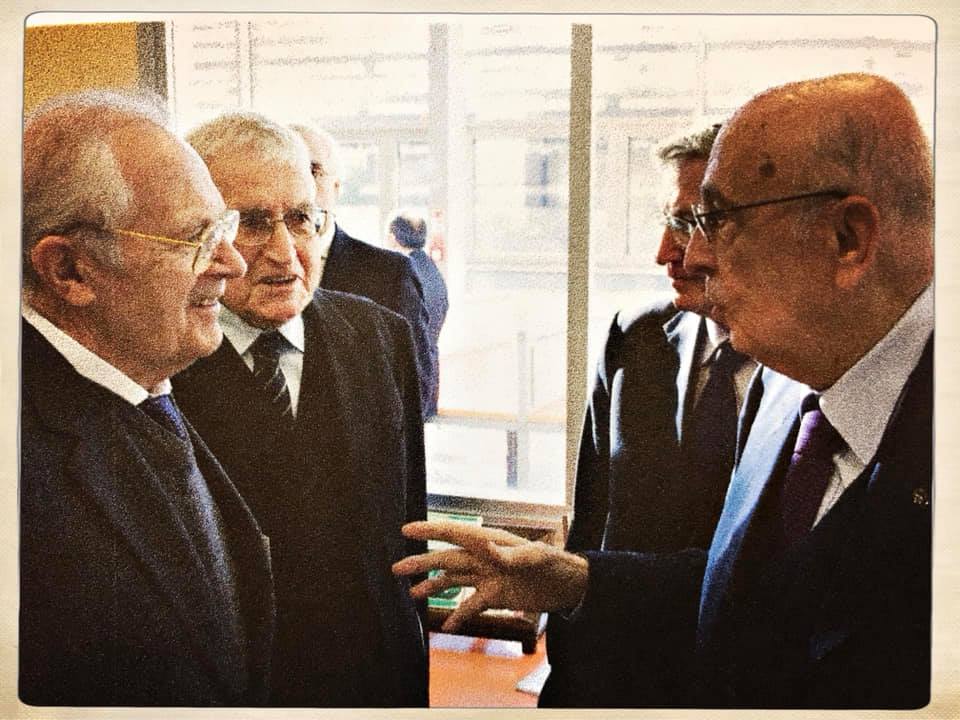
Pasinetti, Garegnani and the president of Italy in 2010

Last week, in my senior seminar on the history of economic thought, I made the kids read a paper by Pasinetti on "Progress in Economic Science", which was published in a book edited by Boehm, Gehrke, Kurz and Sturn. It's a short defense of pluralism in economics on the basis of the co-existence of Kuhnian paradigms, with a relatively optimistic view of the possibility of progress, in a discipline in which, as he noted, the object of analysis is changing continually, the ideas of the researchers might affect the functioning of the object of study, and value judgments cannot be avoided, in part because they affect everyday material conditions. As he said: "It is enough to think of the devaluation of a currency, or of the movements of wages and salaries, to realize how deeply these phenomena affect everybody’s pocket."

Sadly Pasinetti has died yesterday. He was perhaps the last great name of the Anglo-Italian Cambridge School, that tried to put the works of the classical authors and Marx and the Keynesian Revolution together, and intimately associated with the work of Piero Sraffa. I remember reading a paper on how the school could be divided in a more Marxian strand (with Pierangelo Garegnani as the main author) and a Ricardian one, around Pasinetti. This also had political implications with Pasinetti representing the center right Christian Democrats, and Garegnani on the left, linked to the Communist Party. I once told that to Garegnani, who dismissed the idea of Sraffian schools.*

Pasinetti will be remembered for his work on the Cambridge distribution models, the famous Kaldor-Pasinetti model, the participation in the capital debates, and his work on a classical model of structural growth. Personally, his book on the theory of production (Lectures on the Theory of Production) and his discussion and critique of the Maastricht fiscal limits remain the two of his contributions that influenced me the most.

I should note that this comes after a series of deaths in the profession that have significantly affected the heterodox community, and me personally. Vicky Chick, with whom I was supposed to work for my PhD, and Jim Crotty, two of the more creative thinkers within Post Keynesian economics have passed. Also, on a personal note, Nilüfer Çagatay, my colleague in Utah, and Barkley Rosser, the co-editor of the New Palgrave passed away this month. The heterodox community is in mourning.

* The other would be the Smithian one, with Sylos-Labini as the main leader, and a Socialist bent in politics.

Tuesday, February 4, 2014

Heterodox Microeconomics

Tae-Hee Jo, Fred Lee, Nina Shapiro, and Zdravka Todorova have compiled a list of readings in Heterodox Microeconomics that deserves attention and praise (available here). The only classic book that was central in my formation that I see missing is Paolo Sylos-Labini's Oligopoly and Technical Progress (1962). My favorite graduate textbook still is the one by Fabio Petri here.

Wednesday, August 1, 2012

Microfoundations and the capital debates

Steve has commented on the ongoing debates about microfoundations of macroeconomics, mainly between Paul Krugman and Simon Wren-Lewis (for my comments and Simon's reply on his blog go here, and scroll down to the last comments). I just want to further clarify what I think is, from the point of view of the history of ideas, a significant confusion in the debates about microfoundations, and one (oh yes, here he comes again) that is ultimately related to the capital debates (the Rosetta Stone of the history of economics ideas; if you prefer Sraffa's PCMC, as I tell my students, is the Rosetta Stone. To get an idea of what is the meaning of the capital debates go here).

Microfoundations are first and foremost about the determination of relative prices, the core of what we now call microeconomics, and used to be called before the theory of value. Individual behavior, rational or otherwise, is relevant to the extent that one thinks that behavior of individual agents is central for price determination, and that was at the core of the Marginalist Revolution.

The point is that if individual workers (using the figure of a representative rational utility maximizing worker), for example, in the labor market, confronts rational individual profit maximizing firms (again a representative firm), the free play of the market would produce an optimal outcome. Krugman is very clear why he thinks microfoundations are important. He says:
“if the assumption of perfect rationality breaks down even in the most standard of micro settings — if consumers behave in a way inconsistent with full maximization even when doing something as mundane as choosing which type of gas to put in their tank — how absurd is it to insist that, say, Keynesian stories about the economy can’t be right because we can’t fully derive them from intertemporal maximization?”
In other words, if workers say are not concerned with maximizing utility in terms of higher real wages, but in terms of relative wages, or if firms have limited knowledge about the workers willingness to work, and have an incentive to pay wages above the reservation wage (the one that compensates workers for the trouble with parting with leisure time), then the imperfection implies that the labor market will not clear and you might have unemployment. This is basically the efficiency wage story that New Keynesians use to justify unemployment (note that unemployment does result from real wages above the equilibrium level, and not from lack of demand as in Keynes).*

The capital debates show that even if you have workers trying to maximize utility in the normal fashion, and firms too have full information, that is, in the absence of any imperfection, there is no guarantee that lower real wages would imply more intensive use of the labor ‘factor.’ It is actually quite simple, if commodities are produced with commodities, then a reduction in wages also reduces the price of all goods, since they are produced with labor too, and there is a possibility that the fall in the price of commodities that do not use too much labor falls more than proportionally, so the increase in their demand does not lead to an increase in the hiring of new workers. Also, as wages are central for the consumer’s demand, the income effect of any reduction in wages would trump any (if it is positive) substitution effect. In other words, why would a firm hire more workers (even cheap ones) if nobody buys their products?

Further, PCMC does provide a sound way of determining relative prices. Long term normal prices are determined by the technical conditions of production, given one distributive variable (either real wages or interest, or if one prefers, for a given wage-profit frontier). It does take long term patterns of demand as given obviously, since producers would not supply, in the long term, goods and services for which there is no demand. The analysis of the determinants of effectual demand, the long term patterns of demand, are at a lower level of abstraction, and include all the institutional factors associated to fashion, conspicuous display of power, the effects of marketing, etc., that Veblen, Galbraith (father) and other institutionalist authors suggested were relevant.

Also, workers are rationally trying to obtain a fair wage, and to consume according to their tastes and the other social and institutional factors that determine their behavior. But those are taken as given for the determination of long run prices. And firms do maximize profits, and this implies that they add a mark up on their full costs. These models were developed by the authors of the Full Cost Pricing School, and the literature on barriers to entry, e.g. Sylos-Labini, Steindl and others, and the empirical evidence tends to be favorable.

In that sense, heterodox (classical-Keynesian, by which I mean Sraffa’s prices cum Keynes/Kalecki’s effective demand) does have a coherent determination of long run prices, based on rational behavior, as the foundation of the macroeconomic theory. Markets do not produce optimal outcomes and unemployment of productive resources is the normal, long run, position of the economy. In fact, the capital debates not only say that classical political economy (the surplus approach) provides sound microfoundations, but also that it is NOT possible to do so within the neoclassical/marginalist paradigm.***

* Interestingly enough Krugman’s argument for the current recession is not a rigidity in the labor market, but one in the money market, that is, a rate of interest that does not allow for investment at the level of full employment savings, the so-called Liquidity Trap.

** And yes there is empirical evidence in favor of this view, since there is no support for the effect of lower real wages and higher employment. Real wages tend to be pro-cyclical, go down in a recession, and up in the boom.

*** Arrow-Debreu also does not provide a way out of this conundrum.

PS: For the implications of Sraffa's contribution for Keynesian economics see this paper, and this post.

Wednesday, March 28, 2012

Gravitation, Full Cost Pricing and Prices of Production

Franklin Serrano (Guest blogger)

Most Sraffians understand that gravitation of market prices to normal prices is much quicker than the slower, but inevitable, adaptation of capacity to demand. But other eminent Sraffians have made some confusion by wrongly identifying classical prices of production with full cost pricing.

Classical prices of production are the centre of gravitation for market prices and are determined by the costs of the dominant techniques (at the level of normal utilization of fixed capital) and the state of distribution. It is a general theory of the structural determinants and limits for the trend of market prices in all types of markets. In spite of the similar name it has little or nothing to do with “normal cost” or full cost pricing which is a generalization of the descriptions given by some firms as to how they actually calculate their own prices based on a markup over their own costs (not those of the dominant technique).

First of all, there is obvious fact that the theory of prices of production was developed in a historical period in which such these pricing rules simply did not exist (see Hicks’ Market Theory of Money, 1989). And prices of production can still explain, in my view, the structural or trend element even in markets with highly flexible prices subject to wild short run fluctuations and rampant speculation, as in the so-called “commodity” markets (in Garegnani’s comment on Asimakopulos he explicitly mentions the importance of explaining the trend of the relative price of copper even though “at any one time copper prices are 50% or more above or below trend”)

Second, even in the so called fix price markets, were firms set the prices of their products directly, the full or "normal cost" that particular firms use to calculate their own price is the actual cost of these particular firms and the markup these particular firms think they can add to prices without trouble. These calculations generate actual market prices or (if stylized enough to have some generality short run theoretical prices) that are not unique even for a single market as the full cost prices can be different for different firms. These prices differ from prices of production because they refer to the actual costs of some firms and not the costs of the dominant technique available. For that particular product that determines a single price of production for that market.

The way prices of production may regulate the full cost prices of firms is by getting them in trouble whenever their actual costs plus their desired markups are too high relative to the costs (including normal profits) of the dominant technique, thereby attracting new entrants or cause some rival firms inside that market not to follow price rises that are due to increase in costs particular to that firm or “excessive” desired markups of these firms.

Professors Fred Lee and Marc Lavoie are both absolutely right and some Sraffians wrong in saying that full cost pricing is NOT the same thing as the classical theory of prices of production. Where I think they are definitely wrong is in thinking that classical prices of production are thus irrelevant for market forms in which firms follow such rules. For, through the power of actual or potential competition, the classical prices of production are the centers of gravitation that regulate even the trend of the prices of firms that practice full cost pricing. The closest analogy between classical prices of production and the industrial organization literature is thus the concept that Sylos-Labini called “limit” prices.

So market prices in both fix and flex price markets gravitate, towards or around classical prices of production. Any theory of full cost pricing can at best be a particular theory of short run price behavior of some firms in particular types of markets. There are old papers by James Clifton that started this confusion many years ago in Contributions to Political Economy and the Cambridge Journal of Economics. It is about time we stop confusing ourselves and our post Keynesian friends on this issue.

References:

Lavoie, M. (2003), “Kaleckian Effective Demand and Sraffian Normal Prices: Towards a reconciliation,” Review of Political Economy, 15(1) available here.

Lee, F. and T-H. Jo (2011) “Social Surplus Approach and Heterodox Economics,” Journal of Economic Issues, 45(4) available here.

Garegnani, P. (1988), “Actual and Normal Magnitudes: A Comment on Asimakopulos,” Political Economy, republished in Essays on Piero Sraffa: Critical Perspectives on the Revival of Classical Theory, Routledge, 1990.