Showing posts with label Heinz Kurz. Show all posts

Wednesday, February 1, 2023

Luigi Pasinetti (1930-2023)

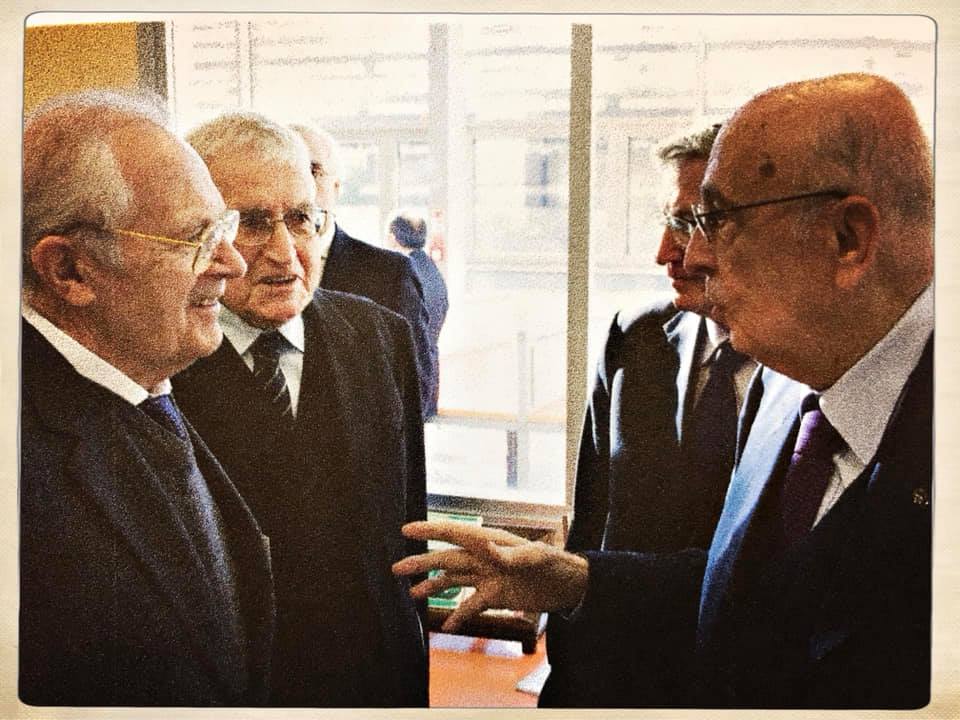
Pasinetti, Garegnani and the president of Italy in 2010

Last week, in my senior seminar on the history of economic thought, I made the kids read a paper by Pasinetti on "Progress in Economic Science", which was published in a book edited by Boehm, Gehrke, Kurz and Sturn. It's a short defense of pluralism in economics on the basis of the co-existence of Kuhnian paradigms, with a relatively optimistic view of the possibility of progress, in a discipline in which, as he noted, the object of analysis is changing continually, the ideas of the researchers might affect the functioning of the object of study, and value judgments cannot be avoided, in part because they affect everyday material conditions. As he said: "It is enough to think of the devaluation of a currency, or of the movements of wages and salaries, to realize how deeply these phenomena affect everybody’s pocket."

Sadly Pasinetti has died yesterday. He was perhaps the last great name of the Anglo-Italian Cambridge School, that tried to put the works of the classical authors and Marx and the Keynesian Revolution together, and intimately associated with the work of Piero Sraffa. I remember reading a paper on how the school could be divided in a more Marxian strand (with Pierangelo Garegnani as the main author) and a Ricardian one, around Pasinetti. This also had political implications with Pasinetti representing the center right Christian Democrats, and Garegnani on the left, linked to the Communist Party. I once told that to Garegnani, who dismissed the idea of Sraffian schools.*

Pasinetti will be remembered for his work on the Cambridge distribution models, the famous Kaldor-Pasinetti model, the participation in the capital debates, and his work on a classical model of structural growth. Personally, his book on the theory of production (Lectures on the Theory of Production) and his discussion and critique of the Maastricht fiscal limits remain the two of his contributions that influenced me the most.

I should note that this comes after a series of deaths in the profession that have significantly affected the heterodox community, and me personally. Vicky Chick, with whom I was supposed to work for my PhD, and Jim Crotty, two of the more creative thinkers within Post Keynesian economics have passed. Also, on a personal note, Nilüfer Çagatay, my colleague in Utah, and Barkley Rosser, the co-editor of the New Palgrave passed away this month. The heterodox community is in mourning.

* The other would be the Smithian one, with Sylos-Labini as the main leader, and a Socialist bent in politics.

Tuesday, April 28, 2020

Das Adam Smith problem

A short lecture on Adam Smith's problem for a Principles class. This might be of more general interest, and perhaps something to watch during the quarantine. The book I used for the lectures on history of economic ideas was Heinz Kurz's Economic Thought: A Brief History, a book that I highly recommend. The discussion here is heavily influenced by Tony Aspromourgos' book The science of wealth: Adam Smith and the framing of political economy, another one you should read if you have the opportunity.

Monday, September 29, 2014

New Book: "Towards a New Understanding of Sraffa" Edited by Bellofiore & Carter

Towards a New Understanding of Sraffa examines the legacy of Piero Sraffa by approaching his ideas in a new light, thanks to the insights gained from the opening of the archive collection of his papers at the Wren Library (Trinity College, Cambridge, UK). It provides a refreshing perspective into Sraffa's approach to money, the role of equilibrium and of the surplus in economic theory.  The study is backed by previously unpublished, original, archival material. It provides an appraisal of the discontinuities in the path leading to the publication in 1960 of Production of Commodities by Means of Commodities since its conception in the late 1920s. It unlocks significant new perspectives about the connection of Sraffa to Marx regarding Standard commodity, the macro-social and monetary theory of exploitation, the tendency of the rate of profit to fall, and the transformation of values into prices of production. It also offers insights on how Sraffa dealt with money in the various phases of his thinking, and explores his ideas about the role of equilibrium and of the surplus in economic theory. It concludes with an account of some recent Sraffa scholarship and points towards future research avenues. 
See rest here.

PS: (Matías here) There was a special issue of the Cambridge Journal of Economics on the topic here, with a response by Heinz Kurz here (subscriptions required). (David here) And here is an earlier piece by Kurz on Sraffa's unpublished manuscripts, in relation to the history of economic thought.

Tuesday, August 20, 2013

Economists with K, or rediscovering something never lost

So there is a certain buzz about the two old Ks, Keynes and Kalecki, and what Krugman and Konczal, the new Ks, have been saying about their theories. Mike is more of a journalist, and it is certainly good that journalists get Keynes right. And even better if they get Kalecki. On Krugman I said enough. He should take a page from Keynes and learn that by 1936 he was:
"no longer of the opinion that the concept of a 'natural' rate of interest, which previously seemed ... a most promising idea, has anything very useful or significant to contribute to our analysis."
In all fairness, for heterodox economists this rediscovery of Keynes/Kalecki is both welcome and a bit frustrating (check the comments in Quiggin post; someone thinks that DeLong was the first to point the relevance of Kalecki's "The Political Aspects of Full Employment").

But here is my advice to recovering neoclassical economists, check these other economists with K, you might learn something: Kahn, Kaldor, Keyserling, Klein, Knapp,  and Kondatriev. Kuznets is often remembered, so no need for rediscovering him, I think. And you can always go back to Gregory King, if you're so inclined. A good active economist with K, that understands both Keynes and Kalecki and how their theories are related to the old classical economists and Marx is Heinz Kurz. I have a list with the Ms and Ss for you to 'rediscover' too.

PS: Just three books on Kalecki published a few years after he passed away that you may want to check out are George Feiwell's The Intellectual Capital of Michal Kalecki: A Study in Economic Theory and Policy, Malcolm Sawyer's Macroeconomics in question: the Keynesian-monetarist orthodoxies and the Kaleckian alternative, and The Economics of Michał Kalecki. For a discussion of Kalecki's views on economic development see this paper by Jayati Ghosh.

Monday, August 20, 2012

More on Sraffa and the theory of value and distribution


Two posts by Alejandro Fiorito, at the Revista Circus blog, and Robert Vienneau follow up my previous post on Sraffa and the Labor Theory of Value (LTV). The former is on the debate between Garegnani and Samuelson, just published in a book edited by Heinz Kurz. Garegnani, who debated with Samuelson since the latter's seminal paper on the production function as a parable back in the early 1960s, basically argued against the notion that Sraffa's system can be seen as a special case of Walrasian General Equilibrium, which was ultimately Samuelson's position.

Vienneau discusses several issues. One that I think it's particularly relevant is Steedman's view that one might have a positive profit rate and negative aggregate surplus value. Serrano and Lucas (not that Lucas!) have written a paper on the subject which suggests that Steedman's counterintuitive results are basically irrelevant. At any rate, as noted by Robert, "Marxist political economy should remain a live and exciting field of scholarly research," and this is to a great extent possible because of Sraffa's legacy.

Sunday, August 21, 2011

Heinz Kurz on the state of the dismal science


Here is a very important paper, by Kurz, published in Investigación Económica (see previous post).  He shares a similar view of what it means to be a heterodox economist with this blogger, and argues that:
"Economics may be a dismal science or discipline, but its present dismal state applies not to the discipline as a whole or to all traditions of economic thought available. It applies to the neoclassical mainstream and especially to NCE [New Classical Economics]."
It is the notion of an economic system that automatically tends to full employment that makes ours a dismal science, but that is NOT a general, even if it is dominant, view in the profession.