Showing posts sorted by relevance for query Krugman Keynesian. Sort by date Show all posts

Friday, December 21, 2012

On the state of macroeconomics: fashion versus logic and evidence

Yes there is something rotten in the kingdom of Denmark, and it is macroeconomics; pretty much as in every other country. There has been an ongoing debate on the blogosphere on the topic (see Krugman, Smith, Thoma, Williamson and Wren-Lewis, not in chronological order, by the way). The New Classical versus New Keynesian debate tends to be on two issues the relevance of microfoundations on the theoretical level, and the importance of price rigidities on the empirical side.

Scientists, as Mankiw put it, are the New Classicals that emphasize the microfundations. They have intertemporal maximization models based on rational representative agents. The New Keynesians are the engineers, again using Mankiw's dichotomy, that strive for economic realism. Or so is what you are expected to believe if you read their posts. Of course all of these presumptions are bogus.

Noah Smith correctly points out that they all use the same DSGE models. But Krugman notes that on policy debates the whole difference is based on the assumption of sticky prices. So they use the same models, but reach very different conclusions. Of course the tools are not neutral though. Using DSGE models has hurt the positions that New Keynesian want to take. For example, Krugman has been forced to argue that the reason for the poor recovery is that the natural rate of interest is negative (and hence the current rate is too high to bring investment and savings into equilibrium).

This is a much weaker position than the one taken by heterodox authors that suggest that the crisis is due to lack of demand associated to worsening income distribution over the last three decades, and the consequent expansion of unsustainable private debt to allow for consumption. So the poor recovery is associated to lack of demand, since wages are stagnant and private debt cannot increase (and the GOP is bent in not allowing public demand to grow).

Note that the Godley type models, which follow the heterodox perspective, were much better for understanding and foreseeing the crisis (see here). There is no reason for intertemporal maximization models, and their kind of microeconomics (Sraffians have better stuff for that). New Classicals, Mankiw notwithstanding, are not scientists (or at least not good ones), since their models do have significant logical problems, and you cannot be a good engineer, somebody concerned with practical applications of scientific knowledge, if you share a model that is flawed.

On an interesting note, Krugman's main complain about Noah Smith's position is that he doesn't understand that the New Classicals have basically treated New Keynesians as outcasts. In his words:
"the freshwater [New Classical] types simply didn’t accept the legitimacy of what the New Keynesians were doing — in fact, didn’t even bother to read any of it, because anyone who actually worked with that kind of model would know that fiscal policy can indeed have an effect in that framework."
The problem is that they don't think he is legitimate. In fact, that is true. Williamson says:
"It doesn't surprise me that Paul Krugman isn't up on what is going on in macroeconomic research. Why should we expect him to go to macro conferences, spend time in seminars, and talk to his colleagues at Princeton? He has plenty on his plate, what with delivering two NYT columns per week, blogging, talking to pundits, and giving speeches. But if he's not up on the field, what purpose does it serve to make up outlandish stuff for people to read?"
Indeed Williamson's critique is that Krugman is not up to date, on the cutting edge, Colander would say. So he has missed the last fashion season in macroeconomics. And Wren-Lewis makes a point that he is a Karl Lagerfeld of macroeconomics (not sure if that is a correct fashion quote). Wren-Lewis points out that:
PK [yes, Paul Krugman] was very much at the forefront of analysing the Zero Lower Bound problem, before that problem hit most of the world. While many point to Mike Woodford’s Jackson Hole paper as being the intellectual inspiration behind recent changes at the Fed, the technical analysis can be found in Eggertsson and Woodford, 2003. That paper’s introduction first mentions Keynes, and then Krugman’s 1998 paper on Japan. Subsequently we have Eggertsson and Krugman (2010), which is part of a flourishing research programme that adds ‘financial frictions’ into the New Keynesian model. You would not think of suggesting that PK is out of touch unless you are in effect dismissing or marginalising this whole line of research.
So he is pretty much au courant, according to his New Keynesian friends (and that sounds right to me too, by the way). No fashion problem with Krugman and New Keynesians. They are trendy too. Good for them.

Yet, what it is expected of science is not fashion, but relevance following logic and evidence. And yes Krugman is right, there is evidence for price rigidity, and also no evidence for the sort of theory of distribution implicit in the mainstream neoclassical DSGE models (productivity equals remuneration of factors of production), or for a natural rate for that matter. And that is the problem with Krugman and his New Keynesian friends, too much preoccupation with fashion, not enough with logic and evidence. If the profession remains concerned with fashionable models it will continue to be irrelevant and impractical.

Tuesday, June 21, 2011

Mr. Krugman and the Ancients


The preliminary paper posted by Krugman for the Cambridge conference on the 75th anniversary of the publication of the General Theory (GT) is an interesting piece. Not fundamentally for what it says, which is nothing new if you read his blog. Something along the lines liquidity traps imply that you need fiscal policy, and we are at one right now. But it is revealing piece about what mainstream Keynesians understand about the evolution of macroeconomics, and how much knowledge has been lost with the rise to dominance of the neoclassical/marginalist approach.

First, it is important to note that by the time of the New Deal and the Keynesian Revolution American academia was dominated by institutionalism. Mitchell was the head of the National Bureau of Economic Research, John Maurice Clark at Columbia was one of the leading figures of the profession and was the president of the American Economic Association in 1935, and so on. Yes, neoclassical economics dominated in England, with Marshallian traditions in Cambridge, and there were several neoclassical economists in the US, like Irving Fisher, but in America they were still not dominant.

Also, Keynesians or proto-Keynesians like Marriner Eccles and Lauchlin Currie, and institutionalists like Adolph Berle and Rexford Tugwell, were instrumental in bringing a whole generation of economists that where like Clark a mix of institutionalists with Keynesians into the New Deal administration. John Kenneth Galbraith would be the most prominent example. It is important to note that none of these economists thought that Keynes’ ideas were related to wage or interest rate rigidities, or that the problem with the Depression was that wages were too high.

These ideas only became dominant after Hicks and Modigliani, and were popularized in Samuelson’s neoclassical synthesis. In fact, it was the neoclassical synthesis, and not General Equilibrium, that made neoclassical economics the dominant approach in the US. The new economists were trained basically in Marshallian micro (partial equilibrium consumer and production theory) and Keynesian macro (Keynesian cross and ISLM). Old institutionalism started to vanish. [And by the way that is fundamentally, with the addition of natural rate ideas, and a Phillips curve in the macro part, what is essentially taught to undergrads; General Equilibrium is a graduate thing].

Krugman correctly criticizes Barro for the interpretation that the problem for Keynes was high wages, and that monetary policy was the solution. But he says: “if that’s all that it was about, the General Theory would have been no big deal.” Note that neither is a correct interpretation of the GT. Krugman having been trained as an old Keynesian, in the neoclassical synthesis (even if it is very likely that Rational Expectations were already important in his graduate training), is okay with the notion that Keynes believed in some sort of rigidity. For him, contrary to Barro, the main rigidity is not in the labor market, but in the capital market. Namely: a rate of interest that is too low and cannot be reduced further.

I should say here that it is a bit amazing that the discussion does not even include a footnote on Keynes and Pigou effects, and how wealth effects according to the neoclassical authors reestablished the notion of full employment equilibrium, and Keynes’ own views in chapter 19, and Kalecki’s famous reply to Pigou. Not even a footnote on Patinkin’s work on the topic. And that in a nutshell is the problem with Krugman’s paper. He gets stuck with two interpretations the uncertainty version of chapters 12 and 17, and the neoclassical synthesis of chapter 18, but he never bothers with chapter 19, the first in the whole book in which flexible wages and prices are allowed, and still no full employment is reached.

That’s why is weird that he thinks that Keynes didn’t say anything about debt. In chapter 19 Keynes says:
“the depressing influence on entrepreneurs of their greater burden of debt may partly offset any cheerful reactions from the reduction of wages. Indeed if the fall of wages and prices goes far, the embarrassment of those entrepreneurs who are heavily indebted may soon reach the point of insolvency, — with severely adverse effects on investment.”
Debt deflation is integral to Keynes' analysis. And that’s why Krugman has to reinvent what was already known (redundant originality one could call it), but put it into a New Keynesian model (his paper with Eggertsson cited in p. 18), which further complicates the issues, since New Keynesian models assume a natural rate and a tendency to it, that is not reached because of some sort of rigidity. Krugman never learnt the ancients (and I’m not even talking about the surplus approach, but just the old Keynesian tradition).

Don’t get me wrong, as I said about the DeLong in another post, Krugman has been essential to debunk a lot of crazy ideas, and support adequate policies. But it is a problem when the reasonable people in the mainstream still use a model that is basically self-adjusting to full employment.

I would not venture a full explanation of why this happened. But my hunch is that the defeat in the capital debates of the 1960s, admitted by Paul Samuelson, which among other things showed the impossibility of having a natural rate of interest (the existence of a rate of interest low enough that would provide full utilization of capital, something that Keynes knew it was important, saying so in the GT, but was unable to obtain because of his insistence on the concept of a marginal efficiency of capital), the dominant approach turned to eclecticism. This meant that Arrow-Debreu General Equilibrium (a short run equilibrium solution) provided the totem for the idea that markets work and are efficient (freeing the radical market fundamentalists to unleash the Rational Expectations revolution, for which markets always clear), while more reasonable authors (still within the mainstream, like Krugman) developed several research agendas on the basis of finding imperfections.

While one might agree with several policy propositions by the more reasonable mainstream authors (we need fiscal stimulus and the debt ceiling is not a real problem being two of those), it is important not to forget that their theoretical stance is deeply flawed. For more on this see my paper on a forthcoming edited book on the 75th anniversary of the GT.

Friday, March 27, 2015

On being a 'real Keynesian'

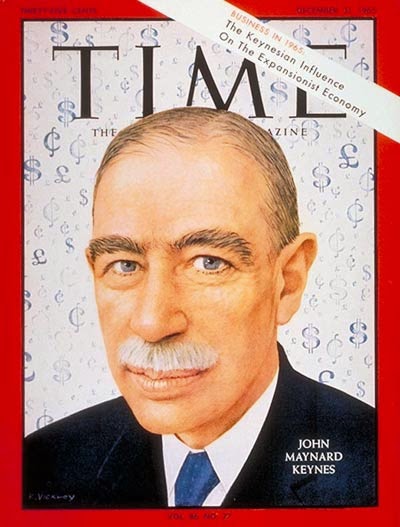
1965: when we were all Keynesians (wink, wink, nudge, nudge, say no more)

Recently the Boston Globe had a piece on the Leontief Prize shared by Duncan and Lance, but emphasizing to some extent that while the winners are true heterodox economists (for a personal definition of heterodox go here) and 'real Keynesians' one would think, some well known progressive economists, like Krugman, are not 'real Keynesians.' In many ways, the issue has been discussed here before (or here).

Keynesian is one of those labels that is imbued with several meanings, and there are, not surprisingly, many prefixes to denote the particular Keynesian tribe, e.g. neo-Keynesian, post-Keynesian, New Keynesian, Old (Neoclassical Synthesis) Keynesian, sometimes referred in less polite fashion as Bastard Keynesian, classical-Keynesian (Sraffian-Keynesian?), etc. And those are just the ones related to theory, since policies have been referred to as Military Keynesianism or more recently weaponized Keynesianism, Social Democratic Keynesianism, Pragmatic Keynesianism, and even Republican Keynesianism. I've been told that Naked Keynesianism is a thing. Semantic saturation may imply that the very meaning of Keynesian is too vague to have any clear connotation. Plain Keynesianism is an avis rara.[1]

One way in which Keynesianism is understood is related to its policy implications. The notion that fiscal expansion might be needed to get out of a recession. An idea not discussed in the GT, beyond some vague reference to the socialization of investment. In that sense, there is little doubt that Krugman, and others like him (e.g. Brad DeLong, Simon Wren-Lewis if we stick to those with prominent blogs) are Keynesians. New Keynesians are for fiscal expansion in the particular situation of the zero bound interest rate, in which monetary expansion cannot be pursued. And they have been consistently against austerity policies in the US and in Europe, and political allies of many radical or heterodox Keynesians.

But if policy is the yardstick of Keynesianism, then one must remember that Keynes supposedly argued in the 1944, after a famous Washington meeting with many Keynesian economists in DC, that he was not a Keynesian.[2] Meaning he was not for further stimulus after the war, presumably because unemployment was not going to be a problem. In the same vein, many heterodox Keynesians are often for contractionary policies, including in situations in which the economy is far from full employment. Lance defended in the QA session after the prize that Brazil might need fiscal adjustment since it has an external problem.[3] These would be anti-Keynesian views, if the fiscal expansion policy proposition is the true meaning of Keynesianism.

But obviously the policy perspective, as important as it is, is only a narrow definition of the meaning of Keynesianism. The essential point that Keynes was trying to prove was that, even with price flexibility, the economic system does not have a tendency to the natural rate of unemployment (or the level of full employment, associated with price stability). He was even very clear that the very notion of a natural rate -- Keynes actually referred to the analogous natural rate of interest rather than the unemployment one, which was only discussed by Friedman in the late 1960s -- was a bad idea. By that measure, Keynes himself failed, since the acceptance of the marginalist investment theory, with investment inversely related to the rate of interest, implied that there was a sufficiently low rate of interest that would bring investment to equilibrium with full employment savings. However, once one gets rid of the neoclassical theory of investment, the possibility of persistent unemployment, of unemployment equilibrium (not disequilibrium) is perfectly possible. The system is inefficient and the cause is not an imperfection.[4]

Note that by this definition Keynes himself failed to provide a full explanation of why the system does not tend to full employment, since the notion of a natural rate was still part of his model. In this theoretical sense, Keynesian ideas had to be fully developed later in order to get to the 'real Keynesian' notion of unemployment equilibrium. An many heterodox Keynesians still fail to get that point. Uncertainty, which is often referred as one of the reasons for persistent unemployment, per se is not a cause for the system not going to full employment. It's just another imperfection. In this case, the group of economists that are 'real Keynesians' is narrow indeed. And it  shouldn't be a surprise that many economists that think of themselves as heterodox do like Say's Law, at least in the long run.[5]

I must emphasize that the fact that the number of economists that understand effective demand is very narrow (and even narrower if you add those that get the old classical political economy theory of value and distribution; are we counting 'real Marxists' too?), and that theoretical confusion and error are widespread is not new. The profession was always dominated by a vague and somewhat incoherent defense of the free market forces. Most Ricardian economists were not 'real Ricardians' and to this day readers of Adam Smith miss the point.[6] The combination of factors that allowed for the Keynesian policy consensus between the Depression and the collapse of Bretton Woods were peculiar, and involved not only the fear that capitalism would collapse, but also the existence of an alternative system.

In one sense, I do agree with the message of the Boston Globe piece. The theoretical definition of Keynesianism takes precedence and is more relevant. Without a solid theoretical result, alternative to the mainstream, there is no basis for an alternative policy prescription. Imperfections may allow for Keynesian policies, but they may also suggest that the solution is neoliberal policies of eliminating imperfections (e.g. rigidities in the labor market). 'Real Keynesians' are truly important. On the other hand, it is important to notice that in the age of austerity, the policy dimension of Keynesianism becomes more relevant.

So I'm increasingly favorable to the Keynesians, that might not be 'real' (heterodox), but that promote Keynesian policies. We need more of those around, even if they are not 'real.' Particularly in government positions. For example, the Keynesian economists in the Kennedy-Johnson administration were certainly not heterodox, and their view of the space for Keynesian policies was built on the notion of rigid wages, and a stable Phillips Curve. All very problematic from a theoretical point of view. But they did the tax cut, the war on poverty and Medicaid/Medicare programs. With enemies like these who needs friends?

[1] Wynne Godley used to say that he was just Keynesian. No prefix.

[2] I'm exaggerating a bit. In the meeting he argued against Abba Lerner's functional finance, even though later he suggested he liked the book in which Lerner's ideas were fully developed. There are many accounts of that meeting, and not all consistent. In one of these, Evsey Domar, who was seating next to Lerner supposedly said to Lerner regarding Keynes non endorsement of expansionary policies that: "he ought to read The General Theory." The implication is that Keynes was not a Keynesian, at least not under all circumstances.

[3] This view has been defended by many economists that are certainly not neoclassical. Some New Developmental economists suggest that fiscal austerity to control inflation, and depreciation to promote growth are required in the current circumstances in Brazil. A similar view is held by some, arguably heterodox, economists in Argentina and Mexico too. I have discussed extensively before why I think this is a misguided policy (e.g. here or here).

[4] Hence the relevance of the capital debates. Keynes suggestion that the system did not have a tendency to full employment in chapter 19 of the GT, and his arguments there are based on the effects of lower wages and prices on income distribution and on debt. These arguments suggest that the natural (full employment) rate might be a weak attractor of the system. The capital debates eliminate the existence of the full employment rate as an attractor.

[5] And it's not just the heterodox that are often confused, and provide only partial and incomplete critiques of the mainstream. That's even more common among the mainstream. It's particularly true of the younger generation of mainstream economists. Most neoclassical economists do not understand neoclassical economics. I would suggest that reading Piketty gives you a sense of how little neoclassical economists understand neoclassical theory. The same would happen, for example, if one reads Noah Smith's blog. On this go here.

[6] Brad DeLong dismisses Marx because he embraced the labor theory of value (LTV), but sings the praises of Adam Smith, as if he didn't also use the LTV. See here.

Wednesday, September 28, 2011

Lucas in context, Keynes out of context


Krugman decided to try his hand at history of macroeconomic thought in one of his last posts. That's great, since history of thought is essential to understand how we got here. It's also bad, since Krugman is still very much a mainstream author, and misses the point of Keynes' contributions, and the limitations of neoclassical (or more properly, marginalist) approach. He suggests correctly that the New Classical (NC)/Real Business Cycle (RBC) project was a failure, but both the reasons for that and his interpretation of the Keynesian project are misguided.

The first proposition in Krugman's reassessment of the recent history of macroeconomics, is that Keynesian models were ad hoc, and assumed wage and price rigidity. The whole of chapter 19 of the General Theory (GT) is about the effects of price and wage flexibility, and how it does not produce full employment. It was with Franco Modigliani's PhD dissertation, done at the New School for Social Research under Jacob Marschak, that the sticky wage version of Keynesian theory that would dominate the neoclassical synthesis was concocted.

Keynes is actually quite explicit about the negative effects of wage reductions. He says (GT, ch.19-link above):
"A reduction of money-wages will somewhat reduce prices. It will, therefore, involve some redistribution of real income (a) from wage-earners to other factors entering into marginal prime cost whose remuneration has not been reduced, and (b) from entrepreneurs to rentiers to whom a certain income fixed in terms of money has been guaranteed.
What will be the effect of this redistribution on the propensity to consume for the community as a whole? The transfer from wage-earners to other factors is likely to diminish the propensity to consume. The effect of the transfer from entrepreneurs to rentiers is more open to doubt. But if rentiers represent on the whole the richer section of the community and those whose standard of life is least flexible, then the effect of this also will be unfavourable. What the net result will be on a balance of considerations, we can only guess. Probably it is more likely to be adverse than favourable."
Hence, the fix-wage version of Keynes' thought is the result of misconception, that suggests that if markets worked well, without imperfections, they would move to full employment. Unemployment is a disequilibrium, by definition a short run situation resulting from a rigidity.

The whole point of the neoclassical synthesis was to suggest that one could continue to teach that markets are efficient, and that supply determined the price and quantity of equilibrium in all markets including those of "factors of production" (i.e. the labor and capital markets), and as a result unemployment could only result  from rigidities in the labor market. Nothing revolutionary there, and in that case, as Keynes foresaw, people would think he was quite wrong or said nothing new.

By the way Krugman does not believe that rigid wages are behind our current lack of full employment (in his view it is the downward rigidity of the rate of interest; Keynes also did not believe in the liquidity trap as the cause of depressions), which makes it more difficult to understand why he defines Keynesians (Old and New) as pragmatic rigid price and wage modelers. You cannot blame then Laurence Kotlikoff for his confusion (here and Krugman's reply and here; Jamie Galbraith, also implicated, gives a better answer since he never said that Keynes is about wage rigidity; scroll down for Jamie's and Kotlikoff's back and forth).

Krugman's second point is that Friedman and Phelps in the 1960s were trying to provide microfoundations to wage and price rigidity. Actually, the microfoundations agenda had more to do with the theoretical development of theories for consumption (Modigliani, Friedman), investment (Eisner, Tobin) and money demand (Baumol, Tobin) behavior. The Phillips Curve (PC) debate and the Friedman-Phelps notion of a natural rate of unemployment is associated to the idea that there is a supply side constraint to the economy, and stimulating demand would ultimately have only effects on prices and not on quantities. The economy naturally moves to full employment, unless there are restrictions, and what is needed is to eliminate the restrictions not stimulate demand.

In other words, the monetarist approach of Friedman accepts the neoclassical synthesis notion that it is the rigidities that cause unemployment. It just proposes a different policy solution. By pointing out the existence of a natural rate of unemployment analogous to Wicksell's natural rate of interest (which Keynes' criticizes in the GT) Friedman was just emphasizing that if one believes in the neoclassical theory of value and there are no restrictions the system moves to full employment. In fact, Friedman's (1970) theoretical framework, an ISLM cum PC and natural rate model, is remarkably close to the neoclassical synthesis models.

In that sense, the Lucas Revolution and the subsequent move, after Kydland and Prescott's work, of most New Classicals , including Lucas, to the Real Business Cycles camp is a not a break with Friedman, and the New Keynesians (NK) that accept everything (including the natural rate) are part of the same tradition. The difference is that some emphasize the long run neoclassical principles and others the short run rigidities that demand policy action.

The fundamental problem of the neoclassical/marginalist approach, and the importance of Keynes analysis, can ONLY be properly understood in light of the 1960s capital debates (for a good reference go here). The point, for the purposes of our discussion here, is that if there is unemployment and real wages fall, neoclassical theory tells you that according to the principle of substitution, more labor is demanded (the cheap thing that is in excess supply) and less machines (capital) are used, since they are relatively more expensive. However, since labor (which is cheaper) is used in the machine sector too their price should fall too, and is not generally true that there is a tendency for the full utilization of "factors of production" according to their relative scarcities. Further, even if the substitution effects go in the right direction, and more labor is used, the income effect of lower real wages tends to be large and have a negative effect on demand (put simply, workers cannot buy stuff), which implies that less of all "factors of production" are used. In other words, there is no natural tendency to full utilization of labor or capital, and both the natural rate of unemployment and its evil twin the natural rate of interest do NOT exist.

So it is peculiar that Krugman thinks that "NK economics [is] useful, if only as a way to check my logic, although it’s not really clear if it’s any better than old-fashioned Keynesianism." What logic? New Keynesian models assume a natural rate, and that the economy (without rigidities) moves to full employment! The problem with the NC/RBC/Lucas' type of theory is not that it failed to predict the 1980s recession or that they think that most crises are caused by real shocks (although both propositions are obviously wrong), as Krugman seems to believe, but that they do maintain the fiction of an efficient market that clears (in their case too fast for Krugman's taste) and that produces a natural rate. If he wants to move in the right direction Krugman should follow Galbraith and announce that it is time to ditch the natural rate hypothesis.

PS: That means that progress in economics is not linear, and that one can and should learn from old and forgotten traditions (classical political economy did not assume full utilization of resources).

Sunday, July 8, 2012

Heterodox and Mainstream Economics: The Great Confusion

Simon Wren-Lewis has a post on heterodox versus mainstream macroeconomics in which he seems surprised by what he calls the Great Divide between the two groups. He claims to be sympathetic to the heterodox project, at least along the lines of Steve Keen, but argues that the "rejectionist strategy is of course unlikely to win friends within the mainstream."

Wren-Lewis also suggests that a Minsky model developed by Keen (which according to Keen was rejected by several mainstream journals) is very similar to his ideas, but he fails to note that the Keen's model, as well as Minsky's theory, does not include a crucial characteristic of mainstream models, New Keynesian (NK), New Classical (NC), Real Business Cycle (RBC) and New Neoclassical Synthesis (NNS) alike, namely: Friedman's natural rate hypothesis.*

If you accept that cycles are just a shock (monetary or real) to an optimal trend and that the only thing that prevents the return of the economy to its optimal level is some sort of rigidity, then the obvious solution, at least in the long run, is to eliminate the rigidities. By the way, that is the reason why the NKs and NNSs authors end up believing in a confidence fairy, very much like NCs and RBCs authors. The NK and NNS fairy being about higher inflation expectations allowing for more investment demand, rather than directly about the less uncertainty allowing for more investment.

Wren-Lewis' confusion is to assume that the proximity of heterodox Keynesian groups and NKs like him on policy issues implies that on a deeper theoretical level there must be agreement too, and that this does not happen because of the sectarian nature of the heterodoxy.

Krugman's views, by the way, are very similar, in the sense that he seems to not quite understand why he is not seen as Keynesian by some heterodox economists. In a recent post, he argues that:
"Some devotees of Keynes claim that people like me aren’t really Keynesians – and while there are some serious grounds for the charge, part of the reason is precisely that we’ve treated Keynes as an inspiration to be modified in the face of evidence rather than as holy writ."
The confusion is incredible. Keynes himself accepted some neoclassical ideas that made his argument limited and heterodox authors actually have discarded a lot of Keynesian concepts (I myself believe that both the marginal efficiency of capital and liquidity preference are highly problematic, but that is material for other posts). The problem with Krugman is that he maintains (yes you guessed) the natural rate (a concept that a least Keynes wanted to drop from his theory), and suggests that unemployment and the recession are caused by the downward rigidity of the interest rate (a liquidity trap), propositions for which there is little evidence. Krugman is the one that treats neoclassical principles (the idea that a natural rate exists) as holy writ!

Both Krugman and Wren-Lewis seem to believe that economics (and science) is about convincing the others on a political level and are puzzled by the fact that heterodox do not fall in line with the NKs. That is why a less rejectionist, to use Wren-Lewis term, strategy is suggested (a similar view by Colander is criticized here). The problem is that evidence and logic (for the logical critique of the natural rate you must get the capital debates) suggest that the natural rate does not exist. Don't get me wrong, on political issues most heterodox authors are with Krugman, Wren-Lewis and company, against austerity, but science implies (as Krugman himself notes) adherence to facts.

So why don't NKs just renounce to the idea of a natural rate once and for all. For one they would make lots of friends within the heterodox community, which is way ahead in understanding the crisis (and foreseeing it too), and also would make their models more realistic.

* I have my own troubles with the kind of model presented in that paper by Keen, which are related to his profit driven investment function, but that is better discussed in another post.

Wednesday, September 21, 2011

If you’re surprised, that means that you were part of the problem


Back in July, in the midst of the debt-ceiling debate, Paul Krugman argued that those that were surprised by the GOP tactic of blackmailing the administration, threatening a default in exchange for cuts on social spending and the maintenance of the tax cuts for the rich were part of the problem. Normal was already not part of the GOP. I agree.

Now Krugman tells us that in this crisis a "lot of the blame goes to the economists, by the way, who abandoned what they used to know." But the thing is that the mainstream of the profession has been dominated by the academic equivalent of the Tea Party for a very long time. My point is that if you didn't know that economists forgot certain things about recessions, and never learned a few other things, you have not been paying attention and/or you must be part of the problem too.

Krugman knows this well, since he argued that:
“By the early 1980s it was already common knowledge among people I hung out with that the only way to get non-crazy macroeconomics published was to wrap sensible assumptions about output and employment in something else, something that involved rational expectations and intertemporal stuff and made the paper respectable. And yes, that was conscious knowledge, which shaped the kinds of papers we wrote. So you could do exchange rate models that actually had realistic assumptions about prices and employment, but put the focus on rational expectations in the currency market, so that people really didn’t notice. Or you could model optimal investment choices, with the underlying framework fairly Keynesian, but hidden in the background. And so on.”
That is, in order to publish (in 'respectable' journals) you had to wrap your reasonable assumptions in crazy models. So it should have been clear back then that rational expectations, real business cycles, supply siders, and their political counterparts in the Reagan administration were more dangerous that Old Keynesians and New Old Keynesians (or Old New Keynesians for that matter) were willing to admit.

The problem is not just that New Keynesians of all sorts and political affiliations (Ben Bernanke, Brad DeLong, Paul Krugman, Greg Mankiw, Christina Romer or Larry Summers) can be seen as equivalents to the old Neoclassical Synthesis, the modern equivalents of John Hicks and Alvin Hansen, trying to incorporate the Keynesian insights that lack of effective demand was behind the Great Depression (now our Great Recession), and that fiscal stimulus is necessary, while maintaining the contradictory argument that the price and quantity of all "factors of production", including labor, can be determined by the equilibrium in the labor market. [If this is true lower real wages should equilibrate the labor market and involuntary unemployment should vanish].
From a policy point of view this is certainly important, but it misses the more essential question that Keynes theory was not (at least was not intended to be) about imperfections, and arguably the inability of the Neoclassical Synthesis of overcoming that original contradiction is part of the reason of the rise of New Classical economics, and the acceptance by New Keynesians of the Friedmanian notion of a natural rate.  Can you blame the profession that believes in the self-adjusting nature of the system towards the natural rate (included in all New Keynesian models) that fiscal stimulus is only needed in the short run and that the economy is on its path to recovery?

Hansen (1938, p. 34), in the book depicted above, said that the profession was: "living in a time when economics stands in danger of a sterile orthodoxy." [The time, by the way, was the 1937-38 recession]. We are in that position again, and people like DeLong and Krugman, as I said before, the best within the mainstream, would miss the opportunity of providing a more solid foundation for economic theory if they do not recognize the importance of the heterodox contributions of the more radical disciples of Keynes and Kalecki. We do not need another Neoclassical Synthesis, and we should try not to miss this new opportunity to complete the Keynesian Revolution.

Further, although we have our Hansens, so to speak, we do not have our Lauchlin Currie or our Marriner Eccles.  That is, the real heterodox Keynesians within the administration. Currie, by the way, wrote an unpublished review of the General Theory, for the eyes of the Board only, that is far better than most responses in academia, which did not rely in either interest rate (liquidity trap) or real wage rigidity. In fact, Currie argues correctly that (following chapter 19 of the General Theory) falling wages would make things worse. If respectable economists in the mainstream, like Krugman and DeLong, miss this opportunity this period will be remembered as 'the years of low theory.'

PS: For a discussion of Eccles and Currie see here. The classic book on Currie is by Roger Sandilands here.

Tuesday, April 27, 2021

Gatekeepers and herd behavior: On Tooze and the radicalization of Krugman

"But that one is holding the poop!"

Adam Tooze, the author of the monumental Crashed (who was, incidentally,  student of Wynne Godley, one of my mentors), wrote a piece for the London Review of Books that has received a lot of praise. While it reviews Paul Krugman's latest book, it provides an overview of the radicalization of New Keynesians, or at least some, that dominate both in academia, and in the corridors or power. The gatekeepers of knowledge and academic  and intellectual influence, with a close connection to power, so to speak. He tells us at the outset that Krugman, the economist that was a bulwark of free trade, even when the theories for which he received his Sveriges Riksbank Prize (aka the Nobel) suggested that some degree of intervention might be good, and that remained even after the 2008 crisis a defender of the conventional macroeconomic model, not only has moved to the left, but also that "in Joe Biden’s Washington, Krugmanism rules."

This is, however, a misinterpretation of the current situation. Tooze suggests that Krugman is one of the "high-powered centrists inching their way towards seemingly obvious political conclusions." The group includes "three centrists – Biden, Janet Yellen and Jerome Powell [that are] undertaking an experiment in economic policy of historic proportions." And he, also, argues that: "what sets Krugman apart within this cohort is the way he has, since the 1990s, stopped being a gatekeeper of the status quo and instead become its critic. In this respect his closest analogue is Joseph Stiglitz, also once of MIT, a member of the Clinton administration and chief economist to the World Bank. Both men have indisputable standing as members of the elite club of New Keynesians."

I see Krugman as being closer to what Colander, Holt and Rosser referred to as the cutting edge of the profession. The role of cutting edge of the profession, in my reply to them (see the paper in Fred Lee and Marc Lavoie's book here), is to make more reasonable policy propositions, while maintaining the notion that markets do produce efficient outcomes, in spite of the unsurmountable logical problems brought by the capital debates, and that led to the rise of vulgar economics. Krugman in that sense is the epitome of the cutting edge. Of course, in order to make reasonable points he would discard many of his own ideas. But he is no critic of the mainstream. The problem with Tooze's argument lies in there. Krugmanism cannot rule, if he basically had to discard his ideas in order to remain relevant. And relevant here simply means that he can be seen to be on the right side of history, more skeptical of free markets, free trade, and willing to accept significant expansion of deficits and debt.

The ideas that won the day and rule in Biden's America are heterodox ideas, that in fact, until very recently Krugman dismissed as not serious. The possibility of continuous expansion of the welfare state, and the expansion of fiscal deficits and debt were anathema to him. Not only he was against expansionary fiscal policy, but even 'Medicare for All,' the signature proposal of Senator Bernie Sanders, something that is common in all advanced economies, was dismissed as a political nonstarter. And certainly that idea, which is not that radical, has remained in the background, and is unlikely to be pushed by the 'radicalized' Biden administration. Perhaps even Krugman still thinks is far too lefty to be acceptable in the United States.

Biden might be the president, and he has a lot of power about what elements of the agenda to push, and he has certainly moved to the left. No doubt about that. Not surprisingly Heather Boushey and Jared Bernstein, economists with heterodox and labor connections, are defending the fiscal expansion from the Council of Economic Advisers (CEA), while Larry Summers, the quintessential insider of the Clinton and Obama administrations, is criticizing from outside. But the Democratic Party has moved to the left, and the politicians have followed. It is the party of Bernie and Alexandria Ocasio-Cortez (AOC). And the establishment knows they need to move if they want to remain relevant, and have a fighting chance in 2024, since the working class is radicalized, and many will abandon the party if Biden does not deliver.

They are like the French politician that, seeing the masses pass in protest, tells his friends in the café he must leave and follow them, since he is their leader. This is, it goes without saying, more like herd behavior, than leadership. Krugman is, in that sense, the leader of an intellectual sea change about views on the role of the state in the economy.

Tooze may think that these arguments are just the diatribes of those in the left that are angry,* infuriated he argues, with the slow pace of change in the center. The issue is that, even though Krugman is following the herd, he certainly is a central gatekeeper in the economics profession. A profession that has been attacked for good reasons, for its excessive influence in policy, and the recurrent blunders of its luminaries.

Krugman still argues in terms of the conventional model, that he defends, as having done a good job explaining the 2008 crisis. People like Wynne Godley, that truly foresaw the 2008 crisis, often only received the acknowledgement ex-post, sometimes too late, after passing away.** Krugman dismisses heterodox economists as not serious. A type of red-baiting of heterodox economists with significant impact on the ability of the profession to change. He also validates some of worst within the mainstream and is willing to play by their harsh rules.+ This is, of course, because the prestigious teaching positions he held, and still holds, the 'Nobel', that was created to give respectability to certain ideas, the weekly column in the NYTimes are all powerful platforms. The danger in this, in accepting Krugman's narrative that he has been right all along, is to convince ourselves that the profession has indeed changed. Now the dangers of neoliberalism and their main defenders, mainstream economists, are gone. The profession is rehabilitated. But the retreat of neoliberalism is only temporary. Krugman and other gatekeepers will change their tune when the current Keynesian moment passes. If the Bidenomics experiment ends up being of historic proportions, and I do hope it does, although that is still too soon to tell, it will not be a victory of Krugmanism. It will be a victory in spite of it.

* I am not as angry as Paul Romer, though.
** On Krugman critique of Godley's 'hydraulic' model, and my response go here.
+ He famously said: "By the early 1980s it was already common knowledge among people I hung out with that the only way to get non-crazy macroeconomics published was to wrap sensible assumptions about output and employment in something else, something that involved rational expectations and intertemporal stuff and made the paper respectable. And yes, that was conscious knowledge, which shaped the kinds of papers we wrote." [Italics added] See the quote and a discussion of the role of another gatekeeper in France that also won a 'Nobel' here.

Friday, August 16, 2013

Krugman on Friedman, Austrians, and Paradise Lost

I was a bit busy this week and did not weigh in on Krugman's latest incursion (and here too) on the history of economic ideas. He correctly dismisses Conservative economists in pre-Keynesian times, and particularly Hayek (and Austrians), who suggested that recessions and depressions were useful, as not relevant. And also, notes Friedman was more sophisticated. He also notes correctly (as was pointed out here before), that Friedman used when he was forced to present a complete model and ISLM with a Phillips Curve, that was not very different from the more Keynesian versions of the model done by the Neoclassical Synthesis authors.

He is more positive about Friedman because:
"He [Friedman] was willing to give a little ground, and admit that government action was indeed necessary to prevent depressions. But the required government action, he insisted, was of a very narrow kind: all you needed was an appropriately active Federal Reserve... [But Krugman does not ] want to put Friedman on a pedestal... [since] the experience of the past 15 years, first in Japan and now across the Western world, shows that Keynes was right and Friedman was wrong about the ability of unaided monetary policy to fight depressions."
Note that Krugman also notes Friedman's critique of Austrian business cycle theory (see here), which shows that in spite of being marginalist and part of the mainstream, still the extreme laissez faire view makes them part of the fringes  of the profession. In other words, Austrians stand for the mainstream as the Tea Party stands for the more moderate right wing.

Perhaps the most important point in Krugman's reflection on the state of the profession is his confession that he used to consider himself "a free-market Keynesian — basically, a believer in Samuelson’s synthesis. But [he is] far less sure of that position than [he] used to be." Good enough. Note, however, that what he means by a 'free market' Keynesian is a peculiar mix.

The Neoclassical Synthesis, was based on Hicks ISLM and Modigliani's fixed wages. The fundamental idea is that with wage flexibility the system would lead to full employment, a proposition that Keynes denied in the General Theory. In addition, the capital debates have shown, and Samuelson admitted in 1966, two years before Friedman re-introduced the Wicksellian notion of a natural rate, that the neoclassical parable in which substitution led to full employment of factors of production does not hold.

So, beyond the ideological stance (which made more sense at the time of the Old Neoclassical Synthesis, during the Cold War) Free Market Keynesianism was always kind of a misnomer. Remember that Keynes in 1926 suggested that Liberalism (in the traditional European sense of Laissez Faire) was dead.

Thursday, October 18, 2012

Not so fast, the premature recovery problem

There is a certain brouhaha about the speed of the recovery. John Taylor says financial crises do not lead to slow recoveries (also Michael Bordo here). On the other hand, Krugman (and also Reinhart and Rogoff here) say that slow recoveries from financial crises are the norm. At stake, obviously, whether Romney is right and Obama is at fault for the slow recovery. Don't get me wrong, I would tend to agree that recoveries are relatively slow after a financial crisis, since deleveraging is a slow process.

Yet, that is not the main issue about this debate. The point is that ALL involved agree that the system has a natural (automatic) tendency to move back to the trend. Bordo refers nicely to Friedman's 'plucking' model. He reminds us, how it works:
"Friedman imagined the U.S. economy as a string attached to an upward sloping board, with the board representing the underlying long-run growth rate. A recession, in this view, was a downward pluck on the string; the recovery was when the string snapped back. The greater the pluck, the faster the bounce back to trend."
So the deeper the recession was, the faster would the recovery be. In other words, for the GOP economists (Taylor in this case) Obama is aborting holding back the economy and precluding what should be a premature or fast recovery. However, the point the critics make is that debt deleveraging makes the recovery slow, but it is more or less automatic anyway. Government is necessary to speed up something that markets, if they weren't imperfect, would do.

Krugman ideas are based on a recent paper on what he called the Fisher-Minsky-Koo model. Steve Keen has provided a full critique of a previous version here (h/t Lord Keynes who also provides an invaluable bibliography on debt deflations here). The essential point that generates an imperfection in the case of Krugman's model is that an external shock (a Wile E. Coyote moment in his terms, since agents finally notice the floor is gone) brings down the natural rate of interest, which becomes negative for a while (see my discussion on Krugman and the natural rate here). In that case, monetary stimulus is not capable of getting the economy naturally back on track, since the interest rate cannot fall below zero, and as a result agents cannot increase consumption enough to bring full employment automatically.

Hence, in the New Keynesian model of debt-deflation the change from more conventional neoclassical models is that they allow for a sudden (and exogenous) reduction in the debt limit that agents can borrow to reduce the natural rate. It's a financial shock (not a real one) that makes the rate of interest that would equilibrate investment with full employment savings (the inverse of consumption) negative. Agents suddenly understand that they would need a negative interest rate to satisfy their intertemporal consumption plans. From a post-Keynesian (I prefer classical-Keynesian but who cares), the problems are not related at all with the natural rate (yes the capital debates have shown that this makes no sense, where did I read that before?). So deleveraging has a direct effect on the ability of consumers to spend, and there would be no automatic bounce back if the equilibrium rate was not negative.

You may think it is a minor issue, and from a policy point of view it certainly the differences are minor. However, note that the New Keynesian version of the recovery suggests that markets are fundamentally, in the long run, efficient (again against logic and evidence) which is an essential totemic myth that they need to preserve.* And that has policy implications. Recoveries from financial crises are slow, as Krugman says, but not because the natural rate is negative. It is a political problem that involves class conflict. It is because agents that cannot consume out of wages (which have stagnated) cannot borrow themselves out of the crisis, and the federal government, the only one that can, will not do it for political reasons (to keep workers demands in line). That's why heterodox economists are not just for expansionary fiscal policy (and don't think that if the Fed signals more inflation investment confidence will pick up), but argue for higher wages, stronger unions, and debt relief.

* Let alone the funny thing that both sides in this dispute are basically arguing that the economy gravitates around a trend that is exogenous and attracts the actual economy (in a stronger or weaker way), and the way they actually measure the gravitational center (the natural trend) is by averaging the actual rates.

PS: And no, it's not a joke, they do actually sell that T-shirt!

Friday, September 12, 2014

Krugman is actually right on ISLM and Minsky

I tend to disagree a lot with Krugman, at least on theoretical issues. His brand of Keynesianism supposes that the system doesn't work because of imperfections. For him, the current slow recovery is due to the fact that the natural rate of interest is basically negative and you cannot use monetary policy to stimulate the economy (see critique of this here). However, on his recent debate with Lars Syll (and here; Brad De Long also posted here), a post-Keynesian, with whom I probably share a more radical interpretation of Keynes and its relevance for economic theory, Krugman seems to get things right.

The main points in Lars initial post, based on Minsky's book John Maynard Keynes is that traditional representations of Keynes do not emphasize the cyclical component of Keynes' theory and that true or fundamental (non-probabilistic) uncertainty is often ignored. Lars adds a little bit more on his response to Krugman and De Long, but essentially is the same argument. Keynes didn't like the ISLM (which is from a historical point of view difficult to defend, after all the only stuff he wrote on this, to Hicks, was quite positive, even if it is of little relevance), that it is static (not paying attention to cyclical or dynamic phenomena), and perhaps more interestingly that the interaction of real and monetary variables in the model is simplistic.

Krugman points out that the General Theory (GT) is NOT about cyclical fluctuations per se. It is about the determination of the long run level of output and employment, around which the economy fluctuates, and he correctly notes that cycles only appear as an afterthought in chapter 22 of the GT. And that is precisely correct. The GT is revolutionary because it suggests that with price flexibility (not price rigidity as in the old Neoclassical Synthesis or the New Keynesian stories) the system gets stuck in a situation of unemployment equilibrium. Emphasis on equilibrium. Yes, unemployment at less than full employment and output below its potential level are both together in an equilibrium situation.

Patinkin suggested that Keynes meant unemployment disequilibrium, since within the neoclassical framework, unless there is a rigidity of some sort, and the system should go to its long run equilibrium position with full employment. Minsky (1975, p. 268), in the book cited above, says that Keynesian economics should be seen as the: "economics of permanent disequilibrium." That has no basis on the GT. Actually, the GT would be a less radical book if it only said that with instability the system might be always in a disequilibrium position. Keynes was very radical since he argued that the very notion of a natural rate should be abandoned (on this Paul and Brad have a lot to learn). Some Post Keynesians tend to dislike the idea of equilibrium (echoes of Joan Robinson's late critique of the idea), which ends up making them closer in many respects to the modern mainstream authors with their dislike for long term equilibrium positions.

So the GT is not about cycles (Keynes' Treatise on Money, a very conventional and Wicksellian book was about cyclical disequilibrium caused by differences between the natural and banking rates of interest, which, interestingly enough is closer to Krugman's way of thinking than the GT, or than to Lars, who is aware of the limitations of the natural rate concept). But that's not all that Krugman got right this time.

He quotes the famous passage in which Keynes says that the system is not violently unstable (GT, p. 249). And while Post Keynesians are correct to note the relevance of fundamental uncertainty, it is important also to consider the stabilizing role of conventions and institutions, to which Keynes alludes. Expectations play a role, but investment is not completely volatile, and it was a problem for Keynes only when "the capital development of a country becomes the by product of the activities of a casino" (GT, p. 159). In fact, given the relevance of the accelerator in determining investment, the central role of expectations is about the level of demand. For example, in the US investment has been subdued since demand is not growing fast and there are not reasonable expectations that it will any time soon.

Where New Keynesians go wrong, and in this case is actually Brad, not Paul (but he would certainly agree) is on the relevance of the marginal efficiency of capital, criticized by Minsky (even though it's far from clear that Minsky abandoned it). Brad thinks that Minsky critique of it is myopic and basically a PR problem. He says that it is: 
"Short-sighted, in that it is not Hicks who would be Minsky’s long-run intellectual adversary but rather Freidman [sic], Lucas, and Hayek, and so building bridges to the Hicksians ought to be a very high priority."
Probably true, but from a policy point of view. From a theoretical point of view, Hicks use of the marginalist notion of an investment function inversely related to the rate of interest (something Keynes also used) implies that there would be a rate of interest low enough that would produce full employment, that is a natural rate, which would preclude Keynes' claim about unemployment equilibrium (and the absence of a natural rate). In other words, with the marginal productivity of capital you have that unemployment must be a disequilibrium situation caused by some imperfection that inhibits the system from reaching the natural rate.

And yes the capital debates are relevant since they show that the inverse relation is only possible in a one commodity world. No natural rate, and no need to think about imperfections. And that's why the comment by Lars on the connection between real and monetary variables being simplistic within the ISLM is right on the mark. The idea that the central bank controls a monetary rate, that may get out of whack with the natural, and that by manipulating it can affect real variables is limited at best.

PS: For my previous defense of a modified ISLM go here and here. 

Monday, November 18, 2013

Lars Syll on Krugman, Wren-Lewis and the New Keynesian apologetics

By Lars P. Syll

Is academic (mainstream neoclassical) macroeconomics flourishing? “New Keynesian” macroeconomist Simon Wren-Lewis had a post up not that long ago on his blog, answering the question affirmatively:
Consider monetary policy. I would argue that we have made great progress in both the analysis and practice of monetary policy over the last forty years … However, it has to be acknowledged that policymakers who look at the evidence day in and day out believe that New Keynesian theory is the most useful framework currently around. I have no problem with academics saying ‘I know this is the consensus, but I think it is wrong’. However to say ‘the jury is still out’ on whether prices are sticky is wrong. The relevant jury came to a verdict long ago… 
It is obvious that when it comes to using fiscal policy in short term macroeconomic stabilisation there can be no equivalent claim to progress or consensus. The policy debates we have today do not seem to have advanced much since when Keynes was alive… 
What has been missing with fiscal policy has been the equivalent of central bank economists whose job depends on taking an objective view of the evidence and doing the best they can with the ideas that academic macroeconomics provides…The contrast between monetary and fiscal policy tells us that this failure is not an inevitable result of the paucity of evidence in macroeconomics. I think it has a lot more to do with the influence of ideology…
And today another sorta-kinda “New Keynesian” — Paul Krugman — has a post up arguing that the problem with the academic profession is that some macroeconomists aren’t “bothered to actually figure out” how the New Keynesian model with its Euler conditions — ”based on the assumption that people have perfect access to capital markets, so that they can borrow and lend at the same rate” — really works. According to Krugman, this shouldn’t be hard at all — “at least it shouldn’t be for anyone with a graduate training in economics.”

Read the rest here.

Friday, April 25, 2014

Krugman on Palley's Gattopardo Economics

So Krugman has weighed in on Tom's review of Piketty's Capital, which is all the rage now. Krugman's defense of Piketty is based on denying that neoclassical economics is a theory of distribution, on the one hand, and on the other suggesting that using mainstream models to discuss inequality might be a strategy, that is a politically calculated plan of action, that would put the discussion of inequality at the center of the political agenda. This without necessarily, he argues, stop discussing the methodological issues on how to do economics.

On the first topic, he is obviously disscusing the issue that is central to the capital debates (and central to Piketty's book) which was discussed by Tom, and also by Jamie Galbraith, and Lars Syll and in my own post on the topic, that linked to Jamie's review. According to Krugman:
There are a few economists on the left who seem to believe that: 
1. You need to believe in the existence of a perfectly well-defined aggregate measure of capital to believe in the marginal productivity theory of income distribution; 
2. If you believe in, or even use, marginal productivity theory, you are conceding that capitalists deserve their income. 
Neither of these things are true. Nothing about marginal productivity theory depends on the exact truth of a simple aggregate production function with capital defined by a single number. And saying that capital gets its marginal product in no way says that the people who own that capital deserve what they get.
First of all. It is NOT an issue of right and left. It is a question of logic and evidence. And yes, you may very well  have a disaggregate intertemporal version of the marginalist analysis, and you still have to show that there is a rate of interest (a natural one, that Krugman always cites, and says it has been negative, by the way), that equilibrates investment to full employment savings.

So yes dude, marginal productivity implies that the remuneration of capital, its natural rate of interest, produces full utilization of capital (and to derive that you need full utilization of labor, since if labor was not utilized its price would fall, and substitution would imply more demand of cheap labor rather than capital), and that by definition capital receives according to its productivity. Distribution is endogenous. As much as labor receives according to its productivity (Krugman should read the stuff in his Principles book, by the way, in which he teaches exactly that).

Also, Krugman says that:
You can be perfectly conventional in your economics — or, my own attitude and what I think is Piketty’s, willing to use conventional models when they’re convenient and seem useful without treating them as irrefutable truth — while still taking inequality very seriously.
This is a repetition of an old arguments of his about using flawed theoretical models to say reasonable policy propositions. He argued before that:
By the early 1980s it was already common knowledge among people I hung out with that the only way to get non-crazy macroeconomics published was to wrap sensible assumptions about output and employment in something else, something that involved rational expectations and intertemporal stuff and made the paper respectable. And yes, that was conscious knowledge, which shaped the kinds of papers we wrote. So you could do exchange rate models that actually had realistic assumptions about prices and employment, but put the focus on rational expectations in the currency market, so that people really didn’t notice. Or you could model optimal investment choices, with the underlying framework fairly Keynesian, but hidden in the background. And so on.
And that it a nutshell is what Tom is criticizing. The need to make things look respectable, in Piketty's book, are what make his contribution very likely Gattopardo economics.

PS: Krugman has more on Palley here, and more to follow from NK on that later; also if you want to understand why Krugman does not understand the limitations of mainstream economics go here for a primer on the capital debates.

Saturday, September 14, 2013

Hydraulic Krugman on Wynne Godley

Paul Krugman commented on the NY Times piece on Wynne. There are many little incorrect interpretations, which derive from his lack of understanding of the history of ideas. First, he equates Wynne's model with the old hydraulic Keynesianism (i.e. Neoclassical Synthesis) of Phillips (of Phillips curve fame, but also of the hydraulic model of the British economy). Nothing further from the truth.

Wynne came to economics via P. S. W. Andrews, one of his two most influential teachers at Oxford (the other being being Isaiah Berlin). Andrews and the full cost price authors that were part of the Oxford Economists' Research Group (OERG), under the leadership of Roy Harrod, and were in general more concerned with practical applications than with theoretical first principles. That influenced the way Wynne developed his skills as a modeler at the British Treasury, before being taken by Nicholas Kaldor, to head the Cambridge Department of Applied Economics (DAE), where he built together with Francis Cripps the Cambridge Economic Policy Group (CEPG).

Note that conventional hydraulic models, including the sort of Cowles models like the Klein-Goldberger model of the US economy, put great emphasis on the estimation of parameters based on certain simplistic macro behavior. Wynne took a very different approach to modeling than Klein-Goldberger. He was more concerned with what he referred to as 'model architecture' than with parameter estimation.

The architecture, which was careful about stock-flow consistency, showing that everything came from somewhere and went somewhere so to speak, also imposed a clear causality structure, which determined most of the results. In fact, Wynne believed that significant variations of the parameters might not greatly influence the end result of the model, which was used for simulations and scenarios that helped to understand how the economy functioned, rather than for strictly forecasting purposes.

Krugman then says these models were abandoned because they failed in the face of the Great Inflation of the 1970s, and because they did not deal with consumption in a coherent way. Here again he is wrong. First of all, Wynne's models had no trouble dealing with the inflation of the 1970s, correctly pointing out the effects of oil prices, devaluation, and wage pressures from the cost side rather than demand pull views, and he was one of the few that correctly foresaw the big recession that the Thatcher policies would cause.

On consumption the notion that Friedman somehow is better than Duesenberry and the relative income approach of other old Keynesians goes to show how limited is Krugman's understanding of his own tradition in the field (for more go here). Note that he believes that New Keynesians are just grafting a more sophisticated behavioral decision making approach to old Keynesian stories, without owing up to the limitations that the Old and New Keynesian models, based on rigidities and imperfections to avoid the tendency to the natural rate.

Wynne's model, in the Kaldorian tradition, with a supermultiplier determining growth, and with the Oxford pricing tradition determining prices, was free of the main limitations of the Hydraulic tradition to which Krugman belongs, whether he understands it or not. That is why Jonathan Schlefer, from the NY Times, is correct in suggesting that rebuilding macro on the basis of Wynne's work would make more sense.

On a funny note at the end, Krugman reveals his misconception about the role of old ideas in the history of science, and economics in particular. He says: "it is kind of funny to see a revival of old-fashioned macro hailed, at least by some, as the key to a reconstruction of the field." In his view, old ideas are only relevant if you can formalize them in modern garb, but are not a source of forgotten and incorrectly discarded knowledge that are better prepared to understand how the economy works. The limitations of the 'great economists' of today, make the loss of economists like Wynne all the more painful.

PS: Full disclosure, I'm quite biased on this topic, having worked for Wynne at the Levy Economics Institute for two years in 1997-98.

PS': Two additional posts by Unlearning Economics and Philip Pilkington and a link by Lars Syll (h/t for the link to Unlearning).

Friday, April 26, 2013

When were we Keynesians?

From a policy point of view, in the United States, the two common periods associated with the ascendancy of Keynesianism are right after the so-called Roosevelt recession in 1937-38, when Currie and Eccles and other fiscal expansionists got the upper hand in the dispute with Morgenthau and the deficit hawks, and the Kennedy-Johnson tax cut in 1964, when the New Economics became dominant in the Council of Economic Advisors (CEA), during Walter Heller's chairmanship, when James Tobin (among others) was a staff member.

And it is correct that in both periods expansionary fiscal policies, which are broadly Keynesian, were actually pursued. But it would be a mistake to think that Keynesian ideas actually won the day, and became common sense among policy makers and the political elites in the US. In fact, while Keynesian ideas and Keynesian economists became dominant for short periods, for the most part political elites remained firmly conventional and remained wedded to sound finance ideas. Without World War II and then the Cold War, which allowed for some type of Military Keynesianism, Keynesian ideas would not have had a chance.

In theory too, while Keynesian ideas associated to the possibility of unemployment in the short run became dominant, the reason was not Keynes' own explanation that this would be the normal, long term situation, associated even to a situation with wage and price flexibility. Unemployment was seen as an imperfection, something that required in the short run a brief stimulus, but that did not have significant long term effect. Hence, by the 1950s if small deficits in recessions or war periods would be acceptable for politicians, they were certainly not seen as desirable as a longer term instrument for economic development.

Domar, Lerner and other Functional Finance authors, that took Keynes' fiscal ideas to their logical conclusion never became dominant. In a sense, we can say that we were never truly Keynesian. Only by the 1970s a sort of perverse Keynesianism would eventually prevail within one of the wings of the Republican Party. Supply-siders would argue that lower taxes, not as a result of its multiplier effects, but as a result of the incentives to invest, would lead to higher growth, hence deficits were not a problem. This was embraced by some more mainstream Republicans also, as a way of promoting the 'Starve the Beast' strategy, i.e. cut taxes in a boom, and force welfare cuts in a crisis (any similarity with current events is totally not a coincidence).

On the other hand, most Democrats, which were never particularly Keynesian, moved away even from a short term defense of anti-cyclical fiscal policy. For that reason we should not be surprised that austerity, and sound finance ideas have gained so much traction in recent debates about the Great Recession, and why we should continue to have a very slow recovery.

PS: The significant victory of Keynesians was less about the consensus on anti-cyclical fiscal policy than the implementation of programs that established automatic stabilizers, like unemployment insurance.

PS2: Krugman today says that the austerian's position has imploded with the Rogoff-Reinhart debacle. Also, he shows that most Americans actually are not concerned about deficits, but the wealthy are. I guess politicians respond to the wealthy then. Like in gun control, what the majority wants does not necessarily translate into policy.

Thursday, April 26, 2012

The inflation expectations fairy


There are confidence fairies and there is the inflation expectations fairy. It's a 4% fairy apparently. I'll explain. So Krugman correctly points out always that the more fundamentalist neoclassical economists (the Talibans that love price flexibility and instantaneous adjustment to full employment, not the moderates that also believe in a natural rate, but think it takes a while to get to it like Krugman himself) believe that the economy would recover if only a proper environment for investment was created. Hence, if confidence returned we would have a recovery.

They obviously invert causality between confidence and recovery. As noted by Marriner Eccles long ago: "confidence itself is not a cause. It is the effect of things already in motion. (...) What passed as a 'lack of confidence' crisis was really nothing more than an investor's recognition of the fact that new plant facilities were not needed at the time." Investment is the result of a growing economy, in which firms tend to adjust their capacity to demand. No demand for your goods no need to invest to create capacity to produce more. Plain and simple.

Now a dispute on what is the appropriate policy for the Fed, and what has been Bernanke's role has developed between Krugman and Bernanke (see here and here) [Ball has a more academic paper saying basically the same as Krugman here]. They argue that Bernanke has been correct in pursuing quantitative easing -- the buying of long term Treasury bonds to keep not just short, but also long term interest low -- and saving banks, but he has been reluctant to increase the inflation target to 4%. Blanchard has said pretty much the same about the need for a higher inflation target (this was hailed as new thinking in macroeconomics; with that criteria when Greenspan disregarded the 6% natural rate of unemployment level, believing it was somewhat lower, he was a radical innovator!). [I’ll leave for another post the question of why are we even talking about an inflation target in the US if the Fed supposedly doesn’t have one].

Krugman notes that Greg Mankiw actually has sent a veiled (or not so veiled threat, as he is the advisor to Romney, which may or may not have something to do with Bernanke’s reappointment in the future), saying that “if Chairman Bernanke ever suggested increasing inflation to, say, 4 percent, he would quickly return to being Professor Bernanke” (originally published here, yep Mankiw also writes regularly for the NYTimes).

So what is the mechanism according to Krugman (and the ‘progressives’ like the IMF chief economist Blanchard) by which a higher inflation target would lead to a recovery? In Krugman’s own words:
"If the Fed were to raise its target for inflation — and if investors believed in the new target — expected inflation over the medium term, say the next 10 years, would be higher. … [and] higher expected inflation would aid an economy up against the zero lower bound, because it would help persuade investors and businesses alike that sitting on cash is a bad idea. "
So if the Fed says it’s willing to accept a higher level of inflation – without doing anything concrete and objective like intervening and forcing banks to refinance the mortgages of people in foreclosure – then if investors are persuaded they may be confident enough to spend more. And that’s not a fairy?! The problem with any theory, including the New Keynesian, that believes [or says it does in order to get published] that there is a tendency to full employment, is that it must end on some sort of confidence for spending story, since under normal conditions the system would actually do it anyways. The confidence fairy is dead; long live the inflation expectations fairy!

Wednesday, April 4, 2012

Not so Keen on Krugman

I have been critical of the theoretical positions held by Krugman for a while now, even if he and DeLong, and even Summers, have been useful for policy reasons. Now a lengthy debate between Krugman and Steve Keen, a very pragmatic and reasonable post-Keynesian (and I guess part of MMT tradition) that understands endogenous money has developed [a good summary with all the links here].

First, and foremost endogenous money implies that the rate of interest is exogenous and determined by monetary authorities. That per se is not necessarily in contradiction with a neoclassical/marginalist view according to which the rate of interest equilibrates investment to full employments savings, as Krugman clearly believes. Wicksell [see here] certainly did not think so either.

For Wicksell in a giro system, in which all transactions were recorded as debit/credit relations, credit could expand indefinitely, but in the real world, bank reserves would vanish and lending would eventually collapse if the bank rate remained below the natural rate for a long period. That is fundamentally the reason why Krugman does not understand the notion that banks can create reserves, and that loans cause deposits. In other words, what regulates the bank rate is, ultimately the natural rate of interest.

Further, the natural rate of interest is NOT a banking phenomenon in marginalist analysis, and, as a result, cannot be exogenous to the system. It results from the marginal productivity of capital and the intertemporal decisions of consumers. Krugman is in fact very clear that he supports the loanable funds theory of interest.

Hence, Peter Cooper is correct to point out that ultimately the debate with Keen must revolve around a notion of a long term normal rate of interest that is institutionally determined by the central bank independent of the marginalist notion of the natural rate. That can only be obtained with the proper critique of the neoclassical notion of capital.