Showing posts with label Carlo Cipolla. Show all posts

Monday, June 30, 2014

More on Argentina and the Vulture Funds and the sanctity of contracts

So the Argentine government decided to negotiate with the Vulture Funds to avoid a default, which is eminent if no agreement is reached, well, basically today. This is not necessarily bad news, given the potential consequences of a default. It is also one of the frustrating results of the decision of the very Conservative (and pro-bussiness) Roberts Supreme Court. To preside over the negotiations Judge Griesa chose a Wall Street lawyer (who boasts in his CV to have sued Elliot Spitzer for exceeding his authority in investigating Wall Street fraudsters). Argentina is trying to pay today to the ones that renegotiated, but whether that will happen is still not clear (apparently without success).

Note that the consequences of the default could be dire indeed. It would put more pressure on the exchange rate, lead to further depreciation that would be both inflationary, and contractionary, since it would basically reduce real wages. The economy would be forced to continue to grow at very low levels, as it has done since 2011, to avoid a current account crisis. In part, the problem exists even if Argentina does NOT default. Meaning the current account is already close to its limit and the reserves are not sufficiently high (around US$ 28 billions or so), and that's the reason the government has tried to finish negotiations with creditors that did not enter the previous debt reschedulings, including the Paris Club.

The notion is, arguably, that in a world with significant amounts of liquidity, and the chance that low rates of interest in international markets will continue for a while, access to international financial markets would be a reasonable solution for the Argentinean current account constraint. In fact, Brazil has financed a larger current account deficit with little or no problem (maybe the rate of interest is too high, and could be lower, but that's another discussion).

This does not necessarily mean that the Kirchner government has backtracked on previous policies, at least not completely. Reducing foreign indebtedness, after the default and the renegotiation, was the rational choice, and the commodity boom basically provided the policy space for it and for the accumulation of reserves. But borrowing in international markets, when the current account and reserves do not allow for continuous growth, might be fine too if borrowing is done on a sustainable basis. In other words, if the Argentinean government manages exports and imports (import substitution here plays a role as much as export promotion) to allow for the service of debt.

Also, renegotiation of debts (and default might be just a phase in a renegotiation process) are common, and do not show that (as some angry and, quite frankly, not very informed readers suggest in comments on posts on the default, not just in this blog) Argentina is a "deadbeat country and nobody should ever lend to them again." Note that defaults are actually quite common in history.

For example, Cipolla (1982) describes the bankruptcy of the banking houses of a developed country associated to the default of a developing and 'deadbeat' country. What countries are these, you ask. England and Italy, and of course England is the deadbeat one. According to Cipolla (1982: pp. 7-8):
“The large companies of the dominant economy (Florence), which operate in the underdeveloped country (England), have a vital interest in securing the local raw material (wool) for the home market. By logic of events they are led to grant increasingly larger credits to the local rulers, on whose benevolence the licenses for the export of raw material ultimately depend. The rulers of the underdeveloped country, however, instead of using the credit to finance productive investment, squander the funds in war expense and are soon forced to declare bankruptcy.”
So in the mid-fourtenth century the banking houses of Bardi and Peruzzi were brought down by the sovereign default in England and, hence, Florence, more accurately than Italy, was hit by the default. And there are several other countries that would now be considered developed (e.g. Germany) that defaulted before, without being excluded forever from financial markets.

Most countries that default do pay eventually, just at a new rate with extended periods. Renegotiations are normal, and the basis for them is the ability to repay, since it would be better for creditors to receive something. Note also, that creditors (as a whole, not an individual creditor per se) seldom make losses, and that is why all countries after a shorter or longer spell come back to international financial markets. The reason is not difficult to understand, since developing countries pay risk premiums well above the safe assets (Treasury bonds), the advantage of holding developing country debt even for a short while is sufficient for compensating default risks. And besides most savvy investors try to get out before the default (or in the case of Vultures, enter afterwards, to buy debt at the bottom, and make a kill in the courts; it is a good business model, if nothing else).

Changing the terms of contracts, which is basically what a default and renegotiation does, is not new and not the privilege of debtors. In fact, when the credit card company sends a "change of terms notice" to their cardholders, increasing fees or directly the interest rate, it is basically renegotiating unilaterally your contracts. So that is a normal market practice, and Argentina is not violating the sanctity of contracts, and is at least trying to honor its debts, as it has done for the last two hundred years.

Finally, beyond Argentina the consequences of the Robert's Court for international financial markets have been well summarized by UNCTAD, namely:
  • First, by removing financial incentives for creditors to participate in orderly debt workouts, the rulings will make future debt restructuring even more difficult, in particular for outstanding bonds without a Collective Action Clause, the actual amount of which is unknown but is likely to be large.
  • Second, obligating third-party financial institutions to provide information about assets of sovereign borrowers will have a significant impact on the international financial system as it forces financial service institutions to provide confidential information on the sovereign borrower's global financial transactions to facilitate the enforcement of debt contracts for the creditors.
  • Third, the ruling will erode sovereign immunity.
In other words, reduces the chances of debt renegotiations, and of sovereign governments to manage its international reserves, reducing policy space. The question here is not if or whether Argentina should pay, which it was already doing, but at what cost, and who would benefit. The Robert's Court went with Wall Street, and that's no surprise. Interestingly this might hurt even Wall Street. Oh well.

Reference:
Cipolla, C. (1982), The Monetary Policy of Fourteenth-Century Florence. Berkeley: University of California Press.

Thursday, November 28, 2013

The deep causes of the Great Divergence: or why China fell behind

In the last post, I suggested that Kenneth Chase's explanation of why China invented, but did not pursue the development of gunpowder and guns to its ultimate consequences, could be seen as the very deep cause of the so-called Big Divergence, i.e. of the rise to dominance by Western Europe. Chase explains the lack of interest in the development of firearms in China as the result of geographical conditions and how they affected warfare. He argues that two types of warfare developed after the invention of firearms.
"Where there were technologically advanced agrarianate societies that were not threatened by steppe or desert nomads, we find the combination of firearms and pikemen, with an emphasis upon infantry (western Europe, Japan). Where there were technologically advanced agrarianate societies that were threatened by steppe or desert nomads, we find the combination of firearms and wagons, with an emphasis upon cavalry (eastern Europe, the Middle East, India, north China)."
From a geographical point of view Chase divides Eurasia in three regions. The Arid Zone, which includes those areas that supported pastoral nomads, the Inner Zone including the areas that were directly threatened by pastoral nomads, principally eastern Europe, the Middle East, India, and China, and the Outer Zone that was not directly threatened by pastoral nomads, principally Western Europe and Japan, as shown in his map below.
In a sense, this is a more sophisticated geographical argument than the one put forward by Jared Diamond in Guns, Germs and Steel, since it is capable of explaining why Western Europe and not China (or India, or the Ottomans) dominated the world, while Diamond (in a book that uses old political economy arguments, in particular the notion of surplus, something typical of many historians as argued here before) can only explain why Europeans conquered the people outside Eurasia (that had less luck in the choice of animals and plants to domesticate, and less chance to spread them in an East-West axis with similar climate) really. Note that Cipolla long ago had noted that the main advantage of Westerners when they arrived in the East (Vasco da Gama in 1498) was basically military.

The only thing missing in most of these non-economists discussions of the causes of Western European dominance is the role of demand expansion in technological progress and economic growth in general. But many historians do have an implicit demand-led growth or Keynesian story too, I should add. By the way, on the Keynesian view of many historians it might be worthwhile reading the last section of Garegnani and Palumbo's entry on the Elgar Companion to Classical Economics available here.

PS: This also suggests that on some level, particularly military and naval technology, the West was already ahead of the Oriental Empires considerably before Pomeranz and the revisionists time frame (i.e. around 1800).  However, the argument does not hinge on Eurocentric views about the superiority of culture, as in many neo-Weberian arguments (e.g. David Landes).

Wednesday, November 27, 2013

The Fiscal-Military State and Western Hegemony


An often neglected, at least in economics, argument for the rise of the West (leaving the debate of when the Big Divergence took place, if around 1800 or before, for another post), is its fiscal advantage when compared to the Oriental Empires (Mughal, Ottoman, Safavid and Qing). Patrick O'Brien, the prominent author of the idea of Western fiscal exceptionalism, suggests that the smaller and more urbanized polities of the West found it easier to tax their populations than the Eastern empires with more extensive territories, larger populations and less urbanized economies, even if the latter were in many respects more advanced than the former. The figure below shows that to some extent the Dutch dominance, and then the English ascension, go hand in hand with and increase of tax revenue as a share of GDP.
The figure shows only the Ottoman empire, at the bottom of the graph, as a comparison to the Western economies, but it gives a sense of the stark differences after the mid-17th century. In a sense, O'Brien's argument can be seen as a variation of Charles Tilly's famous argument that "War made the State, and the State made war." Inter-State wars gave a military edge to Europe, which was solidified in the higher revenues which led to larger and more organized navies in particular. In this respect, the work by Jan Glete on the effects of a permanent navy on State formation deserves also careful reading.

However, the reasons for the militaristic nature of the Western economies is not well developed in the Fiscal-Military State literature. Kenneth Chase's book on the history of firearms provides an interesting answer.

He argues that early firearms were not very effective when used against cavalry because of their overall lack of mobility, poor rates of fire, and limited accuracy. As a result, their effectiveness was restricted to infantry and siege warfare, and were not used in regions threatened by nomads (which include all the Oriental Empires), in which cavalry warfare was dominant. That is why the Chinese invented guns, but failed to keep up with Western developments. The same could be said about sailing techniques, and the combination of guns and sails, to use the terms of Cipolla's classic book.

Monday, October 7, 2013

Crooks, Liars, Idiots and Plutocrats: On the deep causes of the government shutdown

Economic historian Carlo Cipolla famously noted that human beings fall into four basic categories: the martyr who takes an action and suffers a loss while producing a gain to others; the genius or prodigy who takes an action by which he/she makes a gain while yielding a gain also to society; the crook (and liar too) who takes an action by which he/she makes a gain causing others a loss; and the stupid person who causes losses to others while deriving no personal gain and even possibly incurring losses. At first glance, the shutdown of the government and the looming debt-ceiling crisis seem to indicate that we are dealing with idiots, the likes of Michele Bachmann, Ted Cruz, Louie Gohmert, Steve King, and other Tea Party Republicans.

See more at Triple Crisis Blog.

Saturday, March 9, 2013

Gotta love empirical evidence supporting

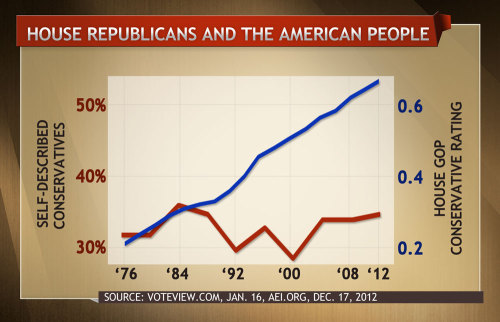
The proposition that data has a liberal bias [ht/, of course to Matias for the notion, and to Chris Hayes (Up with Chris Hayes) for the image. Link to research paper here]. In this graph, the blue line is conservatism as measured by the AEI House of Representatives Conservative Rating, and, drum roll please, the red line is actual, self-described, conservative level of, gasp, conservative voters. Clearly way more liberal, and increasingly so, than the Cipolla-idiots they elect.

Friday, February 22, 2013

Social history and economic development

Carlo Cipolla noted in his Before the Industrial Revolution that social history is an essential component for our understanding of economic progress. He notes that:
"The history of the professions is an essential part of the story of 'intangible' values. Scholarly prestige, restrictive practices through the enforcement of licensing, relatively high personal income—all these factors individually reinforced each other and in combination made possible the social ascent of the professionals."
He suggests that the financial independence of certain professional categories in Europe (lawyers and doctors, for example), when compared with Asia, might explain some of the divergnet paths between the regions. Before, we go down the road of eurocentrism, I want to note the following table from the book.
Cipolla notes that prostitution went hand in hand with the process of economic development. According to him: "in the sixteenth and seventeenth centuries, the two major centers of prostitution in Europe were Venice and Rome, a primacy which, with the Industrial Revolution, was to be taken over by London and Paris." The decline in the number of prostitutes per 1,000 inhabitants in Rome by the late 17th century is part of that decadence.

I would like to see some revisionist research on the proeminence of prostitution in China. Or maybe the West was 'ahead' in this category at least. And yes Vegas is a sign of development!

Reversal of fortune and settlement colonies

Acemoglu and others have discussed the concept of reversal of fortune, the idea that the areas with high income per capita around the 1500s (basically the areas colonized by Europeans in the Americas and Asia) became relatively poor, and vice versa. The idea is that there is a negative relationship between economic prosperity in 1500 and income per capita today. They suggest that the type of settlement and the institutions built by colonizers explain the apparent paradox.

The idea is that in settlement colonies, were more equalitarian societies were built, institutions protected property rights and led to higher investment and growth (à la North). They use the mortality rates associated to a particular region as an instrument for the type of settlement and institutions built by European colonizers. High mortality rates imply low European population density, more indigenous or African slaves, and more unequal institutions, with less protection of property rights.

It is a clever argument, no doubt (put forward by Engerman and Sokoloff, in fact), and more importantly a creative use of the notion of settlement colonies.* I have several problems with it, nonetheless. It is far from clear that equality is really connected to growth, and that causality runs from Western type property rights to growth, rather than vice-versa. I tend to spend quite a bit of time on this in my Latin American History classes. There are also significant problems with Engerman and Sokoloff's notion that institutions responded to factor endowments [fundamentally the idea that in capital-abundant/labor-scarce societies, wages were high leading to technological development; yes the capital debates again, but I'll leave this for another time].

Recently I found the graph below in Angus Maddison's Contours of the World Economy 1-2030 AD: Essays in Macro-Economic History.
The graph shows that Southern Europe, North Africa, and the Eastern Mediterranean were the high income regions, while Northern Europe was relatively poor. In this case, in fact, disease is not a good guide for the type of institutions built in the different regions. Other than the Italian Peninsula, it is the Nile Valley, i.e. Egypt, that had the highest income per capita during the Roman Empire. The Reversal of Fortune is also evident in this case, with France having a significantly higher income per capita than Egypt, for example. It is hard, however, to think that mortality rates associated to tropical diseases (with Southern Europe and North Africa closer to the Tropics) would have something to do with this particular reversal of fortune.

It was the region of older agricultural settlement, more urbanized, more directly connected with Eastern trade, the Eastern Mediterranean part of the of the Empire that was more developed, and that survived for a longer period (until the Turkish conquest of Constantinople in 1453). The reasons for the reversal of fortune in this case, are connected to the rise of the Atlantic economy, related to the Great Discoveries, and the expansion of the African route to Asia. If you ask me, more relevant than the incentives provided by property rights in explaining the Portuguese (and then Dutch and British) search for the alternative routes to Asia, is the rising and changing patterns of demand in Western Europe (and success is based on the naval-military advantage, Guns and Sails, Cipolla would say). But for our purposes here it is only relevant to note that mortality rates no longer seem a relevant instrument for the types of institutions.

* Moses Finley suggests that the idea of settlement versus exploitation colonies (note that Acemoglu et al., avoid the use of the term colonies of exploitation referring only to the settlement ones) was originally developed by Wilhelm Roscher of the German Historical School and later by Paul Leroy-Beaulieu, a liberal (in the European sense of the word) French economist.

Friday, January 25, 2013

Urbanization and the Great Divergence

The Great Divergence between Western Europe and Asia, in particular China, according to revisionist authors like Ken Pomeranz, André Gunder Frank and Roy Bin Wong, has been a recent phenomenon, from around the early nineteenth century (and some would argue it will be a short lived one too; I expressed my doubts here). The graph below (source: Persson, 2010) shows rates of urbanization in Western Europe and China for a very long period.

Note that, by the renaissance of the twelfth century, Italy, particularly Northern Italy, shows a significant increase in the rate of urbanization, eventually returning to the levels of the Roman Empire. Chinese rates of urbanization are flat, in comparison, in this period. Mind you, the Song Dynasty period was a period of rapid growth in China. By the sixteenth century the rates of urbanization in Western Europe take off, with nothing comparable in China, until recent times.

Rosenthal and Wong (2011, p. 111) argue that "war was responsible for Europe’s urban manufacturing," while Chinese manufacturing remained eminently rural. And there are good reasons associated with the Military Revolution Theory to suggest Western European hegemonic rise was associated to guns and sails, as famously put by Carlo Cipolla.

From my perspective what is great about the graph is the suggestion that Western European growth, and eventually the Industrial Revolution, can be associated to the growth in demand. Note that urbanization goes hand in hand with the expansion and transformation of the patterns of consumption. In cities, that have to be built and all sorts of infrastructure and services must be provided, people have access to new consumption goods, and the significant expansion of demand is what forces supply to adjust. In that sense, urbanization, more than population growth, is a good measure of consumption expansion. And urbanization is certainly one way in which Western Europe was already diverging from Asia as far back as the twelfth century.

Thursday, April 7, 2011

Stop greed and idiocy!


Pending a miracle tomorrow there will be a government shutdown. Marx was right, history repeats itself, first as tragedy than as farce. The reasons are not difficult to understand. Carlo Cipolla, in his fantastic Allegro ma non troppo, explained that there are four kinds of people, the helpless, the intelligent, the idiot and the bandit. For us, the ones that matter are the idiots, that is, the “person who causes losses to another person or to a group of persons while himself deriving no gain and even possibly incurring losses.”

The Laws of Human Stupidity imply that non-stupid people underestimate the damaging effects of idiots. In particular, if there is an increasing number of bandits within the elite of the country (e.g. Republicans and his plutocratic friends) that want to plunder the budget, cutting taxes for the rich and cutting spending for the poor and the elderly, and a large number of idiots (e.g. the Tea Party), with only helpless people (e.g. the Democratic leadership) to avoid catastrophe, then as Cipolla suggested society is sure to go to Hell!