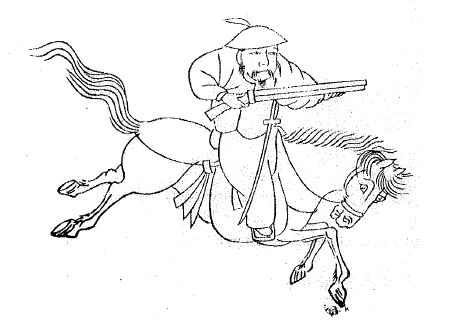
In the last post, I suggested that Kenneth Chase's explanation of why China invented, but did not pursue the development of gunpowder and guns to its ultimate consequences, could be seen as the very deep cause of the so-called Big Divergence, i.e. of the rise to dominance by Western Europe. Chase explains the lack of interest in the development of firearms in China as the result of geographical conditions and how they affected warfare. He argues that two types of warfare developed after the invention of firearms.
 In a sense, this is a more sophisticated geographical argument than the one put forward by Jared Diamond in Guns, Germs and Steel, since it is capable of explaining why Western Europe and not China (or India, or the Ottomans) dominated the world, while Diamond (in a book that uses old political economy arguments, in particular the notion of surplus, something typical of many historians as argued here before) can only explain why Europeans conquered the people outside Eurasia (that had less luck in the choice of animals and plants to domesticate, and less chance to spread them in an East-West axis with similar climate) really. Note that Cipolla long ago had noted that the main advantage of Westerners when they arrived in the East (Vasco da Gama in 1498) was basically military.
The only thing missing in most of these non-economists discussions of the causes of Western European dominance is the role of demand expansion in technological progress and economic growth in general. But many historians do have an implicit demand-led growth or Keynesian story too, I should add. By the way, on the Keynesian view of many historians it might be worthwhile reading the last section of Garegnani and Palumbo's entry on the Elgar Companion to Classical Economics available here.
PS: This also suggests that on some level, particularly military and naval technology, the West was already ahead of the Oriental Empires considerably before Pomeranz and the revisionists time frame (i.e. around 1800). However, the argument does not hinge on Eurocentric views about the superiority of culture, as in many neo-Weberian arguments (e.g. David Landes).
"Where there were technologically advanced agrarianate societies that were not threatened by steppe or desert nomads, we find the combination of firearms and pikemen, with an emphasis upon infantry (western Europe, Japan). Where there were technologically advanced agrarianate societies that were threatened by steppe or desert nomads, we find the combination of firearms and wagons, with an emphasis upon cavalry (eastern Europe, the Middle East, India, north China)."From a geographical point of view Chase divides Eurasia in three regions. The Arid Zone, which includes those areas that supported pastoral nomads, the Inner Zone including the areas that were directly threatened by pastoral nomads, principally eastern Europe, the Middle East, India, and China, and the Outer Zone that was not directly threatened by pastoral nomads, principally Western Europe and Japan, as shown in his map below.

The only thing missing in most of these non-economists discussions of the causes of Western European dominance is the role of demand expansion in technological progress and economic growth in general. But many historians do have an implicit demand-led growth or Keynesian story too, I should add. By the way, on the Keynesian view of many historians it might be worthwhile reading the last section of Garegnani and Palumbo's entry on the Elgar Companion to Classical Economics available here.
PS: This also suggests that on some level, particularly military and naval technology, the West was already ahead of the Oriental Empires considerably before Pomeranz and the revisionists time frame (i.e. around 1800). However, the argument does not hinge on Eurocentric views about the superiority of culture, as in many neo-Weberian arguments (e.g. David Landes).