Tuesday, April 9, 2013

The real legacy of Mrs. Thatcher

Nicholas Crafts has published what is probably the mainstream view of Mrs. Thatcher economic legacy. For him higher Total Factor Productivity (TFP) and a lower NAIRU (natural rate of unemployment) are the results of her policies. I have discussed in other posts the problems with both concepts, so I won't delve into that right now (also not much time to deal with anything now). I just want to point out her legacy in terms of what Crafts calls 'ending the Trade Union veto.'
Graph above shows the fall in unionization rates and the share of wages in total income. The former fell around 10%, from around 50% of the labor force to below 40%, while the latter fell 5% or so. Higher unemployment, no negotiation with unions, lower taxes for the wealthy (marginal income tax rates) and higher for the poor (higher Value Added Tax, VAT), all combined to bring labor into line (end its veto power). That's her legacy. The rest is confusion, or worse just concealing the truth.
PS: A more critical perspective from Krugman here.

Monday, April 8, 2013

How bad is the job market?

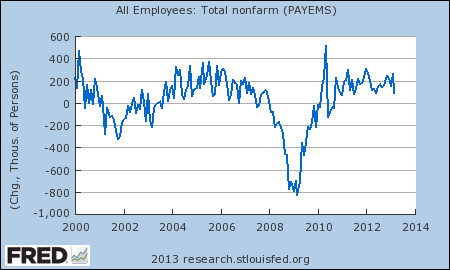
The numbers for the job market last Friday were not particularly good, with only 88,000 new jobs added. Note, however, that the average job creation in the current recovery is not very different from the Bush one (see graph below).
Note that, while the last recession was more severe, with a drop in jobs of 800,000 at some point (against slightly more than 200,000 in the last one), the recovery has been adding a bit less than 200,000 on average (not very different than the previous one). So unless there is more fiscal stimulus (which is very unlikely, to say the least) this recovery will also be slower than the previous (since the hole was deeper).

Sunday, April 7, 2013

Hayek, Freedom, Democracy and the Pinochet Regime

I have been reading Masters of the Universe by Daniel Stedman Jones [got a free copy to write a review], and was a bit surprised about two glaring absences: Sraffa and Pinochet. Yes, talk about strange bedfellows!*

Hayek main theoretical argument, which is common to Austrian and other versions of marginalism alike, is that markets produce efficient allocation of resources, which includes full utilization of labor and capital (i.e. the 'factors of production'). Hayek emphasized heterogeneous, specific capital goods rather than a single malleable homogenous capital value measure. Hayek followed Böhm-Bawerk's emphasis on heterogeneous capital goods and the period of production. He emphasized an intertemporal price system that determines multiple own-rates of interest, but which tended toward a uniform rate, the natural rate.

Unfortunately for him, Sraffa had shown that the two notions were not tenable. As Hayek's business cycle theory was dependent on the differences between the natural rate and the money rate, in a monetary economy, it was his incapacity to deal with the problems raised by Sraffa that made his theoretical relevance in the 1930s to wane. So the complete absence of Sraffa from the book seems to be a significant lapse, but understandable since this is a book written by a historian, not an economist.

The second lapse is more problematic for a historian. Stedman Jones does cite Pinochet in a few places as a fellow traveller of the neoliberals. He even tells you that Friedman thought that "Britain could avoid the fate of Chile ... [and] he predicted that the 'destruction of democratic society,' were it to occur in Britain, would come 'from the left'." Even if you ignore the wild paranoia about 'the left' being a threat to democracy (Yes Labor was a threat! Doesn't that sound like the tea Party? Obama is a threat to democracy too, isn't he?), at least it seems to acknowledge that Pinochet was responsible for the end of democracy in Chile (and yes pictured above is uncle Milton with Pinochet). Not that this should be a controversial proposition. But Friedman was okay with economic policy in Chile.

Hayek had, if that is possible, an even more outrageous view of the Pinochet regime (he also visited and was received by Pinochet). Hayek was not only full of praise for the economic policies of the Pinochet Regime, but also supportive in political terms. He was concerned that Chile, and the Apartheid regime in South Africa too, did not receive a fair coverage from the 'liberal' press in Western countries, and suggested in his infamous interview with El Mercurio that a dictator like Pinochet might be a necessary step towards a liberal democracy. A more thorough treatment of the issue, in particular since Hayek suggested that economic and political freedom were intertwined, would have been relevant, to say the least.

PS1: The other picture above is of Thatcher and Pinochet. It is always good to remember what neoliberals mean when they talk about freedom and democracy.

PS2: I wrote this Sunday night, with no knowledge of Thatcher's health condition. The discussion of her death, and she was the symbol of neoliberalism if there was one (remember her motto, 'there is no alternative'), so far goes to show some of the problems of conventional analyses of neoliberalism. The New York Times has no discussion of her support of Pinochet. The often contradictory support for right wing dictators by neoliberal politicians in developed countries is swept under the rug.

* This is NOT a review. Just a brief comment on specific issues which are not central for the thesis of the book. The actual review of the book is here.

Saturday, April 6, 2013

The Mysterious Death of Duesenberry

James Duesenberry
(1918-2009)

No this is not about a conspiracy theory. For all that I know James Duesenberry died of natural causes in 2009 [I had the opportunity to talk extensively with him at a conference organized by Ed Nell in 1998]. I'm referring to the fact that he is relatively unknown in the profession, as I noted Thursday when I asked my students if they ever heard about him, with only a few affirmative responses. He is also completely absent in textbooks (e.g. David Romer's Advanced Macroeconomics).

This is surprising since, as noted by Robert Frank, "his theory of consumer behavior clearly outperforms the alternative theories that displaced it in the 1950's - a striking reversal of the usual pattern in which theories are displaced by alternatives that better explain the evidence." The alternative that displaced it in the 1950s was Friedman's Permanent Income, for which he got the Sveriges Riksbank Prize (aka the Nobel).

Friedman's more popular theory of consumption was developed as a response to Keynes and Duesenberry, in particular, as a way to suggest that the economic system did have a tendency to full employment after all. Friedman (1957, p. 5) argued:
"The doubts about the adequacy of the Keynesian consumption function raised by the empirical evidence were reinforced by the theoretical controversy about Keynes's proposition that there is no automatic force in a monetary economy to assure the existence of a full-employment equilibrium position. A number of writers, particularly Haberler and Pigou, demonstrated that this analytical proposition is invalid if consumption expenditure is taken to be a function not only of income but also of wealth or, to put it differently, if the average propensity to consume is taken to depend in a particular way on the ratio of wealth to income. This dependence is required for the so-called 'Pigou effect'."
Friedman conveniently ignores Kalecki's response to Pigou, which actually shows that if deflation does have positive wealth effects for consumers, which tend to hold assets, then it is also true that for those holding the corresponding liabilities (the debtors, which could also be consumers) there will be negative wealth effects. The evidence on wealth effects does not suggest that the Pigou effect is strong enough to get an economy out of a recession automatically. Note, however, that there is increasing evidence that real assets have had an impact on household indebtedness and consumption, and have been a source of bubble-led growth (which is unsustainable and prone to crises; see for example this paper).

Duesenberry's Relative Income Hypothesis, developed in his 1949 book Income, Saving, and the Theory of Consumer Behavior, is quite relevant now after the crisis. While Keynes theory of consumption was based on what he referred to as a psychological law, that people consume only a fraction of their income, Duesenberry suggested a sociological explanation. Duesenberry argued that the poor tend to consume a higher proportion of their income than the wealthy, and that, as income increased, the relatively poorer members of society continued to consume a higher share of their income, since their patterns of consumption changed to emulate their well to do peers. A notion that has elements in common with Veblen's notion of conspicuous consumption. Note that this suggests that re-distribution towards the less privileged would boost the economy, since they have a higher propensity to spend (see this paper).

PS: Tom Palley developed a bridge model he calls a Keynes-Duesenberry-Friedman Model (see here). See also Garegnani and Trezzini's paper on consumption and cycles.

A Brief Note on the Sociology of Development


Within the vast literature on the sociology of development, it has been theorized that recent reorganizations of capitalist development, specifically concerning a ‘new international division of labor,’ have reconstituted the global social cartography. What are the contours? & how should the be measured? These questions are difficult, especially given that ever-increasing cross-border linkages and exchanges-a time-space compression, so to speak-, seemingly represent a juggernaut for countries to achieve socially equitable economic path-dependencies.

Given the dynamic connective relationships of complex interdependency, specifically concerning the proliferation of financial capital mobility and the aggrandizement of transnational corporations (TNC’s), the capability for the developing world to achieve, to some degree, relative mobility that transcends the center-periphery divide is perceived to be implausible. As such, global capitalism proliferates ‘third worldization’ through the constant oppressive force of ‘primitive-accumulation', what Myrdal (1957) defined as international ‘backwash’ effects. Hence, the capitalist world economy is reproduced as a world-system (Wallerstein, 1979) of ‘unequal exchange’ (Emmanuel, 1972), in which ‘underdevelopment’ (Frank, 1969), namely, the inability to generate complex domestic patterns of effective demand, ensues peripheral long-run stagnation and monopoly rents, or competitive advantages, for the center; in the final instance, the terms of trade for the periphery fall precipitously - the Prebisch-Singer hypothesis.

Per Cardoso and Faletto ([1967] 1970), however, development in the periphery is possible if foreign capital creates spillover effects. Partial economic growth is viable through what Evans (1995) describes as ’dependent development’, in which there is a relatively strong tripartite relationship between the state, the local bourgeoisie, and foreing capital - an ‘embedded autonomy’ (Evans, 2002). Whether or not this is manifested is the extent to which, as Vernengo (2006) argues, a country does not suffer the inability to borrow in its own currency, especially in which the world economy is structured by the globalization of financial liberalization.

 For more on the topic see here.

Friday, April 5, 2013

The Barriers to Full Employment are Political, Not Economic


By Malcolm Sawyer

In “Political Aspects of Full Employment,” a still widely cited article from 1943, Michal Kalecki raised many questions about the ability of a capitalist economy to maintain prolonged full employment — even though in light of the understanding of tools for stimulating aggregate demand and the use of fiscal policy brought about by the Keynesian ‘revolution.’ In a series of papers, Kalecki showed that the arguments against the use of budget deficits to secure full employment were invalid. Among these arguments, and their rebuttals, were that:
  • deficits add to government debt, which is a burden on future generations (rather, the government debt is bonds owned by individuals, pension funds etc.);
  • deficits crowd out investment (rather, they allow savings to take place and enable investment); and
  • deficits cause higher interest rates (the current situation makes the rebuttal to this clear).

Yet those arguments are still trotted out.

Read the rest here.

Thursday, April 4, 2013

How to solve the crisis without doing a thing

Are you concerned with unemployment and the effects of austerity on the very slow recovery? The Congressional Budget Office (CBO), with the help of mainstream theory, has a solution. Just hike the natural rate of unemployment. Now there are less people involuntarily unemployed, and we are only about 2.2% above 'full employment.' If they hike it a bit more we are done, and John Taylor and Martin Feldstein will be correct in pressing the Fed to hike the rate of interest.
It is a convenient solution no doubt. Mind you the most typical way of deriving the natural rate is from some kind of average of the actual unemployment. In other words, they [mainstream] tell you that the average of a series is the attractor of the actual series. Talk about having things upside down!

This reminds me of the time Bob Solow gave a talk at the New School (in 2001) and suggested at the beginning that the idea of the natural rate was incorrect and should be avoided. By the end of the talk he argued that most analysts think that the natural rate was, back then, at around 5.2%. There it is, the natural rate doesn't exist, but it is 5.2%.

Wednesday, April 3, 2013

Austerity in developing countries too

A new paper by Isabel Ortiz and Matthew Cummins shows that austerity after 2010 has been more or less a general feature of the world economy, and not restricted to developed countries as one might think. The table below shows the changes in government spending in 2010-12 with respect to 2008-9.
As it can be seen, 56 of the 132 developing countries have moved to a contractionary fiscal stance. Note also that the contraction in spending is higher in developing countries than for high income countries. Too much austerity too soon, on a global scale.

South Centre hails Indian drug patent decision

We have discussed the role of property rights in the process of development. The recent Indian case is one in which a broader definition of property rights, one which may be seen by some conservative economists as a violation of patents held by corporations, may actually help the process of development.

From SOUTHNEWS, by Martin Khor:
"The ruling by the Supreme Court of India dismissing the petition from Novartis AG is a historic decision with positive global implications ... The Novartis AG application had claimed a patent for a new salt form (imatinib mesylate), a medicine for the treatment of chronic myeloid leukemia. Novartis sells this medicine in several countries under the brand name Glivec (Gleevec). The Indian patent office had rejected the patent application on the ground that the claimed new form was anticipated in a US patent of 1996 for the compound imatinib and that the new form did not enhance the therapeutic efficacy of the drug. The decision was upheld by the Indian Patents Appellate Board (IPAB).
...
The decision by the Supreme Court of India has significant positive global implications. It has effectively protected the leading role of India in supplying affordable medicines to other developing countries. The reaffirmation of the primacy of health and access to medicines as a right of citizens is particularly important for the international community when these rights are under significant threat under bilateral trade and investment agreements."

Marx, Kalecki, and The Monthly Review School


By John Bellamy Foster

A historical perspective on the economic stagnation afflicting the United States and the other advanced capitalist economies requires that we go back to the severe downturn of 1974–1975, which marked the end of the post-Second World War prosperity. The dominant interpretation of the mid–1970s recession was that the full employment of the earlier Keynesian era had laid the basis for the crisis by strengthening labor in relation to capital. As a number of prominent left economists, whose outlook did not differ from the mainstream in this respect, put it, the problem was a capitalist class that was “too weak” and a working class that was “too strong.” Empirically, the slump was commonly attributed to a rise in the wage share of income, squeezing profits. This has come to be known as the profit-squeeze theory of crisis ...

Read the rest here.

Tuesday, April 2, 2013

Wall Street and the mainstream

Just posted on Blanchard and the role of the IMF in understanding and acting on what it learned after the crisis. I was reminded of that great documentary Inside Job.
And there lies the problem. Institutions are in place to maintain the 'right' kind of learning.

Blanchard and the lessons of the crisis, again

Olivier Blanchard has again posted on the lessons from the crisis, and one has reasons to be underwhelmed again (his previous attempt is discussed here). The general tone is the same as before, we don't know enough (#1 on humility is about that, but also #2 that suggests that we don't know enough about how financial markets operate). Caution here is at the service of an Hippocratic oath suggesting that an intervention carries an obvious risk of harm but a less certain chance of benefit.

His rule #4 says that macro-prudential regulations like capital controls "don’t work great. People and institutions find ways around them. In the process of reducing the problem somewhere you tend to create distortions elsewhere." So, first do no harm [no mention of George DeMartino's actual economic oath, by the way], and please don't use capital controls [that's why I remain very skeptical about the IMF's new view on capital controls; for more go here].

The lesson #3 is simply funny; what they didn't know that there are spillover and contagion effects? He is even making the mainstream sound worse than it is [for a more thorough discussion of what the mainstream learned and its limitations go here].

Last but not least there is lesson #5, which suggests that Central Bank Independence (CBI) does not work if the tasks go beyond inflation targeting. Note that he had defended as a change in macro the idea to raise the inflation target from 2% to 4% [seriously!]. Here he tells you that CBI has been "one of the major achievements of the last 20 years." The problem is not with CBI per se, but that with new demands on central banks (why the new demands appeared is an incognita, and he does not think is deregulation, or at least doesn't say so) CBI becomes more difficult.

There is no discussion of why CBI has been orthogonal to the so-called Great Moderation, caused by stagnant real wages and globalization. The problem with CBI is that by definition it imposes a rule of not coordinating with the Treasury on fiscal policy, and in some cases the central bank might be forbidden to do basic things like buying government debt (like the ECB). The justification is the fear of inflationary pressures, while the truth might be closer to Kalecki's view that fiscal and monetary policy are used to maintain a significant level of unemployment to keep workers in line.

So again it seems that Blanchard has learned nothing from this crisis. Mind you, John Taylor, Martin Feldstein and others are out there calling for higher interest rates. So, all in all, you might think that Blanchard, like Krugman and DeLong, is among the most moderate and reasonable in the mainstream. However, he is at the IMF, an institution that is still pushing fiscal austerity, and his inability (or unwillingness) to learn from the crisis has considerably more impact on economic policies around the world.

Monday, April 1, 2013

Eichengreen on Cypriot Crisis

This column was originally published in Estadao Sao Paulo on March 31st.
All of a sudden, tiny Cyprus is making headlines. How could such a small country, with an economy approximately the size of the State of Maranhao, create such big problems?
The answer is that the crisis in Cyprus epitomizes everything that is wrong with the European Union.
Most fundamentally, there is the very fact that Cyprus was allowed to adopt the euro in 2008. It was already an offshore money-laundering center. Even after problems struck other European countries with oversized banking systems, the EU looked the other way when Cyprus offered high interest rates in order to attract additional hot money. It looked the other way when the banks loaded up on high-yielding Greek debt.
The big Cypriot banks all passed the EU’s bank stress tests with flying colors in the summer of 2011, which seems incredible with hindsight. The government had already lost market access, and it was clear that it would require a bailout. It was clear that Greece would restructure its debt and that this would punch a hole in the balance sheets of the banks. In July 2011 the largest power station on the island then blew up, literally, because the government in its wisdom chose that spot to store live ammunition.
For all these reasons, the writing was on the wall. But no serious negotiations were undertaken for the next year and a half. Cypriot officials didn’t want to admit their negligence, while the European Commission for its part didn’t want to negotiate with a Communist-led government. When negotiations finally commenced last month following the election of a new Conservative government, they took place under severe pressure of time.
But this is no excuse for the ham-handed nature of the package. The Cypriot authorities sought to preserve a broken business model – to hold onto their big Russian deposits by taxing small depositors. They are heavily responsible for the panic that ensued.
But nothing forced the European Commission, the ECB and the IMF – the members of the so-called Troika – to agree to a plan that called into question the inviolability of deposit insurance. The IMF had spent years studying the optimal design of deposit insurance. As we speak, the Commission and the ECB are pondering the design of a common deposit insurance scheme as part of their prospective banking union. Now there are doubts about the safety of small deposits not just in Cyprus but in Italy, Spain and throughout the European Union.
The euro group and its new head, Dutch finance minister Jeroen Dijsselbloem, deserve special recognition. It is the nature of the euro group that the chairmanship rotates. Unfortunately, it rotated to an inexperienced chairman at the worst possible time. By first asserting and then denying that the Cyprus depositor bail-in was a template for how the EU would manage subsequent crises, Mr. Dijsselbloem created high anxiety about the future and raised the likelihood that more bank runs and crises will follow.
The ensuing panic has called into question the very survival of the single currency. To halt depositor flight, Cyprus has been forced to impose capital controls. As any Brazilian knows, once capital controls have been imposed they are very hard to remove. The idea that they will be taken off after a week or a month is fanciful. Those controls make a euro deposit in a Cypriot bank worth less than a euro deposit elsewhere. So much for the principle of a single currency. And so much for the “three freedoms” – free movement of not just goods and people but also capital – that EU membership is supposed to confer.
What should have been done instead? EU authorities were right to acknowledge that loaning large amounts of money to the government so it could bail out the banks was no solution, since this would have saddled the sovereign with unsustainable debts. But they were wrong to insist that the government immediately write down bank deposits, even large deposits above €100,000, since doing so meant destroying at a stroke the financial sector that was the Cypriot economy’s most important business. It consigned Cyprus to a depression of historic proportions.
Instead, EU leaders should have acknowledged that Cyprus hadn’t gotten into this mess without their help. The EU had looked the other way when Cyprus adopted the euro. It looked the other way when its banks went after Russian money. It even gave those banks its seal of approval. The EU should therefore have used its rescue fund, the European Stability Mechanism, to inject funding directly into the banks, repairing their balance sheets. Over time, the banks could have been downsized. Standards for foreign deposits, from Russia and elsewhere, could have been tightened. The problem could have been solved without bankrupting the country.
This approach would have come at some cost to other EU countries. But that cost would have been small, given Cyprus’ small size. And cost sharing would have been fair and just, given the role of the EU in allowing the problem to develop. But this presupposes European politicians willing to make the case to their constituents. It imagines an EU in which decisions are driven by economic common sense and not by Germany’s impending elections.
That, of course, would be a very different EU than the one we actually have, in turn raising the question of whether the actual existing EU can survive.
Barry Eichengreen is George C. Pardee and Helen N. Pardee Professor of Economics and Political Science at the University of California, Berkeley.