Krugman's lecture which will be published in the Review of Keynesian Economics (ROKE).
Thursday, April 21, 2022

Wednesday, April 20, 2022
A new Pink Tide in Latin America?
Episode 52 of the Podcast Missão Desenvolvimento with Paulo Gala and Eduardo Crespo discussing the possible new Pink Tide in Latin America (in Portuguese).
Monday, April 11, 2022
Blog Moving to Substack (and first post)

"Where is Everybody?"
The blog will continue here for announcements, messages and links to more substantive pieces. But those will be posted from now on at Substack. I might also post videos in another platform. But more on that later. Link for first post (on whether the US is a failed State, something that got some traction during the pandemic, particularly in the aftermath of the January 6 riot) here.
Tuesday, March 22, 2022
Registration for the Godley-Tobin Lecture

Registration for the 5th Godley-Tobin Memorial Lecture, for those that cannot be at Bucknell University for the event, is now open here.
Sunday, March 13, 2022
Some thoughts on inflation and what not to do about it
I have written extensively over the years on inflation and some of that is here in the blog (see this or this, or this more recently on Volcker the inflation dragon slayer, if you believe in fairy tales; there's way more if you search the blog; I also highly recommend this paper by Perry and Cline in ROKE, which is open, btw). My more recent piece on inflation came out recently in Catalyst, just before the war in Ukraine (on the war see this by Palley, and this old piece by Gary Leupp after the Crimean crisis in 2014), and the spike in oil, and foodstuff prices. But although this exacerbates things, the gist of my argument remains the same.
Inflation which had accelerated because of the supply constraints, and not because of the recovery or excess demand (sure the economy recovers fast in the US, but more than two million workers less are employed now than at the beginning of the pandemic; see figure below). It was all related to the pandemic and the problems in the supply chain, and logistic issues. Chips that affected the prices of cars, port and trucking issues, and even then energy prices that explained most of the increase (as I noted in my piece; see also the BLS report here).
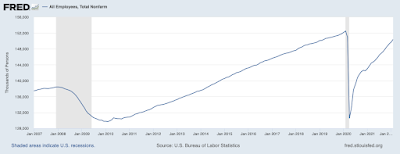
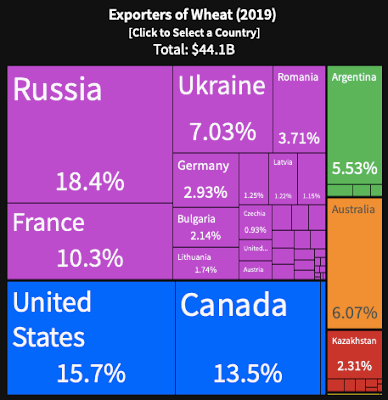
This is all now exacerbated because of the war in Ukraine, which, together with Russia, produces a significantly large amount of oil, natural gas, and key food commodities like wheat. For example, both countries supply about 25 percent of global exports of wheat.
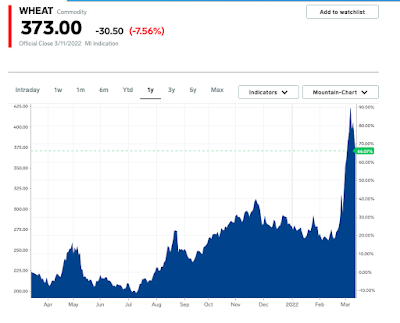
And wheat prices have certainly go up with the crisis (low point there before the spike is less than a month ago). Both energy and food are basic goods that entered in the production of everything, including themselves, and the implications of this are important.
Ricardian rent theory suggested that the extensive use of of lands of lower quality would increase the rent, squeeze profits and (given that wages for him were at subsistence, and accumulation depended on profits) lower accumulation. In this case the higher rents that oil producers, for example, would obtain would impact prices, and given the inability of workers in most places (including the US) to demand higher wages (blame it on years of lack of organization, decreasing unionization and so on, which are hard to reverse even in the current context of heightened mobilization as I suggested in the Catalyst piece), real wages will fall. So this would make the supply side effects of the crisis worse. Inflation will remain higher.
But as I noted in the paper, wage resistance, the propagation mechanism that fueled the distributive conflict back in the 1970s is dormant now, and nobody should expect high inflation (let alone hyper, which is a completely different story). Also, in principle the hike in prices should not have, any direct effect on growth. But the effects of inflation acceleration on the mood for more fiscal expansion in Washington will impact growth. And higher interest rates that are coming will impact too (although I think less) spending, and also cool down the housing market, and that will have effects on consumption too. So the likely effect is higher inflation and lower growth. Btw, in the piece I suggest that this is the return of the 70s, all with a victory of the GOP in the elections and with Biden playing the role of Carter (That 70s Show reunion).
So what to do about all this. Conservatives and orthodox economists have demanded fiscal and monetary restraint. That, of course would only work if inflation was demand driven. I won't say anything else here on that. It would be a waste of time. On the left there have been some alternative policies. Some suggested price controls (and don't get me wrong, I do think they can be effective, and were under certain circumstances, old post here). But price controls would require a bureaucracy capable of controlling prices, and an economy much more organized, and particularly one in which key parts of the supply chain are at home, like the planned economy during World War II, in order to work. This is not the case right now.
Anti-monopoly and regulation policies, which have also been floated by some progressives, are also not particularly useful. I won't go into the whole issue of what in Latin America we called the oligopolistic view of inflation (as I note in my piece the first Gilded Age was a period of deflation, and the this current Gilded Age had been, so far, one of a Great Moderation), but even if you assumed that regulation could do something, the timing would be too long to have any significant short term effect.
Some MMTers have suggested that a Jobs Guarantee (JG) is the way to stop inflation, and while I'm for a JG for employment security reasons, I'm very skeptical about its relevance for price stability (my general views on MMT and inflation in this long post here). The main idea is to control wage increases, but again those will be in the medium term subdued, in my view, and the distributive conflict will not spark a price-wage spiral like in the 70s.
The US will use its oil reserves, and will use its power to try to manage production by OPEC countries, not just Saudi Arabia, but even Venezuela (a mission already went and visited Maduro, and not Guaidó, not surprisingly). And this efforts will probably to some degree contain what could be an even worse increase in global prices.
As it turns out I think that in the short run there is little that can be done. Inflation will remain higher. Not high inflation, but higher than the very low that we experienced for the last 30 or 40 years in advanced economies. The problem is not inflation, but the fact that real wages will fall, and that this will be used as an excuse for contractionary policies. Also, in some parts of the world this would lead to food shortages, and heightened social conflicts. This is inevitable to some extent, and the result of higher prices for basic goods, which do affect distribution as noted by Ricardo (in his case a squeeze of profits). The question that nobody asks is what is the problem with 8 percent annual inflation if real wages kept up with it. There's no evidence that it would affect growth, and in order to have some impact and disorganize relative prices seriously it would have to be much, much higher (classic paper on that by Bruno and Easterly here). Essentially the best thing that can be done is not much, but that is not in the cards.
Thursday, March 10, 2022
Beyond Vulgar Economics: Conceição Tavares and Heteredox Economics

My paper (in Spanish) for a book on social thinkers in Latin America edited by Marcelo Rougier and Juan Odisio, and that I presented in a few venues since 2020, is now revised and done. The book includes chapters on Raúl Prebisch, Aníbal Pinto, Víctor Urquidi, Celso Furtado, Juan Noyola Vázquez, Helio Jaguaribe, Aldo Ferrer, and Osvaldo Sunkel, besides mine on Maria da Conceição Tavares. A version available here.
Tuesday, March 1, 2022
Ukraine: what will be done and what should be done?
By Thomas Palley
While rightly condemning Russia for its invasion, the mainstream media continues to selectively report the history behind these events. In my view, its omissions are intentional and contribute to the tragedy. They inflame public understanding, render a diplomatic resolution more difficult, and lock us into a worse trajectory.
Let me make further clear my argument: (1) President Putin is head of the Russian state which is under slow-motion implacable attack by US-led NATO. (2) After failing to secure a satisfactory diplomatic resolution, he has taken action to head off that attack.
If you accept those two propositions, the Ukraine story is massively more complicated than simply claiming Putin is an aggressor and we (the US) are good. There will be no lasting peace until that complexity is fully engaged.
Read rest here.
Monday, February 14, 2022
American Exceptionalism and the Liberal Menace: the US and Ukraine

By Tom Palley
American exceptionalism is the most dangerous doctrine in the world, and it has been on full display in the current Ukraine crisis. Worse yet, the loudest advocates have been America’s elite liberal class.The doctrine of exceptionalism holds that the US is inherently different from and superior to other nations. That superiority means the US is subject to a different standard. Its actions are claimed to be benevolent and above international law, and the US is entitled to intervene at will around the world, including building a global network of military bases and garrisons that it would never permit another power to have.
Read rest here.
Saturday, February 12, 2022
Review of Keynesian Economics is out!

The issue focuses on monetary macroeconomics. The lead article is Professor Marc Lavoie’s 2021 Godley-Tobin Memorial Lecture titled Godley versus Tobin on monetary matters. That is followed by an article by Federal Reserve economist Jeremy Rudd titled Why do we think that inflation expectations matter for inflation? (And should we?). Additionally, there is an article on the role of risk and uncertainty in Keynes’ and Kalecki’s interest rate theory; an article providing a modern theory of animal spirits founded on contemporary psychological theory; an article on pre-Keynesian application of Keynesian policies in the Great Depression; and an article augmenting the standard undergraduate upper-level macroeconomics model with hysteresis via the central bank’s estimate of the natural rate of interest.
Friday, February 11, 2022
JERZY OSIATYŃSKI 1941-2022

By Jan Toporowski*
Jerzy completed his matriculation at Juliusz Słowacki Liceum in Warsaw and went on to study economics in the elite foreign trade faculty of the Main School of Planning and Statistics (Szkoła Główna Planowania i Statystyki SGPiS – now reverted to its pre-War name of the Main School of Commerce Szkoła Główna Handlowa). He completed his PhD there and by then had fallen into the circle of economists around Michał Kalecki, who lectured on the economics of capitalism and convened seminars on economic planning and development economics. Jerzy started teaching, and was remembered as a charismatic teacher who made himself available to students and was willing to explain, instead of just repeating dogmas. His brother Wiktor became a well-known writer. A concert-pianist sister married an Englishman and left Poland to live in London.
In 1963 he joined the ruling Polish United Workers’ Party, a natural move for a socialist with ambitions to have a voice in political discussions, if only on the topic of socialist economic and political reform. Kalecki (who never joined any party) was criticising the economic plans being implemented by the government, and the younger generation of Party members, most notably Jacek Kuroń and Karol Modzelewski, were demanding democracy. This would have been a polite discussion were it not for rising discontent in the country at large over shortages of food and other basic articles of consumption, the result of the government’s economic mismanagement.
In the wake of the Six-Day War in 1967, the government tried to redirect criticism towards internal enemies who sympathised with the Israeli defeat of Poland’s Arab allies. Outraged by this accusation by inuendo from a government that claimed to be of the Left, Osiatyński went to a meeting of his Party cell to demand that the Party leader, Władysław Gomułka state clearly who were the internal enemies sympathetic to international Zionism. Osiatyński was expelled from the Party.
Worse was to follow. Public institutions started drawing up lists of Jewish staff who were to be sacked and expelled from the country. Most of Poland’s Jewish population had been killed by the Nazis during the War. The poorer sections of the communities that survived left for Israel after the establishment of that state, leaving only the assimilated Jewish people, who no longer considered themselves to be particularly Jewish, in the middle and professional classes. A particular target after March 1968 were student protestors who were accused of abusing their privileges in a workers’ state by criticising that state while living off the labour of ‘ordinary working people’. Osiatyński’s doctoral thesis on ‘Comparative advantage in the analysis of economic growth factors in socialism’ (Korzyści komparatywne w analizie czynników wzrostu gospodarki socjalistycznej)prepared under the supervision of Kazimierz Łaski, was failed. (It eventually passed, under the formal supervision of Henryk Fiszel, in 1973, after the fall of Gomułka).
Very few institutions were able to resist the purge of Jews and ‘revisionists’ who wanted a more democratic socialism. Among those institutions was the Polish Academy of Sciences, whose staff had no teaching duties and so were unable to corrupt revisionist-minded students. Here Tadeusz Kowalik was leading a research group that was publishing the collected works of Oskar Lange. Following the death of Kalecki in April 1970, a job was created for Jerzy to edit the collected works of Kalecki.
Support came from Kalecki’s friends in Cambridge UK, where Joan Robinson helped to secure visiting fellowships for Osiatyński and Kowalik. In Cambridge Osiatyński acquired a taste for Stilton cheese and material for his post-doctoral thesis (praca habilitacyjna) on the Cambridge capital controversies, that was published in Poland in 1978 under the title Kapitał, podział, wartość: kryzys ekonomii neomarginalistycznej (Capital, distribution, value: the crisis of neomarginalist economics). Between 1979 and 1988, six volumes of works by Kalecki appeared in Polish with Osiatyński’s extensive background notes. There were other visits to the Institute for Development Studies at Sussex University and Oxford University. In 1988, his book on Kalecki’s economics of socialism Michał Kalecki on a Socialist Economy was published by Palgrave, with a foreword by Włodzimierz Brus, despite Kalecki’s disagreement with Brus over market socialism, that Osiatyński made clear in his book.
Both Osiatyński and Kowalik became involved in supporting the workers’ movement Solidarity that emerged in the 1970s and in the informal study groups that were set up to discuss forbidden literature. When the first semi-free elections were held in 1989 Osiatyński was elected to the Polish Parliament and started a political career. He was appointed Minister of Planning in the first non-Communist Government of Tadeusz Mazowiecki, taking over the premises of the old Planning Commission where Kalecki had worked and criticised. By then the Ministry had been reduced to providing economic forecasts while at the Finance Ministry Leszek Balcerowicz with his adviser Jeffrey Sachs pushed through the shock therapy that devastated the Polish economy for the next two decades, and eventually brought to power the present right-wing populists (a fine example of Kalecki’s belief that the immiseration of the working class brings out the worst as well as the best in all classes).
In 1992, Jerzy had his chance at the Finance Ministry. But by then it was too late. The damage to Poland’s industrial infrastructure and institutions had been done, and the Finance Ministry reduced to little more than fending off demands for debt repayments. Political commitments coincided with the publication by Oxford University Press of the English edition of Kalecki collected works, from 1990 to 1997, now in seven volumes. He threw himself into consultancy work in Post-Communist countries on behalf of multilateral financial institutions. But his political career could not survive the fragmentation of the liberal social democratic politics on the fringes of the old ruling party. In 2001 he lost his parliamentary seat. However, he retained his position in the Institute of the History of Science at the Polish Academy of Sciences (Instytut Historri Nauki Ekonomicznych Polskiej Akademii Nauk) until 2004, when he moved over to the Economics Institute of the Academy. In 2010 he was appointed economic adviser to the Polish President Bronisław Komorowski. Three years later he resigned from this position to become a member of the Monetary Policy Committee of the Polish central bank, Narodowy Bank Polski.
In 1990, he hosted at his flat in Warsaw a reunion of his colleagues from SGPiS who had lost their jobs and been forced into exile in the 1968 purges. He felt very keenly their exile and their eventual passing away. This was particularly so in the case of Kazimierz Łaski, who had directed the work of both Kalecki and Osiatyński at SGPiS in 1960s, and had been exiled to Austria. Łaski died in 2015. Osiatyński arranged for the publication of Łaski’s exposition of Kaleckian macroeconomics, in his Lectures in Macroeconomics, and its translation into English, published by Oxford University Press in 2019. In 2018 he visited London for the last time, meeting up with Geoff Harcourt, an old friend from Cambridge, at the launch of the second and final volume of Jan Toporowski’s biography of Kalecki. In 2019 he helped to put together a conference at the OECD in Paris, commemorating the 75th anniversary of the Bretton Woods conference by exposing the criticisms made by Kalecki and Raul Prebisch of the Keynes and White Plans. I was working with him on editing the conference volume when he entered hospital in January. He died on the 4 February.
Jerzy Osiatyński was awarded the title of Professor in 1989. In the following year he was given an honorary doctorate by New York University. He leaves a widow, Elżbieta.
Classical Political Economy or the Surplus Approach
Here our other conversation with LP Rochon, about the chapter on Classical or Surplus approach authors. My co-author, Suranjana Nabar-Bhaduri and I talk about the Real Bills Doctrine, Bullionism, Say's Law the implications for theories of crisis. And about several authors, Smith, Ricardo, Tooke and more.
Thursday, February 10, 2022
Rational expectations, New Classicals, and Real Business Cycles Schools
A video conversation with LP Rochon and my co-author Bill McColloch on our chapter for the forthcoming book on the history of ideas. Many topics, including Friedman vs Lucas relevance, the Lucas critique, the empirical turn in the profession, and more. More info on the book soon.
Thursday, January 20, 2022
2022 Godley-Tobin Memorial Lecture: Paul Krugman
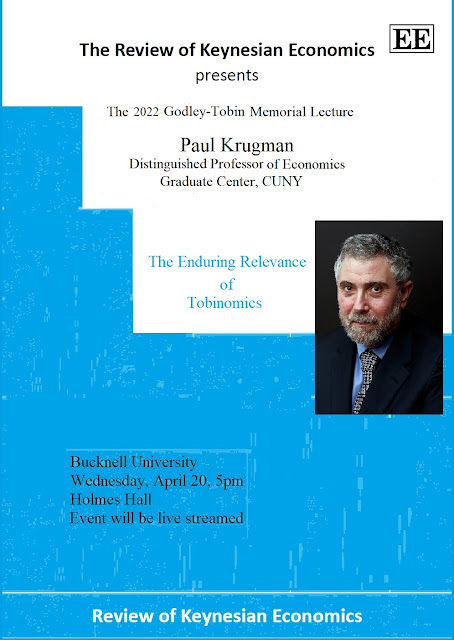
Professor Krugman’s work has focused on international economics and macroeconomics. He is a prominent American public intellectual who is widely recognized for his regular column in The New York Times. The title of Professor Krugman’s lecture is “The enduring relevance of Tobinomics”.
Subscribe to:
Posts (Atom)