Partial video (my fault) of the conference about the book edited by the late Jerzy Osiatynski and by Jan Toporowski published by Oxford University Press. Our chapter on Prebisch with Esteban Pérez is available in a preliminary version here.
Friday, December 9, 2022

Saturday, December 3, 2022
Public vs private debt
I was teaching about deficits and debt this last week. If you know me and follow this blog, you'd know that I always emphasize the importance of the distinction between debt in domestic currency and debt in foreign currency. Functional finance authors (and MMT too) are correct in noting that a country cannot default on debt in its own currency (for a model of a currency crisis and default, in foreign currency go here; as afar as I know the only formalization of a PK alternative to the Krugman model).
At any rate, teaching about the US for mostly US kids, that is not an important distinction, since the US has only debt in its own currency. Most of them thought that the current levels of public debt are too high (with respect to what you may ask, the ability to repay or the kind of society we live in?). I would hope that by them most of them tend to think that we do not have enough public debt. I mean the amount of homeless people, or the windshield washers in the corners of the streets, suggest that we need more public spending. The graph below shows the break between public and private debt in the US.
.png)
It is clear that the amount of public debt shrank from about 50 percent of total debt in the early 1950s to something around 10 percent right before the 2008 financial crisis, and most of the growth was in the financial sector. Since then public debt has grown to about 30 percent. Household and corporate debt did increase over time, but not much. The important lesson in the case of an economy like the US (with debt in its own currency) is that public debt is safer than private debt, since the government cannot default and its spending does affect the level of activity and the ability of the private sector to thrive.
Friday, December 2, 2022
Kalecki's Alternative to Keynes and White's Plans its Consequences
.png)
Webinar on Kalecki and his views on the Bretton Woods agreement. To register go here.
Tuesday, November 29, 2022
Savings Glut, Secular Stagnation, Demographic Reversal, and Inequality: Beyond Conventional Explanations of Lower Interest Rates

New Working Paper published by the Political Economy Research Institute (PERI). From the abstract:
Interest rates have declined over the last 40 years, a period of increasing inequality. The steady decline in interest rates has been interpreted by and large as resulting from a decline of the natural rate of interest. This paper surveys the main explanations associated with the notion of a decline in the natural rate of interest, including the savings glut and the secular stagnation hypothesis. It analyzes the views according to which demographic forces were behind the decline, and might perhaps be associated to a future rise of the same natural rate. It also discusses the view according to which the role of inequality has been also to affect the natural rate of interest. Finally, views that discuss the role of monetary and financial factors, including the so-called global financial cycle literature, are discussed. It is argued that the conventional view suffers from logical and empirical problems that are ultimately insurmountable. A brief critique of the notion of a natural rate of interest, and alternative monetary theory of the decline of interest rates, as determined exogenously by the monetary authority of the hegemonic country, the United States, is proposed.
Read paper here.
Saturday, November 12, 2022
Lula's election and what lies ahead
It's been a while since I wrote about the Brazilian crisis (a summary of the previous catastrophic election here). In part that election and the continued crisis explains why I have written less, not just about Brazil. This has been a long economic depression that started in 2015 (see graph), with a coup in 2016 and since 2018 the added problem of a right-wing authoritarian regime that won an election that was only possible with the political proscription of Lula. But at least the political problems have started to be solved with this election.
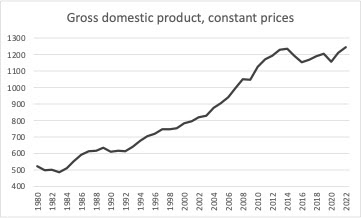
Source: IMF. Peak in 2014 (2022 estimated)
The Lula election last Sunday is a redemption story, no doubt. Not only because there was no prove of his corruption, even if corruption existed,* and even though the international press, including the reputable media continues to refer to him as an ex-convict. Corruption is a problem, but the one that matters is associated to the needs of governance in Congress, and the current Bolsonaro government has dealt with payments to members of congress through the so-called secret budget. And that will not vanish, and that could cause problems in the future. But in all fairness, the size of that and the implications in terms of the functioning of the political system, let alone for economic growth or the well-being of the population are far from clear.
At any rate, that is a secondary issue. The problems that Lula and his coalition will face are on the economic front. And not because Brazil is facing a serious crisis, like neighboring Argentina. This is the worst economic crisis in Brazilian history, but is purely political, and has been aggravated by the decisions taken by the Brazilian authorities, starting in 2015 with Dilma, trying to stave off the coup, and then with Temer and Bolsonaro.
The main problem is the limit on government spending, the ceiling that would limit the ability of the government to promote not just a more solid recovery, but more importantly one that allows for increasing real wages for those at the bottom. Fiscal rules were put in place for this reason, for the possibility of a left of center government, and that is why financial markets were convulsed by Lula's talk this week, and the real devalued. Not that it matters much.
There will be some arrangement that will allow the expansion of spending to cover the social transfers, and some additional social spending that was left out of Bolsonaro's last budget. But fiscal conservatism will be something that will have to be combated throughout the next four years, and not just from the opposition. Many within the government's complex coalition will be for austerity. There will be plenty of time to talk about that, and I would normally be pessimistic.
However, two things make me a bit optimistic (which is not very characteristic). It is important to differentiate what Lula does from what he says, or even what he believes. This is true of many on the left in Latin America. Before the previous Pink Tide, two decades ago, I was more concerned with the pleas for fiscal responsibility of many on the left. As it turns out, many of the progressive governments did expand social spending, and promoted an acceleration of growth, including Lula, and a significant expansion of real wages. Someone will say, this is not 2003, and there is no commodity boom that will lead to growth, or at least the easing of the external constraint.
However that was not what explained the Brazilian growth in the first Lula government. The external constraint was eliminated to some extent by the boom in commodity prices, but the fundamental source of foreign reserves was financial, and resulted from the relatively high remuneration for assets in domestic currency. That was to some extent possible because interest rates in advanced economies have been low in the center, and they will likely remain low (even if they are increasing right now). So on that front it is possible to expect an acceleration of government spending, and higher transfers to the relatively poor, with higher real wages at the bottom. Besides, Bolsonaro is gone, and that should be reason enough to be optimistic about the future.
* There is no evidence of Lula's personal corruption. The infamous Triplex apartment, for example, is clearly not his, and he never benefited in any other proven way. Many Latin American politicians, including Eduardo Cunha, which was instrumental in Dilma Roussef's impeachment, does appear in the Panama Papers. Paulo Maluf had undeclared accounts in Switzerland, just to name another Brazilian politician for whom there is objective, material evidence of corruption. To suggest that Lula knew about corruption, is more or less like saying that FHC knew about the buying of votes in congress to allow for his reelection (or many other issues during his government). In other words, is to say the obvious.
Comments on the history of the Review of Keynesian Economics on its tenth anniversary
By Thomas Palley
This Fall (October/November 2022) marks the tenth anniversary of the founding of the Review of Keynesian Economics (ROKE). The founding co-editors were Louis-Philippe Rochon, Matias Vernengo, and I. At the beginning of 2018 Louis-Philippe Rochon stepped down to become sole editor of the Review of Political Economy and he was replaced by Esteban Pérez Caldentey.
Since then, ROKE has further enhanced its reputation, becoming a leading heterodox economics journal as measured by its Clarivate citation score. It also has premier standing for official research assessment purposes in France, Italy, and Brazil.
Active plans for the journal were set in motion in late 2011 and the first issue was published in Autumn 2012. That first issue includes a founding statement by the three co-editors which lays out the motivation for establishing the journal, its scope, and its purpose. The statement is on ROKE’s website. I think it has aged very well and there is not much in it that I would change today. I encourage people to read it.
Read rest here.
Friday, November 11, 2022
Palley on the history of the Review of Keynesian Economics
Here a short video. I do offer a few remarks. I would add that Louis-Philippe was central not just in the initial discussions that we had going back two decades now, to when we were at Kalamazoo College, but in getting Elgar into the journal business. Not sure Elgar would have done that without LP convincing them. This happened at the time that the Journal of Post Keynesian Economics (JPKE) was transitioning from Paul Davidson editorship, to the Jan Kregel and Randy Wray period.
I suggested Tom to LP, since he had been our teacher at the New School, and I thought three would be a better setting for adjudicating differences between the editors. Tom wanted a journal more open to other traditions. I would say in my view the reasons are not exactly connected to pluralism, as Tom discusses in the clip, and more to the restoration of a political alliance that was more or less in place during the Golden Age, between neoclassical synthesis Keynesians like Bob Solow (who is a member of the board) and people like Joan Robinson. That's why I suggested the Godley-Tobin lecture that in my view makes that alliance explicit. In that sense, the plan, that was originally in LP's plan a post-Keynesian journal related to monetary issues, to not compete directly with the JPKE, became the non-hyphenated Keynesian journal.
PS: And yes, the story of why the hyphen in the JPKE, as told to me by Paul Davidson, is that it couldn't be the Journal of Keynesian Economics, since the acronym would be JOKE! The term post-Keynesian (or is it Post Keynesian) already existed, but in my view it was the JPKE that sedimented its use, and in a sense that was an accident.
Wednesday, October 26, 2022
Some thoughts on radical environmentalism and heterodox economics
Ecological economics emerged in the 1970s, as a sub-field of mainstream economics, using some of the conventional tools of neoclassical economics, but trying to move away from it, not only regarding some of the theoretical choices, but also distancing from some of the ethical concerns of the mainstream (Holt and Spash, 2009). Even though there were precursors to ecological economics, in particular the work of Kenneth Boulding, Nicholas Georgescu-Roegen and Karl William Kapp, it is clear that the profound crisis of capitalism in the early 1970s, and the preoccupations with population growth, famine, and exhaustible resources, exacerbated by the oil shocks, were central for the sudden prominence of environmental concerns within the economics profession. Paul Ehrlich’s book, The Population Bomb, and the celebrated report on The Limits to Growth, published by a Massachusetts Institute of Technology (MIT) team and the Club of Rome marked a significant cultural shift, and the beginning of the international concern with the ecological limitations of human activity.
The 1970s was also a period of significant macroeconomic turbulence, with the collapse of Bretton Woods, stagflation and a crisis that brought about the end so-called Keynesian Consensus. It was in this period of crisis of Keynesian economics that an heterodox alternative to the mainstream was developed. In part for that reason, Ecological Economics is seen as being critical, and part of the broader heterodox tradition. But their are good reasons to be skeptical about this view.
Read rest here.
Saturday, October 22, 2022

Beyond vulgar heterodox economics: a note on the legacy of Pierangelo Garegnani (1930-2011)
My paper, in Italian, which was a modified version of a talk last year, has been published in Moneta e Credito, and is available for download here.
Wednesday, September 21, 2022
Thinking about Inflation: A conversation with Marc Lavoie
The conversation on inflation with Marc Lavoie at the Fields Institute in Toronto. I think that there was an agreement, between us, and most people in the room that the oligopolistic view of inflation does not hold water. I tried to discuss the Argentinean case on the basis of a piece that I co-wrote with Fabián Amico and Franklin Serrano, published in the local version of Le Monde Diplomatique online. A longer version, also in Spanish, here. An English version is in the works, btw.
Saturday, September 10, 2022
Lance Taylor (1940-2022) and his legacy

With Lance in Beijing (2001)
My plan was to work on inflation theory (and I did write a conflict model, that can be seen as being in Lance’s tradition later on; in my view his best book is the one that is less formal, and is on inflation, his Marshall Lecture at Cambridge, Varieties of Stabilization Experience; at the time I first read it I didn't know that the title was a quote from Henry James; the other candidate is his book with Eatwell Global Finance at Risk. Both are more books than manuals). But I started working with Wynne Godley on his stock-flow model for the joint Center for Economic and Policy Analysis (CEPA) and Levy Economic Institute project. A year into the project I told Lance that it would make sense if I worked on something related to the project, namely the sustainability of the US external account. Lance was very nice about it, and not only went along, but also provided funding, since I received CEPA’s dissertation grant.
I ended up writing something that was very close to Massimo Pivetti’s monetary theory of distribution. The theory at least. Lance provided comments and feedback, and, at some point, told me that I was obsessed with this monetary distribution thing (I was, indeed). But he also provided support, and his criticism was always constructive. Lance was the best supervisor one could have. He guided the work with frequent conversations, read and criticized what I gave him to read, and, after it passed certain standards, approved it, even if it wasn't exactly a Lance Taylor dissertation. He never tried to mold my thinking, or force me to work on own his terms. Sadly, that isn’t the norm in academia. I think he had been lucky with his supervisor too. He once spoke fondly of Hollis Chenery (his supervisor; not his mentor, which I think was Rosenstein-Rodan; I might be wrong), because he protected the radicals, which were under pressure in the late 1960s at Harvard. His intellectual generosity, among several other qualities, is something that will be deeply missed.
Lance was open to alternative methods, and approaches, what he called closures (certainly more than I am), and his comparative method was influenced by other disciplines, the qualitative "thick descriptions" a la Clifford Geertz that he liked. I actually ended up reading a bit of Geertz because of my conversations with Lance, particularly when I was the assistant director at CEPA (he was the director) and he organized a book on several comparative studies of liberalization in peripheral countries (the one on Brazil, which was supposed to appear in a previous volume, and should have been written by Edward Amadeo, was eventually written by me; photo above is from one of the conferences that led to that book). Geertz saw anthropology, as he famously put it, "not [as] an experimental science in search of law but an interpretive one in search of meaning." The thick description was essentially the interpretive work of the ethnographer. Lance took that view, in some sense, of economics, blending the description of the historical and institutional features of peripheral countries, with relatively simple models in what Paul Krugman (a co-author; Paul's first paper was the one on contractionary depreciations with Lance) called the MIT or Solow type models (my only other model in that sense, is the currency crisis one that puts Krugman's one upside down).
Lance was open to alternative methods, and approaches, what he called closures (certainly more than I am), and his comparative method was influenced by other disciplines, the qualitative "thick descriptions" a la Clifford Geertz that he liked. I actually ended up reading a bit of Geertz because of my conversations with Lance, particularly when I was the assistant director at CEPA (he was the director) and he organized a book on several comparative studies of liberalization in peripheral countries (the one on Brazil, which was supposed to appear in a previous volume, and should have been written by Edward Amadeo, was eventually written by me; photo above is from one of the conferences that led to that book). Geertz saw anthropology, as he famously put it, "not [as] an experimental science in search of law but an interpretive one in search of meaning." The thick description was essentially the interpretive work of the ethnographer. Lance took that view, in some sense, of economics, blending the description of the historical and institutional features of peripheral countries, with relatively simple models in what Paul Krugman (a co-author; Paul's first paper was the one on contractionary depreciations with Lance) called the MIT or Solow type models (my only other model in that sense, is the currency crisis one that puts Krugman's one upside down).
I tend to think that this methodological stance is Lance most enduring legacy, and the one that had the most influence on my own work. Most discussions of his work emphasize the gap models (which I think are problematic, the savings and fiscal gaps in particular), or the stagnationist model of growth, which builds on Bob Rowthorn's seminal Neo-Kaleckian growth model (and also on Amitava Dutt's model, which I think was part of his dissertation work under Lance). Some might even think that it was the reversal of his views on the role of exchange rates in development, his paper with Roberto Frenkel on stable and depreciated exchange rates as engines of growth (which can be seen in line with Luiz Carlos Bresser-Pereira and Jaime Ros views, and as being at the center of New Developmentalism). Others might think it's his work on Social Accounting Matrices that prefigured, and went hand in hand with his appreciation for Wynne Godley's stock-flow consistent models (on Wynne's methodological stance, see this old post).
In a way, all these models, and others (I could have added the Minsky crisis one, that is often neglected), to some extent show the use of models for Lance. He was somewhat eclectic, and use them to illustrate some of the issues with developing countries. But for him that had to be complemented by the interpretive thick descriptions. In my view, the models per se were less relevant for Lance, who was an unorthodox lefty that remained so, as someone remembered recently, even as the whole world moved to the right in the 1980s, and 1990s (he told me that a director of research at the World Bank, that had become a neoliberal, told him in his last visit to that institution, if he wasn't ashamed for still defending those structuralist views). And he did leave MIT for the NSSR, which was a strong signal of his political views. The simple model allowed him to tell the stories.
I have a tendency to prefer greater consistency in the models, and I'm less keen on accepting some possibilities of neoclassical/monetarists closures for the real world. But his methodology, which in some sense contrasts with the large stock-flow models that my other mentor (Wynne) liked, is certainly something I think it is a more fruitful way of thinking about macroeconomic problems. But again the specific models per se are less relevant, and the thick description that they illustrate with simplicity matter more.
Thursday, June 23, 2022
Modern Money Theory in the Tropics: A Reply to Agustin Mario
Our reply to a very inaccurate discussion of our views on MMT by Agustin Mario. From the abstract:
This paper responds to some inaccuracies on the discussion of our views on Modern Money Theory (MMT), as discussed by Agustin Mario. We believe that while is correct in noting that autonomous spending generates taxes, and fiscal balances are a result, MMT authors overlook the difficulties in pursuing expansionary fiscal policy in the developing countries. These are limited by the existence of an external constraint that cannot be solved with a flexible exchange rate policy regime. Foreign reserves and capital controls are needed.
In particular, I want to emphasize that the notion that we said in any place, or that it is implied that Esteban and I believe in supply side constrained growth is preposterous, and is either done in bad faith or complete ignorance. The main issue again is that we do not believe in free capital mobility and flexible exchange rates for developing countries, something that apparently Warren Mosler was defending down in Argentina a few weeks ago, asking for lower rates of interest, floating rates and fiscal expansion in complete disregard of the inflationary and contractionary impact that devaluation would have, and the limits imposed on fiscal expansion.
I also want to emphasize this particular reply to Mario:
Mario (2021, 364) says that “[t]o borrow in foreign currency is not a need but a policy choice.” The naïve conclusion is that debt in foreign currency can be completely avoided. The argument is akin to suggesting that breathing in an environment that is polluted is not necessary, just a decision, even if one lives next to a polluting factory and is too poor to move. Developing countries must import intermediary and capital goods, by their nature of being behind in the technological development ladder and being integrated into the complex division of labor of the modern world economy. That is unavoidable, and not a policy choice. Countries that are excluded, by the imposition of sanctions by the United States show the alternative. Developing countries should, obviously, minimize the amount of foreign debt they incur, and this should be at a level that is sustainable, with exports growing faster than the interest rate on foreign debt (Cline and Vernengo 2016).
And that is why reserves matter. This phrase, that we cite again, is something that no economist from a developing country would have written, for obvious reasons:
on a floating exchange rate, a government does not need to fear that it will run out of foreign currency reserves (or gold reserves) for the simple reason that it does not con- vert its domestic currency to foreign currency at a fixed exchange rate.
In our view, exchange rates should be managed (and that implies raising interest rates to preclude depreciations sometimes is required), capital controls and accumulation of reserves are a must, and fiscal policy should be pursued to the limit of the external constraint.
Subscribe to:
Posts (Atom)