Showing posts with label Lula. Show all posts

Wednesday, July 31, 2024

Very brief comments on Venezuela

The election in Venezuela is always contentious. I've written quite a bit about it over the years (see everything here; on the previous presidential election see here). Some have decided already that is a fraud, and sustain that the previous ones were also, although that is far from clear, and most likely Maduro (let alone Chávez) did win all the previous elections. This time around things are less clear. First of all, the opposition seemed more unified, even with the disqualification of Maria Corina Machado, a mistake by Maduro, both from a general preoccupation with democracy, and also, because the actual opposition candidate, Edmundo González Urrutia, might have been more effective.

In my view, the only way to know what happened one would have to check the data, and that is still not possible. Both Lula and Petro have asked for a peaceful recount of the votes. It is the only way to find out what actually happened. Same calls have been issued by reasonable opposition people like Francisco Rodriguez.

There is a great distance from saying that there were problems with the election, to suggest that is what fraudulent, and that Maduro is a dictator. Obviously Venezuela is flawed democracy. But, in all fairness, the US is very flawed too. A lot of people are excluded, some for questionable reasons, like being jailed, which disproportionately affects blacks and Hispanics, and several can't vote on a Tuesday, with limited numbers of polling places and not enough voting machines in poor areas, leading to much longer waiting times for working class people. Disenfranchisement is common here, and has been historically speaking. These are just some examples. And it would be an understatement to say that Trump, and many others, have authoritarian tendencies.

That is NOT to say that everything is fine with Maduro and Venezuela. Certainly he has authoritarian tendencies, and even if he is proved to be the actual winner, there were too many problems with the elections. However, these are only exacerbated by the sanctions imposed by the US, and the anti-democratic tendencies of the opposition, always ready to promote a coup, with US support. Lifting the sanctions, and a more rational American policy towards Venezuela could be the actual path for more democratic outcomes there. Hope springs eternal.

PS (8/4/24): It has been now almost a week, and the government has not provided all the information necessary for the recount of the votes and it looks increasingly like they won't do it. I still think that best solution, rather than acknowledging the victory of the opposition candidate, a mistake the US committed before, would be to lift the sanctions and engage in diplomacy, as Lula has been trying to do, in order to get the government to provide full vote tallies. After all, the US has engaged in diplomacy with much worse international actors.

Wednesday, June 19, 2024

Lula's fiscal problems

Almost everything that’s wrong with conventional views on fiscal policy is on display in this column (well written and clear) by one of the key journalists from Folha de São Paulo, Vinicius Torres Freire. He suggests that the current fiscal adjustment is not credible. For him, this is a confidence crisis, caused by Lula’s insistence on attacking the central bank policy and his lukewarm support for the adjustment. Why the adjustment is necessary, he never asks. It’s evident, for any educated or serious person, one must conclude. Debt is too high, spending cannot go on forever. These are truisms, and if repeated long enough they do seem right.

The problem of course is that the Brazilian fiscal problems (note that it is unclear why deficits that are not particularly large by historical or comparative standards and debt that grew as a proportion of GDP, but is in domestic currency and can be rolled over without any trouble routinely, are a problem) started when the economy stopped growing in 2015. And that’s when PT tried to promote an adjustment to appease the radical right. It was only then that public debt started growing as a share of GDP (see graph). We know how well that strategy worked out for Dilma.

In my Catalyst piece from last summer, I suggested that the problems Lula would face would be within his own coalition. The fiscal conservatives inside his coalition, and, in particular, those on the left and within PT, which include his own Finance Minister, Fernando Haddad. Haddad truly and earnestly believes, as much as Torres Freire, that the path to growth is through fiscal consolidation, lower deficits and debt, obtained in his view mostly by increasing revenue (his critics and the 'markets', read the traders on Faria Lima, would prefer cuts on social spending), and obtaining investment grade, which would lead to an investment boom.

Note that many political scientists, for example Marcos Nobre here, suggest that somehow the problem is that Lula needs to negotiate with the so-called Centrão, the clientelist groups in congress that control voting and have a grip on governability. In that view, he is between the rock of lack of governability, and the hard place of macroeconomic instability. In other words, he either continues with the clientelist policies that allowed all governments to deal with congress since the return of democracy, but pays the price of not being able to deliver the fiscal results necessary,  or he confronts them and does the adjustment, and keeps stability (and growth), but might have his agenda blocked. In this view,  price stability and growth go hand in hand, since fiscal restraint also allows for lower interest rates, which would be instrumental for growth. If Lula negotiates with the Centrão he would also spend on unnecessary things rather than the crucial things that are needed for growth, including in the green transition, in this view. The notion is that whatever he does, the likelihood is that the extreme right (the right without fear) might return (even without Bolsonaro).

Of course, that's a false dilemma. Brazil has no fiscal problem. The best way to consolidate, reducing debt, if that is deemed essential, would be promoting growth, and investing (public investment), including on a green transition, and that would allow the ratio of debt to GDP to fall, even if debt per se went up. The main problem for Lula is that many in his own party, and his key ministers are promoting an adjustment that might force him to miss the mandatory minimum expenditures on education and health, that would preclude providing the increases in wages of public sector workers, and the minimum wage, that would help promote a recovery. So Lula's fiscal problems are not what you might think, an economic constraint on his ability to spend. Brazil has no fiscal problems, which are always political problems, and has not have any serious external issues either, a recurrent theme gong back for more than two decades and discussed here, more recently (and here and here, the last one with links to 7 additional posts, to give a few examples over the years). Lula's problem is fiscal conservatism.


Sunday, September 3, 2023

Lulismo’s Past and Present

Lula da Silva’s return to the presidency in Brazil has opened up the possibility of deepening democracy and expanding the scope of egalitarian advance for the Brazilian working class. In what ways might his administration pursue expansionary fiscal and redistributive policies that would improve the conditions of his political base?

In the latest print issue of Catalyst, Matías Vernengo explores the historical and contemporary contours of Brazil’s political economy and outlines how the Lula administration can trade a restrictive economic policy for a broadly redistributive one.

Read more here.

Monday, January 30, 2023

A common currency for the Mercosur

 Actual proposal by Haddad and Galípolo at Folha de São Paulo

Lula's visit to Argentina, during the  Community of Latin American and Caribbean States (CELAC) meeting, brought about a brief discussion of the possibility of a common currency. I have discussed here (as well as many guest bloggers) both currency unions, in particular the euro, and it's consequences. Note that the FT piece linked suggested that the common currency was the first step in a long process. I doubt it, in part because, if the end goal is a real currency union, it would be a terrible idea. The actual proposal by the current finance minister, Fernando Haddad, and one of his collaborators, Gabriel Galípolo, falls short of a common currency area. It is still a bad idea.

The idea is to reduce the use of the dollar for bilateral transactions, and Haddad and Galípolo, in their piece for Folha de São Paulo last year, suggested that this would stimulate integration and trade. It is unclear that even that is correct. And there are other experiences with that kind of instrument in the region (e.g. the SUCRE in Ecuador, not the old currency, but the compensation mechanism).

The question about the proposal, which includes the creation of a digital currency and a central bank of the south, is what purpose does it serve. Haddad and Galípolo had suggested that it would further integration. That seems unlikely. Most of the integration has been done with Mercosur, and the most important way to integrate the countries in the region would be productively. The common currency won’t solve the Argentine external problems associated to the lack of dollar reserves either. And it won’t solve the Brazilian issue of how to deal with the political problem of the self-imposed fiscal ceiling limit, which make no sense, and constrains the ability of the government to promote growth and reduce inequality.

It is also unclear that anything beyond some general discussions would take place, and not just because the conditions are very different, and Argentina does not have dollar reserves, and hence the peso would depreciate considerably more with respect to the sur (the tentative currency) than the real would (note that the peso has depreciated way more than the real with respect to the dollar, and that to some extent explains the inflation differentials).

More importantly, Argentina has presidential elections this year, and it has to avoid a default on external obligations, something that is not the case in Brazil, obviously. In my view, the point of this announcement was purely political, and to suggest that the integration between the two countries, one with a threatened economy, the other with a threatened democracy, is a priority. Both left of center presidents stand together. Of course, the right place for this is UNASUR, not the Mercosur, and talks should be explicitly political. There is no circumstance in which a movement in the direction of a common currency makes any sense.

Saturday, November 12, 2022

Lula's election and what lies ahead

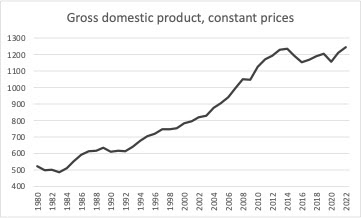
It's been a while since I wrote about the Brazilian crisis (a summary of the previous catastrophic election here). In part that election and the continued crisis explains why I have written less, not just about Brazil. This has been a long economic depression that started in 2015 (see graph), with a coup in 2016 and since 2018 the added problem of a right-wing authoritarian regime that won an election that was only possible with the political proscription of Lula. But at least the political problems have started to be solved with this election.

 
Source: IMF. Peak in 2014 (2022 estimated)

The Lula election last Sunday is a redemption story, no doubt. Not only because there was no prove of his corruption, even if corruption existed,* and even though the international press, including the reputable media continues to refer to him as an ex-convict. Corruption is a problem, but the one that matters is associated to the needs of governance in Congress, and the current Bolsonaro government has dealt with payments to members of congress through the so-called secret budget. And that will not vanish, and that could cause problems in the future. But in all fairness, the size of that and the implications in terms of the functioning of the political system, let alone for economic growth or the well-being of the population are far from clear.

At any rate, that is a secondary issue. The problems that Lula and his coalition will face are on the economic front. And not because Brazil is facing a serious crisis, like neighboring Argentina. This is the worst economic crisis in Brazilian history, but is purely political, and has been aggravated by the decisions taken by the Brazilian authorities, starting in 2015 with Dilma, trying to stave off the coup, and then with Temer and Bolsonaro.

The main problem is the limit on government spending, the ceiling that would limit the ability of the government to promote not just a more solid recovery, but more importantly one that allows for increasing real wages for those at the bottom. Fiscal rules were put in place for this reason, for the possibility of a left of center government, and that is why financial markets were convulsed by Lula's talk this week, and the real devalued. Not that it matters much.

There will be some arrangement that will allow the expansion of spending to cover the social transfers, and some additional social spending that was left out of Bolsonaro's last budget. But fiscal conservatism will be something that will have to be combated throughout the next four years, and not just from the opposition. Many within the government's complex coalition will be for austerity. There will be plenty of time to talk about that, and I would normally be pessimistic.

However, two things make me a bit optimistic (which is not very characteristic). It is important to differentiate what Lula does from what he says, or even what he believes. This is true of many on the left in Latin America. Before the previous Pink Tide, two decades ago, I was more concerned with the pleas for fiscal responsibility of many on the left. As it turns out, many of the progressive governments did expand social spending, and promoted an acceleration of growth, including Lula, and a significant expansion of real wages. Someone will say, this is not 2003, and there is no commodity boom that will lead to growth, or at least the easing of the external constraint.

However that was not what explained the Brazilian growth in the first Lula government. The external constraint was eliminated to some extent by the boom in commodity prices, but the fundamental source of foreign reserves was financial, and resulted from the relatively high remuneration for assets in domestic currency. That was to some extent possible because interest rates in advanced economies have been low in the center, and they will likely remain low (even if they are increasing right now). So on that front it is possible to expect an acceleration of government spending, and higher transfers to the relatively poor, with higher real wages at the bottom. Besides, Bolsonaro is gone, and that should be reason enough to be optimistic about the future.

* There is no evidence of Lula's personal corruption. The infamous Triplex apartment, for example, is clearly not his, and he never benefited in any other proven way. Many Latin American politicians, including Eduardo Cunha, which was instrumental in Dilma Roussef's impeachment, does appear in the Panama Papers. Paulo Maluf had undeclared accounts in Switzerland, just to name another Brazilian politician for whom there is objective, material evidence of corruption. To suggest that Lula knew about corruption, is more or less like saying that FHC knew about the buying of votes in congress to allow for his reelection (or many other issues during his government). In other words, is to say the obvious.

Wednesday, July 28, 2021

The economics of New Developmentalism

New versus Classical Developmentalism

New paper by Tom Palley, titled “The Economics of New Developmentalism: A Critical Assessment” which has been published in Investigacion Economica. Palley argues that "the issues raised will be a key element in the 2022 Brazilian presidential election that will likely pit Ciro Gomes versus Lula in the first round. Gomes aligns with New Developmentalism. Lula inclines to Classical Developmentalism. Of course, economic analysis is just part of the development problematic. It must be reconciled and integrated with the political reality of Latin America’s unethical economic elite, its corrupted political class, and the omnipresent threat of US intervention against change that challenges the economic status quo."

Sunday, October 7, 2018

The Brazilian Election or Brazilian Fahrenheit 11/9

#nothim protest in São Paulo

This is, hands down, the most important election in Brazilian recent history. Haven't seen any exit polls, but if the last polls are trustworthy expect a second round between an openly fascistic candidate, Bolsonaro, and the Workers' Party (PT in Portuguese) and Lula's candidate Haddad. Maybe Ciro Gomes has a shot. The US and international media have been part of the problem, in all fairness, for the rise of Neo-Fascism. They suggest that Bolsonaro is not acceptable (like many in Brazil that have protested, pictured above), but they suggest that the Workers' Party is as dangerous and radical, but on the left of the political spectrum. Red scares continue to dominate the media decades after the collapse of Soviet communism. It's a bit tiring.

Note that as I argued in many posts in the past the Brazilian situation is not the result of an economic crisis, fiscal or external. No real economic problem existed. It was, and it still is, a political crisis. Corruption exists, but it is also not the problem. That's what right wingers have used as a political instrument to counter their inability to win elections. The main cause of the political crisis is the result of the moderate improvement in social conditions and inequality during the PT administrations, and the backlash that this has caused in segments of the middle and upper classes.

Interestingly, Dilma Rousseff, the impeached president, is not accused of anything and might have a shot at the Senate seat held by Aécio Neves, her rival in the last election, who is trying desperately to win a seat in Congress to avoid being prosecuted (contrary to Lula, that has been jailed as a result of someone saying he owned an apartment, without a single shred of corroborating evidence; Aécio is recorded asking for a R$2 million bribe, suggesting his cousin would pick it up, since it was a person he could trust and kill if he opened his mouth, and the cousin was later filmed and caught with the money).

It is far from surprising that the Workers' Party is still in the dispute, and might win. Life conditions for the vast majority did improve in their governments (even if there is a lot to criticize in their policies). And they did win the last four elections. They are responsible for a frustrated right wing base that cannot win elections and resents social improvement. But the responsibility for the rise of Neo-Fascism in Brazil should all be placed squarely with the Brazilian Social Democracy Party (PSDB), the main alternative to PT, that failed to win elections since 1998 (20 years now), and to abide by the democratic rules when loosing.

Besides, the justice system is now seen by many as a corrupted system itself, and the impunity of proven corrupts within PSDB has sapped their support within the middle and upper classes. That empty space has been occupied by Bolsonaro, that claims to be anti-corruption, as Collor did back in the 1990s, and is probably all but. PSDB will probably collapse as the main opposition party after this election. And the middle and upper class are as a result left with a more radical and authoritarian alternative.

In this respect, the Brazilian situation is not very different than the American one discussed by Michael Moore in his last movie Fahrenheit 11/9. Sure there are many reasons for the rise of Trumpism. But the elites in the Democratic Party have an important part in that rise. So-called liberals that did not respect democracy (e.g. the fact that all West Virginia counties went for Bernie, but Hillary got the delegates), or pushed and defended Neoliberal policies (e.g. the shocking role of Obama in the Flint catastrophe) were central to explain what happened (and more important than Russia).

In similar vein, many PSDB intellectuals that had a lot of pride about their fight against the last dictatorship in Brazil, are co-responsible for perhaps helping lead to a new one (since many in the Bolsonaro camp, including him, have suggested they would not accept the results if they loose). Aécio was explicit about not accepting the results of the elections in 2014. And PSDB supported the coup, hoping to be able to win elections as soon as PT was tarnished as corrupt. From jail Lula has defeated them once again. Decent people around the globe now hope he can defeat Fascism too (if he has a chance).

But the blame for this is all in the hands of the supposedly reasonable and well-behaved Brazilian Social Democrats. And the US media, by suggesting that PT is as despicable as the Neo-Fascists is helping them too. If Bolsonaro wins, you know who is to blame.

At any rate if you are interested in digging any deeper go read my previous posts, going all the way back to December of 2015, that chronicle the unfolding of the crisis:
  1. Goodbye Lula, Hello Failed State
  2. The Strange Death of Progressive Brazil
  3. The Mediatic-Parliamentary Coup in Brazil
  4. Brazilian coup and US misinformation
  5. Some thoughts on the impeachment and the right wing turn in Brazil
  6. New York Times on the Brazilian coup... I mean impeachment
  7. The strange and misunderstood reasons for the Brazilian crisis

Friday, May 25, 2018

Lula da Silva is a political prisoner. Free Lula!


Three hundred academics and public intellectuals joined to launch a manifesto denouncing the detention of the former Brazilian president and current Presidential candidate Lula da Silva. The petition discusses in detail the arbitrary nature of the trial conducted by Judge Sergio Moro against Lula da Silva, stating that he is nothing less than a political prisoner. The document asserts that the international community should treat him as such and demands his immediate release.

Read more here (your truly signed too).

Saturday, March 31, 2018

Goodbye Lula, Hello Failed State

"We are building the Anti-Lula."
"So are we."

In October 2002, Luiz Inácio Lula da Silva won Brazil’s presidential election and famously argued that hope had defeated fear. In fact, to preempt the fears of local and international finance elites, which threatened capital flight if the Workers’ Party (PT) candidate won, Lula had already signed the infamous “Letter to the Brazilian People” in which he pledged to follow relatively orthodox economic policies. Predictions about his government, and the global economy in general, were not particularly optimistic; fear was greater than hope in many quarters.

Sixteen years later, Lula—the leading candidate in Brazil’s October 2018 presidential election—has been convicted on corruption charges and could be jailed as soon as April 4, officially disqualifying him from the race. If so, we are likely to hear that the initial reasons for fearing Lula were wellfounded. Certainly the mainstream media will portray his imprisonment in that fashion, and Lula’s army of detractors is more than eager to wage attacks on him. In recent months, his campaign has been met with protests, and on March 26, two bullets struck his campaign caravan in southern Brazil. If Lula’s imprisonment plays out as is likely, Brazil will institutionalize a vast system of patronage and abuses the bureaucratic machine for personal gain via illegal payments and bribes, controlled by a right-wing cartel.

Read rest here.