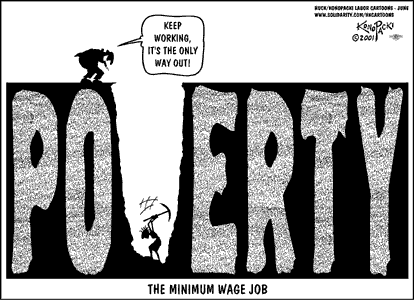
Showing posts with label Living Wage. Show all posts

Sunday, July 27, 2014

CEPR on "Minimum Wage Workers Pay Cut Clock"

The last time the federal minimum wage was raised was July 24, 2009, to $7.25 per hour. Workers making the minimum wage have been facing a continual pay cut since then, as inflation has eroded the purchasing power of the minimum wage.

The first minimum wage pay cut clock shows how many dollars America's minimum wage workers have lost since July 2009. Every second it shows how much more money they're losing, as long as the federal minimum wage remains stuck at $7.25. Mind you, even if the federal minimum wage were to catch up to its July 2009 level, it would still be far below its historical level. The peak year for the U.S. minimum wage was 1968.

The second clock shows how many dollars America's minimum wage workers have lost since July 24, 2009 if the minimum wage had instead been raised to its 1968 level and then kept pace with inflation since then. Every second it shows how much more money they're losing, as long as the federal minimum wage remains below its historical peak.

See here.

Monday, July 21, 2014

EPI | Why It’s Time to Give Tipped Workers A Living Wage

By Sylvia A. Allegretto and David Cooper
Raising the wage floor for tipped workers is crucial for a number of reasons. Rising income inequality and the accompanying slowdown in improving American living standards over the past four decades has been driven by weak hourly wage growth, a problem that has been particularly acute for low-wage workers (Bivens et al. 2014). Tipped workers—whose wages typically fall in the bottom quartile of all U.S. wage earners, even after accounting for tips—are a growing portion of the U.S. workforce. Employment in the full-service restaurant industry has grown over 85 percent since 1990, while overall private-sector employment grew by only 24 percent.4 In fact, today more than one in 10 U.S. workers is employed in the leisure and hospitality sector, making labor policies for these industries all the more central to defining typical American work life. Ensuring fair pay for tipped workers is also a women’s issue. Women comprise two out of every three tipped workers; of the food servers and bartenders who make up over half of the tipped workforce, roughly 70 percent are women. Allegretto and Filion give an historical account of the tipped-minimum-wage policy and bring much-needed attention to how the two-tiered wage system results in significantly different living standards for tipped versus non-tipped workers. For instance, tipped workers experience a poverty rate nearly twice that of other workers. This contradicts the notion that these workers’ tips provide adequate levels of income and reasonable economic security.
Read rest here.

Bivens, Josh, Elise Gould, Lawrence Mishel, and Heidi Shierholz. 2014. "Raising America’s Pay: Why It’s Our Central Economic Policy Challenge." Economic Policy Institute, Briefing Paper #378. http://www.epi.org/publication/raising-americas-pay/

Monday, December 30, 2013

'Tips or Starve' or the Wage crisis: The USA's new underclass

A documentary on the working poor. Not sure if this is right, but it seems that in bars and restaurants the wage is below the federal minimum of US$7.25 (see video at 4:40).

Thursday, September 12, 2013

Living wage, fast food walkouts, and Henry Ford's $5

Something I have not posted about, but that deserves attention is the organization of fast food workers this summer, and the series of walk outs to demand a living wage of $15 per hour (see here, for example). Note that the current minimum wage is less than half at $7.25 per hour, last raised in 2009. Figure below shows the real value now is well below the average of the 1960s and 1970s (data for nominal minimum wage here).
Since the 1980s the real minimum wage has fluctuated at a lower level. One can only hope that fast food workers, with the support of the Service Employees International Union (SEIU), manage to obtain some concessions from junk food corporations.

For a discussion of the Living Wage see this paper by Bob Pollin, and his book (here).

PS: Only recently I've learned that Henry Ford's famous $5 a day wage (which would be more or less $14 per hour today), which went together with  reduction of work time to 8 hours per day, was controlled by the Sociological Department, which required workers not to drink, that they saved money, that they attended church, that they proved a record of saving part of the wages, and of course it was for married men, not for singles or women, since that would not lead to family values. It was also part of a broader program to make good American citizens of the immigrants in his factory. While some progressives actually liked Ford's program, like the institutionalist economist Commons, others like the radical John Reed were not convinced. For more go here.