Showing posts with label Prebisch. Show all posts

Sunday, April 26, 2026

Central Bank Independence and Fiscal Rules in the Periphery


Reading Keynes in Buenos Aires

This week I participated (virtually) in a conference in Colombia organized by the finance ministry, alongside a remarkable group of participants, including Rafael Correa, Isabella Weber, and Daniela Gabor. The focus of the discussion was the ongoing dispute between the government of Gustavo Petro and the Colombian central bank over the persistence of relatively high interest rates, and the broader question of central bank independence.

None of this, of course, is new. Variants of this conflict have played out repeatedly, including in the United States, where Donald Trump has openly criticized the Federal Reserve for maintaining interest rates he considers too high, and has clashed with Jerome Powell, as I have discussed here. But the Latin American context adds an important layer that is often missing from these debates.

The first point worth stressing is historical. The notion of an independent central bank is a relatively recent invention. Central banks have existed for centuries, but their functions have evolved significantly. Early central banks, even before institutions like the Bank of England (see here and here), were deeply intertwined with the fiscal needs of the state. They acted as fiscal agents, helping to finance public debt, often at levels that would alarm today’s orthodox commentators. In Britain, public debt during the Industrial Revolution exceeded 100 percent of GDP, with significant portions effectively absorbed by the central bank.

In this context, I suggested an analogy with Ha-Joon Chang’s argument about kicking away the ladder. Chang shows that today’s advanced economies relied heavily on protectionism and industrial policy during their own development, only to later promote free trade as the universal path, effectively denying developing countries the same tools. Something similar can be said about central banking. Historically, advanced economies used their central banks as instruments of development and as fiscal agents of the state, helping to finance large public debts and support economic transformation. Once they achieved development, they moved toward promoting central bank independence as a general principle, thereby limiting the ability of developing countries to use similar financial tools. In that sense, one could say that they also kicked away the financial ladder.

The idea that central banks should operate according to fixed rules, insulated from political pressures, is more closely associated with the gold standard era and the late nineteenth century. Even then, this rule-based framework reflected specific historical conditions rather than a timeless principle. And, as is well known, it broke down in the interwar period, when governments, faced with high unemployment, and the crisis of British hegemony, abandoned orthodoxy in favor of more active coordination between central banks and treasuries.

The US experience is illustrative. Under Marriner Eccles during the New Deal and World War II, the Federal Reserve worked closely with the Treasury, including maintaining low interest rates on government debt. It was only with the Treasury–Fed Accord of 1951 that the modern notion of central bank independence took shape. Even then, the separation was never as clean as the textbooks suggest.

This is because, at a more fundamental level, the central bank and the Treasury cannot be meaningfully separated. The central bank still acts as the fiscal agent of the state. Government spending creates money, whether through keystrokes in digital accounts, as emphasized recently by Modern Money Theory authors, or more traditional mechanisms. The idea that governments can run out of money (domestic issued money) in a technical sense is a useful fiction, one that obscures the real constraints, which are not financial but material. As John Maynard Keynes famously suggested, if it can be done, financing can be arranged.

This brings us to the present conjuncture. The recent inflationary episode in the United States was not primarily the result of excessive demand, but of supply-side disruptions, pandemic-related bottlenecks and energy price shocks (I wrote many posts on that; see this one). As these factors subsided, inflation fell. The Federal Reserve’s aggressive interest rate hikes were, at best, incidental to this process, and at worst risked pushing the economy into recession. What prevented that outcome was not monetary policy, but fiscal expansion, particularly the initial stimulus enacted by the Biden administration, the one that Larry Summers referred to as the worst economic mistake of the last 40 years (it's worth remembering).

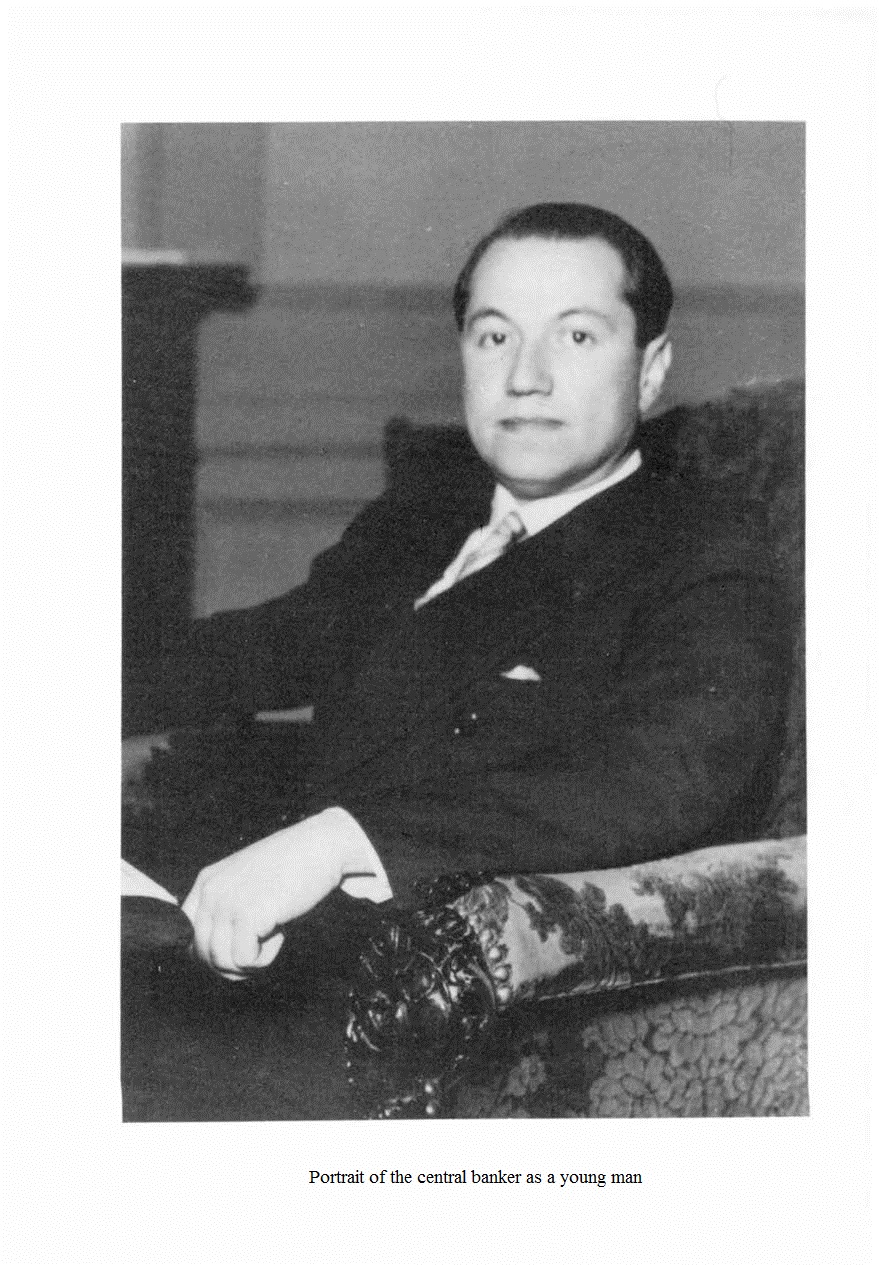
If this is the case at the center, the implications for the periphery are even more significant. In Latin central bank independence is even more recent than in the US. It results from institutional arrangements that have evolved particularly in the wake of the debt crises of the 1980s and the imposition of the Washington Consensus, but that have been fully accepted by left of center governments in the region (note that most central banks in the region were created to deal with development issues in the aftermath of the 1930s crisis; this is represented by Prebisch, reading Keynes in Buenos Aires, in the figure above*).

The debate in Colombia mirrors similar tensions in Brazil, where Luiz Inácio Lula da Silva has criticized high interest rates maintained by the central bank under the previous chairman, appointed by Jair Bolsonaro, Roberto Campos Neto.  Interest rates, which remain high with the current president of the Brazilian Central Bank, Gabriel Galípolo, have not precluded growth, which depended on fiscal expansion and higher wages. True, Brazil has returned to growth, but it has done so more slowly than it could have, but not as a result of the interest rate policy. Instead, the slower pace of growth results from the self-imposed fiscal limits (see this by Haluska, Serrano and Summa).

Here is where the Colombia and Latin America, more generally, diverge from the US case. In the periphery, central banks do not operate in a vacuum. Their policies are constrained by the global financial environment, particularly by the stance of US monetary policy. Higher interest rates in the United States put pressure on developing countries to maintain relatively high rates of their own, in order to stabilize nominal exchange rates and avoid capital outflows and depreciation. Currency depreciation is not only inflationary but also contractionary, making macroeconomic management far more difficult.**

This is why the question of central bank independence, while important, is ultimately secondary to the issue of fiscal rules. Even countries without severe external constraints, such as Colombia or Brazil, face self-imposed limits on their ability to use fiscal policy to expand demand and promote growth. These constraints are not natural. The challenge, then, is not simply to debate whether central banks should be independent or not and from whom (certainly from financial markets). It is to rethink the broader framework within which monetary and fiscal policy operate, particularly in the periphery.

The discussion in Colombia, therefore, is not just about the appropriate level of interest rates or the degree of central bank independence. It is about the broader question of how much room governments have to use fiscal policy as a tool for development.

* Yes, the figure is AI; and the 9 of July monument, the obelisk, which was completed in 1936, was designed by Raúl's brother, Alberto Prebisch.

** Hélène Rey refers to this as the dilemma (instead of trilemma), since countries, with fixed or flexible (and, I guess, anything in between) exchange rate regimes, loose monetary policy autonomy with greater capital mobility.

Sunday, May 19, 2024

Esteban Pérez Caldentey on the Ideas of Raúl Prebisch

Esteban Pérez's talk at the University of Chile, about Raúl Prebisch, about whom we have written several papers. This is in Spanish.

Thursday, May 18, 2023

How Industrialization Become the Core of Raúl Prebisch's Thought

New paper by Adriana Calcagno. From the abstract:

This paper focuses on the intellectual path through which Raúl Prebisch placed industrialization at the center of his economic thought and policy recommendations. It shows how the changing international  context  of  the  1930s  and  1940s  made  him  depart  from  laissez-faire  and  adopt counter-cyclical policies, gradually abandoning the agrarian export-led growth model and finally embracing industrialization as the new growth strategy for Argentina and Latin America.

Published here, and working paper open for download here.


Friday, May 5, 2023

Friday, April 30, 2021

Prebisch After ECLAC and UNCTAD

My talk at the Universidad Nacional de Colombia last Friday, in Spanish of course. Part of the argument is that Prebisch, contrary to what is often assumed, moved from an argument that emphasized the role of the external constraint in leading to underdevelopment during his United Nations years, to one that put the emphasis on the patterns of domestic consumption, and its negative impact on the surplus, following the literature on stagnation, in his last book on peripheral capitalism. I suggest that the change is problematic.

Thursday, February 11, 2021

Prebisch’s Critique of Bretton Woods Plans


Prebisch, Williams and Kalecki

New Working Paper with Esteban Pérez at the networkideas. From the abstract:

The name and work of Raúl Prebisch are often associated with the problem of long-term economic development in Latin America. Less well known and explored is Prebisch’s contribution to the study of the monetary and financial problems of the countries of the periphery in relation to those of the center. Prebisch analyzed the post-WW-II monetary plans of John Maynard Keynes and Harry Dexter White from the perspective of their compatibility with his national autonomous monetary policy proposal. He thought that both plans had important shortcomings that would prevent the achievement of their intended objective, international equilibrium in the balance-of-payments. The plans ignored the differences in the levels of development between center and periphery. These differences implied that economic and monetary phenomena could not be viewed through the same lens and that all countries could not be subject to the same norms in monetary policy. Prebisch’s concerns were shared by John H. Williams and also, by Michal Kalecki.


Monday, December 30, 2019

Raúl Prebisch as a Central Banker and Money Doctor


Here we edited with Esteban Pérez and Miguel Torres some unpublished manuscripts from Prebisch related to the Federal Reserve missions, led by Robert Triffin, to the Dominican Republic and Paraguay, in which he emphasizes the need of capital controls in peripheral countries that did NOT have the key hegemonic currency. There is also a discussion of Keynes and White's plans for Bretton Woods, which were partially published before. In Spanish. Happy New Year!

Saturday, June 29, 2019

Forty Years of Balance of Payments Constrained Growth and Thirlwall's Law

From original draft by Thirlwall

Thirlwall's seminal paper on the balance of payments (BOP) constrained growth is forty years old. Paul Davidson once referred to the BOP constrained growth as a positive Post Keynesian contribution to economics. The Review of Keynesian Economics (ROKE) will publish soon a special issue with many well-known contributors to the literature, and with a paper by Thirlwall himself.

The idea built on the Kaldorian supermultiplier model (Kaldor mark II), and with a few simplifying assumptions, it showed that economic growth depends on the rate of growth of exports divided by the the income elasticity of demand for imports. A very similar idea, as Thirlwall knew, was developed by Raúl Prebisch and Latin American Structuralists. The model, contrary to the dominant mainstream growth model at the time (the Solow model), was demand-led, and allowed for significant divergence between center and periphery.

The 1970s were a period in which both macroeconomic research was biased towards short-term issues, with stabilization after the oil shocks and inflation acceleration becoming central, and also it was the decade in which heterodox groups were effectively segregated from the profession, publishing in alternative journals. These factors certainly affected the popularity of the model.

The most remarkable thing about the model, beyond its simplicity, is its incredible empirical relevance. So much so that is one of the few regularities that has been called a Law (like Okun's, for example). Financial flows might reduce under certain circumstances, the BOP constraint, but at the end of the day, capital flows must be paid with exports, and that implies that the constraint for developing countries is a strong limit to expansion. In advanced economies, income distribution and class conflict might play a more relevant role.

At any rate, it seems that under different circumstances, particularly regarding the sociology of the economics profession, this would have been a contribution meriting the Sveriges Riksbank Economics Prize in Memory of Alfred Nobel.

Will post more, with links to free papers soon.

PS: I haven't written much on Thirlwall's law, but here is a paper in response to a critique by Jaime Ros and a co-author, published by Investigación Económica, in Spanish.

Monday, January 7, 2019

Raúl Prebish’s Unpublished Manuscripts on the Buenos Aires Lectures on Economic Dynamics


By Esteban Pérez Caldentey

Raúl Prebish’s Unpublished Manuscripts on the Buenos Aires Lectures on Economic Dynamics edited by Esteban Pérez Caldentey (ECLAC) and Matías Vernengo (Bucknell University), have been published in the ECLAC Review, August 2018

Raúl Prebisch (1901–1986), the Second Executive Secretary of the Economic Commission for Latin America and the Caribbean (ECLAC) which he joined in 1949 is mostly known for his long-run analysis and diagnostic of the development problem of Latin America, which he fully stated in “The economic development of Latin America and some of its principal problems” (1950), also known as Prebisch’s “Manifesto”.

However, prior to joining ECLAC Prebisch also devoted a great part of his time and career the analysis of business cycles in theory and in practice (he was the first Director General of the central bank of Argentina created in 1935 and Prebisch himself drafted the project for the bank). On the basis of his cycle analysis he began to develop a theory of dynamics which sought to introduce two elements that, according to Prebisch, were missing from the Classical and Keynesian analyses, time and space.

Prebisch argued that capitalist economies evolved and developed in growth cycles. From 1920 to 1944 his analyses of capitalism centered on Argentina and on the characteristics of its business cycle. He attributed the phases of the Argentinean cycle to external causes determined to a large extent by the policy and economic performance in developed countries (Great Britain and the United States).

Read rest here.

Link to CEPAL Review here.

Sunday, November 11, 2018

Heterodox Central Banking in the Periphery

Our paper with Esteban Pérez on Prebisch's missions as a Money Doctor during the Fed-led missions directed by Triffin to Paraguay and Dominican Republic has been publish in Research in the History of Economic Thought and Methodology. From the abstract:
Traditionally, monetary policy in Latin America followed the recommendations of the missions of the monetary “doctors” who defended an independent central bank and a pro-cyclical monetary policy, adhering to the automatic adjustment of the gold standard. A key function of central banks was to support fiscal stability. The effects of the Great Depression and its aftermath in the periphery countries questioned these recommendations and gave way to a shift in monetary policy. An illustrative example is provided by the creation of the Central Bank of the Argentina Republic (BCRA) under the auspices of Raúl Prebisch, and the technical assistance missions of the United States Federal Reserve to several Latin American countries some of which were led by Robert Triffin. Prebisch actively participated in mission to Paraguay and the Dominican Republic bringing the experience he had acquired as director of the BCRA and the tools devised to adapt monetary policy to a changing external context and circumstances. The use of the discount window and exchange controls, among other instruments, was seen in this new view as necessary to pursue counter-cyclical policies and to provide support for industrialization and full employment in the periphery.
Read rest here. 

Saturday, September 8, 2018

Prebisch manuscripts for his classes on economic dynamics


There is a trend in the history of economic thought field to depend more on archival research. It is certainly nothing new, since some of the best research in the history of ideas, e.g. Sraffa's reconstruction of Ricardian theory, was essentially dependent on archives. The publication of Keynes collected papers have also sparked a wealth of interpretations about his theories, not all worth reading. I have done some research in Marriner Eccles archives at the University of Utah.

In part, this trend results from the fact that there is increasingly more archival material for modern economists that are closer in time to us. Letters, unpublished papers, class notes and so on. That might be useful sometimes, but it can also lead to lamppost driven research or the streetlight effect, where researchers just look at where it is easier to find results, rather than to what really matters.

At any rate, Prebisch's 1948 classes at the University of Buenos Aires, from a few years after he was let go from the Argentinian Central Bank, and before he went to the Economic Commission for Latin America (ECLA, later ECLAC), on Economic Dynamics are (in our view) relevant because they do shed some light on how he thought about economic dynamics, a theme that was central for the theories and the policy action of ECLAC which did have a significant impact on how government in the region managed their economies in the 1950s and 60s.

They have now been published by CEPAL Review with an intro with Esteban Pérez. Link here. With Esteban we have this paper in English on Prebisch and his views on economic dynamics.

Tuesday, June 12, 2018

Raúl Prebisch: Peripheral Development


Our book is out (in Spanish). You can buy it here. We have written a few papers in English if you are interested available here, and here, for example. my review of Dosman's biography is available here.

Thursday, June 29, 2017

Prebisch and Central Banking

You can read here the Power Point of our presentation at History of Economics Society conference on Prebisch and Central Banking and his role as a Money Doctor in the 1940s after he left the Central Bank of Argentina.

Monday, April 3, 2017

The Global Political Economy of Raúl Prebisch

Book edited by Matias Margulis is now out in print. From the blurb:

The Global Political Economy of Raúl Prebisch offers an original analysis of global political economy by examining it through the ideas, agency and influence of one of its most important thinkers, leaders and personalities. Prebisch’s ground-breaking ideas as an economist – the terms-of-trade thesis and the economic case for state-led industrialization – changed the world and guided economic policy across the global South. As the head of two UN bodies – the Economic Commission for Latin America and the Caribbean (ECLAC) and later the United Nations Conference on Trade and Development (UNCTAD) – he was at the frontline of key North–South political struggles for a fairer global distribution of wealth and the regulation of transnational corporations.

Prebisch increasingly came to view political power, not just economic capabilities, as pivotal to shaping the institutions and rules of the world economy. This book contextualizes his ideas, exploring how they were used and their relevance to contemporary issues. The neoliberal turn in economics in North America, Western Europe and across the global South led to an active discrediting of Prebisch’s theories and this volume offers an important corrective, reintroducing current and future generations of scholars and students to this important body of work and allowing a richer understanding of past and ongoing political struggles.

Monday, January 23, 2017

The Global Political Economy of Raúl Prebisch


New book edited by Matias Margulis. We have a chapter with Esteban Pérez, a new updated version of this paper really. Many interesting contributions from Eric Helleiner, Peter Ho and Robert Wade to cite three well-known scholars of development. From the blurb:
The Global Political Economy of Raúl Prebisch offers an original analysis of global political economy by examining it through the ideas, agency and influence of one of its most important thinkers, leaders and personalities. Prebisch’s ground-breaking ideas as an economist – the terms-of-trade thesis and the economic case for state-led industrialization – changed the world and guided economic policy across the global South. As the head of two UN bodies – the Economic Commission for Latin America and the Caribbean (ECLAC) and later the United Nations Conference on Trade and Development (UNCTAD) – he was at the frontline of key North–South political struggles for a fairer global distribution of wealth and the regulation of transnational corporations.
Prebisch increasingly came to view political power, not just economic capabilities, as pivotal to shaping the institutions and rules of the world economy. This book contextualizes his ideas, exploring how they were used and their relevance to contemporary issues. The neoliberal turn in economics in North America, Western Europe and across the global South led to an active discrediting of Prebisch’s theories and this volume offers an important corrective, reintroducing current and future generations of scholars and students to this important body of work and allowing a richer understanding of past and ongoing political struggles.
The book will be out in March.

Tuesday, November 8, 2016

Reading Keynes in Buenos Aires

Paper with Esteban Pérez published in the print (it was online since last year) edition of the Cambridge Journal of Economics. Abstract:
Keynes had a profound influence on Prebisch in terms of the diagnosis about the main failures of market economies and the need to pursue pro-active and anti-cyclical policies. However, Prebisch was critical of some aspects of Keynes’s General Theory of Employment, Interest and Money, in particular on the theory of interest and the multiplier. His attitude can be explained by a difference in the object and method of analysis. Prebisch’s interests focussed on dynamics and the cycle, themes that were peripheral to Keynes’s central message. Prebisch’s Keynesian influence and his rejection of some aspects of Keynes’s magnum opus explains why at the same time that Prebisch is often described as the Latin American Keynes, he is portrayed as concerned mainly with the long-run development problem of Latin America and without proper consideration to demand factors as fundamental determinants of output and employment.
Paper behind the wall, I'm sorry to say, here.

Monday, October 10, 2016

Raúl Prebisch and economic dynamics: cyclical growth and centre-periphery interaction

New paper. From the abstract:
Prebisch believed that understanding the evolution of capitalist economies over time and in different contexts required a general cycle approach, encompassing all the different areas of economic activity, which he labelled “economic dynamics.” This theory, developed between 1945 and 1949, stemmed from a critique of both neoclassical and Keynesian theories, which Prebisch viewed as static representations of capitalism. It was applied first to a closed economy and then to a centre-periphery context. The theory combined the notion that profit is the driving force of economic activity, with a process of forced savings and the idea that the time lag between income circulation (and the resulting demand) and the completion of the production process are the main source of cyclical fluctuations. Prebisch’s dynamics theory, which he never completed, influenced his “development manifesto” (Prebisch, 1950).
Read full paper here. 

Tuesday, June 21, 2016

Prebisch on Economic Dynamics


Here is the link to the power point presentation on the unpublished Buenos Aires lectures given by Raúl Prebsich on economic dynamics at the University of Buenos Aires in 1948, right before he entered ECLAC, that we presented (actually Esteban did it, I only participated in the Q&A) at the History of Economics Society Meetings. Next year the conference is in Toronto.

Monday, April 18, 2016

Prebisch's dynamic theory

New paper with Esteban Pérez published in ECLAC Review; for now only the Spanish version is available, but soon there will be an English version (they always release it later).

Friday, November 20, 2015

Reading Keynes in Buenos Aires

Keynes reading (not the same)


New paper just published in the Cambridge Journal of Economics. From the abstract:
Keynes had a profound influence on Prebisch in terms of the diagnosis about the main failures of market economies and the need to pursue pro-active and anti-cyclical policies. However, Prebisch was critical of some aspects of Keynes’s General Theory of Employment, Interest and Money, in particular on the theory of interest and the multi- plier. His attitude can be explained by a difference in the object and method of analysis. Prebisch’s interests focussed on dynamics and the cycle, themes that were peripheral to Keynes’s central message. Prebisch’s Keynesian influence and his rejection of some aspects of Keynes’s magnum opus explains why at the same time that Prebisch is often described as the Latin American Keynes, he is portrayed as concerned mainly with the long-run development problem of Latin America and without proper consideration to demand factors as fundamental determinants of output and employment.
Read full paper here.