Showing posts with label Powell. Show all posts

Wednesday, June 17, 2026

Warsh, beyond Powell and glory

 
Soon in a theater near you!

Kevin Warsh will have a difficult task ahead. But it is not quite the one most political and economic analysts have been emphasizing. For much of the commentariat, Warsh’s problem is that he needs to hike interest rates, and defy Trump. Many are concerned that he won't have the courage to do it.

Although he was seen as a hawk on inflation, he has been tempted by the possibility that artificial intelligence might raise productivity and allow lower interest rates. Like Alan Greenspan in the 1990s, who came to believe that the internet had reduced the inflationary impact of growth, Warsh appears, at least circumstantially, as a dove. Worse, he might do Trump's bidding and effectively end the independence of the Fed (gasps from the audience), and undermine its credibility (a terror flick for very serious economists).

But for most commentators the mild acceleration of inflation, associated to the price of oil and the war in Iran, and the uncertainty about the actual impact of AI (on that see Austan Goolsbee on Soumaya Keynes podcast) have made that position look less tenable for most analysts. Hence the renewed calls not merely to resist Trump’s pressure for lower rates, but to hike them. To imitate Powell, in this view, would be the path to respectability. Perhaps even to glory. It would also be a mistake.

Ruchir Sharma, for example, draws the conventional hard-money conclusion. Warsh, he argues, should begin his tenure by raising rates and ending the Fed’s easy-money bias. The argument is wrapped in populist language. Inflation hurts workers and the poor, while easy money fuels asset prices and benefits the rich. There is a kernel of truth there. But it is not always the case (see also). Besides rate hikes will not produce cheaper oil. The best hope there is the end of the war in Iran.

Powell was lucky. His interest-rate hikes did not produce a recession through the housing channel, reducing credit and consumption. But those hikes were not the main reason inflation came down. Inflation declined largely because the cost-push pressures associated with the pandemic value-chain disruptions and the oil shock after the Ukraine war subsided. The lesson is not that Powell became Volcker and saved the Republic. The lesson is that supply shocks eventually faded, and the Fed received more credit than it deserved.

This is the problem with the constant invocation of Volcker. As I argued before in my post on Paul Volcker’s legacy, the conventional story exaggerates the virtues of monetary toughness and obscures the social costs of disinflation. The Volcker shock was not a technocratic morality play in which courage defeated inflation. It was a brutal tightening that produced a deep recession, weakened labor, and accelerated the decline of workers bargaining power. It also caused the debt crisis and the lost decade for several developing countries. To recommend that Warsh seek his Volcker moment is to misunderstand both the causes of the current inflation and the political economy of monetary policy.

The same problem underlies what I called inflation paranoia. The New Consensus view treats inflation as always and everywhere a problem of excess demand, to be solved by the central bank through higher rates. But the recent pandemic inflation and its more recent and milder rekindling are not fundamentally excess demand, or a wage-price spiral driven by an overheated labor market and distributive conflict. It is a cost-push episode shaped by energy shocks and the previous one by logistics problems too. Again, this is NOT the 70s show.

Warsh cannot fix cost-push inflation by hiking interest rates. He can slow the economy, weaken labor markets, and perhaps prick asset bubbles. But that is not the same thing as solving the causes of inflation. There is no significant risk of high inflation. The biased lesson drawn from the Volcker legacy is that central bankers achieve greatness by inflicting pain. The better lesson is that Warsh should not seek glory by repeating Powell’s hikes or, worse, by chasing a new Volcker myth.

Sunday, February 19, 2023

On central bank independence, and Brazilian monetary policy

The issue is back in the news. This time in Brazil (it was briefly an issue here when Trump did not reappoint Yellen, and then complained about Powell's interest rate where too high). At any rate, I always thought that there were good reasons for skepticism about central bank independence (CBI). As noted by Massimo Pivetti in this old piece on the Maastricht Accord and the, at that time, plan for the euro, the main reason to be doubtful is related to the interaction of monetary policy and fiscal policy. And as Quantitative Easing in the post-Global Financial Crisis has shown, central banks have become again fiscal agents of the state (never stopped being that, in all fairness).

The other important reason alluded by Pivetti for doubting CBI is the effects of the interest rate on the exchange rate and balance of payments. This is a quote from Pivetti:

And one could add, through the exchange rate, the effects on inflation also matter. This can be illustrated by the discussion of the Brazilian case. Lula has been very critical of the policies of the Brazilian Central Bank (BCB), and of the higher interest rates, since the campaign last year, and some sort of a truce has been in the works, with him being less direct (or at least that has been reported).

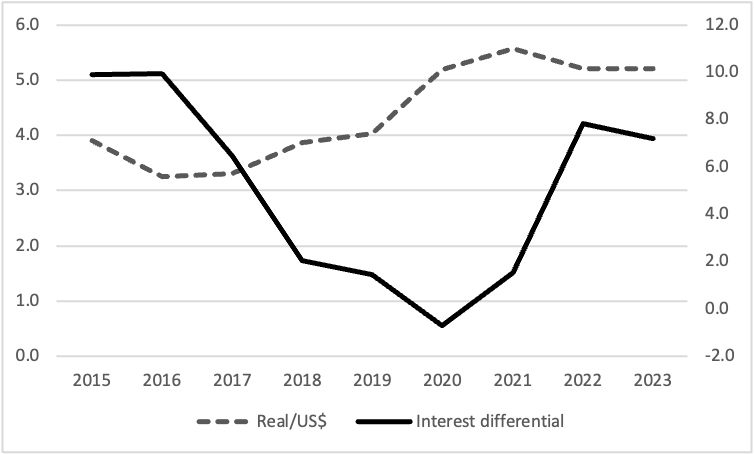
At any rate, the notion is that the higher interest rate is inimical to growth, even though Brazil did grow with relatively high interest rates in his first two mandates. The important thing to note is that Brazil had back then a relatively high and positive interest rate differential, that is a domestic nominal interest rates higher than the sum of external interest rate (the US rate) plus the risk premium (e.g. J.P. Morgan's Emerging Market Bond Index, EMBI), plus the expected nominal devaluation. In fact, as the interest rate differential (here just the difference of the BCB's Selic rate, the Fed Funds plus the EMBI) was coming down, the exchange rate depreciated.

Note that inflation accelerated and has been above the BCB's target only in more recent times, and the exchange rate is only one component of that. The higher prices of energy commodities, and the snags on the supply chain matter in the Brazilian case too. But the higher interest rate, and the higher and positive differential, did allow eventually for the stabilization of the exchange rate.

There is ample space to discuss how high the rate should be, but I'm doubtful that it can be close to zero or very low as suggested recently by André Lara Resende (that since my last post on his views, see here, has move away from Cochrane's fiscal theory of the price level, and closer to MMT; I just read his new book and that seems to be the case; on Cochrane's views on inflation see this video, also with John Taylor and Kevin Warsh).

Below the BCB's Selic rate and the Fed Funds for a longer period, starting after the stabilization of the Real Plan in the 1990s.

 
As one can see (Selic on the left, and Fed Funds on the right), the hike in the Brazilian rate has accompanied the hikes in the US, which are totally unnecessary, in my view, since inflation is cost push and not demand pull, but that's another story. But the fact remains that the ability of central banks in the periphery to conduct monetary policy independently from what happens in the center is still curtailed. Note that the reduction of Brazilian rates, from higher levels (since a positive differential must be maintained to avoid capital flight and depreciation), was possible because the Fed Funds for the most part has been very low.
 
That's probably the more important discussion about the CBI. Not just independence from financial interests, as John Kenneth Galbraith used to suggest, but also the degree of independence in a world with a hegemonic currency.

PS: In the Brazilian case, the really important question for the Lula government will be his ability to increase spending beyond the fiscal ceiling. That, and the ability to eliminate hunger, and reduce poverty rates, would determine the political success of his administration.